VPD and Humidity Control for Cannabis Grows
Royal King Seeds Editorial Team
Relative humidity on its own does not tell you what the plant is experiencing. A room at 55% RH and 72°F and a room at 55% RH and 82°F read identically on a basic hygrometer and are two different environments as far as the canopy is concerned. Vapor pressure deficit is the number that combines the two, and it is the one worth managing.
The Three Numbers That Matter
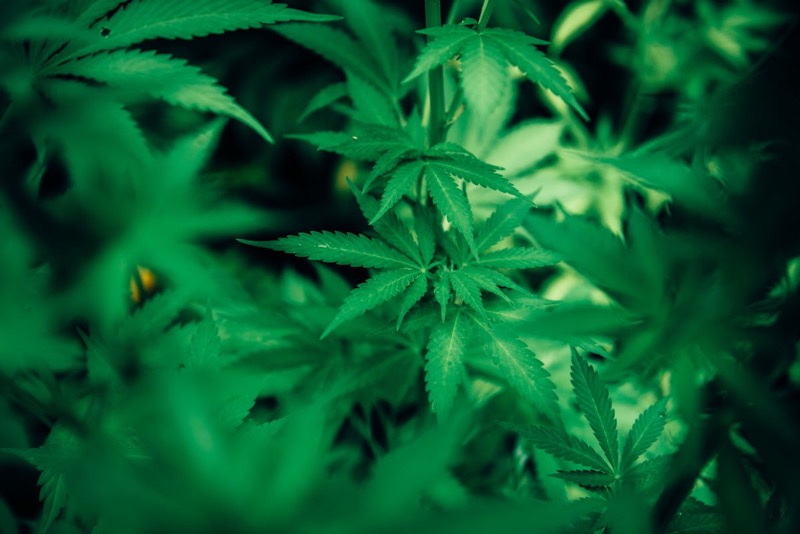
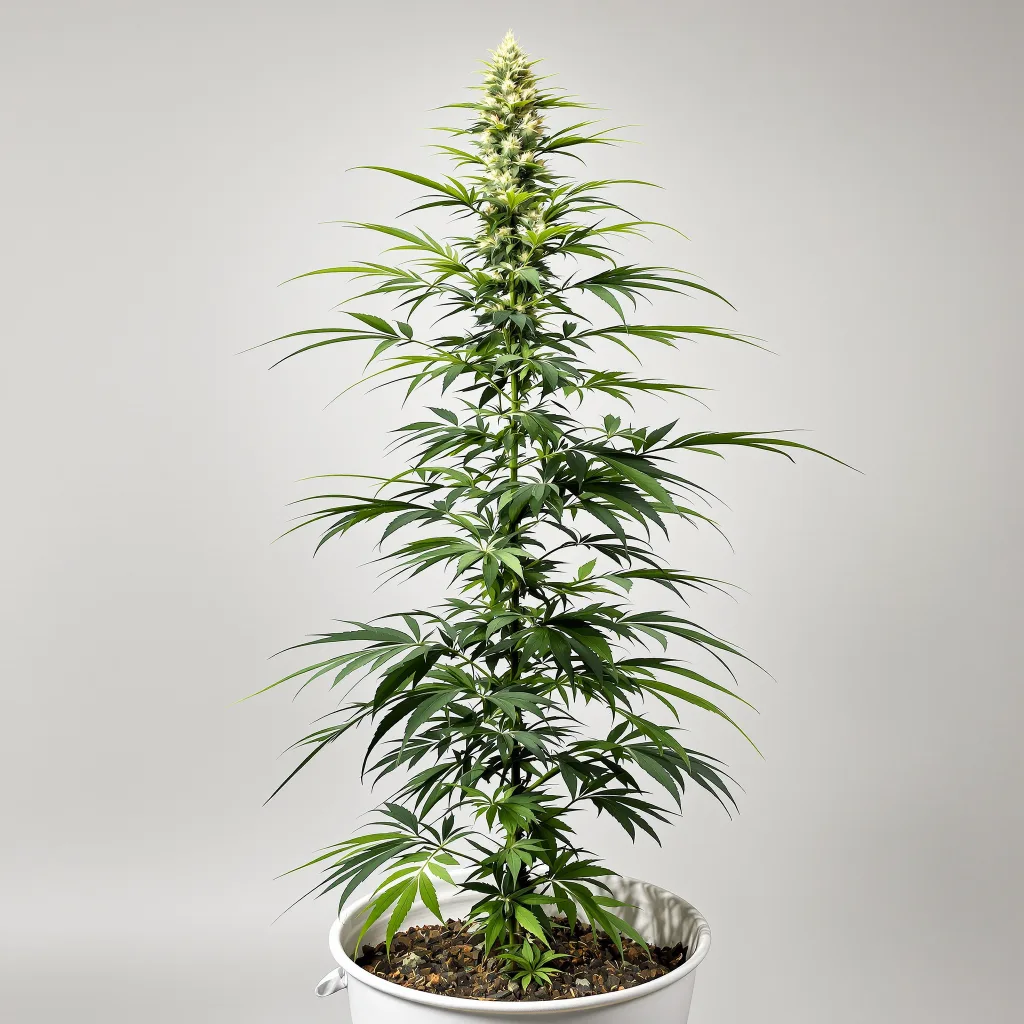
A canopy this dense does not share one climate. The air near the lights and the air under the leaves can sit half a kilopascal apart until something moves it.
What VPD Is, and Why It Beats Watching RH
Vapor pressure deficit is the gap between the moisture the air could hold at its current temperature and the moisture it is actually holding, expressed in kilopascals. High VPD is dry, thirsty air that pulls water out of leaves quickly. Low VPD is close to saturated, and the gradient that drives transpiration all but disappears.
Plants meter water loss through stomata, the pores on the leaf surface. Inside the useful VPD band for a given stage, stomata sit open at an efficient aperture: carbon dioxide goes in, water vapor comes out, and the roots keep up. Push VPD too high and stomata close defensively, which shuts down carbon dioxide uptake along with water loss and slows photosynthesis. Let VPD fall too low and there is barely a gradient to transpire against, which slows the bulk flow that carries minerals up from the root zone.
A hygrometer alone cannot tell you which of those you are in, because the same RH reading means different things at different temperatures. That is the whole case for working in kPa rather than percent.
The Calculation, and What the Numbers Look Like
VPD = SVP × (1 − RH/100)
SVP is saturation vapor pressure, the most moisture the air can hold at the current temperature. It climbs steeply and non-linearly with temperature: across the range in the table below it increases by roughly 1.8 times for every 10°C (18°F). That steepness is why temperature control does at least as much work as humidity control in getting VPD where you want it.
| Air Temperature | SVP (kPa) | VPD at 60% RH | VPD at 50% RH |
|---|---|---|---|
| 65°F / 18°C | 2.06 | 0.82 kPa | 1.03 kPa |
| 70°F / 21°C | 2.49 | 1.00 kPa | 1.25 kPa |
| 75°F / 24°C | 2.98 | 1.19 kPa | 1.49 kPa |
| 80°F / 27°C | 3.57 | 1.43 kPa | 1.79 kPa |
| 85°F / 29°C | 4.00 | 1.60 kPa | 2.00 kPa |
Read the 50% column and the direction becomes obvious. Cooling from 80°F to 70°F at a fixed 50% RH takes VPD from 1.79 kPa down to 1.25 kPa, a fall of about half a kilopascal. Cooling lowers VPD; warming raises it. Anyone who has seen that stated the other way round has seen it stated backwards, and it matters, because it is the difference between reaching for the heater and reaching for the dehumidifier.
One consequence of the same arithmetic: 80°F at 50% RH is already 1.79 kPa, above where you want to be in flower. The fix is to bring the temperature down, not to add moisture to a flowering room.
Leaf VPD vs Air VPD, and Which One These Tables Use
This is the detail that makes two VPD charts disagree. The published target ranges that circulate for cannabis are almost all leaf VPD, calculated from leaf surface temperature rather than air temperature. Every number on this page is air VPD, calculated from what an ordinary temperature and humidity sensor at canopy height reads, because that is the instrument nearly everyone actually has.
The two are close but not the same. A transpiring leaf under good airflow is usually a little cooler than the surrounding air, commonly on the order of 2 to 3°F under LED with a fan moving over the canopy. The gap is not fixed: it narrows or reverses under a hot lamp, in still air, or when the plant closes its stomata and stops cooling itself.
If you want leaf VPD, measure leaf temperature with an infrared thermometer aimed at a shaded upper fan leaf and substitute that for air temperature. If you are working from air temperature, as here, expect your calculated figure to run slightly higher than a leaf-based chart would give for the same room.
Stage-by-Stage Targets
Requirements move with the growth phase. Seedlings and fresh cuttings cannot replace water as fast as they lose it and need a low deficit. Plants in late veg tolerate and benefit from a higher one, because that is what drives the transpiration stream. In flower the priority shifts: keeping relative humidity down to protect dense buds becomes the constraint, and the VPD figure follows from that rather than the other way round.
| Stage | Air VPD Target | Temp | RH | What You Are Protecting |
|---|---|---|---|---|
| Seedling / clone | 0.4–0.8 kPa | 72–78°F | 70–80% | Root establishment |
| Early veg | 0.8–1.0 kPa | 72–80°F | 60–70% | Canopy expansion |
| Late veg / pre-flower | 1.0–1.2 kPa | 75–82°F | 55–65% | Nutrient throughput |
| Early flower | 1.0–1.3 kPa | 75–80°F | 50–60% | Bud site formation |
| Mid flower | 1.1–1.4 kPa | 72–78°F | 45–55% | Bulk and resin |
| Late flower | 1.0–1.4 kPa | 68–74°F | 40–50% | Keeping bud rot out |
Read the room in more than one place. The air immediately under the lamp is warmer than the air inside the canopy, so two sensors at the same RH can sit at genuinely different VPDs at the same moment, with the top of the plant running the drier of the two. If your upper and lower sensors disagree, the usual answer is not a climate setting but air movement: a low oscillating fan that mixes the column will bring the two readings together. Set targets from a sensor at canopy height rather than one taped to a tent wall.
Transpiration, Mineral Uptake, and Why This Is a Yield Question
Transpiration is what moves minerals. As water vapor leaves the stomata, tension propagates down the xylem to the roots and pulls water and dissolved minerals upward. VPD sets the rate of that whole chain.
At low VPD the gradient is small, water moves out slowly, and the pull is weak. Calcium and magnesium feel this most, because calcium in particular travels with the transpiration stream and is not readily remobilized once deposited. A grow sitting at chronically low VPD can show calcium symptoms on new growth with plenty of calcium in the reservoir, because the plant cannot move it fast enough. Our cannabis nutrient deficiency guide covers how to tell a transport problem from an actual shortage.
At high VPD the stomata close, and closed stomata do not admit carbon dioxide. Photosynthesis slows even though the light has not changed, which is why adding light intensity to a room that is already too dry can make things worse rather than better. Our grow light guide covers how PPFD and climate have to move together.
Raising and Lowering Humidity
Raising it, mostly early:
- Ultrasonic humidifiers. Cool mist, efficient, well suited to tents. Use distilled or filtered water or you will dust the leaves with minerals.
- Evaporative units. Lower output, low maintenance, fine in a small sealed-ish space where what they add stays put.
- Humidity domes. Still the most effective tool for clones and seedlings, because they hold a low-deficit pocket right around tissue that has no root system yet.
Lowering it, mostly in flower:
- Dehumidifiers. The primary tool once buds are forming. Sizing is the part people get wrong; see below.
- Exhaust ventilation. Works when the air you are pulling in is drier than the air you are pushing out, and not otherwise.
- Air movement. Fans do not lower the temperature of a room and they do not remove any water from it. What they do is break up the still, humid pockets that form inside a dense canopy and speed evaporation from wet surfaces, which is a real contribution to bud rot prevention even though the room-level RH barely moves.
- Watering discipline. Letting the medium dry back further between waterings, and not leaving runoff standing in trays, lowers the moisture load the room has to deal with in the first place.
Sizing a Dehumidifier
Capacity is quoted in pints per day at a specified test condition, usually warmer and wetter than a flowering room. Real output in a 70°F tent is typically well below the number on the box, so buy above what the arithmetic suggests rather than at it.
| Space | Minimum | Comfortable | Notes |
|---|---|---|---|
| 2×4 tent | 20 pt/day | 30 pt/day | Ventilation alone often carries veg |
| 4×4 tent | 30 pt/day | 50 pt/day | Size up for a dense canopy |
| 4×8 tent | 50 pt/day | 70 pt/day | Two units often beat one large one |
| 10×10 room | 70 pt/day | 100+ pt/day | Plumb the drain, do not empty a bucket |
Placement matters as much as capacity. Put the intake at or just above canopy height, where the moisture the plants are releasing actually is. A unit sitting on the floor under a canopy at four or five feet is being fed the driest air in the room. In a tent, most growers run a small unit inside and let its waste heat leave through the existing exhaust path.
The Lights-Off Spike Is the Real Hazard
The most dangerous moment in a flowering room is lights-off. Temperature falls, often 5 to 10°F within the hour in a well-insulated tent. The amount of water in the air has not changed, but the air's capacity to hold it has, so relative humidity climbs, sometimes sharply. A tent sitting comfortably at 50% RH and 78°F during lights-on can be at 65 to 70% within an hour of the lamp going off. That is squarely inside the band where botrytis spores on a dense cola have what they need.
This is why growers find bud rot in a room whose daytime numbers looked fine all season. The measurement was taken during the window that was never the problem. Two fixes, in order of usefulness:
- Run the dehumidifier through the dark period, set to hold the target at the lights-off temperature rather than the lights-on one. In practice that means accepting a slightly lower daytime RH to leave headroom for the nightly rise.
- Shrink the temperature swing. A 5°F drop produces a much smaller RH spike than a 10°F drop. Keeping lights-off temperature above about 65°F in late flower, and keeping an oscillating fan running through the dark period when there is no lamp heat to stir the air, both help.
If You Find Bud Rot: What to Do, and What Never to Do
The late-flower band on this page exists because of bud rot, so the page owes you the other half of the instruction. Inspecting dense colas every couple of days from week six is only useful if you know what to do when an inspection turns something up.
Bud rot is usually Botrytis cinerea, which shows up as a gray or brown collapse starting inside a dense cola, often with a stem that pulls apart into dry, dusty tissue. It is not the only fungus that colonizes cannabis. Aspergillus species also grow on flower, and they are the reason mold on cannabis is a health question and not only a crop-loss question. Aspergillus can cause serious lung infection in people whose immune systems are suppressed and in people with existing lung disease such as asthma, COPD or cystic fibrosis. The CDC's overview of aspergillosis sets out who is at risk and how the infection presents.
So the handling rules are short and they are not negotiable:
- Do not consume flower that is visibly moldy, and do not smoke, vape or extract it. Extraction concentrates contaminants along with everything else; it does not clean anything up.
- Cutting the bad part out does not make the rest safe. Fungal growth extends beyond what is visible on a cola, so removing the obvious patch tells you nothing about the material next to it.
- Drying, curing, heating or trimming does not fix contaminated flower. None of those processes are a decontamination step.
- Remove affected material from the room and dispose of it. Bag it where it stands rather than carrying an open, sporulating cola through the canopy, seal the bag, and put it in the outdoor trash rather than a bin inside the grow space.
- Then fix the cause, which is climate. Get the lights-off RH down, add air movement inside the canopy, open up dense colas by removing the leaves trapping moisture against them, and if the infection is widespread consider harvesting the clean material early rather than losing more of it.
Never try to rescue a questionable cola. The value of a single bud is not worth the exposure, and that goes double if anyone in the household is immunocompromised or has a lung condition. Our mildew and mold control guide covers identification and prevention in more detail, and the harvesting and curing guide covers the second window where humidity control decides whether a crop survives.
Myth vs Reality
Dial-In Protocol
Stage 1: before there are plants in the room
- ☐ Put two sensors in, one at canopy height and one lower in the space, rather than one on a wall
- ☐ Log 24 hours of empty-room temperature and RH, lights-on and lights-off
- ☐ Convert both to VPD with the formula above
- ☐ If the baseline is outside 0.4 to 0.8 kPa, fix that before seedlings go in
Stage 2: veg
- ☐ Hold 75 to 78°F at 60 to 65% RH, roughly 0.85 to 1.0 kPa
- ☐ Check the lights-off RH does not clear 70%; if it does, drop the daytime setpoint
- ☐ Get the two sensors agreeing within about 5% RH, adding air movement if they do not
Stage 3: flower transition
- ☐ Walk RH down a few points a week toward 50 to 55% by week three
- ☐ Leave temperature where it is for now; the RH change alone moves VPD gently enough
- ☐ Bring the dehumidifier online if veg was running on ventilation alone
Stage 4: late flower
- ☐ Drop to 68 to 74°F at 40 to 50% RH
- ☐ Set a lights-off RH alarm at 55% and investigate anything that trips it
- ☐ Open the interior of dense colas every two days from week six, and act on anything you find
Genetics, Growth Habit, and How Much Precision a Plant Demands
Cultivars do not all respond the same way to the same climate. Sativa-leaning and equatorial-origin lines evolved under warmer, breezier, lower-humidity conditions and tend to shrug off a high-VPD hour more readily. Indica-leaning and kush lines, whose backgrounds are mountainous and more temperate, often have a narrower comfortable band but reward precise control with heavy resin. Bud structure matters at least as much as either: an open, airy flower dries out between waterings and after a humid night, while a dense one holds moisture in its center no matter what the room sensor says.
Autoflowering lines, descended from Cannabis ruderalis populations of Central Asia and Eastern Europe, spend less total time in the high-risk late-flower window simply because their cycle is shorter, which reduces cumulative exposure to botrytis pressure. Browse our autoflowering cannabis seeds and feminized cannabis seeds and check the published flowering time and structure on each listing against the space and the climate you actually have.
Frequently Asked Questions
What is a good VPD for cannabis in flower?
Does cooling the room raise or lower VPD?
Is this page's chart leaf VPD or air VPD?
My plants show calcium symptoms and I am already adding cal-mag. Why?
My tent hits 70% RH overnight. What do I do?
Do I need a VPD chart, or is a hygrometer enough?
How does CO2 supplementation interact with VPD?
Safety note: CO2 is a simple asphyxiant that displaces oxygen, and because it is denser than air it pools in enclosed rooms and low spots such as basements and floor-level areas. Only enrich a space you can mechanically ventilate, fit a dedicated CO2 monitor with an audible alarm rather than relying on an oxygen monitor alone, keep people out of the space while CO2 is being introduced, and follow the manufacturer's instructions and any occupational requirements that apply to your facility. Exposure limits and health effects are documented in the OSHA Occupational Chemical Database entry for carbon dioxide.
I found gray rot inside a cola. Can I dry it and use the rest?
My basement runs 70 to 75% RH all year. How do I fix that?
Shop Strains Featured in This Guide
Hand-picked seeds from our catalog that match this article's topic. Free shipping on eligible orders of $150 or more.
Strain Seeds
Browse the full All Cannabis Seeds collection
Premium genetics, shipped from within the US.
Related Articles
High-Altitude Home Grows: 7 Seeds Above 5,000 ft
support-mediumUsing Inert Growing Mediums for Precision Control
support-growLow-Watt Grows (150–300 W): 7 Seeds That Still Deliver
support-trainTop 5 Cannabis Strains for Cerebral Palsy, Medical Picks
generalBotanical and Cannabis Buds
accessoryLoose Leaf and Blunt Wraps
Ready to Start Growing?
Shop feminized, autoflower, and CBD strains with 95% germination and free delivery on eligible orders of $150 or more.
Shop Cannabis Seeds