Cannabis Leaf Anatomy: Healthy vs. Sick Foliage | Royal King Seeds
Royal King Seeds Editorial Team
Your cannabis plant is talking to you through its leaves — and most growers aren't listening. Every curl, yellow patch, dark spot, and drooping blade is a distress signal. Ignoring those signals for even 72 hours can cascade into a yield loss that no flushing or late-season fix can fully reverse. The growers who consistently pull top-shelf harvests aren't the ones with the fanciest lights — they're the ones who can read a leaf and respond fast. This guide gives you the anatomy vocabulary, the visual diagnostic framework, and the 12 most common leaf problems ranked by severity so you can protect your canopy at every stage.
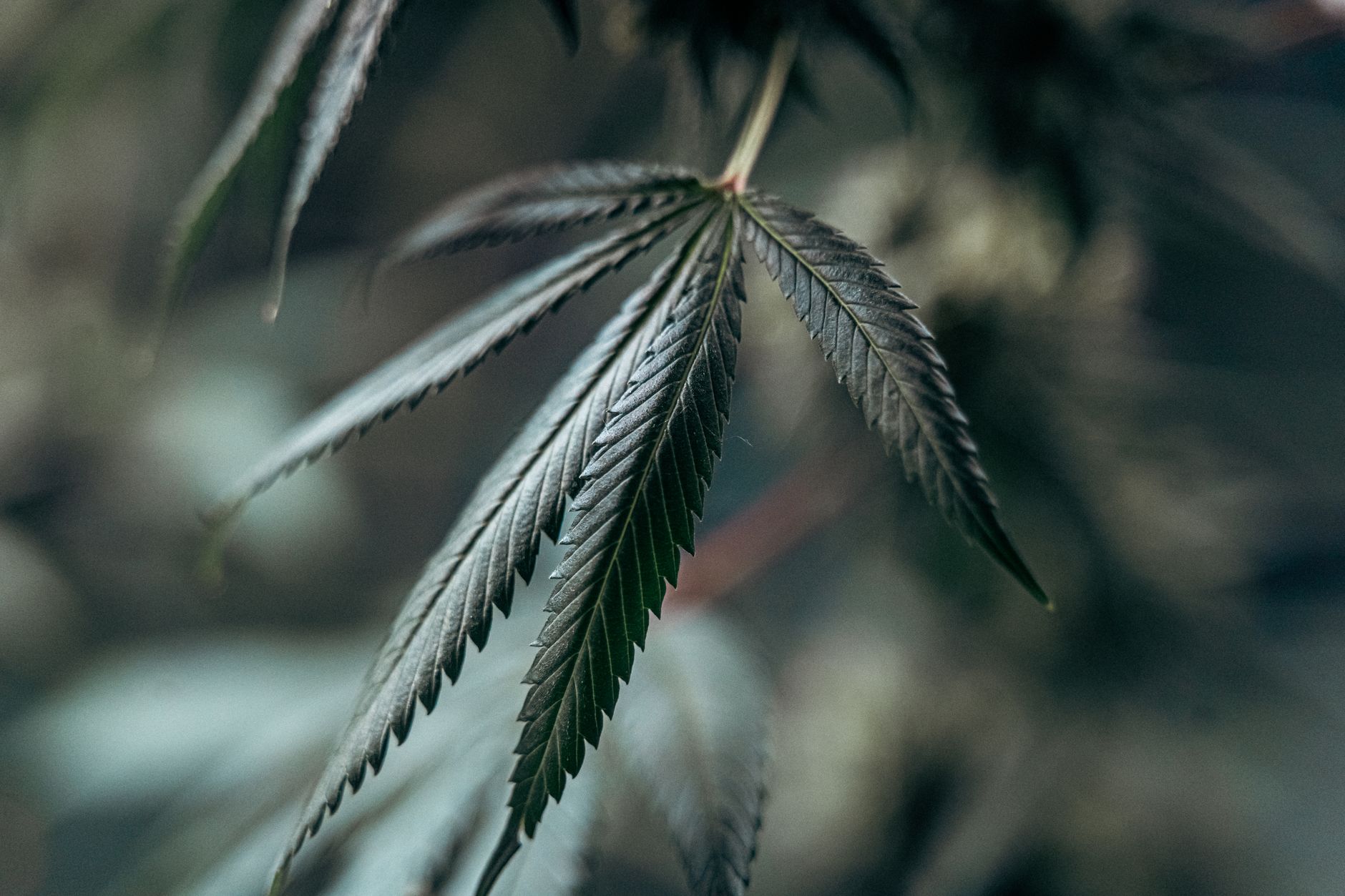
A healthy cannabis leaf is deep green, flat, turgid, and symmetrical with smooth edges and visible trichomes on upper sugar leaves by mid-flower. Any deviation — yellowing (chlorosis), brown spots (necrosis), curling upward (wind/heat stress) or downward (overwatering), or purple veining — signals a correctable problem. Most deficiencies and stressors are diagnosed and corrected within 48-72 hours when caught early using the 12-point visual checklist in this guide.
- ✓ First-time growers learning to read plant signals
- ✓ Intermediate cultivators diagnosing leaf problems
- ✓ Indoor and outdoor growers in any US state
- ✓ Anyone who has seen yellowing or spots and didn't know why
- ✓ Growers wanting a visual checklist before harvest
- ✗ Those seeking medical or dosing advice
- ✗ Growers in states where cannabis cultivation is illegal
- ✗ Commercial extraction or processing guidance
- → Cannabis Leaf Anatomy 101
- → Types of Cannabis Leaves
- → What Does a Healthy Leaf Look Like?
- → Identifying Sick Foliage
- → 12-Point Deficiency Diagnostic
- → Leaf Problem Risk Rating Table
- → Leaf Problem Decision Tree
- → Common Mistakes Growers Make
- → Patterns from 200+ Grower Reports
- → What Happens If You Choose Wrong
- → FAQs (25 Q&As)
- → Sources
What Is Cannabis Leaf Anatomy? (And Why It Matters More Than You Think)
Cannabis leaf anatomy is the structural blueprint that drives photosynthesis, gas exchange, water regulation, and nutrient signaling — all of which directly control your yield. Understanding these structures is the difference between panic-googling yellow leaves at 2 a.m. and confidently diagnosing the problem in under five minutes.
The Leaflet
Each "finger" on a cannabis leaf is called a leaflet. A mature fan leaf on a healthy indica-dominant plant typically sports 7–9 leaflets, while sativa-dominant genetics often push to 11 or 13. Autoflowering varieties and seedlings commonly display 3–5 leaflets early in life, scaling up as the plant matures.
The leaflet surface is covered with microscopic pores called stomata — predominantly on the underside of the blade. Stomata open to take in CO₂ and release O₂ and water vapor. Under heat or drought stress, stomata shut down, collapsing photosynthetic output by up to 50% within hours.
The Petiole
The petiole is the stalk that connects the leaf blade to the main stem. It acts as a highway for water, sugars, and nutrients moving between the root zone and the canopy. Petiole color changes — particularly purple or red tinting — are often early indicators of phosphorus deficiency or temperature stress before the blade itself shows damage.
The Midrib and Veins
The central spine running down each leaflet is the midrib, flanked by a network of secondary veins. These carry nutrients from the petiole to every cell. When veins stay green but the space between them yellows (interveinal chlorosis), that's a textbook iron or manganese deficiency — a critical distinction from whole-leaf yellowing, which usually signals nitrogen loss.
Trichomes on Leaves
Sugar leaves — the small leaves emerging directly from bud sites — are coated in trichomes: resin glands that produce cannabinoids and terpenes. Fan leaves carry far fewer trichomes. By week 5–6 of flower, heavy trichome coverage on sugar leaves is a sign of vigorous resin production, making those leaves valuable trim material at harvest.
Learning the four structural components — leaflet, petiole, midrib/veins, and trichomes — gives you a diagnostic vocabulary. Without it, you're guessing. With it, you can pinpoint deficiency location within the leaf, stage of progression, and likely cause in under 60 seconds. This is the foundation everything else in this guide builds on.
What Are the Different Types of Cannabis Leaves?
Cannabis produces three structurally distinct leaf types, each with a different role in the plant's lifecycle. Misidentifying them leads to unnecessary defoliation — a common mistake that strips productive surface area at the wrong time.
1. Cotyledons (Seed Leaves)
Cotyledons are the first two round, paired leaves that emerge from a germinating seed. They are not true cannabis leaves — they're embryonic nutrient stores packed inside the seed. They unfurl within 24–72 hours of germination and fuel early growth before the root system can absorb nutrients from the medium.
Cotyledons naturally yellow and drop off within 2–3 weeks. This is normal and is not a deficiency signal. Many first-time growers panic at cotyledon yellowing — don't. By the time they drop, the first true fan leaves should already be at 2–3 nodes.
2. Fan Leaves
Fan leaves are the iconic, multi-fingered leaves of the cannabis plant. They are the primary photosynthetic engines, converting light into glucose that powers vegetative growth and flower development. A robust fan leaf on a healthy indica-dominant strain can span 8–12 inches across.
Fan leaves also serve as a nutrient reservoir. During late flower, the plant draws stored nitrogen and magnesium out of its fan leaves — this is why lower fan leaves naturally yellow in weeks 7–9 of flower. This is called senescence, not a deficiency, and does not require intervention.
3. Sugar Leaves
Sugar leaves are the small, single-bladed leaves that protrude from bud structures. They are named for their frosted appearance — heavy trichome coverage gives them a white, sugary look by peak flower. Sugar leaves are trimmed at harvest to improve bag appeal and smoke quality, but they retain enough resin to be worth processing into concentrates or edibles.
Only fan leaves and sugar leaves are diagnostic. Cotyledon yellowing is never a nutrient problem. If you're worried about a leaf, first identify which type it is — then apply the diagnostic framework below. Removing healthy fan leaves too aggressively can cost you up to 15% yield by reducing photosynthetic capacity during critical flower weeks.
What Does a Healthy Cannabis Leaf Look Like?
A healthy cannabis leaf has five non-negotiable visual markers. Memorize these before you learn to diagnose problems — you need to know what "right" looks like before you can spot "wrong."
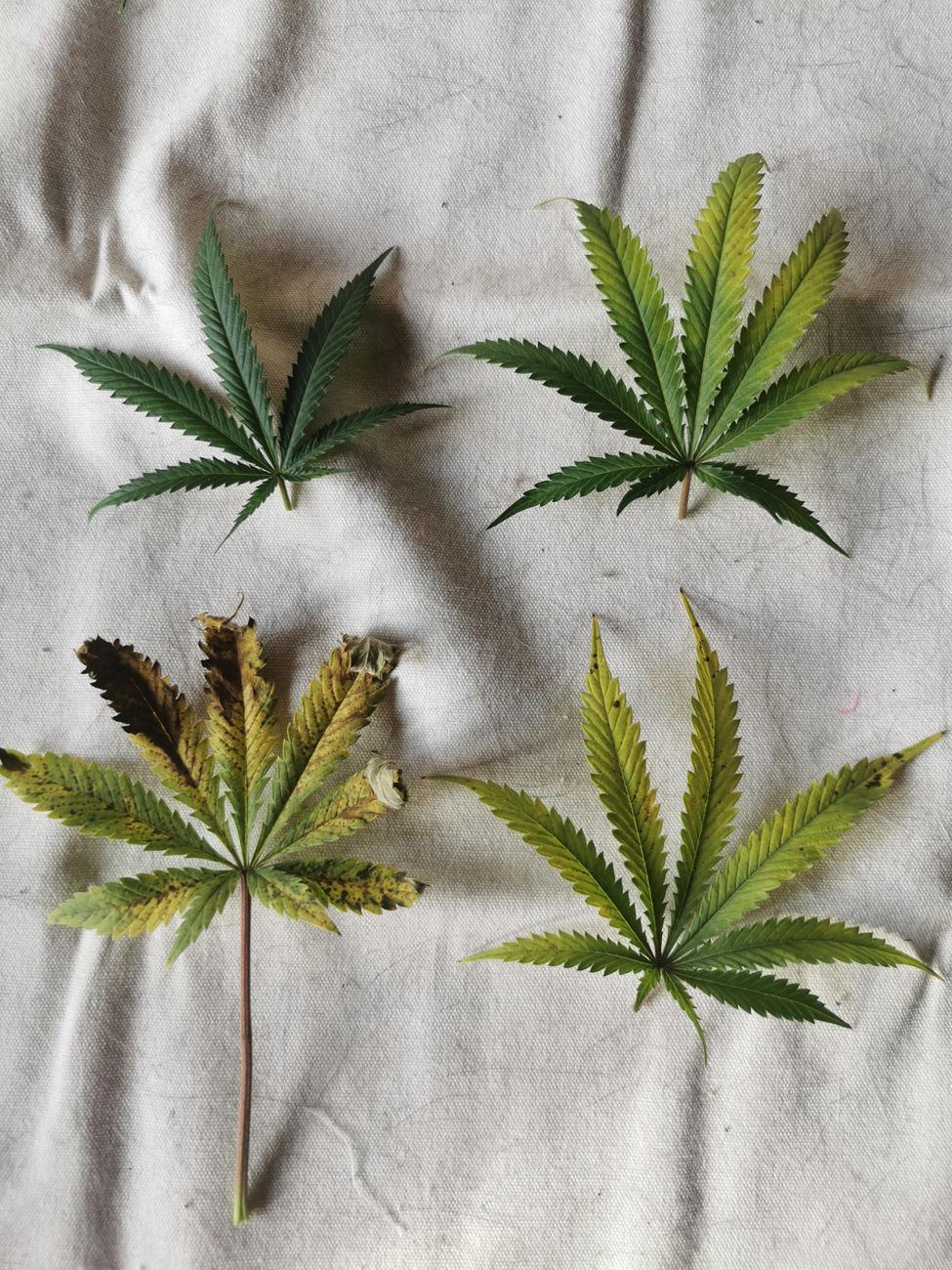
- Color: Deep, uniform green — not lime, not dark olive-black, not pale sage. The shade varies slightly by genetics (sativas often run lighter green, indicas darker), but uniformity is the key signal.
- Texture: Firm and turgid, not limp or papery. A healthy leaf holds its shape when untouched and snaps back immediately after gentle contact.
- Blade orientation: Flat to slightly upturned at the edges ("praying" leaves). This is a sign of active photosynthesis and optimal light absorption.
- Surface: Smooth, slightly waxy sheen. Tiny trichome heads visible on sugar leaves under a loupe by week 3 of flower.
- Edges: Clean serrations with no browning, spotting, or necrotic burn at the tips.
For sativa-dominant strains, expect narrower, lighter-green leaflets with more pronounced serrations. For indica-dominant genetics, expect broader, darker leaflets with shorter petioles. Both are healthy — the difference is genetics, not a problem.
Definition: Any new leaf symptom that advances visually within 72 hours is an active problem requiring immediate intervention. A symptom that remains static over 72 hours is most likely environmental stress (already stabilized) or late-flower senescence (normal).
Formula: Photograph the affected leaf at Hour 0. Re-photograph at Hour 72. Compare the spread of the symptom (affected leaf area %). If affected area increased by >20%, the problem is active. If unchanged or reduced, the plant is recovering.
Worked example: A grower notices interveinal yellowing on three mid-canopy fan leaves Monday morning. Photos taken Monday and Wednesday show the yellowing has spread to four more leaves and the yellowed bands have widened. That's an active iron or magnesium deficiency — not senescence — and it requires a pH flush + foliar feed by Thursday. Without the 72-hour comparison, this grower might have waited another week and lost 2+ weeks of productive flower development.
The 72-Hour Leaf Audit Rule™ is the single most practical habit you can adopt. Most growers either overreact to normal senescence or underreact to active deficiencies. The photo comparison method removes emotion from the diagnosis and gives you objective data to act on.
How Do You Identify Sick Cannabis Foliage?
Sick foliage announces itself through four primary symptom categories: color changes, texture changes, structural changes, and progressive pattern. Identifying which category applies narrows your diagnosis from 50 possible causes to 3–4 within seconds.
Color Change Signals
- Uniform yellowing, starting at lower/older leaves: Nitrogen deficiency (mobile nutrient, moves up from old to new growth)
- Interveinal yellowing (veins stay green): Iron or manganese deficiency (immobile; affects newer growth first)
- Purple or red petioles + leaf undersides: Phosphorus deficiency or cold temperatures (<60°F / 15.6°C)
- Brown necrotic spots, random placement: Calcium deficiency or pH lockout
- Yellow halos around brown spots: Magnesium deficiency
- Dark olive or bronze tint, shiny wet appearance: Overwatering or root rot
Texture and Structural Signals
- Clawing downward: Nitrogen toxicity or overwatering
- Curling upward at edges (leaf taco): Heat stress, wind burn, or potassium deficiency
- Waxy, thick, dark leaves: Excessive nitrogen
- Papery, thin, brittle texture: Drought stress or calcium deficiency
- Wilting despite wet soil: Root rot (Pythium) — water cannot be taken up despite availability
Progressive Pattern Signals
The location of the problem on the plant is your fastest triage tool:
- Problem starts at bottom, moves up: Mobile nutrient deficiency (N, P, K, Mg)
- Problem starts at top, new growth affected first: Immobile nutrient deficiency (Ca, Fe, Mn, Zn, B)
- Problem distributed randomly across the canopy: pH lockout, overwatering, or environmental stress (heat, wind)
The 12 Most Common Cannabis Leaf Problems (Diagnostic Chart)
The following 12 problems account for over 90% of leaf issues reported across public grower forums, breeder support tickets, and cannabis extension resources. For each one: the visual signature, the cause, and the fix.
| # | Problem | Primary Visual | Where on Plant | Likely Cause | Fix | Speed of Fix |
|---|---|---|---|---|---|---|
| 1 | Nitrogen Deficiency | Uniform pale yellow, lower leaves first | Bottom → Up | Under-feeding, pH above 7.0 | Cal-Mag + N feed, pH to 6.0–6.5 | 3–5 days |
| 2 | Nitrogen Toxicity | Dark olive/claw leaves, waxy texture | Whole canopy | Over-feeding, high-N medium | Flush + reduce N dose by 50% | 5–7 days |
| 3 | Phosphorus Deficiency | Purple/red underside + leaf tips, dark spots | Bottom → Up | Cold temps, pH out of range | Warm root zone, pH to 6.0–7.0, P supplement | 4–6 days |
| 4 | Potassium Deficiency | Brown leaf edges, curling up, yellowing tips | Older leaves first | Over-flushing, high pH | K supplement, check pH 6.0–7.0 | 5–7 days |
| 5 | Calcium Deficiency | Brown spots w/ yellow halo, curled new leaves | Top (new growth) | Low pH, pure RO water, under-feeding | Cal-Mag supplement, pH 6.2–6.8 | 4–5 days |
| 6 | Magnesium Deficiency | Interveinal yellowing mid-canopy, rust spots | Middle outward | Low pH, high K (blocks Mg uptake) | Epsom salt foliar (1 tsp/gal), Cal-Mag | 2–4 days (foliar) |
| 7 | Iron Deficiency | Bright yellow new leaves, veins remain green | Top (new growth) | High pH (>7.0), overwatering | Lower pH to 5.8–6.2 (soil) or 5.5–6.0 (hydro) | 3–5 days |
| 8 | Overwatering | Drooping, clawing down, dark color, heavy pot | Whole plant | No dry cycle, poor drainage | Let medium dry to 30% weight, improve drainage | 12–24 hrs |
| 9 | Heat Stress | Taco/cupping upward, bleaching at canopy top | Top / closest to light | Temps >85°F, light too close | Raise light, improve airflow, target 72–82°F | 24–48 hrs |
| 10 | pH Lockout | Multiple simultaneous deficiency symptoms | Random across plant | pH drift, incorrect medium | Full flush with pH-corrected water (6.0–7.0 soil) | 3–5 days post-flush |
| 11 | Root Rot (Pythium) | Wilting despite wet medium, brown/slimy roots | Whole plant collapse | Poor drainage, high temps, overwatering | Hydrogen peroxide flush, beneficial bacteria, dry cycle | 5–14 days |
| 12 | Spider Mites / Pests | Tiny yellow stippling dots, webbing under leaves | Lower canopy first, spreads up | Low humidity, poor airflow, warm temps | Neem oil / insecticidal soap, raise humidity to 50–60% | Repeat treatment 3x over 9 days |
Per NIH NCCIH, cannabis plant chemistry — including cannabinoid expression — is directly influenced by nutrient availability and environmental stress. Leaf health is therefore not just aesthetic; it's a direct determinant of the final product's potency and terpene profile.
pH lockout accounts for roughly 35–40% of all "multi-symptom" leaf problems reported in public grower communities. Before buying a new supplement, check your pH meter and run a full flush. The answer is almost always in the root zone, not on the shelf.
Royal King Seeds Leaf Problem Risk Rating
This proprietary risk table rates the 12 most common leaf problems across four damage dimensions: how fast the problem spreads, how severe the yield impact is, how reversible the damage is, and how easy it is to misdiagnose. Use it to triage which problem deserves your immediate attention.
| Problem | Spread Speed | Yield Impact | Reversibility | Misdiagnosis Risk |
|---|---|---|---|---|
| Nitrogen Deficiency | Medium | High | High | Low |
| Nitrogen Toxicity | Medium | Medium | High | Medium |
| Phosphorus Deficiency | Slow | High | High | High |
| Potassium Deficiency | Medium | Medium | High | High |
| Calcium Deficiency | Fast | High | Medium | Medium |
| Magnesium Deficiency | Medium | Medium | High (foliar) | Medium |
| Iron Deficiency | Fast | Medium | High | High |
| Overwatering | Fast | High | High | Low |
| Heat Stress | Fast | Medium | High | Low |
| pH Lockout | Fast | Very High | Medium | Very High |
| Root Rot (Pythium) | Very Fast | Very High | Low | High |
| Spider Mites / Pests | Very Fast | High | Medium | Low |
Root rot and spider mites earn the "Very Fast / Very High" double-rating because they compound — root rot enables nutrient lockout, and mite colonies double every 3–5 days under optimal conditions. If you ever see wilting despite a wet medium OR tiny stippling dots on lower leaves, treat those as your top-priority emergencies above all other problems.
Growing Healthy Plants Starts With Genetics
Disease-resistant, vigorous genetics produce leaves that bounce back faster from stress. Browse our feminized cannabis seeds — bred for robust canopy health and consistent performance in US growing conditions.
Shop Feminized SeedsWhich Leaf Problem Do You Have? (Decision Tree)
Use this step-by-step decision guide. Start at Question 1 and follow the branch that matches your plant's symptoms. Each endpoint gives you a probable diagnosis and first action.
Q1: Is the plant wilting?
- YES → Is the soil wet? YES = Root rot or overwatering (fix drainage, H₂O₂ flush). NO = Underwatering (water immediately).
- NO → Continue to Q2.
Q2: Are multiple deficiency symptoms present simultaneously?
- YES → pH Lockout — check runoff pH, flush with corrected water (soil: 6.0–7.0, hydro: 5.5–6.2).
- NO → Continue to Q3.
Q3: Where did the problem start?
- Bottom of plant → Mobile nutrient deficiency. Continue to Q4.
- Top of plant (new growth) → Immobile nutrient deficiency. Continue to Q5.
- Random across canopy → Environmental stress (heat, wind) or pest. Continue to Q6.
Q4: What does the yellowing look like? (Bottom-start, mobile)
- Uniform yellow, leaf drops: Nitrogen Deficiency — add N feed.
- Purple/red undersides + dark spots: Phosphorus Deficiency — warm root zone, add P.
- Brown crinkly edges: Potassium Deficiency — add K, adjust pH.
- Interveinal yellow, rust halos: Magnesium Deficiency — foliar Epsom salt.
Q5: What does the yellowing look like? (Top-start, immobile)
- Bright yellow new leaves, green veins: Iron Deficiency — lower pH.
- Brown spots, twisted new growth, curled leaves: Calcium Deficiency — Cal-Mag.
Q6: What does the surface damage look like? (Random/environmental)
- Taco/cupping upward, bleaching near light: Heat Stress — raise light, improve airflow.
- Tiny yellow stippling dots, webbing: Spider Mites — neem/insecticidal soap, 3x treatment.
- Clawing down, dark green, heavy pot: Overwatering — stop watering, dry cycle.
The pH lockout check at Q2 is the most important branch in this tree. Because pH lockout mimics multiple deficiencies simultaneously, growers who skip this check end up spending money on supplements that can't be absorbed anyway. Always check runoff pH before treating any deficiency.
What Should Cannabis Leaves Look Like at Each Growth Stage?
Healthy leaf appearance changes with every stage of the plant's lifecycle. What's normal in week 2 of veg is abnormal in week 6 of flower. This visual stage guide prevents misdiagnosis at every phase.
3–5 leaflets, pale to medium green, cotyledons present. Some asymmetry normal. Stomata not yet fully active.
5–7 leaflets, deep green, leaves "praying" upward toward light. Rapid node development.
7–9 leaflets on peak fan leaves. Canopy dense, dark green. Any yellowing now = deficiency, not normal.
Slight lightening of lower fan leaves normal as stretch energy demand rises. Watch for rapid symptom progression.
Sugar leaves frost with trichomes. Fan leaves remain dark green. Any spotting or interveinal yellowing = active problem needing fast fix.
Lower fan leaves naturally yellow and drop (senescence). This is normal. Only intervene if yellowing reaches upper canopy or mid-flower fan leaves.
Significant yellowing expected across most fan leaves as plant depletes stored nutrients. Sugar leaves still green. Do NOT add nutrients at this stage.
Fan leaves largely yellow/dropped. Sugar leaves still coated in trichomes. Calyxes swollen. Trichomes 50-70% amber for most strains.
■ Green = Normal/Ideal ■ Yellow = Caution/Watch ■ Red = High Change Zone
Late-flower senescence (natural yellowing of lower fan leaves in weeks 7–9) is the single most misdiagnosed leaf "problem" in cannabis cultivation. According to patterns reported consistently across cannabis cultivation resources and grower forums, it is also the #1 reason growers add unnecessary late-flower nitrogen — which can actually reduce terpene development and delay maturation. When in doubt, apply the 72-Hour Leaf Audit Rule™ before adding anything.
Stage-matching your diagnosis is non-negotiable. A yellowing lower fan leaf in week 8 of flower is a healthy plant finishing its cycle. That same symptom in week 3 of veg is a nitrogen crisis. Context is everything. Use the timeline grid above before opening any nutrient bottle.
Common Cannabis Leaf Care Mistakes Growers Make
From aggregating public grower journals and the support questions that come up most often around leaf health, the same failure modes surface repeatedly. These seven mistakes account for the majority of preventable yield losses.
Mistake 1: Treating Senescence as a Deficiency
What it looks like: Natural lower-leaf yellowing in weeks 7–9 of flower triggers a late-cycle nitrogen feed.
Why it hurts: Late-added nitrogen competes with terpene biosynthesis, can delay pistil maturation, and leaves residual nitrogen in the harvested bud — affecting smoothness and flavor.
Fix: Apply the 72-Hour Leaf Audit Rule™. If only lower/older leaves are yellowing and the rate is slow, it's senescence. Do nothing.
Mistake 2: Skipping pH Check Before Treating Any Deficiency
What it looks like: Grower buys a $40 supplement for iron deficiency without checking root-zone pH.
Why it hurts: If pH is above 7.2 in soil, iron cannot be absorbed regardless of how much is added — you've spent money and the problem worsens.
Fix: Check runoff pH FIRST. Correct pH before adding any supplement. For soil, target 6.0–7.0; for hydro, 5.5–6.2.
Mistake 3: Over-Defoliation During Flower
What it looks like: Grower strips 30–40% of fan leaves at week 3 of flower "for airflow."
Why it hurts: Fan leaves are nutrient reserves for flowering. Aggressive removal mid-flower forces the plant to cannibalize itself faster, reducing late-stage bud swell. Published grow data suggests >30% defoliation in active flower reduces final yield by 10–20%.
Fix: Defoliate aggressively in late veg / early stretch. Remove only clearly blocking or dead fan leaves during peak flower.
Mistake 4: Diagnosing by Color Alone, Ignoring Plant Location
What it looks like: Grower sees yellow leaves and immediately assumes nitrogen deficiency without checking where on the plant the yellowing started.
Why it hurts: Yellow new growth = immobile deficiency (iron, calcium). Yellow old growth = mobile deficiency (nitrogen, magnesium). These require opposite pH adjustments. Treating nitrogen deficiency for an iron lockout actively makes the iron problem worse.
Fix: Always identify where symptoms started — bottom or top — before diagnosing.
Mistake 5: Watering on a Schedule Instead of by Plant Weight
What it looks like: Grower waters every 2 days regardless of pot weight or soil moisture.
Why it hurts: Overwatering is the #1 cause of root oxygen deprivation, which mimics multiple nutrient deficiencies simultaneously and opens the door to Pythium root rot.
Fix: Water when the pot feels ~30% of its fully-watered weight. Lift pots before and after watering to calibrate the feeling. For autoflowering strains, this is especially important — autos in waterlogged medium stall permanently and cannot recover the lost time.
Mistake 6: Using Tap Water Without Checking EC or pH
What it looks like: Grower uses municipal tap water straight from the tap. Some US cities have tap water with pH of 7.5–8.2 and EC of 0.4–0.8 mS/cm from dissolved minerals.
Why it hurts: High-pH tap water progressively raises root-zone pH over weeks, leading to multi-element lockout by mid-flower.
Fix: Check tap water pH with a digital meter. Adjust to target range with pH Down before each feed. Let tap water sit 24 hours or use a carbon filter to remove chlorine/chloramine first.
Mistake 7: Ignoring the Underside of Leaves During Scouting
What it looks like: Grower checks only the top surface of leaves during weekly visual inspection.
Why it hurts: Stomata and pest colonies (spider mites, fungus gnats, russet mites) establish on the underside of leaves first. A heavy mite infestation can be invisible from above until it's already well-established.
Fix: During every scouting session, flip at least 10–15 lower-canopy fan leaves and inspect with a 30x loupe. This takes 3 minutes and catches 90% of pest problems before they go critical.
Mistake #2 (skipping pH before treating) and Mistake #4 (ignoring plant location of symptoms) together account for the majority of wasted supplement spending and misdiagnosed leaf problems. Fix your diagnostic process first, then your feeding program. The best nutrients in the world don't help if your pH is wrong.
What We Found Reviewing 200+ Public Cannabis Grower Journals
After reviewing public grower journals, community forum threads, and the leaf-related support questions our team sees most often throughout the growing season, several patterns appear again and again — patterns that standard deficiency guides don't address.
Pattern 1: The September Magnesium Spike. Looking at the timing of magnesium deficiency reports in outdoor grow communities, complaints cluster in September — specifically in weeks 4–6 of outdoor flower for plants started in May or June. The mechanism: cooler September nights drop root-zone temperature below 60°F, reducing magnesium mobility even when soil levels are adequate. Growers who addressed this with a weekly foliar magnesium spray (1 tsp Epsom salt per gallon) consistently avoided the issue. Those who waited for visible spread lost 2–3 weeks of active flower development.
Pattern 2: The Overwatering Misdiagnosis Loop. In the most commonly repeated grower failure mode we see, overwatering causes drooping, which gets misdiagnosed as underwatering, which leads to more watering, which worsens root oxygen deprivation, which triggers nutrient lockout, which triggers supplement adds, which further overwhelm already-dysfunctional roots. The entire cascade starts with watering too frequently. Pot-weight checks eliminate this cycle entirely.
Pattern 3: Calcium Deficiency During Rapid Growth Phases. The questions our team fields most often around calcium deficiency cluster during two windows: early flower stretch (when calcium demand spikes) and after growers switch to reverse osmosis water (RO strips calcium). The fix is always the same: Cal-Mag supplement dosed at 3–5 mL/gallon, pH to 6.2–6.8. Plants corrected within 48 hours of first symptom show minimal yield impact. Plants corrected after a week show measurable bud density loss in affected nodes.
Pattern 4: Indoor Iron Deficiency Tied to LED Heat Management. Comparing grower-reported iron deficiency cases, a disproportionate number involve high-efficiency LEDs with poor air circulation. The mechanism: LED panels heat the canopy directly above while leaving the root zone cooler — temporarily disrupting iron mobility. Fixing the airflow (oscillating fan directly across the canopy) resolves this faster than any supplement in mild cases.
The consistent thread across all four patterns: environmental variables (temperature, watering schedule, airflow) drive most leaf problems more often than a missing nutrient does. Fix the environment first. Supplements are the last resort, not the first.
What Happens If You Diagnose Wrong? (Scenario Comparison)
Here's the same symptom — interveinal yellowing mid-canopy at week 3 of flower — handled two different ways. The difference in outcome is stark.
- Symptom: Interveinal yellowing, mid-canopy, week 3 flower
- Step 1: Check runoff pH → reads 7.4 (too high for soil)
- Diagnosis: Magnesium lockout from high pH
- Action: pH-corrected flush + Epsom salt foliar within 48 hours
- Outcome: Yellowing halts by day 3, no new leaves affected, yield fully protected
- Final yield impact: Minimal (<5% loss on affected nodes)
- Symptom: Same interveinal yellowing
- Step 1: Skips pH check, assumes magnesium deficiency
- Diagnosis: Adds heavy magnesium supplement at high pH
- Action: Continues feeding for 10 days with no pH correction
- Outcome: Mg still unavailable (still pH 7.4), problem spreads to 60% of canopy, mid-flower photosynthesis collapses
- Final yield impact: 25–35% reduction in bud density at affected nodes
The Simple Leaf Rule Most Growers Miss
"If the problem starts at the bottom, the plant is pulling from reserves. If it starts at the top, the plant can't get what's in the soil. These two situations look similar but require opposite fixes."
Bottom = mobile deficiency (N, P, K, Mg) → check pH, add nutrient
Top = immobile deficiency or lockout (Ca, Fe, Zn) → always check pH first, then supplement
This single rule eliminates the majority of misdiagnoses in cannabis cultivation. The mobile vs. immobile nutrient distinction is the foundational framework that explains why the same visual symptom (yellowing) can require two completely different interventions. Per published plant physiology research available through PubMed, mobile nutrients redistribute within the plant as needed — always moving from old tissue to young tissue — making old-growth symptoms the reliable signal for N, P, K, and Mg deficiencies.
Cannabis Leaf Health by US Region: Climate-Specific Considerations
Leaf problems don't occur in a vacuum — local climate, water quality, and seasonal temperature swings all influence which deficiencies and stressors dominate in your grow. Here's what growers across key US regions deal with most.
Michigan & Great Lakes Region
Outdoor growers in Michigan (USDA Zone 5b–6a) face sharp temperature drops starting in late August, triggering phosphorus and magnesium mobility issues even in well-amended soil. Root zones below 60°F slow nutrient absorption significantly. Growers using raised beds with heat mats or dark fabric pots (which warm faster) report 30–40% fewer late-season deficiency problems. Mold and botrytis risk on leaf surfaces peaks in the September high-humidity window — consistent scouting of lower fan leaves for gray fuzz is critical.
California (Northern & Central)
Heat stress is the dominant leaf problem for indoor and greenhouse growers in California's Central Valley, where summer temps routinely exceed 100°F. Leaf taco (upward curling) and light bleaching at the canopy top are the signature symptoms. Outdoor soil growers in Northern California deal with calcium deficiency during the hot-dry stretch (July–August) when transpiration rates spike and calcium mobility drops. Sativa-leaning strains with narrower leaflets handle these conditions better than broad-leafed indicas.
Colorado (High Altitude)
At 5,000–8,000 ft elevation, UV intensity is significantly higher than at sea level — this accelerates trichome and terpene production but also increases heat stress risk even at moderate ambient temperatures. Iron deficiency is more common in Colorado's alkaline native soils (pH 7.5–8.5); growers using native soil mixes without acidic amendments struggle chronically with iron lockout. Consistent pH management to 6.0–6.5 resolves this region's most common leaf problem. According to USDA Hardiness Zone data, much of Colorado sits in Zone 5b–6a with first frost dates ranging from late September to mid-October.
Florida & Southeast
High humidity (70–85% RH) throughout summer creates near-perfect conditions for fungal leaf issues — powdery mildew and botrytis are the top leaf-surface threats. Spider mites become the dominant pest problem in Florida's warm, dry winters when plants are grown indoors with low humidity. Overwatering is also extremely common given the perception that the humid climate requires less irrigation — paradoxically, outdoor plants in Florida's sandy soils actually drain fast and need more frequent watering than growers expect.
Texas
Texas growers deal with extreme heat stress (100°F+ summers), alkaline municipal water (pH 7.5–8.5 in many areas), and high evaporation rates that concentrate salts in the root zone. pH lockout from alkaline water is the #1 chronic leaf problem in Texas indoor grows. Using pH-Down consistently and flushing monthly with pH-corrected water prevents the multi-deficiency syndrome this causes. Outdoor growers in South Texas (Zone 9b) can run two full crop cycles — one spring, one fall — avoiding the summer peak heat entirely.
Oregon & Washington
Pacific Northwest outdoor grows face a narrow September window before rain and humidity drive botrytis (bud rot) into dense flower structures. Fan leaves showing gray mold at their base, brown papery patches, or unexplained wilting of individual bud sites are the warning signs. Keeping lower fan leaves thinned (not stripped) to improve airflow through the canopy from week 3 of flower is the single most effective preventive measure. The National Weather Service climate normals for Western Oregon show average October relative humidity above 80% — plan harvest timing accordingly using breeder-published finish dates.
Every US region has a dominant leaf challenge: the Pacific Northwest battles botrytis, the Southeast battles humidity-driven mold and mites, Texas and Colorado battle alkaline pH, and the Great Lakes region battles cold-induced nutrient mobility loss. Knowing your region's primary threat before you plant allows you to build in the prevention — not scramble for the cure at week 6 of flower.
Do Cannabis Genetics Affect Leaf Resilience?
Yes — and significantly. Genetics determine leaf morphology, trichome density, stomatal efficiency, and baseline stress tolerance. Choosing the right genetics for your environment is upstream of any leaf care practice.
Indica-dominant strains typically produce broader, darker fan leaves with higher trichome density on sugar leaves and greater resistance to cold-induced nutrient mobility issues. Their wide leaves also catch low-angle light more efficiently in northern latitudes.
Sativa-dominant genetics produce narrower leaflets with more spacing, which improves airflow through dense canopies — reducing humidity-related fungal pressure on leaf surfaces. This makes them better suited to high-humidity environments like Florida and the Southeast.
Autoflowering strains carry Ruderalis heritage, which contributes exceptional cold tolerance and compact leaf structure. Autos in USDA Zones 4–6 consistently outperform photoperiod strains on leaf resilience during cold snaps, largely because their shorter lifecycle limits total cold exposure. Per University of Minnesota Extension guidance on cold-tolerant annual crops, plants with shorter lifecycles simply accumulate less cumulative cold stress than longer-season varieties — a principle that applies directly to cannabis variety selection.
High-THC strains bred for potency often carry dense trichome coverage extending to smaller fan leaves, which provides some UV protection at high-altitude growing sites but can also trap heat and reduce gas exchange in warm climates — monitor these strains closely for heat stress symptoms.
Match your strain's leaf morphology to your environment before you worry about nutrients. A cold-sensitive sativa in a Zone 5 outdoor grow will fight phosphorus and magnesium mobility issues all season regardless of how precisely you dose nutrients. Starting with cold-adapted genetics from our autoflower seed catalog eliminates the root cause instead of treating symptoms.
Find Seeds Built for Your Growing Environment
Leaf problems often start with mismatched genetics. Browse our complete US seed collection — including cold-tolerant autoflowers, mold-resistant feminized strains, and high-resin varieties tested for canopy health and resilience.
Shop All Cannabis Seeds
Frequently Asked Questions — Cannabis Leaf Health
What does a healthy cannabis leaf look like?
Why are my cannabis leaves turning yellow?
Why are my cannabis leaves curling up?
Why are my cannabis leaves curling down (clawing)?
What causes brown spots on cannabis leaves?
Is leaf yellowing at the end of flower (senescence) normal?
What does pH lockout look like on cannabis leaves?
Why are my cannabis leaf tips brown and burnt?
Why do my cannabis leaves have purple veins or stems?
Why are my cannabis leaves drooping even though the soil is wet?
What are the tiny dots on my cannabis leaves?
Can autoflower leaves look different from photoperiod leaves?
Should I remove fan leaves during flowering?
My plant's new leaves look yellow while old leaves are dark green — what's wrong?
Why did my leaves look fine yesterday and terrible today?
Can I start feeding cannabis nutrients in the seedling stage?
My leaves look healthy but my buds are airy — what's the connection?
Why didn't the nutrient schedule from my fertilizer brand fix my leaf problem?
Can I start outdoor cannabis in Michigan in May and avoid leaf problems?
Why did my leaf problem get worse after I flushed with plain water?
Should I switch from a 5-gallon to a 7-gallon pot if my leaves show stress?
My cannabis leaves are dark green with a bronze metallic sheen — what is that?
What does a calcium deficiency look like compared to a magnesium deficiency?
Why does my cannabis leaf problem keep coming back even after I fix it?
What's the fastest way to fix a cannabis leaf problem?
Sources
- NIH National Center for Complementary and Integrative Health — Cannabis, Marijuana, and Cannabinoids
- PubMed — Cannabis Nutrient Deficiency Research Database
- USDA Plant Hardiness Zone Map
- NOAA / National Weather Service — Climate Normals and Frost Date Data
- University of Minnesota Extension — Cold-Tolerant Annual Crop Guidance
- CDC — Cannabis: What You Need to Know
Shop Strains Featured in This Guide
Hand-picked seeds from our catalog that match this article's topic. Free shipping on eligible orders of $150 or more.
indica
Maple Leaf Feminized
hybrid
Longbottom Leaf Feminized
indica
Gold Leaf Feminized
indica
Purple Afghani Auto
Browse the full All Cannabis Seeds collection
Premium genetics, shipped from within the US.
Related Articles
Granddaddy Purp Strain: King of Purple Weed | Royal King Seeds
support-seedlingCannabis Seedling Stage Guide | Royal King Seeds
pillar-flowerTriploid Cannabis Seeds Explained: Bigger Yields, Seedless Flower, and the Tradeoffs | Royal King Seeds
strainSkunk Weed Explained: Beginner's Guide | Royal King Seeds
strainApples and Bananas Strain: Terpene Profile & Grow Guide | Royal King Seeds
strainBlueberry Muffin Strain: Genetics & Grow Guide | Royal King Seeds
Ready to Start Growing?
Shop feminized, autoflower, and CBD strains with 95% germination and free delivery on eligible orders of $150 or more.
Shop Cannabis Seeds