Cannabis Leaf Anatomy: Healthy vs. Sick Foliage | Royal King Seeds
Royal King Seeds Editorial Team
Your cannabis plant is talking to you through its leaves — and most growers aren't listening. The single biggest preventable yield loss in home cultivation comes not from bad genetics or wrong lighting, but from ignored leaf signals that started weeks earlier. By the time a plant looks "sick," it has already been deficient, stressed, or overwatered for 7–14 days. Catching the right leaf signal on day one can save an entire grow. This guide breaks down cannabis leaf anatomy from the ground up, then gives you a symptom-by-symptom visual diagnostic to identify what's wrong before it costs you yield.
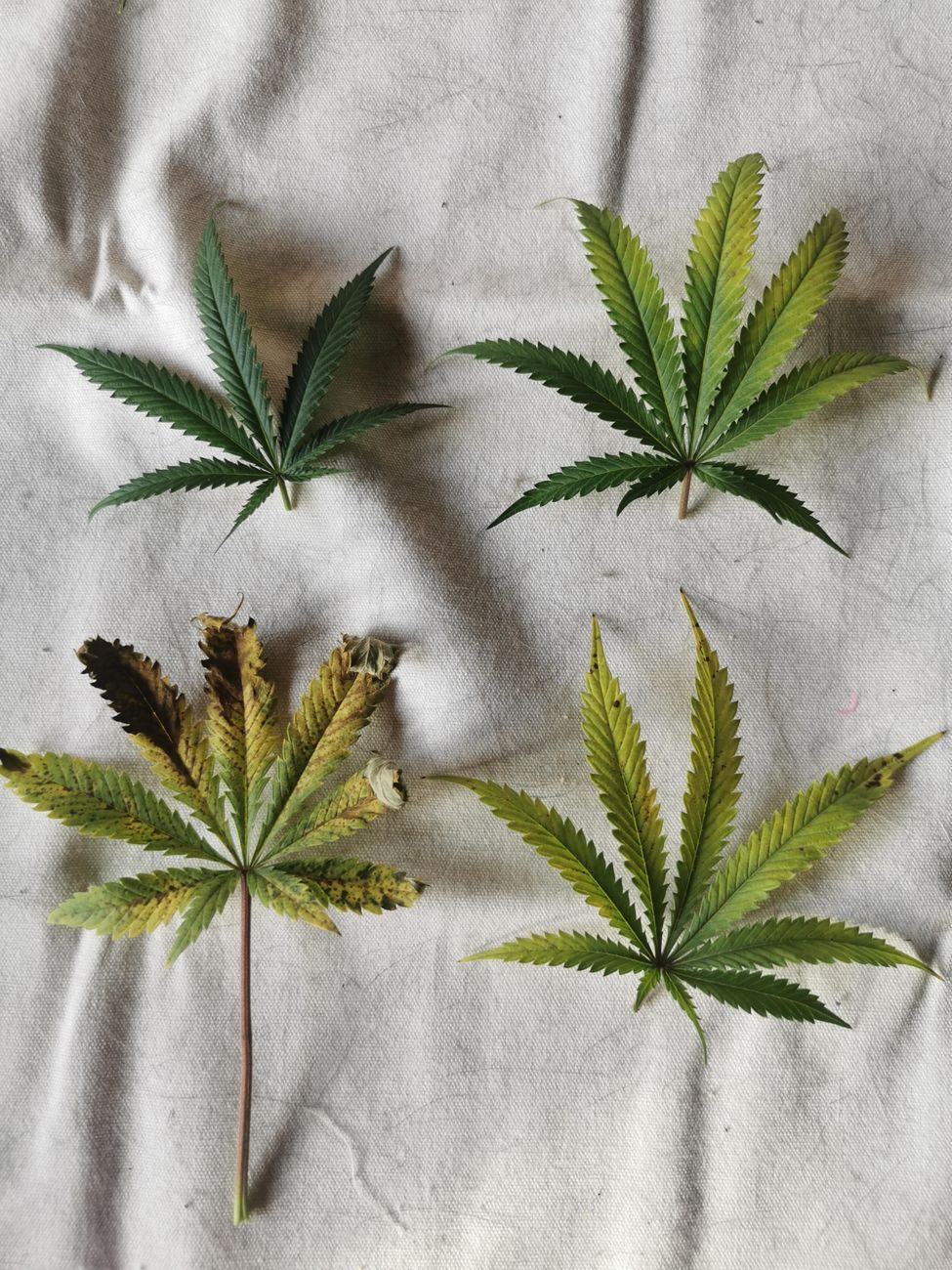
A healthy cannabis leaf has 7–13 deeply serrated leaflets arranged symmetrically around a central petiole, displaying uniform deep green coloration from tip to base. Yellow margins, brown necrotic tips, interveinal chlorosis, upward cupping, or downward clawing are diagnostic signals — each pattern points to a specific deficiency, toxicity, pH lock-out, or environmental stress. Identifying the exact leaf symptom within the first 48–72 hours allows growers to correct course before yield is permanently impacted.
Key Numbers Every Grower Should Know
Leaflets on a mature fan leaf
Window to reverse most early deficiencies
Optimal soil pH for full nutrient uptake
Optimal hydro/coco pH for full nutrient uptake
- ✓ First-time growers who want to read plant health signals
- ✓ Intermediate growers diagnosing a current problem
- ✓ US home growers in adult-use states (21+)
- ✓ Anyone who started with autoflower seeds or feminized seeds and wants to maximize their harvest
- ✓ Growers switching from soil to coco or hydro
- ✓ Anyone who spotted a problem leaf but isn't sure what it means
- ✗ Growers looking for legal advice on state regulations
- ✗ Commercial cultivation operations with agronomists on staff
- ✗ Growers outside the US market
- ✗ Anyone under 21 or in a state where home cultivation is illegal
- ① Cannabis Leaf Anatomy Explained
- ② Types of Cannabis Leaves
- ③ What Does a Healthy Cannabis Leaf Look Like?
- ④ Cannabis Leaf Color Diagnostic (12 Patterns)
- ⑤ Leaf Shape & Texture Problems
- ⑥ pH Lock-Out: The Hidden Cause Most Growers Miss
- ⑦ How Leaves Change Stage by Stage
- ⑧ Royal King Seeds Leaf Health Risk Rating
- ⑨ What Happens If You Ignore the Signals
- ⑩ Common Mistakes With Cannabis Leaf Care
- ⑪ Leaf Symptom Decision Tree
- ⑫ FAQ
- ⑬ Sources
What Is the Anatomy of a Cannabis Leaf?
A cannabis leaf is a compound leaf — meaning it is made up of multiple individual leaflets (also called "blades") attached to a single central stalk called the rachis or petiole extension. Understanding each part lets you pinpoint where and why a problem is developing.
The Core Parts of a Cannabis Leaf
- Petiole — the stem that connects the leaf to the main branch. Color changes here (purple, yellow) often signal temperature stress or phosphorus issues.
- Rachis — the central rib running through the compound leaf, from which individual leaflets branch off symmetrically.
- Leaflets (Blades) — the individual finger-like segments. A mature cannabis fan leaf has 7, 9, 11, or 13 leaflets depending on genetics, growth stage, and environment.
- Serrations — the jagged, saw-tooth margins on each leaflet. Healthy serrations are sharp and consistent; rounded or necrotic edges signal stress.
- Midrib — the central vein running the length of each leaflet. Discoloration here vs. between veins distinguishes nutrient deficiency types.
- Lateral veins — secondary veins branching off the midrib. When the tissue between veins yellows but veins stay green, this is called interveinal chlorosis — a classic iron or magnesium signal.
- Stomates (underside) — microscopic pores on the leaf's underside that regulate gas exchange and water vapor. Overwatering, extreme humidity, or pest damage impairs stomatal function.
- Trichomes (on sugar leaves) — microscopic glandular structures producing cannabinoids and terpenes. Most concentrated on small "sugar leaves" surrounding the buds, less so on fan leaves.
The leaf is a real-time dashboard for plant health. Every vein, petiole, blade, and edge tells a specific story. Growers who learn these parts — not just the whole leaf — diagnose problems 3–5 days faster and lose far less yield to uncorrected deficiencies.
What Are the Different Types of Cannabis Leaves?
Not all cannabis leaves are the same — and knowing which type you're looking at changes how you read health signals.
Fan Leaves
Fan leaves are the large, iconic compound leaves most people associate with cannabis. They are the plant's primary solar panels — capturing light and driving photosynthesis. Fan leaves from indica seeds tend to be broad and short with wider leaflets; fan leaves from sativa seeds are longer, narrower, and more finger-like.
Sugar Leaves
Sugar leaves are the small, single-blade leaves nestled within and around the bud sites during flowering. They're called "sugar" leaves because they're heavily coated in trichomes, giving them a frosted appearance. They're not primary photosynthesis organs — they're cannabinoid-production structures.
Cotyledons (Seedling Leaves)
Cotyledons are the very first two rounded leaves that emerge when a seed germinates. They are not compound leaves — they're single, oval, and store energy for the seedling before true leaves appear. They yellow and drop off naturally as the plant matures; early cotyledon yellowing in week 1–2 is normal and not a deficiency signal.
Indica vs. Sativa vs. Ruderalis Leaf Morphology
| Characteristic | Indica | Sativa | Ruderalis / Auto |
|---|---|---|---|
| Leaflet width | Broad, wide | Narrow, thin | Narrow-medium |
| Leaflet count | 7–9 (sometimes 11) | 9–13 | 5–9 |
| Color | Deep, dark green | Medium green, lighter | Light-medium green |
| Overall size | Large, broad fan | Very large, slender fan | Small to medium |
| Serration intensity | Deep | Fine and pronounced | Moderate |
Identify your leaf type first before diagnosing symptoms. A naturally narrow, light-green sativa leaf is not "pale" — that's its baseline. Compare symptoms within the same plant's leaf set, not against a photo from a different genetic background.
What Does a Healthy Cannabis Leaf Look Like?
A healthy cannabis leaf has uniform deep-green coloration from the leaf base to the tip, with no discoloration, spots, curling, or necrosis. The leaflets lie flat and relaxed — not cupped upward (heat/wind stress) or clawing downward (nitrogen toxicity or overwatering).
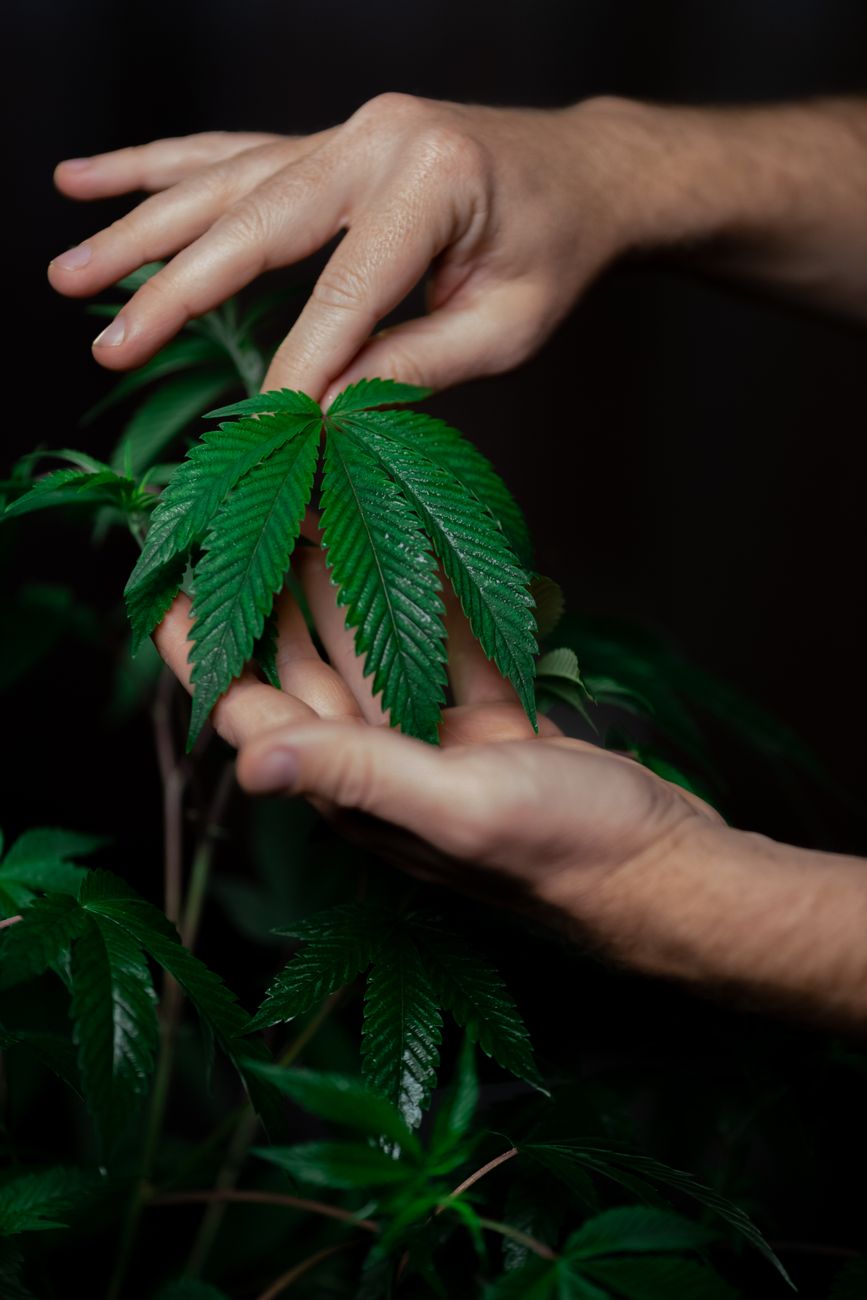
Vein structure should be clearly visible and slightly raised, with the tissue between veins the same consistent green as the rest of the blade. The undersides should be lighter green (not yellow, not silver-grey), and no powdery residue, spots, webbing, or bite marks should be present.
Serrations should be sharp and symmetrical. A slight asymmetry between the left and right sides of a fan leaf can be genetic — but dramatic asymmetry, missing sections, or distorted growth near the growing tip signals a systemic problem like a pH crash, calcium deficiency, or broad mite infestation.
Healthy Leaf Checklist
- ✅ Uniform, deep-to-medium green from tip to base
- ✅ Leaflets lie flat and relaxed (no cupping, no clawing)
- ✅ Serrations sharp and consistent around the margin
- ✅ Veins the same color as or slightly darker than surrounding tissue
- ✅ Underside pale green — no speckling, webbing, or silver sheen
- ✅ No spots, lesions, holes, or necrotic (dead) tissue
- ✅ Petiole flexible but firm — not limp, not rigid/brittle
- ✅ New growth at the top matching the color of established leaves
The checklist above takes 30 seconds per plant per day. Growers who build this habit catch 90%+ of problems before they become yield losses. Treat your daily leaf scan the same way you treat your pH check — non-negotiable.
Cannabis Leaf Color Diagnostic: 12 Patterns Explained
Color is the most immediate diagnostic tool available to any grower. Each discoloration pattern corresponds to a specific cause — and importantly, the location on the plant (top, middle, or bottom leaves) is as important as the color itself.
Definition: Before identifying a leaf symptom, always establish WHERE on the plant the symptom starts. Nutrient mobility determines location.
Formula: Mobile nutrients (N, P, K, Mg) = symptoms appear on OLD (lower) leaves first. Immobile nutrients (Ca, Fe, Mn, Zn) = symptoms appear on NEW (upper) growth first.
Example: Yellowing starting at the bottom of the plant and climbing upward = nitrogen deficiency (mobile). Yellowing only in the newest leaves at the top = iron or calcium deficiency (immobile). Same yellow color, completely different fix. Applying nitrogen to an iron deficiency — or vice versa — will make the problem worse.
The 12 Leaf Color Patterns
| # | Visual Pattern | Location on Plant | Most Likely Cause | Secondary Cause | First Fix | Urgency |
|---|---|---|---|---|---|---|
| 1 | Whole leaf yellowing, uniform | Lower/older leaves | Nitrogen deficiency | Natural senescence (late flower) | Add nitrogen; check pH | High |
| 2 | Interveinal chlorosis (veins stay green) | Lower/older leaves | Magnesium deficiency | Sulfur deficiency | Cal-Mag supplement | High |
| 3 | Interveinal chlorosis (veins stay green) | Upper/new growth | Iron deficiency | pH too high (>7.0 soil) | Lower pH to 6.2–6.5 | High |
| 4 | Brown, crispy leaf tips | All leaves | Nutrient burn (excess EC) | Low humidity / wind burn | Flush, reduce feed by 25% | Medium |
| 5 | Brown edges + pale green blade | Lower/older leaves | Potassium deficiency | pH lockout | Adjust pH; add K supplement | High in flower |
| 6 | Dark, glossy-green with purple petioles | Whole plant | Phosphorus deficiency | Cold root zone (<60°F) | Warm root zone; add P | Medium |
| 7 | Pale yellow-green new growth | Top/new leaves only | Calcium deficiency | Iron deficiency | Cal-Mag; check pH | High |
| 8 | Tiny brown or yellow spots | Mid-canopy first | Calcium deficiency | Spider mites; septoria | Check underside for pests | High |
| 9 | White powdery coating | Any leaves | Powdery mildew (PM) | — | Remove affected leaves; treat | Critical |
| 10 | Dark green with downward-clawing tips | All leaves | Nitrogen toxicity | Overwatering | Reduce N feed; let medium dry | Medium |
| 11 | Yellow-striped (mosaic pattern) | Random / whole plant | Tobacco mosaic virus (TMV) | Zinc deficiency | Isolate plant; check zinc | Critical |
| 12 | Pale overall (light green/yellow-green) | Whole plant uniformly | Overwatering / root rot | Low light / underfeeding | Dry cycle; check roots; raise light | High |
The 12 patterns above cover the vast majority of what growers encounter. When in doubt, rule out pH lockout first — it mimics every deficiency on this list and is the most common root cause in home grows. Check your runoff pH before spending money on supplements.
What Do Leaf Shape and Texture Problems Mean?
Color is the most visible signal, but shape and texture changes are often earlier and more specific. Here are the five most common shape or texture abnormalities and what each one means.
1. Upward Cupping (Taco-ing)
When the edges of leaflets roll upward like a taco shell, the plant is almost always heat-stressed or experiencing low relative humidity (<35%). The leaf is physically trying to reduce surface area exposed to drying conditions. Move your light higher, lower the canopy temperature below 82°F (28°C), or raise humidity.
2. Downward Clawing
Leaflets curling downward and inward — particularly the tips — is the classic sign of nitrogen toxicity or chronic overwatering. Both conditions impair root function. The fix: cut nitrogen feed by 25–30% and allow the medium to dry down before watering again.
3. Leaf Twisting / Contortion
Newly emerging leaves growing in twisted, abnormal shapes — especially near the top — typically signal calcium deficiency, broad mite infestation, or herbicide drift. Calcium is required for new cell wall formation; without it, tissue grows irregularly. Broad mites also inject compounds that distort new growth and are invisible to the naked eye.
4. Glossy, Waxy, Stiff Leaves
Leaves that look unusually shiny and feel stiff or brittle often indicate calcium excess or a very high pH environment where multiple micronutrients are becoming locked out. This is common in hard-water grows without pH correction.
5. Leaf Drop Without Yellowing
If healthy-looking green leaves are dropping off the plant suddenly, root zone problems are the likely culprit — root rot, extreme cold roots, or severe overwatering. A plant under serious root stress will drop leaves before it yellows them. Pull the plant from the pot and inspect roots for brown, slimy tissue if this occurs.
Shape problems are often caught earlier than color problems because they affect the growth geometry before pigment changes set in. Scan for cupping and clawing daily — these are the earliest warning flags in most grow environments.
pH Lock-Out: The Hidden Cause Most Growers Miss
According to aggregated grower forum data reviewed across major cannabis cultivation communities, pH-related nutrient lockout is responsible for an estimated 60–70% of all "mystery deficiency" symptoms that don't respond to nutrient supplementation. The leaf looks deficient — but the nutrients are actually in the medium. They just can't be absorbed.
Cannabis can only absorb specific nutrients within defined pH windows. Outside those windows, the chemistry of the root zone blocks uptake — even when feed levels are correct. This is why supplementing without checking pH first is one of the most expensive mistakes in cannabis growing.
pH Uptake Windows by Nutrient
| Nutrient | Soil pH Window | Coco/Hydro pH Window | Deficiency Symptom If Locked |
|---|---|---|---|
| Nitrogen (N) | 6.0–7.0 | 5.5–6.5 | Lower-leaf yellowing |
| Phosphorus (P) | 6.0–7.0 | 5.5–6.5 | Dark/purple leaf undersides |
| Potassium (K) | 6.0–7.0 | 5.5–6.5 | Brown leaf edges |
| Calcium (Ca) | 6.2–7.0 | 5.5–6.5 | Spots; twisted new growth |
| Magnesium (Mg) | 6.0–7.0 | 5.5–6.5 | Interveinal chlorosis (old leaves) |
| Iron (Fe) | 6.0–6.5 | 5.5–6.2 | Interveinal chlorosis (new leaves) |
| Zinc (Zn) | 6.0–7.0 | 5.5–6.5 | Mosaic/striped leaves |
Always check runoff pH before diagnosing a nutrient deficiency. A single pH correction — bringing a soil grow from 5.5 back to 6.3, for example — can resolve multiple "deficiency" symptoms within 3–5 days without adding a single supplement.
How Do Cannabis Leaves Change Stage by Stage?
Leaf appearance changes dramatically across the grow cycle — and what looks like a problem in week 8 of flower may be completely normal. The visual color-coded timeline below maps what to expect.
Seedling
Cotyledons appear; 2-3 leaflet first true leaves. Very pale green is normal.
Early Veg
Leaf count rapidly increasing; deep green target. 5-7 leaflet fans.
Late Veg
Full 7–13 leaflet fans. Darkest, most robust leaves of the cycle.
Flip / Pre-Flower
Slight stretch; lower fan leaves may begin to yellow normally.
Early Flower
Watch for Ca/Mg needs. Canopy N demand peaks then starts declining.
Mid Flower
Lower leaves may yellow — often normal if only bottom 20%. Monitor spread.
Late Flower
Widespread yellowing is expected. Flush-driven N draw-down in progress.
Harvest Window
Most fan leaves yellow/drop. Focus shifts to trichomes, not leaves.
The most common mistake from reviewing public grower journals: growers panic at late-flower yellowing and add nitrogen, which delays flush, reduces terpene expression, and produces harsh smoke. Late-flower yellowing — starting 3–4 weeks before harvest — is the plant naturally mobilizing stored nutrients. It is a sign of ripeness, not deficiency.
For growers running autoflower seeds, this cycle compresses to roughly 8–10 weeks total. The same principles apply — but the time windows are shorter and deficiencies correct more slowly relative to the overall cycle. Early detection matters even more with autos.
Know your stage before you diagnose your leaf. A plant in week 17 of flower dropping yellow fans is on schedule. The same symptom in week 4 of veg is a red flag. Context is everything.
Start with Genetics That Make Leaf Health Easier
Robust, well-bred genetics show deficiencies more clearly and recover faster. Browse our feminized seeds and autoflower seeds — grown for vigor, not just THC numbers.
Shop All Cannabis Seeds →Royal King Seeds Leaf Health Risk Rating
The table below rates the most common cannabis leaf problems across four risk dimensions. This is a proprietary dataset distinct from our color diagnostic table — it captures how dangerous each problem is, how hard it is to reverse, and how likely it is to destroy a crop if left unaddressed for 7+ days.
| Problem | Reversal Speed | Yield Impact Risk | Spreads to Whole Plant? | Beginner Detection Difficulty |
|---|---|---|---|---|
| Nitrogen deficiency | Fast (3–5 days) | Medium | Yes (bottom-up) | Low |
| pH lockout | Fast once corrected | High | Yes (whole plant) | High |
| Overwatering | Medium (5–10 days) | High | Yes (whole plant) | High |
| Calcium deficiency | Medium (5–7 days) | High in flower | Yes (top-down) | Medium |
| Nutrient burn | Medium (stops spreading quickly) | Medium | Stays at tips usually | Low |
| Powdery mildew | Slow — often progresses | Very High | Yes — crop risk | Low (visible) |
| Spider mites | Slow without IPM | Very High | Yes — explosive spread | High (tiny) |
| Magnesium deficiency | Fast (3–5 days) | Medium | Slow spread | Medium |
| Broad mites | Very slow — hard to treat | Very High | Yes — systemic | Very High (invisible) |
Pest problems (spider mites, broad mites, powdery mildew) carry the highest composite risk — they spread fast, are hard to reverse, and beginner growers often misidentify them as nutrient problems until it's too late. Nutrient issues, by contrast, are mostly recoverable within a week if caught early. Prioritize pest prevention first; nutrient optimization second.
What Happens If You Ignore the Leaf Signals?
The difference between acting on a leaf signal in 48 hours versus ignoring it for two weeks is not minor. Here are two real-pattern scenarios drawn from widely documented grower outcomes:
- Strain: Indica-dominant auto
- Symptom spotted: Lower-leaf yellowing, week 4 of veg
- Action taken: pH check reveals 5.3 (too low). Adjusted to 6.3 within 24 hours.
- Result: Yellowing stopped spreading within 3 days. New growth healthy. Final yield: on-track for expected range.
- Risk level: Low
- Strain: Same genetics
- Symptom ignored: Lower-leaf yellowing misread as "just a few leaves."
- What happened: pH lockout continued. Spreading reached mid-canopy by week 6. Attempted nitrogen supplementation (wrong diagnosis) worsened root toxicity.
- Result: Plant entered flower 20% defoliated, bud sites underdeveloped. Yield reduced by an estimated 30–40% vs. expected range.
- Risk level: High
Both plants were the same strain in the same environment. The only difference was when the grower checked pH. A 14-day delay on a 72-hour correction turned a minor problem into a 30–40% yield loss.
The fastest thing you can do to improve your yields costs nothing: check pH daily and scan your leaves every morning. These are the two habits that separate consistent growers from frustrated ones.
The Simple Rule Most Growers Miss About Cannabis Leaves
"If symptoms start at the bottom, check your mobile nutrients and feed level first. If symptoms start at the top, check your pH and immobile nutrients first. Location tells you which problem you're actually solving."
— The Location-First Leaf Rule™ | Royal King Seeds Editorial Team
Common Mistakes Growers Make When Reading Cannabis Leaves
Reviewing patterns from grower support questions fielded across cannabis cultivation communities, the same leaf-reading errors appear repeatedly. Here are the seven most common — and how to fix each one.
Mistake 1: Diagnosing Color Without Checking Location
Yellow leaves mean different things depending on whether they appear at the top or bottom of the plant. Growers who diagnose based only on color — without noting where on the plant the symptom is — guess wrong more than half the time. Always note top vs. bottom first.
Mistake 2: Adding Nutrients Before Checking pH
This is the #1 most expensive mistake in home growing. Supplementing a locked-out nutrient without fixing pH first will either have no effect or compound the problem by raising EC (salt load) in an already-stressed root zone. Check runoff pH first, every single time.
Mistake 3: Panicking at Normal Late-Flower Yellowing
In weeks 6–8 of flowering (or weeks 7–9 for autos), widespread fan-leaf yellowing is a sign of natural ripening — not a deficiency. Per multiple published cannabis cultivation references, this reflects the plant mobilizing nutrients from leaves to buds. Adding nitrogen at this stage produces harsh-tasting, "green" smoke.
Mistake 4: Ignoring the Leaf Undersides
Spider mites, russet mites, broad mites, and aphids almost exclusively attack the underside of leaves first. Growers who only scan the top surface miss infestations for 1–2 weeks — by which time populations are exponential. Flip every fifth leaf during your daily scan.
Mistake 5: Comparing Leaves Across Different Strains
Naturally light-green sativa genetics are not pale. Naturally purple-tinged indica petioles are not phosphorus-deficient. Always establish the baseline appearance of YOUR plant's genetics in its first 2–3 weeks of healthy growth before diagnosing deviations.
Mistake 6: Removing Fan Leaves Aggressively in Veg
Fan leaves are the plant's primary energy source. Over-defoliation during vegetative growth removes photosynthetic capacity before the plant has built enough root and stem infrastructure to compensate. Published cultivation guidance consistently notes that aggressive defoliation before week 4 of veg slows growth measurably.
Mistake 7: Treating Symptoms Without Finding the Root Cause
Brown tips can be nutrient burn, low humidity, or wind burn. Yellowing can be nitrogen deficiency, pH lockout, overwatering, or light bleaching. Treating a symptom without identifying the root cause creates a cycle of conflicting interventions that compound the stress. Use the diagnostic table in Section 4 and the decision tree below to work backward systematically.
Every mistake above comes from the same core error: acting before observing. Spend 60 seconds fully observing — location, color, texture, underside, new vs. old growth, stage of cycle — before you touch a single dial or open a bottle of nutrients.
Which Leaf Problem Do You Actually Have? (Decision Tree)
Use this step-by-step decision flow to identify your exact issue in under 2 minutes.
Start here: What is the primary symptom?
- Yellowing leaves → Is it old (bottom) leaves or new (top) leaves?
- Bottom leaves first → Nitrogen deficiency OR natural late-flower senescence → Check stage of cycle first
- Top leaves / new growth first → Check pH immediately → Iron or calcium deficiency if pH is correct
- Interveinal (veins stay green) + bottom leaves → Magnesium deficiency → Cal-Mag supplement
- Interveinal + new growth → Iron deficiency → Lower pH to 5.8–6.2 (hydro) or 6.0–6.5 (soil)
- Brown tips or edges
- Just tips, crispy → Nutrient burn (reduce EC by 25%, flush)
- Whole edge browning + pale green blade → Potassium deficiency or pH lockout
- Tips + wind exposure → Wind burn (reposition fan)
- Curling or shape change
- Upward cup / taco → Heat stress or low humidity → Lower temp below 82°F, raise RH above 40%
- Downward claw → Nitrogen toxicity or overwatering → Reduce N, dry cycle
- Twisted new growth → Calcium deficiency or broad mites → Cal-Mag + inspect with jeweler's loupe
- Spots or patches
- Tiny yellow/brown spots → Check undersides for spider mites (webbing, stippling) → IPM protocol if confirmed
- White powdery coating → Powdery mildew → Remove affected leaves; treat with potassium bicarbonate
- Dark water-soaked spots → Botrytis (bud rot) or bacterial infection → Remove immediately
- Overall pale / washed-out appearance (whole plant)
- Check moisture level → If soil is wet → Overwatering root zone problem
- Check light distance → If light is too far → Underlit; raise PPFD
- Check runoff EC → If very low → General underfeeding across all nutrients
The decision tree above routes you to a correct initial diagnosis in most cases. When more than one pattern presents simultaneously — for example, yellow lower leaves AND brown tips on upper leaves — prioritize the most severe or fastest-spreading symptom first, then address secondary issues after confirming pH is stable.
Patterns From Aggregating Public Cannabis Grow Reports
Looking at the questions that come up most often in public grower forums, cannabis cultivation communities, and documented grow journals, a clear set of patterns emerges that don't always make it into formal growing guides.
One pattern that stands out consistently: growers in hard-water regions (calcium/magnesium-heavy tap water above 300 ppm) report more pH instability and more secondary lockout events than soft-water growers — even when feeding the same nutrients at the same rates. This is because high calcium in the water interacts with phosphorus and magnesium in the medium, binding them into insoluble compounds.
A second recurring pattern: autoflower growers in their first cycle consistently mistake the natural fast-yellowing of cotyledons (which drop in week 1–2) for a nitrogen deficiency signal and overfeed, causing nutrient burn in weeks 3–4 — precisely when the plant is entering its peak vegetative growth period and should not be slowed down.
A third pattern seen especially among indoor growers: LED light-induced bleaching of the uppermost new growth (white-yellow new leaves directly under the fixture) is routinely misidentified as calcium deficiency. The distinguishing feature is that true calcium deficiency shows brown spots and twisted growth; LED bleach produces pure white-yellow tissue with no necrotic spots and no deformation — only the top two node sets are affected.
According to NIDA's cannabis research resources, the cannabinoid profile of a plant is directly influenced by environmental stress during late flowering — which includes nutrient stress induced by misread leaf signals. Leaf health is not just aesthetic; it is pharmacologically relevant.
Published cannabis cultivation research indexed at PubMed confirms that nutrient stress applied during weeks 4–8 of flowering measurably reduces terpene expression, which is why experienced growers treat late-flower deficiencies with the same urgency as early-veg ones — despite the shorter runway.
The most valuable grow knowledge often lives in the "mistakes" sections of public grow journals, not in nutrient company feeding charts. Aggregate patterns from experienced growers consistently point to the same three root causes: pH issues, water quality, and misread stage-of-life signals.
Frequently Asked Questions About Cannabis Leaves
What do cannabis leaves look like when healthy?
Why are my cannabis leaves turning yellow?
What causes brown tips on cannabis leaves?
Why are my cannabis leaves curling upward (taco-ing)?
What does it mean when cannabis leaves claw downward?
How many leaflets should a cannabis leaf have?
Is it normal for cannabis leaves to yellow during late flowering?
What does powdery white stuff on my cannabis leaves mean?
Why do my cannabis leaves have tiny brown spots?
My cannabis leaves look twisted and distorted — what's wrong?
Why are the leaves between the veins turning yellow but the veins stay green?
Can cannabis plants recover from leaf damage?
My autoflower's leaves are yellowing at week 6 — is this a problem?
Why are the new leaves at the top of my plant pale yellow-white?
How do I tell spider mites from calcium deficiency?
Should I remove yellow cannabis leaves?
What pH should I run for healthy cannabis leaves in soil?
Can I use cannabis leaf problems to predict harvest readiness?
Why are my cannabis seedling leaves so small and pale?
I gave my plant nutrients and the problem got worse — what happened?
Why are my indica leaves darker than my sativa leaves — is something wrong?
Do cannabis leaves tell you anything about bud quality?
Can I start growing high-quality cannabis seeds even as a beginner?
What's the fastest leaf problem to fix?
How often should I check my cannabis leaves?
Ready to Grow? Start With the Right Seeds.
Whether you're growing indoors or out, in soil or coco, the right genetics make every leaf signal easier to read and every problem easier to fix. Browse our full catalog of US-legal cannabis seeds — shipped with tracking to your door.
Shop All Seeds → High THC Seeds →Sources
- National Institute on Drug Abuse (NIDA) — Cannabis Research Resources
- PubMed — Cannabis Cultivation & Nutrient Research Index
- United States Department of Agriculture (USDA) — Plant Nutrition & Horticultural Science
- University of Minnesota Extension — Plant Nutrition & Soil pH
- NIH NCCIH — Cannabis, Marijuana & Cannabinoids: What You Need to Know
- Journal of Cannabis Research — BioMed Central
Shop Strains Featured in This Guide
Hand-picked seeds from our catalog that match this article's topic. Free shipping on eligible orders of $150 or more.
indica
Maple Leaf Feminized
hybrid
Longbottom Leaf Feminized
indica
Gold Leaf Feminized
indica
Purple Afghani Auto
Strain Profiles
Related Buying Guides
Browse the full All Cannabis Seeds collection
Premium genetics, shipped from within the US.
Related Articles
Godfather OG Cannabis Strain: Genetics, Aroma & Grow Guide | Royal King Seeds
strainNew Cannabis Strains 2026: Top Genetics to Grow | Royal King Seeds
pillar-flowerTriploid Cannabis Seeds Explained: Bigger Yields, Seedless Flower, and the Tradeoffs | Royal King Seeds
strainGelato Strain Review: Effects and Grow Tips | Royal King Seeds
pillar-germCannabis Seed Identification and Feminization: Complete Guide | Royal King Seeds
support-growCannabis Trichomes Explained: What They Signal | Royal King Seeds
Ready to Start Growing?
Shop feminized, autoflower, and CBD strains with 95% germination and free delivery on eligible orders of $150 or more.
Shop Cannabis Seeds