I’ve grown cannabis long enough to remember when almost every conversation in the grow shop revolved around THC percentage. For years I chased loud aromas, heavy resin, and the biggest “wow” from friends who tried my weed. Then customers started asking different questions: they wanted flower that felt clearer, gentler, and easier to use day to day. That’s when I began taking cannabidiol seriously.
This post is written from a cultivator’s perspective. I’m not making medical claims and I’m not offering legal advice. My goal is practical: explain what CBD is in the plant, what changes it during cultivation, and how I run CBD-forward crops so they finish clean, test predictably, and taste like the living plant smelled at harvest.
If you came here because you typed “What is CBD?” into Google, you’re not alone. I’ve answered that question in grow rooms, in DMs, and across counters where people are also asking about feminized seeds, autoflowering options, soil vs. hydro, lighting schedules, and how to buy cannabis seeds online without getting burned. I’ll cover those real-world angles too.
What is CBD? in plain language
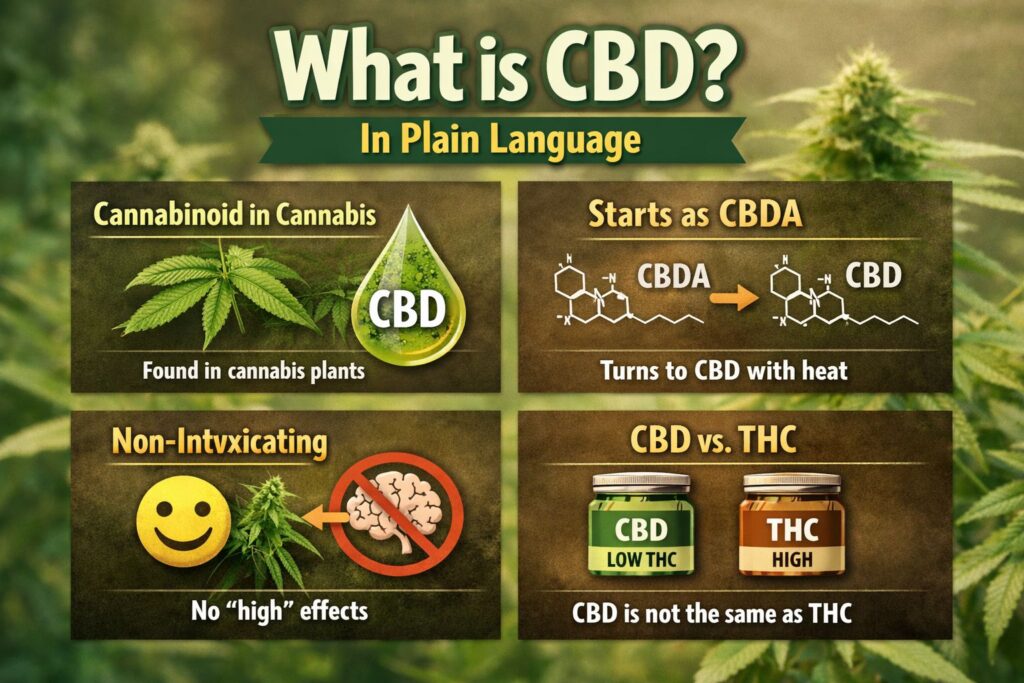
CBD stands for cannabidiol. It’s one of the major cannabinoids produced by cannabis. THC is another major cannabinoid, and it’s the one most people associate with intoxication. In the living plant, cannabinoids mostly exist in their acidic forms. That means CBD is typically present as CBDA, and THC is typically present as THCA.
Why does that matter? Because when you see a lab report or you’re trying to compare “CBD flower” to “THC flower,” you need to understand that the numbers often include a calculated total that accounts for converting acids into neutral cannabinoids with heat. That’s part of cbda lab report interpretation, and it affects everything from harvest timing to how you evaluate a cured jar.
One more point I learned the hard way: asking What is CBD? is really asking several questions at once.
- What cannabinoid profile does the plant produce?
- How much of that profile is genetics versus environment?
- What does “CBD-rich” mean if there is still some THC present?
- How do processing choices change the final chemistry?
We’ll tackle those step by step.
CBD-rich plants, ratios, and why “CBD strain” is not a guarantee
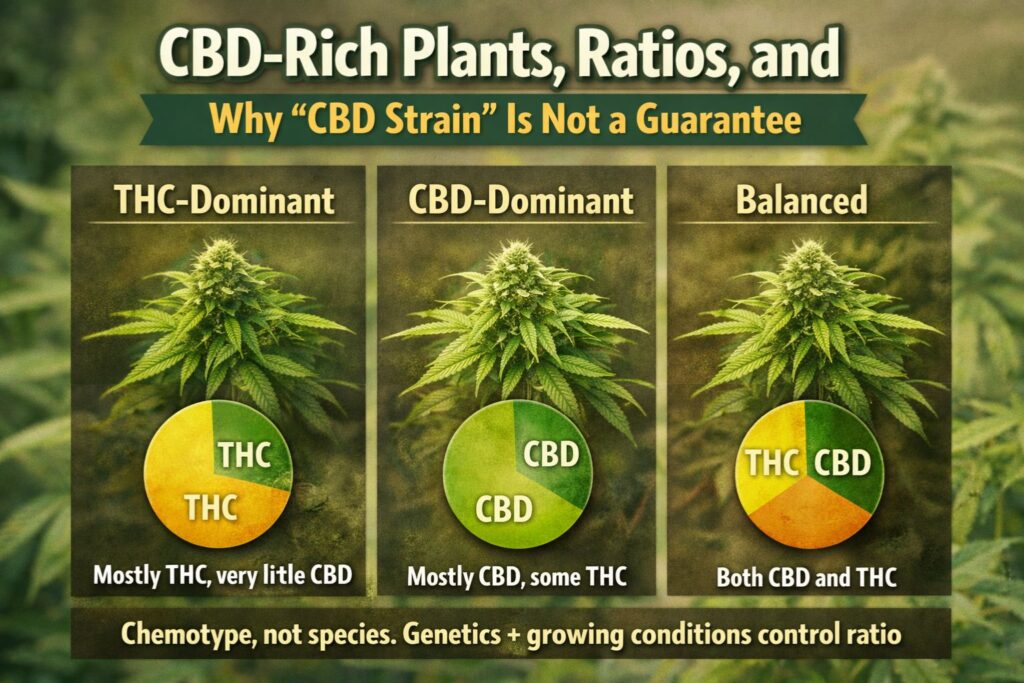
When growers talk about CBD, we’re often talking about ratios and chemotypes rather than a separate category of plant. I keep it simple:
- THC-dominant: THC is the main cannabinoid, CBD is minimal.
- CBD-dominant: CBD is the main cannabinoid, THC is low but not necessarily zero.
- Balanced: meaningful amounts of both CBD and THC.
If you’re growing marijuana for a regulated market, those categories can map to product types. If you’re growing cannabis at home, they map to user experience and to how the flower tests.
This is where cbd chemotype selection becomes the center of the project. Genetics set the ceiling and the floor; the grow determines how close you get to the target. I’ve popped seed packs where two plants looked nearly identical but tested very differently. That’s not a failure, it’s phenotype expression. Your job is to plan for it.
Practical take: build your plan around testing
I treat CBD-focused grows like a selection project, even when it’s small.
- Run more than one plant if you can.
- Keep plants labeled from seedling through cure.
- Sample and test before you scale up.
- If you need consistency, keep mothers and rerun clones.
Those habits support cbd compliance testing strategy later, whether you’re home growing and just want predictable effects or you’re working under strict thresholds.
The grow room basics: what I keep constant on CBD runs
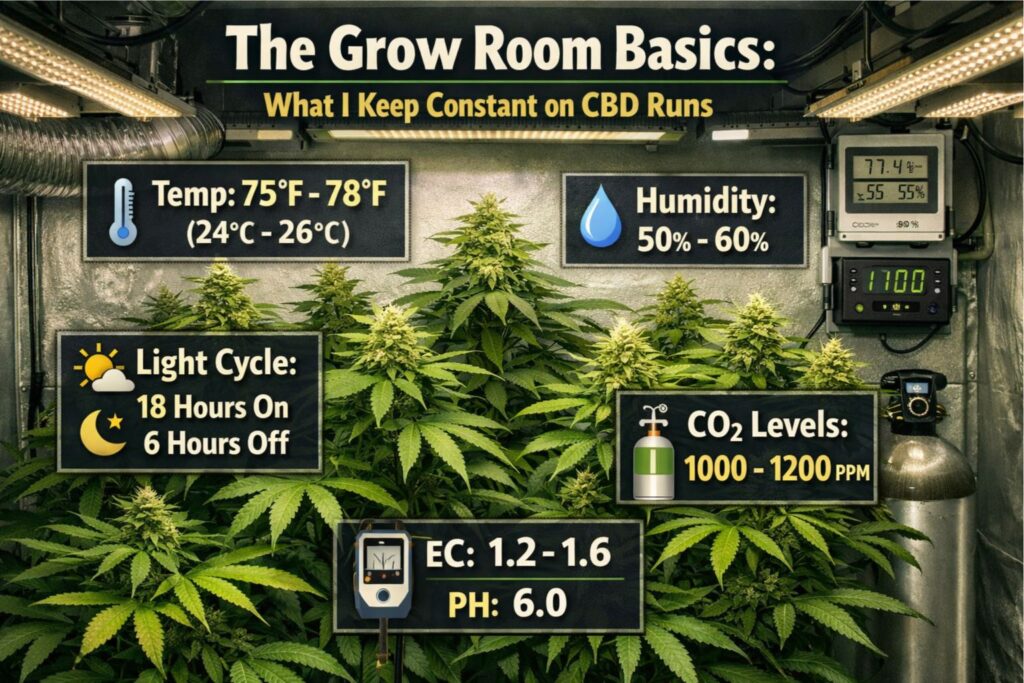
CBD crops don’t require “special” conditions, but they do reward stability. When I’m dialing in cbd flower cultivation tips for a new line, I start with the same fundamentals I’d use for any quality cannabis.
Lighting and photoperiod
Photoperiod plants:
- Vegetative schedule: 18/6 (18 hours on, 6 off)
- Flowering schedule: 12/12
Autoflowering plants:
- I usually run 18/6 or 20/4 through the full cycle, depending on heat load and power costs.
Light intensity is where many growers either leave quality on the table or cause stress that shows up as harsh smoke. In my notes, I literally write “ppfd guidelines for cbd plants” at the top of each run so I don’t get tempted to push the canopy too hard. For ppfd guidelines for cbd plants, these are the ranges I’ve measured and repeated successfully in a non-CO2 home grow:
- Veg: 300–600 PPFD at the canopy
- Early flower: 600–800 PPFD
- Mid to late flower: 800–1,000 PPFD if the cultivar can handle it
If you do supplement CO2, you can push higher, but nutrition and irrigation must match or you’ll see leaf burn and stalled ripening. I’m conservative when I’m targeting low-THC outcomes, because a stressed plant can finish unpredictably.
Temperature, humidity, and VPD
If you only remember one thing from this article, make it this: mold and stress are avoidable with good environmental control.
These are the bands I aim for:
Veg:
- 24–28°C lights on
- 20–23°C lights off
- 60–70% RH
Flower:
- 22–26°C lights on
- 18–22°C lights off
- 45–55% RH
Late flower:
- 20–24°C lights on
- 40–50% RH
For indoor vpd targets for cbd, I work with these ranges:
- Veg: 0.8–1.2 kPa
- Flower: 1.2–1.5 kPa
This is one of the most actionable cbd flower cultivation tips I can offer: dial VPD first, then adjust feeding. When the environment is unstable, nutrient issues get confusing fast.
Airflow and plant spacing
CBD-forward flowers can get dense. I always prioritize airflow:
- Enough circulation to keep leaves gently moving
- Clean intake filtration if possible
- Dehumidification capacity sized for late flower
- Avoiding overcrowded canopies
When flowers stack tight, I’d rather lollipop a bit more than risk botrytis during the last two weeks.
Feeding CBD plants: soil vs. coco/hydro, with targets I actually use
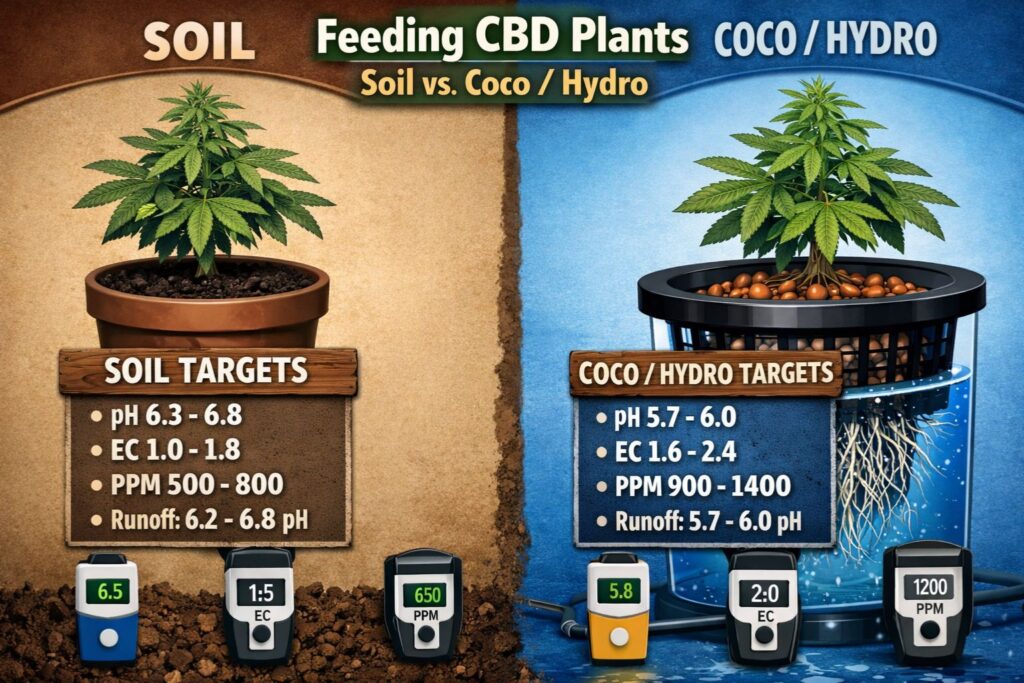
People sometimes ask if CBD plants need different nutrients. Not really. What matters is how a particular cultivar eats and how your medium buffers mistakes.
Soil
In soil, my approach is boring on purpose.
- Start seedlings in a mild mix.
- Build fertility gradually with top dressings.
- Keep irrigation consistent rather than cycling bone-dry and soaked.
- Avoid chasing every small color shift with bottled “fixes.”
When I’m writing notes for cbd flower cultivation tips, I’ll often underline this: overfeeding is more common than underfeeding.
Coco/hydro
If you’re in coco or hydro, EC management is the game. Here are my typical targets:
- Early veg: EC 1.0–1.4 (about 500–700 ppm on a 500 scale)
- Late veg / early flower: EC 1.4–1.8
- Mid flower: EC 1.6–2.2 depending on cultivar appetite
- Late flower: taper down gradually
I also keep pH in the standard range for the system I’m in (for coco, I usually stay around 5.8–6.2). If you don’t own a decent meter, it’s worth buying one before you buy more additives.
These numbers tie back into cbd compliance testing strategy because nutrient stress, lockout, and late corrections can change how the plant finishes and how clean the smoke feels.
Understanding lab reports: cbda lab report interpretation without the confusion
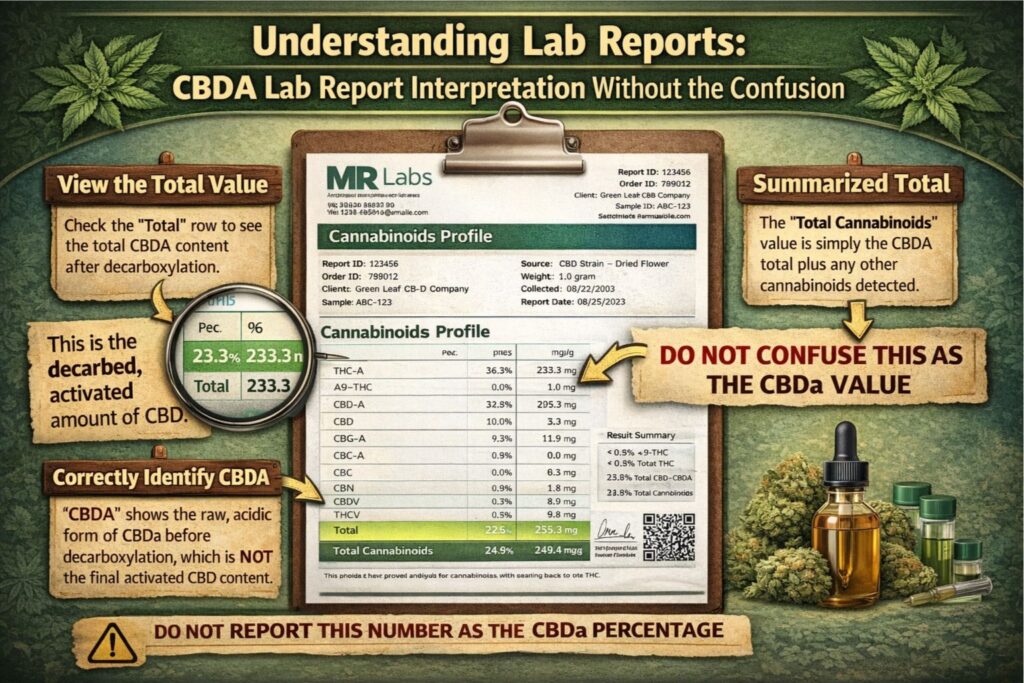
If you’re growing cannabis with any commercial intent, lab reports are part of life. Even for personal growing, they teach you faster than guesswork.
In cbda lab report interpretation, watch for:
- CBD versus CBDA
- THC versus THCA
- “Total CBD” and “Total THC” calculations
- Moisture content and water activity if provided
- Terpenes if you care about aroma and smoothness
Most reports calculate totals using conversion factors because the acidic forms decarboxylate (lose mass) when heated. That means a flower that shows mostly CBDA can still be a strong “CBD” product once it’s smoked or cooked.
When people ask me again, What is CBD?, I often answer with a lab report in hand. It’s the quickest way to show what the plant actually produced.
Harvest timing: how I choose the window on CBD-rich plants
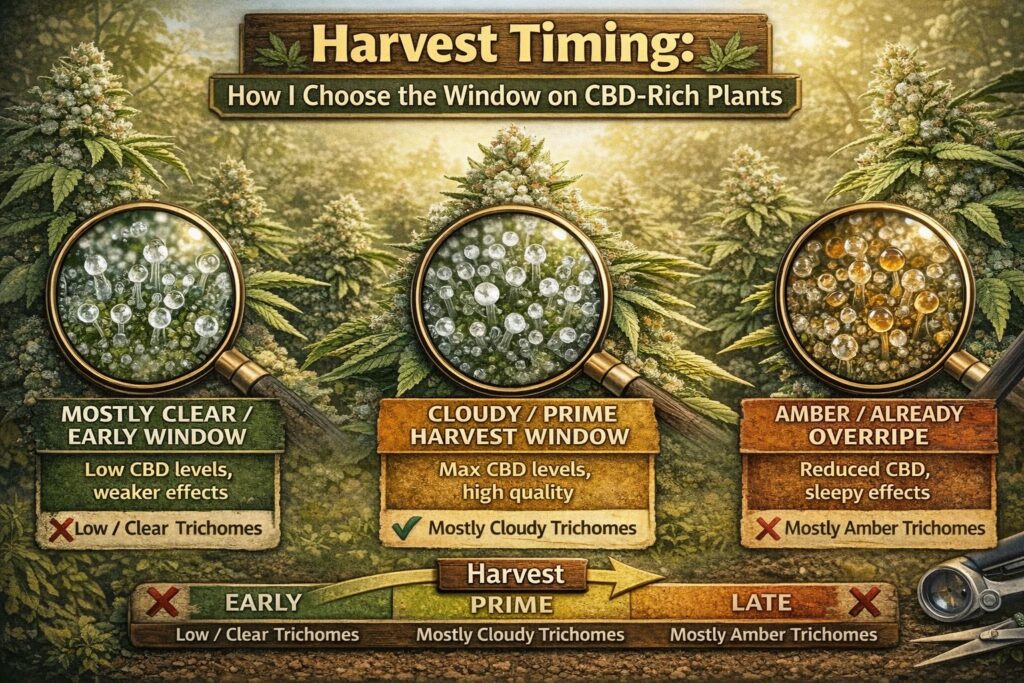
I don’t pick harvest day by calendar alone. I use a combination of plant cues and, when possible, testing.
Here are the cues I watch:
- Calyx swelling slows down
- New white pistils stop dominating the top buds
- Aroma peaks and stabilizes
- Trichomes on flower heads look mostly cloudy with some clear remaining
I’m cautious about chasing trichomes turning noticeably amber as the only signal. Different chemotypes can mature visually at different rates. If your goal is balanced cbd thc cultivars, harvest timing can shift the perceived effect and the flavor more than people expect. With balanced cbd thc cultivars, I also pay closer attention to how the high-end aromas hold in the last week, because the sweet spot can be brief.
A key part of cbd compliance testing strategy is sampling before you harvest the whole room. If you’re trying to stay under a threshold, the safest approach is:
- Take a representative sample early.
- Test it.
- If needed, retest a week later.
That approach costs money, but it’s cheaper than guessing wrong at scale.
Drying and curing: where CBD flower is won or lost
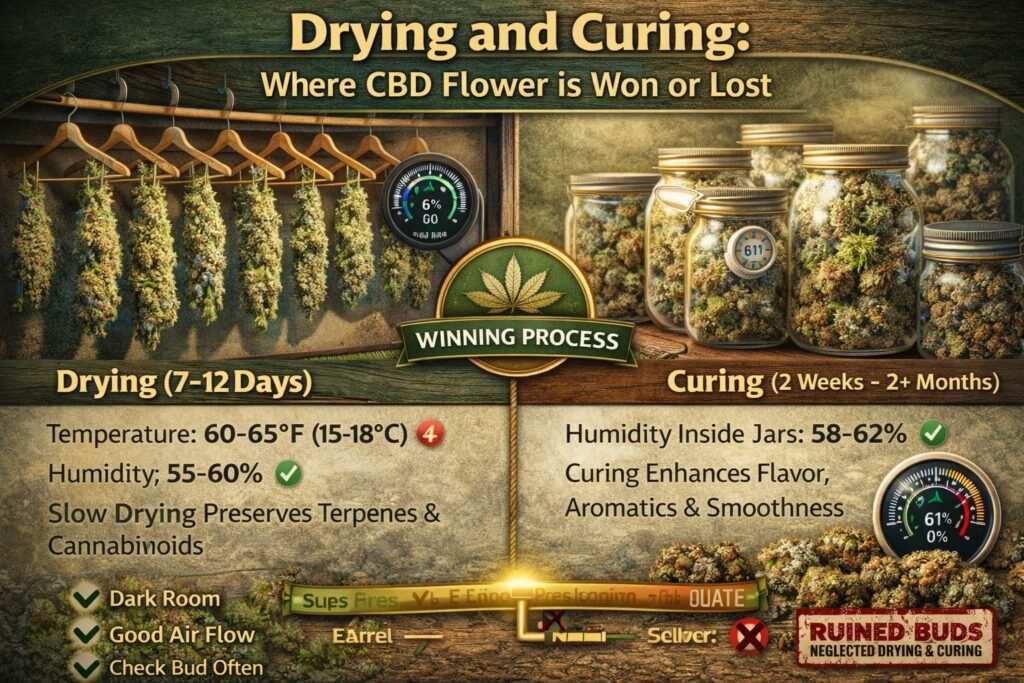
I can grow perfect-looking buds and still ruin them in the dry room. That’s why I treat drying and curing like a separate craft.
Drying cbd flower slowly
My target dry environment is:
- 16–20°C
- 55–60% RH
- Gentle airflow, not direct fan blast
- Darkness or very low light
Drying cbd flower slowly usually takes me 10–14 days. If it’s done in 4–5 days, I almost always lose aroma and end up with harsher smoke. If it stretches beyond two weeks, I watch carefully for mold risk and adjust airflow or dehumidification.
Curing cbd buds for smooth smoke
Once the stems snap and the outside feels dry but not crispy, I cure.
My curing routine:
- Trim and separate lots by plant if I’m hunting phenotypes.
- Jar or bin with a small hygrometer.
- Aim for 58–62% internal RH.
- Burp daily for the first week, then taper.
- Give it at least 2–4 weeks before judging final quality.
This is the heart of curing cbd buds for smooth smoke. The difference between a 7-day “cure” and a real cure is night and day, especially with weed that’s intended to be mellow and flavorful rather than punchy.
Training and canopy management for CBD-focused gardens
Training doesn’t change a CBD plant into a THC plant. But it does change yield, airflow, and bud quality.
The methods I use most:
- Topping once or twice in veg
- Low-stress training to spread branches
- Trellis support in flower for heavy colas
- Light defoliation for airflow, especially mid flower
If you’re running balanced cbd thc cultivars, I recommend avoiding severe late-flower stress. In balanced cbd thc cultivars, that stability tends to show up as a cleaner burn and a more predictable feel. In my experience, the cleaner and more stable the finish, the more consistent the smoke and the easier the post-harvest work.
Building a repeatable seed-to-harvest CBD project
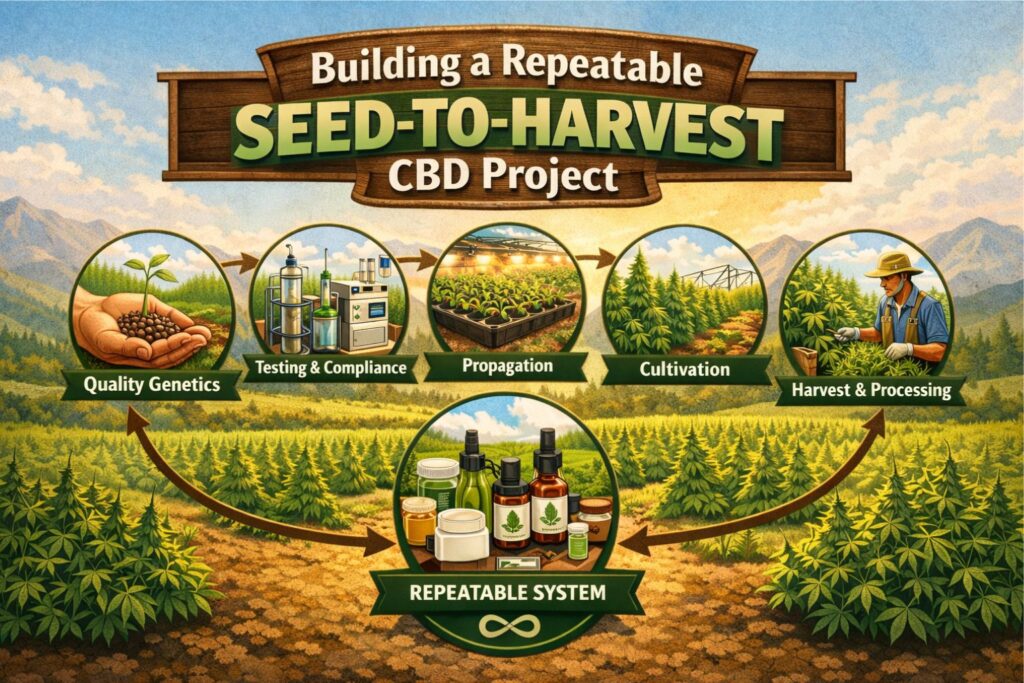
If you want consistent outcomes, treat your grow like a repeatable system. This is my seed-to-harvest cbd workflow.
- Choose genetics with a clear target chemotype.
- Run multiple plants and label everything.
- Keep the environment stable and log changes.
- Feed consistently and avoid emergency swings.
- Decide harvest window using plant cues and, if possible, testing.
- Dry slow and cure long.
- Keep what works and rerun clones.
That seed-to-harvest cbd workflow sounds simple, but it’s the most reliable way I’ve found to answer What is CBD? with something real: jars that test the way they were supposed to and smoke the way people expect.
Buying seeds and planning a CBD-focused grow
People searching for “buy cannabis seeds online” usually have the same concerns: germination rates, shipping reliability, feminized vs. regular, and whether “CBD” is real or marketing.
Here are my practical tips:
- For most home growers, feminized seeds simplify the path to flower.
- If you want to keep a winner long-term, choose photoperiod genetics so you can clone and rerun.
- Autoflowering CBD lines can be great for quick cycles, but you can’t keep a mother plant the same way.
- Avoid building a whole plan around one plant. Phenotype variation is real.
This is where cbd chemotype selection shows up again. When you buy seeds, you’re buying a probability distribution, not a single guaranteed plant.
Risk and trade-offs to be honest about
A trustworthy CBD guide needs to say the quiet parts out loud.
- CBD-forward lines can be less resinous than THC-max lines, depending on genetics.
- If you’re chasing very low THC, you may sacrifice some “classic” weed intensity.
- Testing costs money, but skipping it costs more when consistency matters.
- Mold pressure can be higher on dense, late-finishing plants if humidity control is weak.
- A label like “CBD” does not eliminate the need for cbda lab report interpretation.
If you’re growing in a region with strict rules, treat everything here as cultivation discussion, not legal guidance. Learn your grow laws by region from official sources and make decisions accordingly.
Quick checklists I use
CBD grow setup checklist
- Confirm lighting can hit the ppfd guidelines for cbd plants without hotspots
- Re-check ppfd guidelines for cbd plants after any canopy training or fixture change
- Set up climate control to hold indoor vpd targets for cbd
- Calibrate pH and EC meters
- Plan IPM from day one
- Prepare labels for phenotype tracking
Weekly crop checklist
- Check canopy PPFD and adjust fixture height
- Record temperature and RH swings, especially at lights off
- Inspect leaves and undersides for pests
- Check runoff EC in coco/hydro
- Note aroma shifts to help determine harvest window
Harvest checklist
- Decide harvest window using plant cues, not just days
- If needed, test and retest as part of cbd compliance testing strategy
- Drying cbd flower slowly in controlled conditions
- Follow a consistent approach to curing cbd buds for smooth smoke
FAQ
What is CBD? and does it get you high?
CBD is generally described as non-intoxicating, but real-world effects depend on the full chemical profile and the dose. Many “CBD” flowers still contain some THC. If you want minimal intoxication, focus on cbd chemotype selection, look at lab results, and choose low-THC options where appropriate.
How do I grow CBD flower indoors without mold?
Control humidity and airflow. Keep late-flower RH around 40–50%, maintain steady temps, and avoid overcrowding. Indoor vpd targets for cbd give you a more reliable framework than chasing RH alone. Drying cbd flower slowly also reduces the chance of trapping moisture inside dense flowers.
What’s the best medium for CBD plants, soil or hydro?
Both work. Soil is forgiving and can produce excellent flavor. Coco/hydro can produce fast growth and high yields but demands tighter EC control. Choose the system you can manage consistently and stick to a repeatable seed-to-harvest cbd workflow.
How can I shop for CBD-leaning seeds more confidently?
Look for clear descriptions, realistic cannabinoid ranges, and transparent policies. Expect phenotype variation and plan to test. If your goal includes staying under thresholds, build cbd compliance testing strategy into the budget from the beginning.
How long should I cure CBD flower?
I notice the biggest quality jump between 2 and 4 weeks. Curing cbd buds for smooth smoke is about stabilizing moisture and letting harsh chlorophyll notes fade while preserving aroma. If the cure is rushed, the flower can taste flat or sharp even if it tested well.
Final thoughts from my grow room
I started this article because people keep asking me What is CBD?. The best answer isn’t a marketing slogan; it’s a cultivation process that produces consistent, testable, enjoyable cannabis.
If you take anything away, let it be this: CBD outcomes are built through cbd chemotype selection, stable environment control, and careful post-harvest work. Keep good notes, run small tests, and let your own jars teach you what works.
