Table of Contents
What do cannabis seeds look like ?
Cannabis seeds are the initial, dormant phase of the cannabis plant’s lifecycle. They encapsulate the genetic blueprint and essential resources for germination and growth. Though small and seemingly simple, cannabis seeds are biological marvels designed to survive adverse conditions and sprout into one of the most chemically complex plants known to humans.
External Appearance: What You See
Size
- Cannabis seeds typically measure between 2 mm and 5 mm in length and 1.5 mm to 3 mm in diameter.
- Size of cannabis seeds may vary between indica, sativa, and ruderalis strains. For example:
- Indica-dominant seeds may be slightly larger and rounder.
- Sativa-dominant seeds are often smaller and more elongated.
- Ruderalis seeds (auto-flowering types) are usually the smallest.
Shape
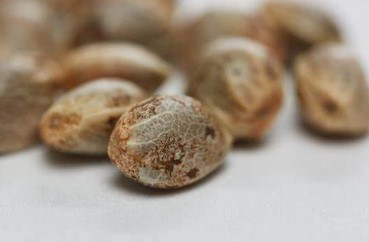
- Generally cannabis seeds are oval or teardrop-shaped with a slight point at one end (micropyle region).
- One end is more rounded, and the other is often tapered.
Color and Markings
- Healthy, mature cannabis seeds have a hard outer shell that is:
- Brown, tan, or gray
- Often covered with dark tiger stripes, speckles, or marbling
- Immature or unviable seeds:
- Pale green, off-white, or yellowish
- Lacking a hardened coat or patterns
- Soft when pinched
Surface Texture
- cannabis seeds are usually smooth and hard when viable
- Seeds may have a waxy or matte finish
- Under magnification, the seed coat may show fine ridges or cellular patterning
Internal Anatomy of a Cannabis Seed
Cannabis seeds consist of multiple layers and structures, each with specialized biological functions:
Seed Coat (Testa)
- The outer protective layer formed from maternal tissue
- Composed mostly of lignin and hemicellulose, making it robust and water-resistant
- Protects the embryo from pathogens, physical damage, and desiccation
Endosperm
- Stores starches, oils, and proteins required for germination
- This tissue nourishes the developing embryo until the first true leaves photosynthesize
Embryo
- The living part of the seed that becomes the plant
- Comprises:
- Radicle – the embryonic root
- Hypocotyl – stem-like region beneath the cotyledons
- Cotyledons – the first “seed leaves” that emerge during sprouting
- Plumule – the embryonic shoot that will develop into stems and true leaves
Seed Maturation and Harvesting
Seed Development
- After pollination, cannabis plants take 4 to 6 weeks to develop mature seeds.
- Seeds form within the calyxes of female flowers when fertilized by pollen.
Signs of Seed Maturity
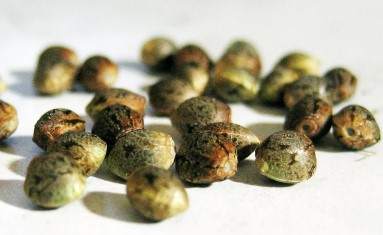
- Color change: From green or white to brown or gray
- Markings: Visible stripes or marbling appear
- Texture: Seeds become hard, with a brittle snap when crushed
- Separation: Mature seeds detach easily from the bracts
Seed Collection
- Seeds are collected during late flowering, often 6–8 weeks after pollination.
- Careful drying and curing are needed to preserve viability:
- Temperature: ~21°C (70°F)
- Humidity: ~50%
- Seeds must be kept cool, dry, and dark for storage
Visual and Microscopic Identification
Under the Microscope
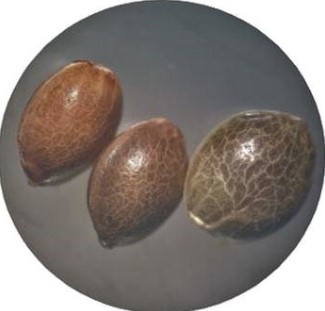
- Cannabis seeds coat shows cellular layering and pigmentation cells
- Embryo structures can be visualized with light microscopy or scanning electron microscopy (SEM)
Distinguishing from Other Seeds
- Cannabis seeds resemble hemp, but:
- Marijuana-type seeds tend to be darker and larger
- Industrial hemp seeds are more uniform and smaller
Spotting Duds
- Cracked, moldy, or discolored seeds
- Hollow seeds (when crushed) are usually non-viable
Cannabis Seed Laws and Regulations
Legal Status
- Varies globally:
- Legal for collection or genetic use in some jurisdictions
- Prohibited for germination in places where cultivation is not allowed
- EU and Canadian laws permit certified hemp seed sales
- U.S. legality remains federal gray area despite state-level allowance
Seed Certification
- Certified cannabis seeds undergo:
- Genetic stability testing
- Pathogen screening
- Documentation of origin and strain
Conclusion: A Seed’s Silent Power
Cannabis seeds, while deceptively small, are intricate carriers of life, chemical complexity, and endless variety. From their visual characteristics—shape, size, and color—to their internal architecture and genetic payload, each seed represents a potential powerhouse of cannabinoids and terpenes. For cultivators and breeders, recognizing the signs of seed health and understanding their biology is critical for successful germination, robust plants, and potent yields.
Cannabis seeds are the genetic bridge between generations of cannabis. Whether through natural selection or human-guided hybridization, they preserve traits, enable innovation, and ensure the continuity of cannabis cultivation in both medicinal and recreational spheres. Their science is as deep as their cultural significance, combining botany, chemistry, and genetics in a single organic capsule.
