Table of Contents
What are photoperiod seeds: the simplest definition I use in the grow room
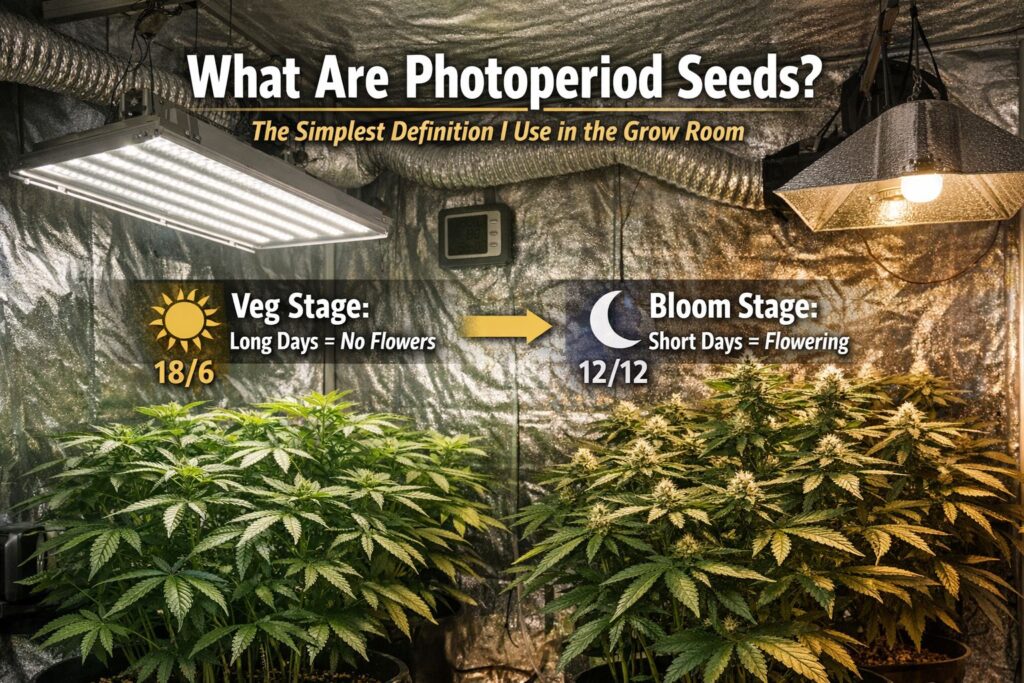
When people ask me, “what are photoperiod seeds,” I answer it the same way I teach new growers in my own garden: these are light-cycle cannabis seeds that stay in vegetative growth as long as they receive long days, and they begin flowering when the day length gets short enough. In an indoor tent, that usually means I keep plants under 18/6 (or 20/4) for vegetative growth and then trigger bloom by switching to 12/12.
That light-response is the key difference. With a photoperiod plant, I control the calendar. If I want a larger structure, I extend veg phase duration. If I need to finish quickly, I shorten veg phase duration and make my 12/12 flip timing sooner. This ability to steer size and schedule is why I still run photoperiod cultivars for most of my cannabis runs even though autoflowering options keep improving.
This article is written from the perspective of how I actually work a photoperiod grow schedule: what I track, what I adjust when things go sideways, and what I wish I had been told before my first indoor run. I’ll use the word cannabis most often, but you’ll also see marijuana and weed used naturally because growers search all three.
Why I still choose photoperiod plants in 2025
I’ve grown marijuana in soil and in coco, in a small tent and in a dedicated room. Across those environments, photoperiod plants give me three advantages that matter more than marketing:
- Control over plant size and shape
A longer veg phase duration lets me build a wide canopy, fill a net, and use canopy training methods to spread tops evenly. If my space is tight, I can keep veg short, limit stretch, and still hit a clean harvest. - More room to recover from mistakes
If I overwater early, misjudge nutrition, or get hit with pests, a photoperiod grow schedule gives me time to correct the issue before bloom. Autos can be unforgiving because the clock doesn’t wait. - Better fit for cloning and phenotype selection
When I find a keeper, I can keep a mother in veg and take cuttings. That matters for consistency, especially when I’m chasing a particular aroma, structure, or harvest window.
None of this means photoperiod is always “better.” It means it’s the tool I reach for when I want control.
Photoperiod seeds vs autoflowering: how I explain it to friends
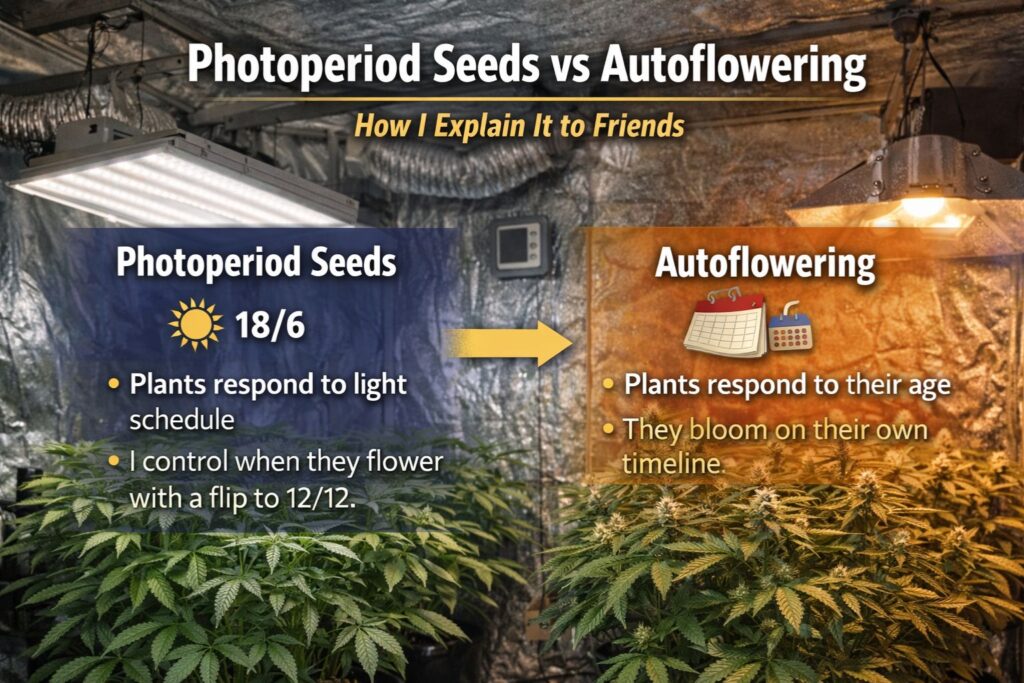
Here’s my practical comparison, based on runs where I’ve grown weed in the same room under the same fixtures:
- Photoperiod plants respond to day length. That is the foundation of what are photoperiod seeds.
- Autoflowers are largely age-driven. They flower on their own timeline.
In practice, my photoperiod grow schedule revolves around switching the light cycle, while an auto run revolves around maintaining stable conditions from start to finish.
If you’re shopping for genetics, here’s how I decide:
- I choose photoperiod when I want to shape the canopy, run a longer veg phase duration, or keep a favorite plant.
- I choose autos when I need a simpler calendar, want smaller plants, or I’m working with a very tight time window.
Both can produce excellent cannabis, but the grow management feels different.
Starting strong: germination and the first two weeks
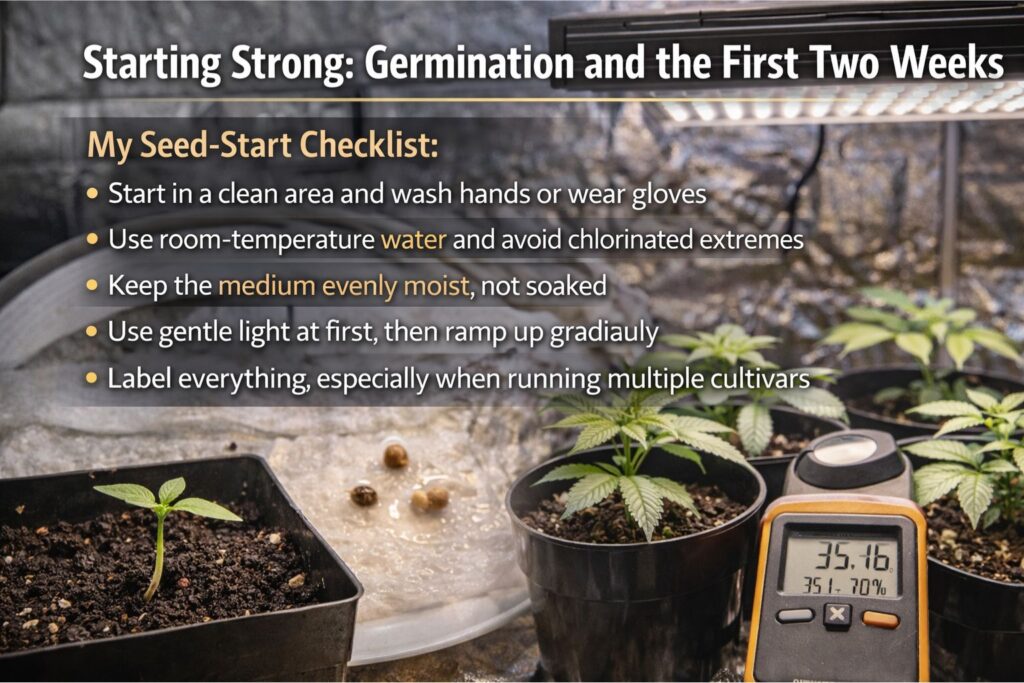
I’ve germinated seeds in paper towel, straight into soil, and into pre-moistened coco. The method matters less than consistency and cleanliness. My best results come from keeping the environment stable, avoiding overhandling, and being patient.
My seed-start checklist:
- Start in a clean area and wash hands or wear gloves
- Use room-temperature water and avoid chlorinated extremes
- Keep the medium evenly moist, not soaked
- Use gentle light at first, then ramp up gradually
- Label everything, especially when running multiple cultivars
During these first two weeks, I start building my indoor ppfd map. I don’t need perfect readings, but I want to know if seedlings are getting blasted in the center while corners are dim. A basic meter or app (used consistently) helps me keep seedlings in a sane range and prevents stretch.
Early mistakes I see all the time:
- Overwatering because the top looks dry
- Starting too hot with nutrients instead of letting roots develop
- Putting seedlings under intense light without an indoor ppfd map
If your seedlings look pale, droopy, or stunted, slow down. In my grows, patience in week one saves weeks later.
Environment targets I actually use in veg
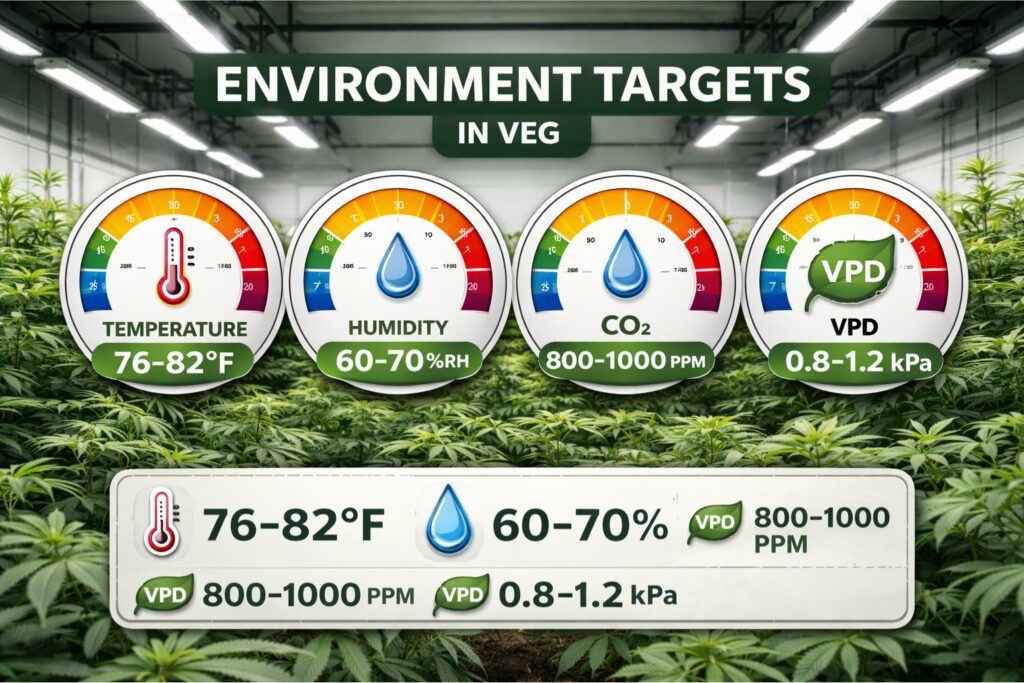
Once seedlings are established, my veg phase duration becomes a decision, not an accident. This is where photoperiod shines. I’m watching plant spacing, root development, and how fast the canopy is filling.
I manage veg with three core dials:
Light intensity and an indoor ppfd map
I like to build an indoor ppfd map at canopy height and update it after I train plants or raise the fixture.
I’ll put real numbers on it because “moderate” is too vague. In my indoor runs, I generally target:
- Seedlings and early veg: about 200–400 PPFD at the top leaves
- Established veg: about 400–600 PPFD
- Early flower after the switch: about 600–800 PPFD once plants are actively stretching
- Mid to late flower: about 700–950 PPFD if heat and CO2 levels allow it
Those ranges aren’t commandments. They’re a starting point I’ve found workable under modern LEDs, assuming reasonable temperatures and airflow. If you track DLI, I like to keep veg in a comfortable daily-light band and avoid pushing flower so hard that I trade aroma for stress.
Practical tip: if leaves taco upward, edges curl, or tops bleach, I treat it as a light/heat problem first, not a nutrient problem.
Air, temperature, and vpd for cannabis
VPD is one of those topics that sounds academic until you use it to diagnose problems. When my room feels “fine” but growth is slow or leaf tips burn, vpd for cannabis often explains it: high heat with low humidity drives the plant to transpire hard, and that can amplify nutrient uptake and stress.
My practical approach:
- In veg, I aim for comfortable temps with enough humidity to keep stomata happy.
- I use vpd for cannabis as a directional tool, not a religion. If I see stress, I adjust temperature or humidity in small steps and wait 24 hours before chasing another variable.
For growers who like targets, this is the band I try to stay near:
- Vegetative growth: roughly 0.8–1.2 kPa VPD (often around 24–28°C with 55–70% RH)
- Flowering: roughly 1.2–1.5 kPa VPD (often around 22–27°C with 45–55% RH)
I adjust around those bands depending on cultivar and leaf thickness. Dense canopies and big colas push me toward better dehumidification and slightly drier air late in bloom.
Feeding and nutrient ec targets
Whether you grow weed in coco or hydro, nutrient strength matters. I track nutrient ec targets because it keeps me honest. In soil, EC is less direct, but the concept still helps me avoid overfeeding.
My core rule: increase feed only when the plant asks for it, not because a chart says so. If leaf tips burn, I back off. If growth stalls and the plant is pale, I check pH, root health, and watering habits before I pour in more salts.
Here’s how I translate nutrient ec targets into numbers for common setups:
- Coco/hydro veg: roughly 1.2–1.6 EC (about 600–800 ppm on a 500 scale, if you use ppm)
- Coco/hydro flower: roughly 1.6–2.2 EC (about 800–1100 ppm on a 500 scale)
I keep pH around 5.7–6.1 in coco/hydro and about 6.2–6.8 in soil, then I let the plant’s response guide me. When runoff EC climbs week after week in coco, I’ll increase irrigation frequency or run a lighter feed for a few days to bring the root zone back into balance.
I’ll repeat nutrient ec targets throughout this article because they’re one of the fastest ways I see new growers get in trouble: if you treat EC like horsepower, you’ll blow the engine.
Building structure: canopy training methods that don’t wreck plants
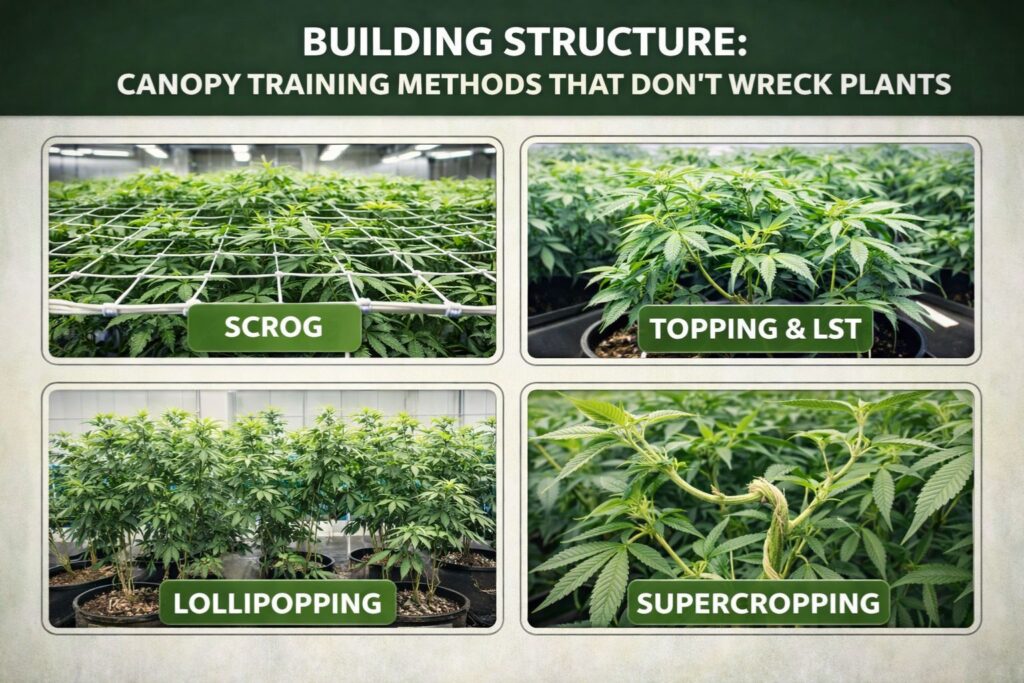
Training is where photoperiod plants really earn their keep. Because I control veg phase duration, I can shape the plant gradually and let it recover before flower.
The canopy training methods I use most:
- Topping after the plant is established
- Low stress training to spread branches
- Defoliation in small passes, not a haircut
- Trellis or netting when I want a flat canopy
- Lower-branch pruning on the bottom third before bloom, depending on density
When I’m designing a photoperiod grow schedule, I treat training like a series of small moves. I’d rather do three gentle adjustments than one aggressive session that stalls growth.
A note on genetics: some plants love training, others sulk. Phenotype variation is real. I’ve had one plant in a pack explode after topping while its sister took an extra week to rebound. That’s normal for cannabis, and it’s why I document what each plant likes.
To keep training consistent, I tie it back to my indoor ppfd map. If tops are uneven, my PPFD is uneven. If PPFD is uneven, ripening becomes uneven. A flat canopy is quality control.
When to flip: my 12/12 flip timing decision tree
New growers often ask for a calendar. I get it, but photoperiod is more about reading the plant and the room than counting days.
My 12/12 flip timing decision is based on:
- Available vertical space and expected stretch
- How full the canopy is (usually I want most of the footprint filled)
- Root health and whether the plant is drinking steadily
- Pest status (I don’t like flipping with an active infestation)
- Whether my photoperiod grow schedule needs to finish by a deadline
If I’m working in a small tent, my 12/12 flip timing tends to be earlier. If I have room and I’m chasing larger plants, I extend veg phase duration and flip later. The flip is the most important lever you have, so don’t rush it.
On flip day, I do three things:
- Clean the floor and remove dead leaves
- Confirm my timer is correct (no light leaks)
- Reset the environment targets for early flower
Flowering environment: what changes after the flip
Once I flip, I’m still tracking the same core dials, but the targets shift.
Light management and an indoor ppfd map in flower
I keep using an indoor ppfd map because flower canopy shape changes quickly during stretch. I raise or dim lights to avoid bleaching and to keep coverage consistent. If I’m running strong LEDs, the middle of the canopy can take far more intensity than the edges, and that’s how you end up with airy buds on the sides.
vpd for cannabis during bloom
In flower, I generally run slightly lower humidity than in veg to reduce the risk of mold, especially when buds get dense. vpd for cannabis still helps: if I make the room too dry, plants can drink hard and pull too much feed; if I keep it too humid, I invite mildew.
I also increase airflow. I want leaves gently moving, not windburned.
Feeding: nutrient ec targets and reading the leaves
This is where I see the biggest difference between growers who harvest clean weed and growers who harvest harsh weed. I pay attention to nutrient ec targets, but I watch the plant even more.
Signals I care about:
- Leaf tips and margins (early burn vs deficiency patterns)
- Petiole posture (droop, claw, or praying)
- Runoff EC in coco (to catch salt buildup)
- Watering frequency (a healthy root zone drinks predictably)
If I see clawing, dark leaves, and slow growth, I suspect too much nitrogen. If I see pale new growth and interveinal patterns, I look at magnesium, iron, or pH issues. I don’t diagnose from a single leaf; I look for trends across the plant.
Integrated pest management cannabis: what I do before problems become disasters
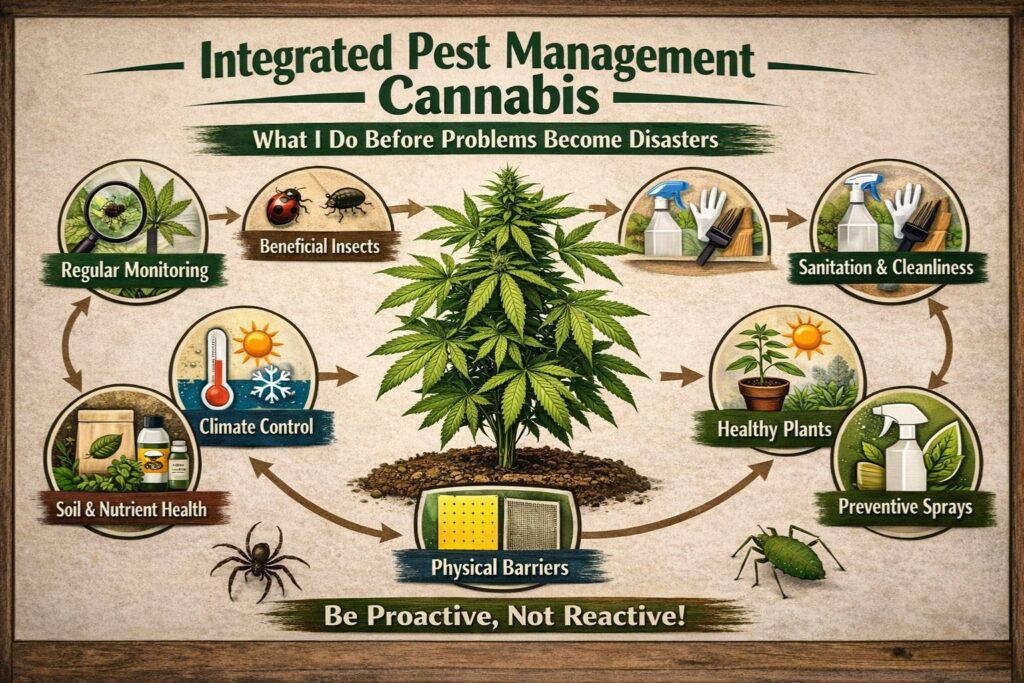
I don’t aim for “pest-free” fantasy. I aim for integrated pest management cannabis that keeps pressure low enough that plants can thrive.
My baseline IPM habits:
- Inspect the undersides of leaves twice per week
- Use sticky traps as an early warning system
- Quarantine new plants and tools
- Keep the floor clean and avoid standing water
- Maintain strong airflow and stable temps
If I see pests, I identify first, then act. Different pests require different approaches, and spraying random products can make it worse. For indoor marijuana, prevention beats reaction.
I keep integrated pest management cannabis in my routine because the worst infestations I’ve dealt with started as a “small” problem I ignored during stretch.
Common issues I’ve seen with photoperiod plants and how I troubleshoot
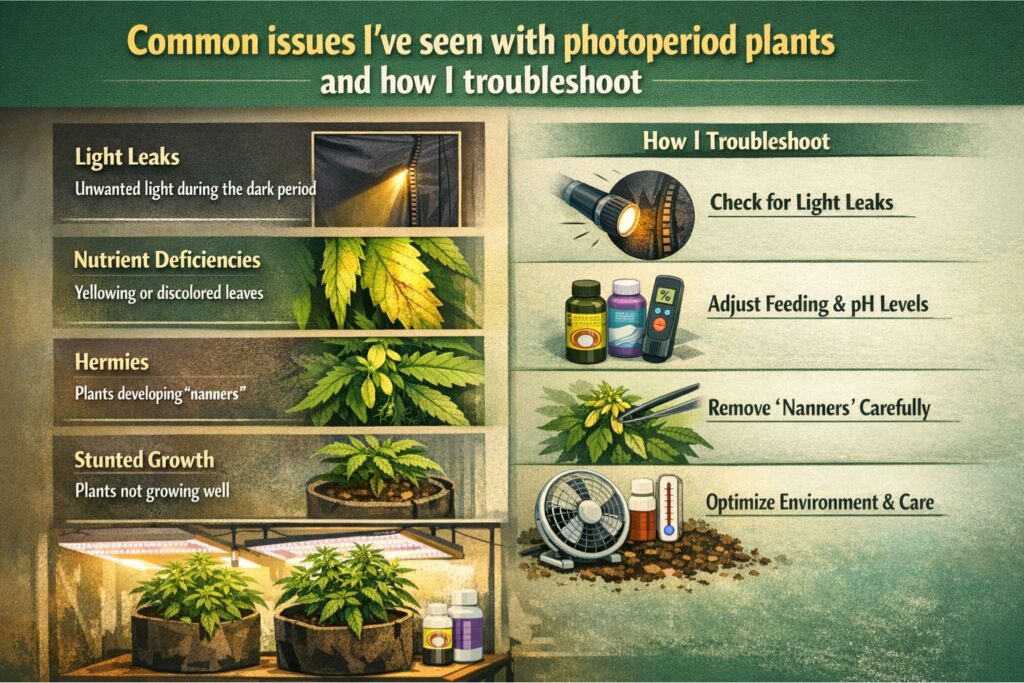
Because what are photoperiod seeds are driven by light schedule, most problems come back to environment and consistency. Here are the issues I’ve personally fought, and the first check I run:
1) Slow veg growth
- Check vpd for cannabis and root-zone oxygen. In my room, slow growth is often too-wet media or too-cool nights.
2) Stretch that gets out of control
- Revisit 12/12 flip timing and light intensity. I also use canopy training methods earlier to keep plants wide rather than tall.
3) Nutrient burn
- Confirm nutrient ec targets and watering frequency. In coco, high EC plus infrequent watering can stack salts.
4) Patchy yellowing
- Check pH and look for a pattern: old leaves vs new leaves. Don’t assume it’s always “needs more feed.”
5) Bud rot or mildew
- Increase airflow, reduce humidity, and improve drying room humidity control after harvest to prevent carryover issues next run.
Every grow teaches something. I keep notes because it’s easy to forget what worked six months ago.
Harvest timing: watching trichomes and the whole plant
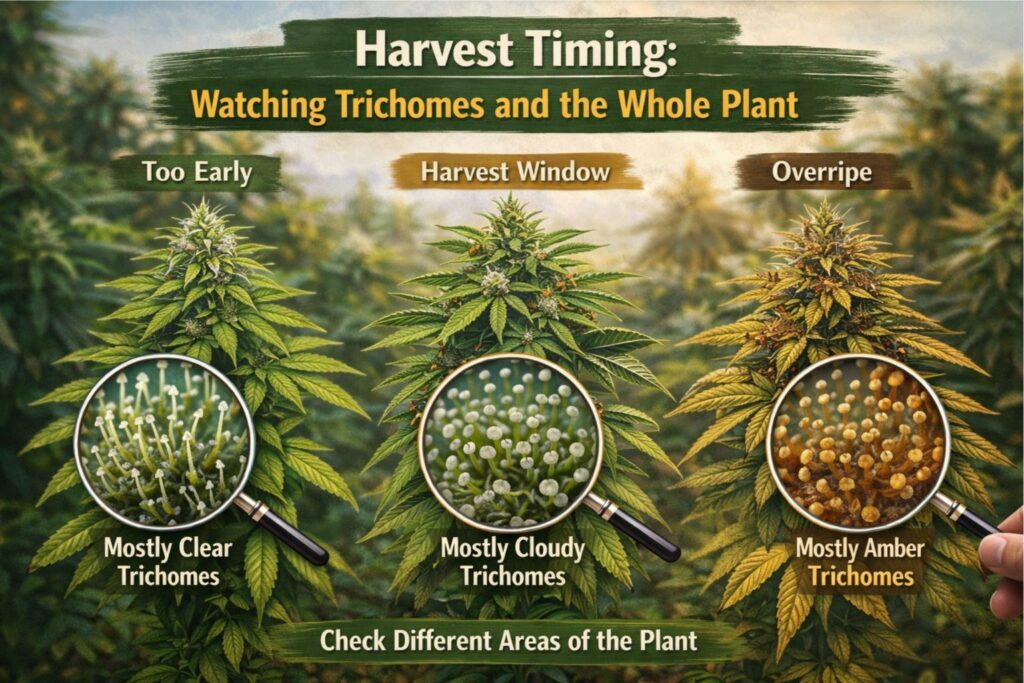
I harvest based on a combination of:
- Trichome development
- Pistil behavior and calyx swelling
- The plant’s overall fade and drinking pattern
- My goals (more uplifting vs more sedating effect)
Trichomes are useful, but I don’t treat them like a magic number. Different cultivars express differently, and phenotype variation shows up here too. I also pay attention to the smell: when terpenes peak, the aroma becomes loud and specific, not just “green.”
I avoid harvesting wet weed too early because it often dries into flat flavor. I’d rather wait a few days and finish strong than chop just because I’m impatient.
Post-harvest: drying room humidity control for smooth smoke
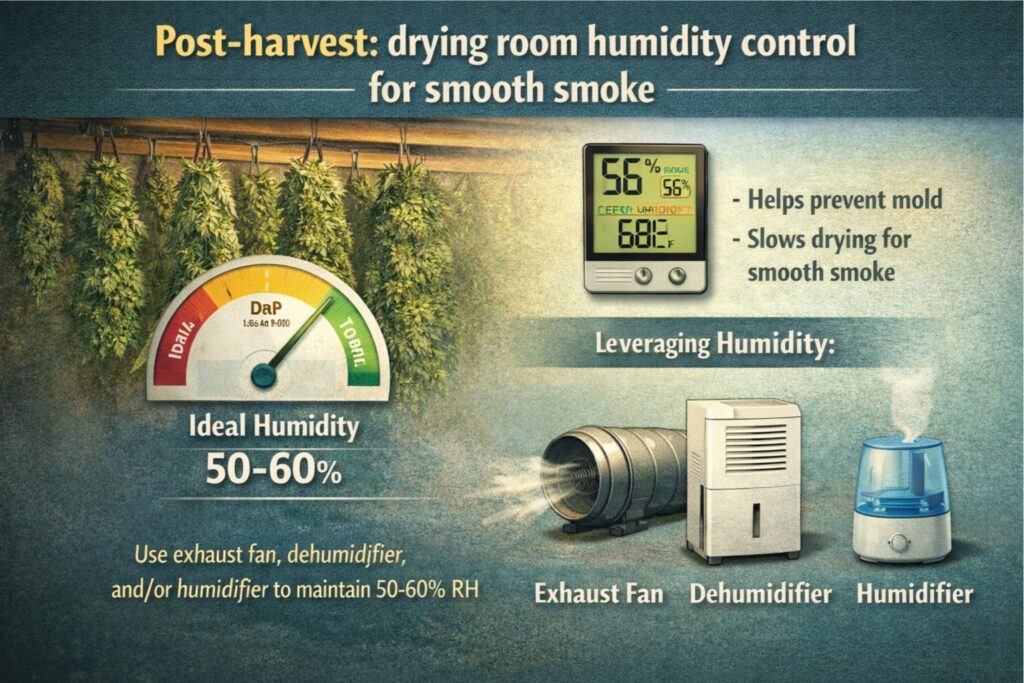
If there’s one place where new growers lose quality, it’s drying and curing. I’ve ruined great cannabis by drying too fast. Now, I treat drying room humidity control like part of the grow, not an afterthought.
My drying approach:
- Hang whole plants or large branches to slow the dry
- Keep the room dark with gentle airflow, not a fan blasting buds
- Maintain steady temps and stable drying room humidity control
- Check daily for stem bend and outer texture
Numbers help here, so this is what I aim for when I can:
- Temperature: roughly 16–20°C
- Relative humidity: roughly 55–60%
- Air movement: gentle, indirect, and consistent
- Time: often 10–14 days, depending on bud size and room stability
If drying finishes in 3–5 days, the room was usually too warm or too dry. That’s when weed tends to lose aroma and feel sharp on the throat.
When the outside feels dry but the stem still has a little give, I jar and begin curing. I “burp” jars more often at first, then less as moisture equalizes.
Drying room humidity control is also how I keep mold risk low. If humidity spikes, I don’t ignore it. I adjust airflow and dehumidification immediately.
Buying photoperiod genetics online: what I look for (no legal advice)
People search for things like “buy cannabis seeds online” or “seed bank shipping” because they want a straightforward experience. I can’t give legal advice, and rules vary by region, but I can share what I personally look for when choosing genetics and placing an order.
My practical checklist:
- Clear labeling of cultivar type and expected photoperiod behavior
- Transparent germination policies and customer support
- Freshness and storage practices
- Discreet packaging and predictable delivery communication
- Options that match my environment (indoor, greenhouse, or outdoor)
I also think about the grow plan. If I’m running a short veg phase duration, I choose plants known for manageable stretch. If I’m aiming for large plants, I choose cultivars that branch well and respond to canopy training methods.
When I shop, I write down why I’m buying: yield, aroma profile, or ease of growth. Shopping with a goal prevents impulse buys that don’t match the room.
My quick-reference photoperiod grow schedule
Below is a simple framework I use. It’s not a rigid calendar; it’s a decision guide tied to plant cues.
Week 0–2: Establishment
- Gentle light, stable moisture
- Start building an indoor ppfd map
- Light feeding; prioritize roots and healthy leaf color
Week 2–6+: Vegetative build
- Extend veg phase duration until canopy fills the space
- Use canopy training methods in small passes
- Track vpd for cannabis and adjust airflow
- Keep nutrient ec targets conservative and increase only when plants demand it
Flip and stretch: Early flower
- Confirm 12/12 flip timing and check for light leaks
- Update the indoor ppfd map as the canopy moves
- Tighten integrated pest management cannabis routines
- Watch for stretch and tuck branches to maintain an even top layer
Mid to late flower
- Maintain stable vpd for cannabis with slightly lower humidity
- Keep nutrient ec targets steady; avoid big swings
- Support branches and avoid heavy stress late in bloom
Harvest to cure
- Harvest when the whole plant signals readiness
- Prioritize drying room humidity control
- Cure slowly for aroma and smooth smoke
FAQ: long-tail questions I see growers searching
what are photoperiod seeds and how do I know they’re not autoflowers?
Photoperiod plants depend on day length to flower. If a plant begins flowering under long-day lighting (like 18/6) without any schedule change, it may be an auto or a fast-flowering type. With photoperiod plants, I decide the 12/12 flip timing, and that flip triggers bloom.
How long should veg phase duration be for indoor weed?
It depends on your space, your training, and the cultivar’s stretch. In a small tent, I often keep veg phase duration shorter and rely on canopy training methods to fill the footprint. In a larger room, I extend veg phase duration to build more tops and a thicker structure.
What light cycle should I run for light-cycle cannabis seeds in veg?
Most indoor growers use 18/6. I sometimes use 20/4 when I want faster growth, but I watch heat and vpd for cannabis because more light can raise temps and push transpiration.
What’s a good 12/12 flip timing rule of thumb?
I flip when the canopy is mostly filled and the plant looks healthy, not hungry or stressed. If the cultivar stretches hard, I flip earlier. If it stays compact, I can wait longer. My 12/12 flip timing is also influenced by deadline and room height.
How do I use an indoor ppfd map without expensive gear?
Consistency matters more than perfection. Even a basic meter helps you compare center vs edge readings. Build an indoor ppfd map at canopy height, then adjust fixture height or dimming to reduce hot spots. A more even map usually means more even bud development.
Why is vpd for cannabis important if my temps and humidity seem fine?
Because the combination determines how fast the plant transpires. When vpd for cannabis is too high, leaves can dry out and nutrient issues show up faster. When it’s too low, growth can slow and mold risk increases. I use it as a troubleshooting lens.
What nutrient ec targets should beginners use?
Start lower than you think, especially in coco. Nutrient ec targets should rise only when plants are drinking well and asking for more. If you see burnt tips, back off and check watering habits and salt buildup.
What are the most useful canopy training methods for first-time growers?
Low stress training and a single topping are the most forgiving. Add a net if you need a flat canopy. The goal is an even top layer so your indoor ppfd map stays consistent across bud sites.
How do I set up integrated pest management cannabis in a small tent?
Keep it simple: inspect leaves, use sticky traps, and keep the space clean. If you bring in new plants or tools, quarantine. Integrated pest management cannabis is mostly about routine and early detection.
How do I avoid harsh weed after harvest?
Slow drying and patient curing. Prioritize drying room humidity control, avoid high heat, and don’t overdry before jarring. Great cannabis can turn harsh if you rush the post-harvest steps.
Final thoughts from my garden
If you remember one idea, let it be this: what are photoperiod seeds is really about control. With light-cycle cannabis seeds, you decide when to flower, how big to grow, and how to shape the canopy. When you pair that control with steady environment management, realistic nutrient ec targets, and disciplined drying room humidity control, you can produce clean, aromatic marijuana that smokes smooth and tastes like the plant you grew, not the mistakes you made.
