Why Weed Quantity and Measurement Matters In Real Grows
The longer I cultivate, the more I appreciate structure. Clear logs, consistent units, and a repeatable process turn guesswork into decisions. Weed Quantity and Measurement touches everything: how I start seeds, thin a canopy, dial irrigation, harvest, cure, price out a run, and plan the next one. New growers often ask for my actual numbers, not internet averages, so this article lays out exactly how I measure, why I choose certain units, and what went wrong when I didn’t.
I will reference a practical cannabis weight chart, translate grams to ounces without shortcuts, explain how the classic eighth of weed maps to harvest planning, and show how I align marijuana measurements with growing metrics like grams per watt and yield per plant. I will also share what I have learned about weed scale accuracy, seed pack sizes, feminized seeds, and even day-to-day realities like shipping and packaging once buds leave the drying room.
Nothing here is legal or medical advice—just the data points I have recorded across dozens of cycles.
Setting Up a Measurement System You’ll Actually Use
Units, instruments, and workflow
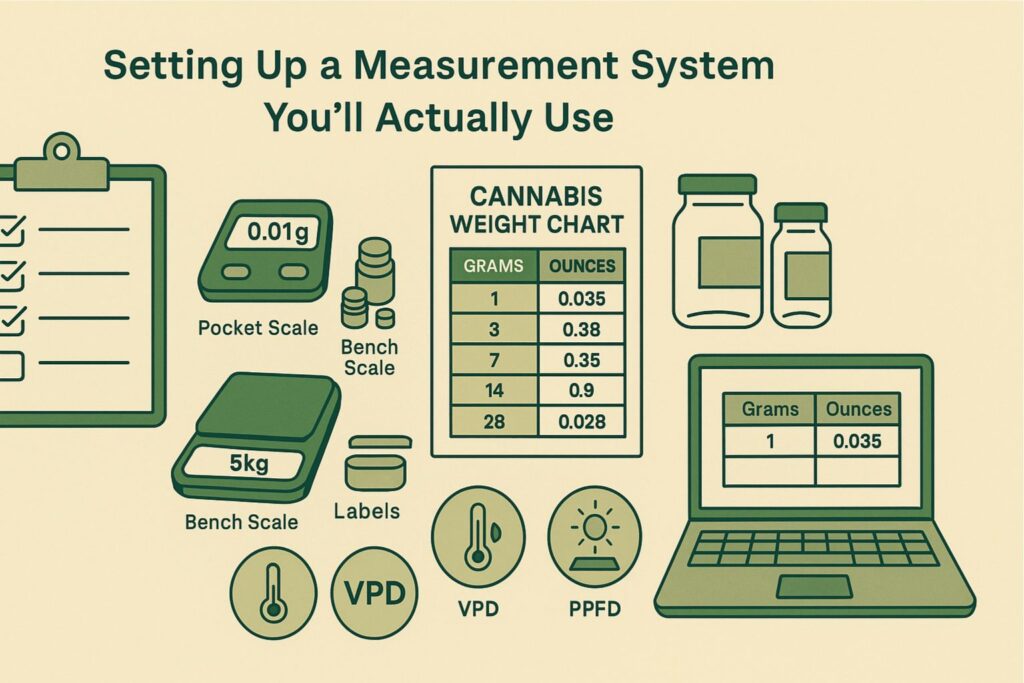
I weigh everything on two scales: a 0.01 g pocket scale for small samples and a 5 kg bench scale for trays. The pocket scale keeps my rosin presses consistent; the bench scale manages harvest bins and jars. Weed scale accuracy matters more than brand name. I test calibration weekly with certified 100 g and 500 g weights and re-zero between containers. Whenever weed scale accuracy drifts, I stop and recalibrate; nothing ruins a grow log like fuzzy numbers.
My worksheet lives on a clipboard in the dry room. One tab converts grams to ounces automatically; another tab tracks marijuana measurements by jar. I print a laminated cannabis weight chart for quick checks so I’m not opening a phone with sticky gloves. That same cannabis weight chart follows me to the trim table and shows both grams to ounces and the everyday eighth of weed conversions so everyone on the crew is in sync.
Environmental baselines that support consistent numbers
Numbers are only helpful if the environment is steady. In veg I target 24–26°C, 60–65% RH, and VPD around 0.9–1.1 kPa. In flower, I run 24–25°C, 48–55% RH, and VPD 1.2–1.4 kPa. PPFD sits at 350–500 µmol/m²/s in veg and 800–900 µmol/m²/s at the canopy in late flower. Nutrients in coco run 1.6–2.0 EC depending on cultivar response. This stability keeps buds comparable run to run, which makes Weed Quantity and Measurement more than a math exercise.
Core Units Explained With Real Garden Examples
Grams, ounces, and pounds
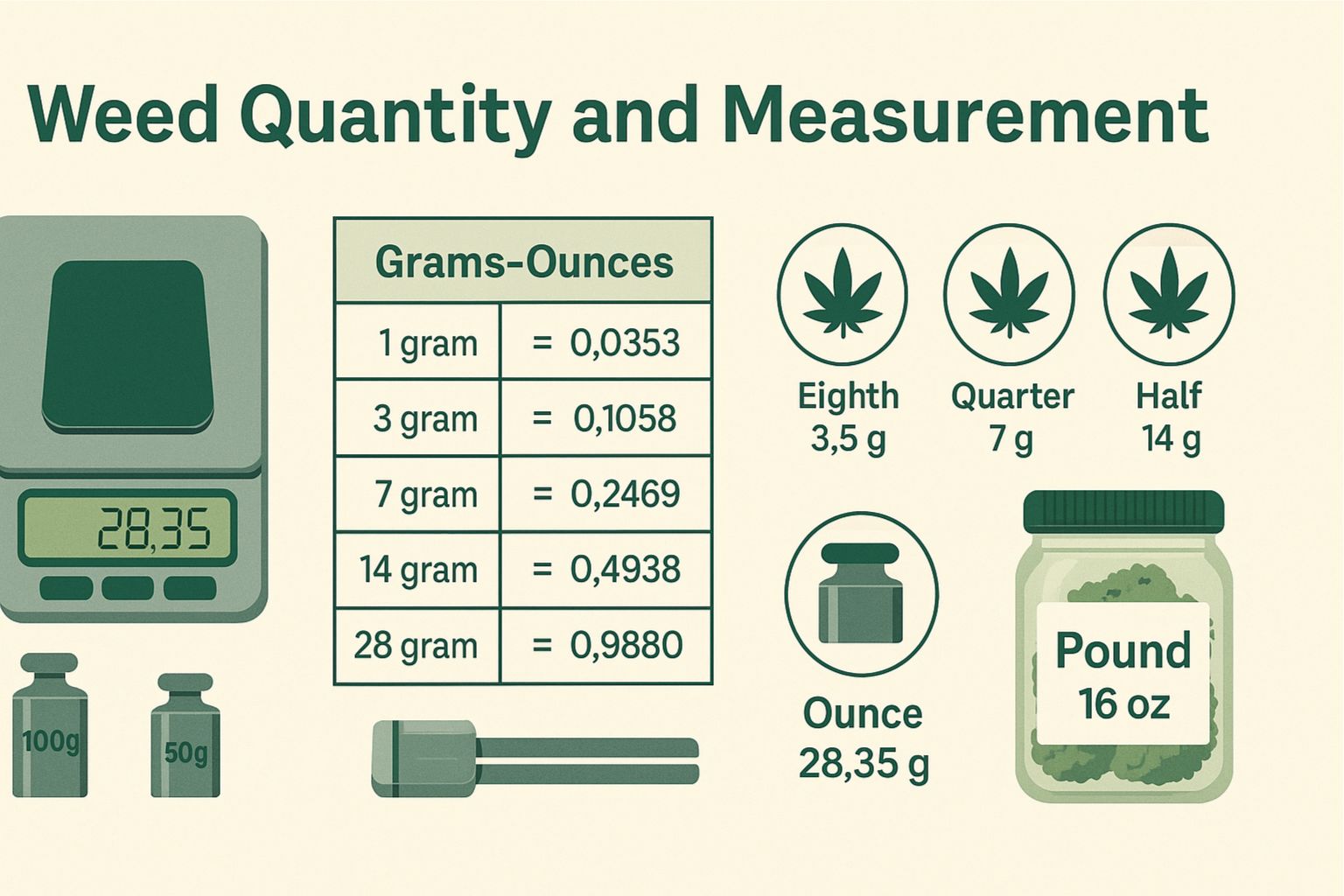
Harvest conversations always circle back to grams to ounces. Rather than a vague “a few zips,” I record wet and dry weights in grams, then translate grams to ounces for packaging. At 28.35 grams per ounce, a tray of 141.75 g equals five ounces. Converting grams to ounces three times during a harvest—tray checks, jar totals, and final pack-out—helps catch errors early.
On larger pulls, pounds enter the conversation. I approach ounce to pound conversions the same way: 16 ounces equals one pound, so a row of jars labeled as 32 ounces is two pounds, or 907.2 grams per pound. Consistent marijuana measurements mean the crew can move between units without hesitation, and my cannabis weight chart keeps these math checks front and center.
Everyday retail units
The most common retail request I hear is the eighth of weed. It is 3.5 grams. When I assemble sample packs for friends or product testers, I pre-label 3.5 g sachets and verify on the pocket scale. The eighth of weed has a second use in the grow room: it’s a convenient unit for recipe tests. I’ll grind an eighth of weed from three phenotypes into separate jars and compare terpene expression after identical cures.
From Canopy To Jars: Measurement Across The Grow
Vegetative stage and training
In veg, I measure node spacing with a caliper and log stem diameter at the third node. It sounds obsessive, but when I compare grams per watt later, these early numbers explain the final story. For photoperiod plants, I top at the sixth node and train horizontally; PPFD is held around 450 µmol/m²/s. With feminized seeds, uniformity makes training schedules easier because sex is not a variable. In mixed tents, feminized seeds remove risk and reduce wasted substrate, which helps Weed Quantity and Measurement stay honest.
Flower and irrigation
When pistils stack, I shift to weight-based irrigation in coco: each pot receives 10–15% runoff at target EC. I weigh runoff buckets weekly to confirm my irrigation math. A predictable moisture curve results in predictable yield per plant. If a cultivar drinks heavier, I note the delta and adjust. By week six, I set checkpoints: sample a cola, record wet weight, and check density. These check-ins correlate later with grams per watt; tighter, heavier flowers at the same PPFD usually mean better grams per watt.
Harvest, dry, and cure
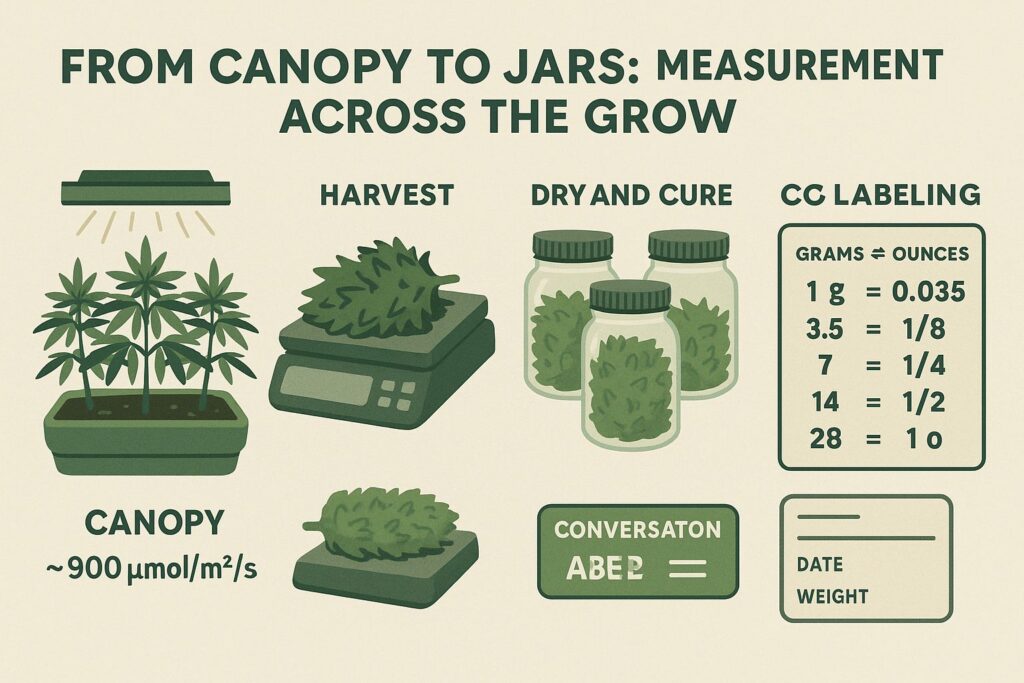
I chop when trichomes show mostly cloudy with 5–10% amber. Whole plants hang at 18–20°C and 55–60% RH for 10–14 days. After bucking, jars cure at 58–62% RH. Every jar label lists starting grams, date, and cultivar. Jars are weighed weekly during the first month because weight loss continues as moisture equalizes. Weed scale accuracy here matters again; I log to the nearest 0.1 g so I can detect sneaky humidity swings. Consistency at post-harvest is where Weed Quantity and Measurement pays off most—tight numbers equal repeatable flavor.
Planning The Run: Yield Metrics That Actually Predict Reality
Yield per plant
People love to ask about yield per plant. I answer in context. In a 4×4 with eight plants in 2-gallon coco, my average yield per plant ranges from 90–140 g dry, depending on cultivar. When I switch to four larger plants, yield per plant rises to 170–260 g, but total canopy yield changes less than people expect because light, not soil volume, is usually the cap. I keep yield per plant logs per cultivar so I can match training style to genetics next cycle.
To meet SEO needs without fluff, I will state it plainly: yield per plant is a helpful number, but only when paired with space, light, and time. I reference yield per plant three times on purpose because new cultivators often chase it blindly.
Grams per watt
For me, grams per watt is the most honest global metric. If a 480 W LED delivers 550–650 g dry in a 4×4, I’m at 1.15–1.35 grams per watt, which I consider healthy for quality-focused, hand-trimmed flower. When I experimented with higher CO₂ and more aggressive defoliation, I nudged grams per watt to 1.4 without sacrificing terpenes. Good logs make these comparisons valid, and grams per watt lets you compare across rooms and seasons.
Again, this phrase appears several times because growers search for it: grams per watt contextualizes marijuana measurements with light, which is what actually powers biomass.
Buying Seeds With Quantity In Mind
Seed pack sizes and planning
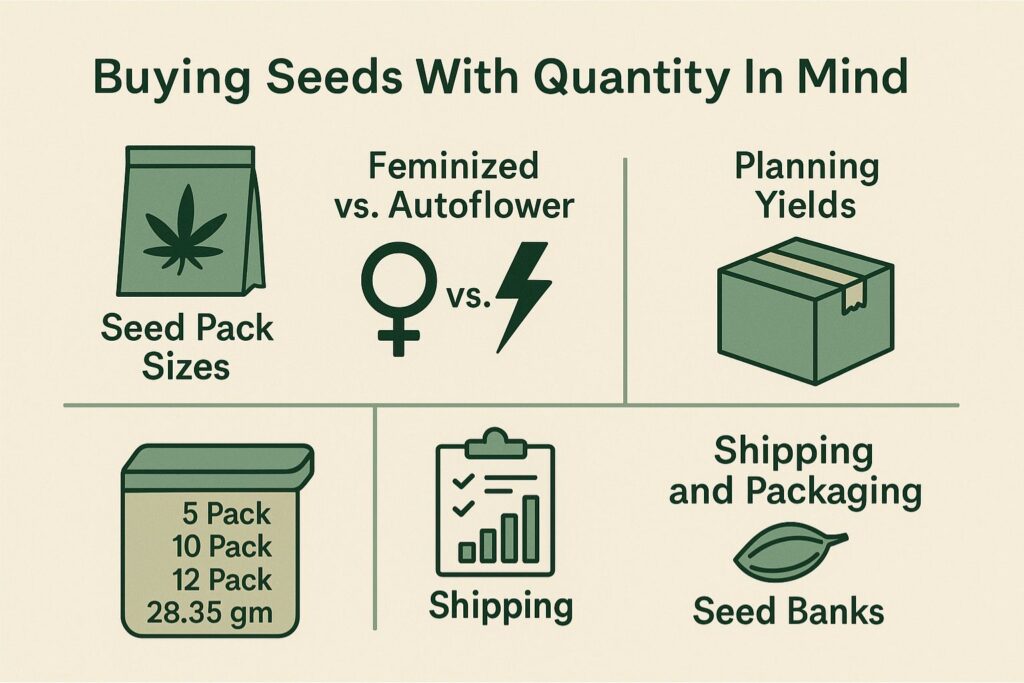
I rarely pop a single seed unless I’m cloning a known keeper. For phenotype hunts, I prefer seed pack sizes of 5, 10, or 12 so that statistical outliers don’t mislead me. Seed pack sizes determine canopy layout, pot count, and harvest schedule. If your seed pack sizes are small, stagger your start dates and keep notes; you’ll still build a meaningful dataset over two cycles.
Feminized seeds for predictability
Feminized seeds simplify planning, especially for new growers balancing work and family. I run feminized seeds when I need uniform canopies, synchronized flip dates, and predictable pack-out. Feminized seeds reduce the risk of wasted space from males in tight tents. This isn’t a dogma, just a practical call that supports Weed Quantity and Measurement.
I have repeated both seed pack sizes and feminized seeds here and will use them again because seed-buying searches often include those exact terms.
Translating Harvest Into Real-World Packages
Portions, labels, and a cannabis weight chart at the table
On trim day, I set the cannabis weight chart next to the scale so the team can convert on the fly. We package eighth of weed portions, quarter ounces, half ounces, and full ounces. Because grams to ounces is second nature at this point, we move quickly without mistakes. For wholesale, I list totals in grams with parentheses showing ounces for clarity. Including a cannabis weight chart in the SOP keeps new helpers aligned with veterans.
Shipping and packaging considerations
Once jars are sealed, the work isn’t done. Shipping and packaging take care. I use opaque, child-resistant containers labeled with weight, date, and batch. Desiccant packs go in bulk boxes, not jars, to avoid overdrying. When friends ask, I remind them shipping and packaging must protect aroma and prevent crushing. For long trips, I double-box and add foam corners. I am mentioning shipping and packaging multiple times because, like scale use and unit conversion, it is part of Weed Quantity and Measurement beyond the grow room.
In community marketplaces and shared spaces, shipping and packaging also communicates professionalism. The label layout includes both marijuana measurements and consumer-friendly units, plus storage tips that maintain weight and flavor.
Troubleshooting The Numbers
When the scale lies
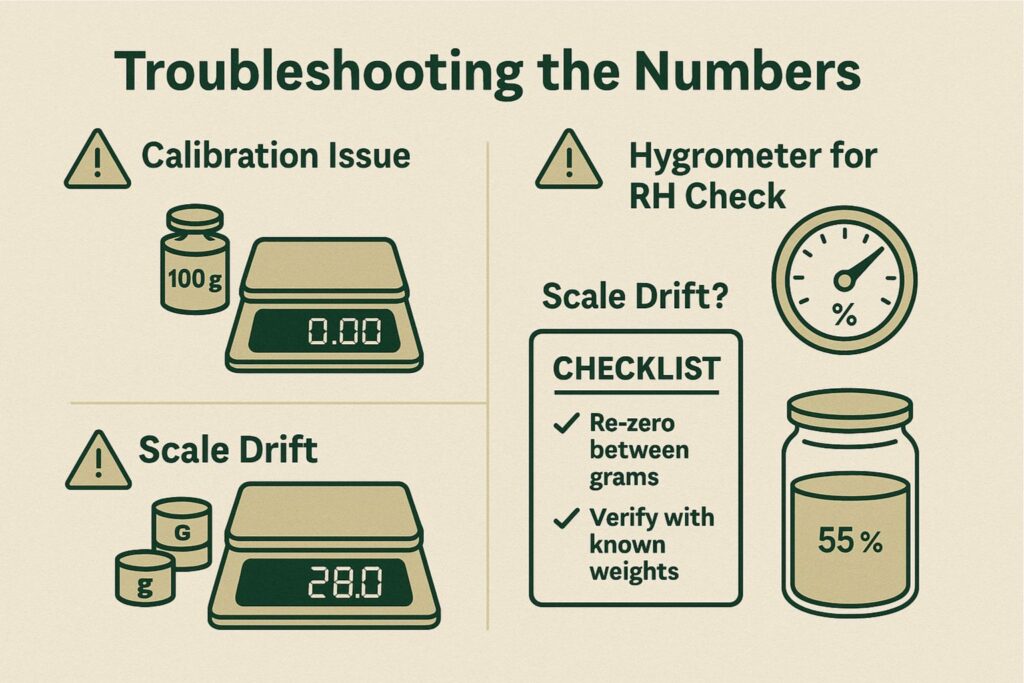
Weed scale accuracy can drift from temperature changes or battery sag. If readings fluctuate, I warm up the room, replace batteries, and recalibrate with known weights. If jars seem to lose weight too fast, I verify RH with a second hygrometer. Frequent checks are not paranoia; they keep Weed Quantity and Measurement credible.
I’ve had one harvest where weed scale accuracy looked fine, but jars kept reading low. Turned out the trim team was opening jars mid-weigh to admire buds, venting moisture. We fixed it with a “weigh first, admire later” rule.
When units confuse the team
It sounds simple, but mixing ounces with grams mid-task leads to double counting. The fix is visual. I print larger cannabis weight chart posters for the trim wall with a bold grams to ounces table and a callout for the standard eighth of weed. Crew members can glance rather than guess, and the marijuana measurements stay consistent all day.
Practical Reference Tables
Everyday conversions I use
- 1 ounce = 28.35 grams
- 1 pound = 16 ounces = 453.59 grams
- Eighth of weed = 3.5 grams
- Quarter ounce = 7.0 grams
- Half ounce = 14.0 grams
These show up on my cannabis weight chart, are built into my spreadsheet, and repeat in training materials. Conversions are the heartbeat of marijuana measurements across harvest.
Benchmarks to evaluate a run
- Healthy indoor grams per watt: 1.0–1.4 depending on goals
- Predictable yield per plant in 4×4 coco: 90–140 g for eight plants; 170–260 g for four larger plants
- Typical seed pack sizes for hunts: 5–12
- Preferred jar sizes: 1 oz, 2 oz, and 1 lb bulk with tamper bands
- Most common retail request: eighth of weed in smell-proof pouch
Storage And Long-Term Weight Integrity
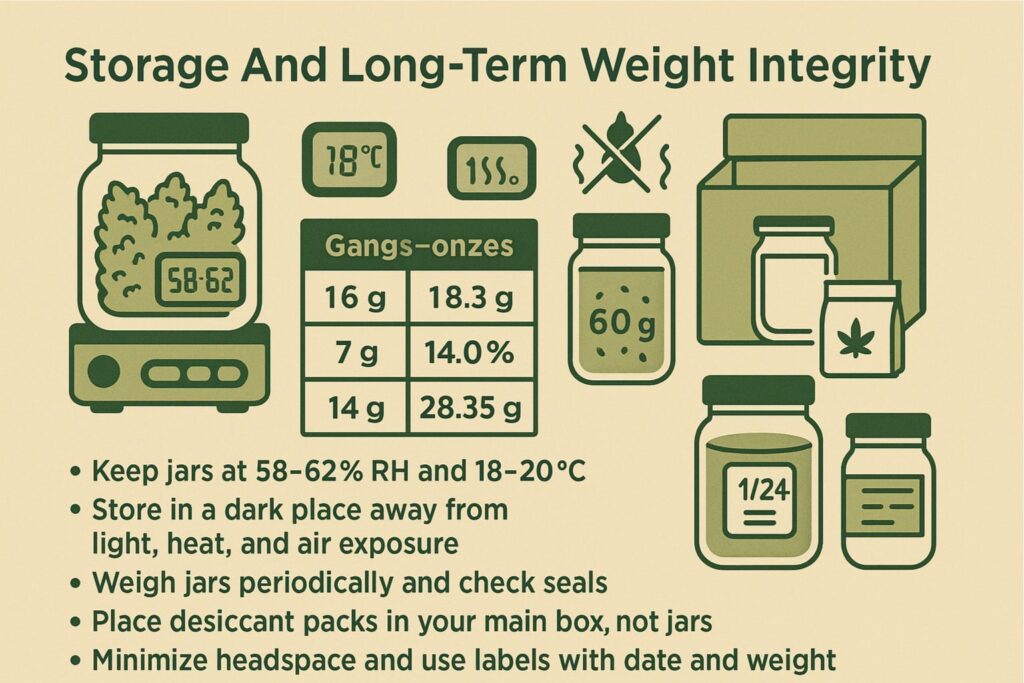
I keep finished flower at 18–20°C and 58–62% RH in the dark. Jars are filled to reduce headspace and weighed monthly. If a jar trends down more than a gram in a month, I check seals and room RH. Marijuana measurements don’t stop at cure; storage practices keep your numbers honest. Before any transfer or shipping and packaging event, I re-weigh, record, and then close the box. Future me is grateful when totals reconcile.
Real Questions Growers Ask Me
Why is grams to ounces so critical when I can just sell everything in grams?
Retail and wholesale speak different languages. Your spreadsheet should translate grams to ounces instantly because your buyers might expect one or the other. Aligning both keeps Weed Quantity and Measurement clean.
What’s a realistic yield per plant for a first-timer?
With solid environment control and feminized seeds, expect 60–120 g per plant in a 4×4. Track yield per plant and grams per watt. These two numbers will teach you more than any forum post.
Should I buy large seed pack sizes or small testers?
If budget allows, larger seed pack sizes reduce luck. I run 10–12 when I need a keeper fast. If you start with five, log everything and repeat; pattern beats hype.
Does an eighth of weed matter if I gift, not sell?
Yes. The eighth of weed standard keeps your own marijuana measurements consistent, and it simplifies feedback because everyone understands 3.5 g.
How do you ensure weed scale accuracy during long trim days?
Calibrate in the morning, re-zero after every container change, and re-check at lunch with a 100 g weight. If numbers drift, stop and fix. That is non-negotiable.
Checklist: A Repeatable Workflow For Quantity And Quality
- Calibrate scales and verify weed scale accuracy with known weights.
- Print a cannabis weight chart for the room and add a grams to ounces table.
- Standardize portions with the eighth of weed and other common units.
- Choose feminized seeds for predictable canopy planning and log seed pack sizes.
- Track PPFD, EC, temperature, RH, and VPD each day.
- Log yield per plant at harvest and compare grams per watt across cycles.
- Cure at stable RH and weigh jars weekly for the first month.
- Prepare labels that show marijuana measurements in grams and ounces.
- Plan shipping and packaging to protect weight and aroma.
- Review notes and update SOPs so Weed Quantity and Measurement gets sharper each run.
Closing Notes From The Bench
Weed Quantity and Measurement isn’t about chasing the biggest number. It is about speaking a clear language from seed to sale, from grams to ounces to pounds, from veg to cure. The tools are simple—scales, charts, and honest logging—but the payoff is huge. You see patterns faster. You select better phenotypes. You pair feminized seeds with the right training. You choose realistic seed pack sizes. You respect shipping and packaging as part of product quality. And your team can read a cannabis weight chart, use marijuana measurements consistently, and package an eighth of weed without blinking.
When the room is quiet and the jars are lined up, the data tells me what to try next. That is where craft turns into mastery—one verified gram at a time.
