
I keep a notebook for every cycle I run. It’s not glamorous, but it’s how I get better. This entry is my Trainwreck Cannabis Strain run, written as a true grower’s journal: what I did in the room, what I measured, what went wrong, and what I’d repeat. I’m not trying to sell you a dream. I’m trying to help you grow better weed with fewer surprises.
Trainwreck Cannabis Strain can be a fast mover. In my space it showed strong early vigor, a noticeable stretch after the light schedule change, and a sharp, bright smell that got louder week by week. It also demanded a steady environment. When I let humidity drift, the plant told me quickly. When I kept conditions stable, it stacked dense flowers and stayed healthy.
Below, I’ll walk through the full cycle: germination, medium choice, environment targets, lighting, my training decisions, feeding, pest prevention, harvest cues, drying, and curing. I’ll also include a few seed-shopping thoughts, because many growers land on Trainwreck Cannabis Strain while browsing marijuana genetics online and want to know what they’re signing up for.
What I wanted from this run
I set three goals before I popped the seeds:
- Keep the canopy even from early veg through mid flower.
- Build a simple feeding routine I could repeat daily without guessing.
- Capture real sensory notes so I could compare jars after curing.
That’s why this post reads like a Trainwreck Cannabis Strain field report. The most useful grow advice is specific, measured, and honest about trade-offs.
Germination and seedling start
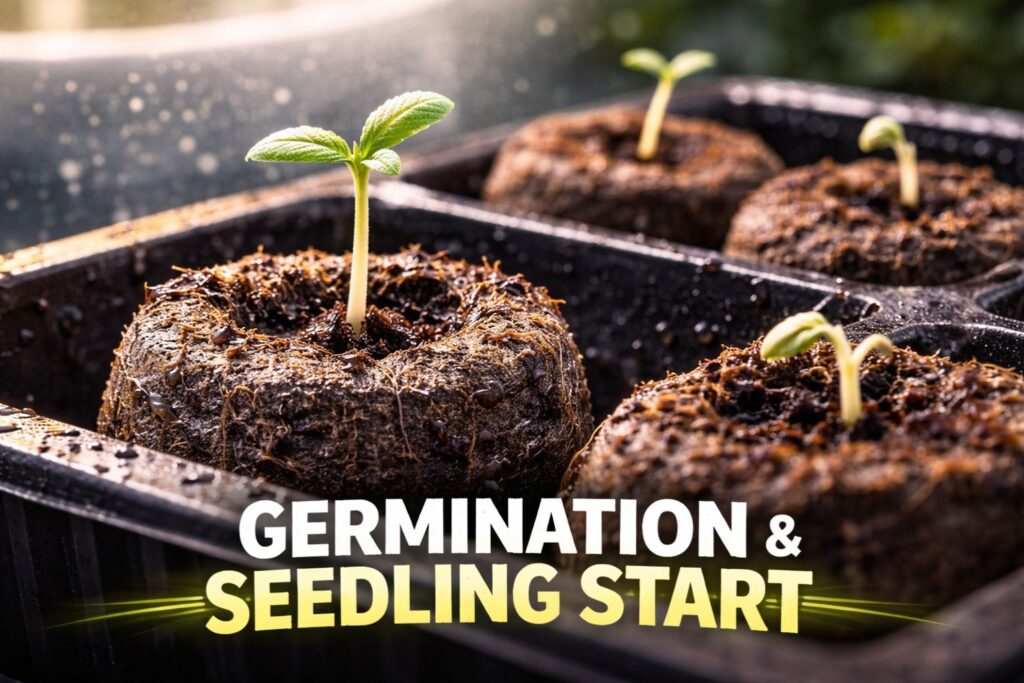
I germinated in a starter plug and moved into the main medium as soon as the seedling was upright and stable. In my experience, Trainwreck Cannabis Strain seedlings don’t like sitting too long in tiny, wet cubes.
My early targets were:
- Temperature: 24–26°C
- Relative humidity: 70–75%
- Light schedule: 18 hours on, 6 hours off
- Light intensity: 150–250 PPFD at the seedling top
I kept airflow gentle. I’m not trying to “strengthen stems” by blasting seedlings; I’m trying to keep the surface dry enough to discourage fungus gnats while still letting the plug stay evenly moist.
Medium choice: soil-style mix vs coco-style feeding

I’ve done Trainwreck in a soil-style mix and in coco-style feeding. For this cycle I chose buffered coco-style medium because I wanted tighter control of the Trainwreck feeding curve and faster correction if anything drifted.
Here’s my plain-English comparison:
- Soil-style mix: easier to start, fewer daily inputs, but slower to correct if you push too hard.
- Coco-style feeding: very responsive, but you have to be consistent with irrigation and EC.
I ran fabric pots, watered to a small amount of runoff, and kept my root zone warm and steady. The whole point was to keep the Trainwreck feeding curve smooth instead of spiky.
Environment targets I actually used
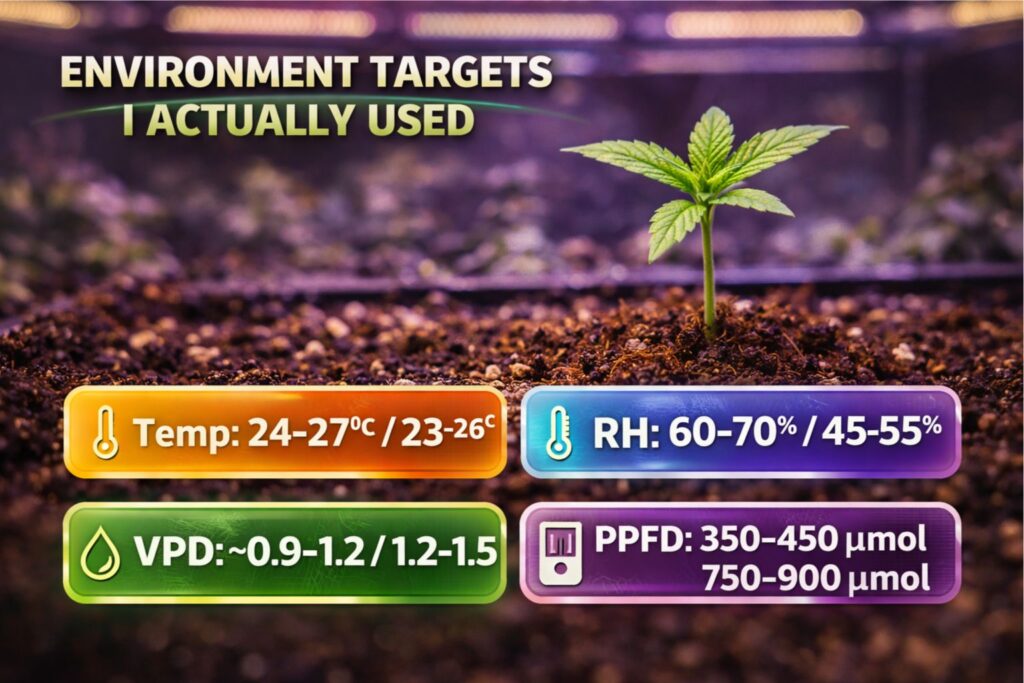
Trainwreck Cannabis Strain rewards stable air. When the room swings, it stretches harder and can throw slightly looser structure.
My targets:
Veg:
- Day temperature: 24–27°C
- Night temperature: 20–22°C
- Relative humidity: 60–70%
- VPD: roughly 0.9–1.2
Flower:
- Day temperature: 23–26°C
- Night temperature: 19–21°C
- Relative humidity: 45–55%
- VPD: roughly 1.2–1.5
Airflow and exchange:
- Constant gentle movement through the canopy
- Strong extraction above the lights to remove warm, humid air
These are not magic numbers. They’re simply where my plants looked relaxed: leaves slightly praying, no tacoing, no persistent droop.
Lighting and PPFD notes
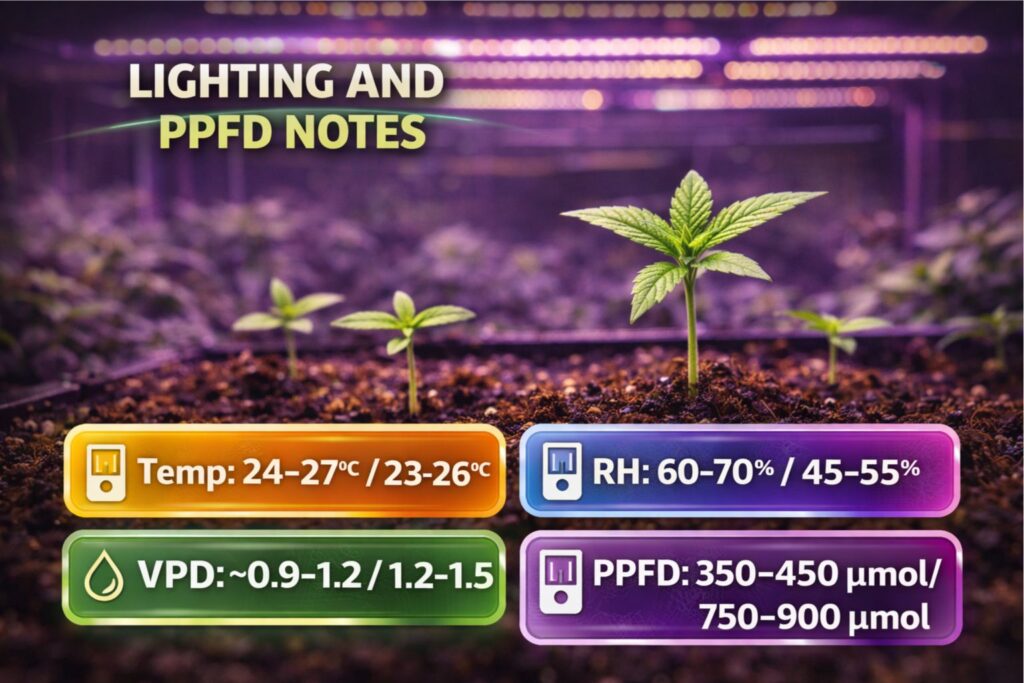
I used LED lighting and measured intensity at canopy level. If you don’t have a meter, you can still succeed, but it’s harder to separate lighting issues from feeding issues.
My rough PPFD targets:
- Early veg: 350–450 PPFD
- Late veg: 450–600 PPFD
- Early flower: 650–800 PPFD
- Mid flower: 750–900 PPFD if the plant is thriving
I increased intensity slowly. In this run, the best growth came from steady increases paired with steady watering and a stable VPD.
Training: my Trainwreck canopy plan
Trainwreck canopy plan is the part of this run I’m most proud of, because it prevented the classic Trainwreck “one tall spear” problem.
This Trainwreck canopy plan had four steps:
- Top once after 5–6 healthy nodes.
- Start low-stress training early to spread branches outward.
- Top the two strongest new leaders to create a wider frame.
- Install a trellis before the flip and keep the canopy level during stretch.
I wrote down every tie-down change and every cut. That way my Trainwreck canopy plan became repeatable, not just “I did some training.”
During the first two weeks of flowering stretch, I adjusted the trellis daily. This is where the Trainwreck canopy plan either works or fails. If you wait, the stems harden and you end up bending too aggressively.
Veg selection: my Trainwreck phenohunt notes
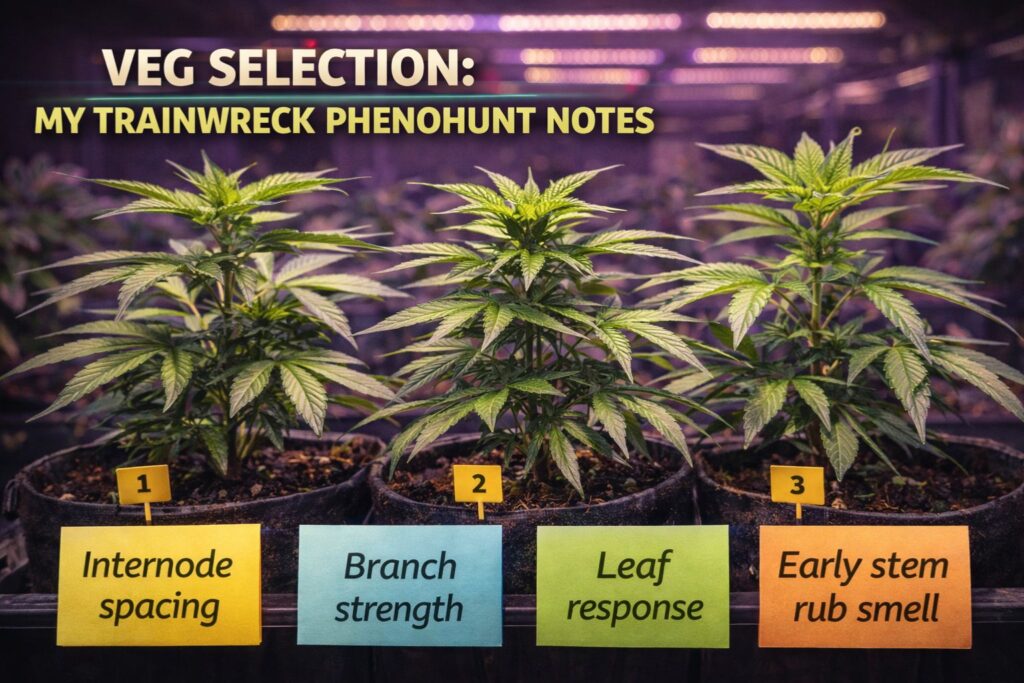
I started multiple seeds and kept Trainwreck phenohunt notes on each plant. Even within one pack, I saw noticeable differences.
My Trainwreck phenohunt notes focused on:
- Internode spacing under the same light
- Branch strength after topping
- Leaf response to the same EC
- Early stem-rub smell
Two plants stood out. One was taller with more stretch potential. The other was slightly bushier with stronger side branching. My Trainwreck phenohunt notes helped me decide which one would fit my tent best and which one would be better in a larger room.
I also learned that Trainwreck phenohunt notes are only useful if you keep them consistent. If you change feed or light between plants, you’re not comparing phenotypes anymore; you’re comparing conditions.
Feeding: the Trainwreck feeding curve I followed
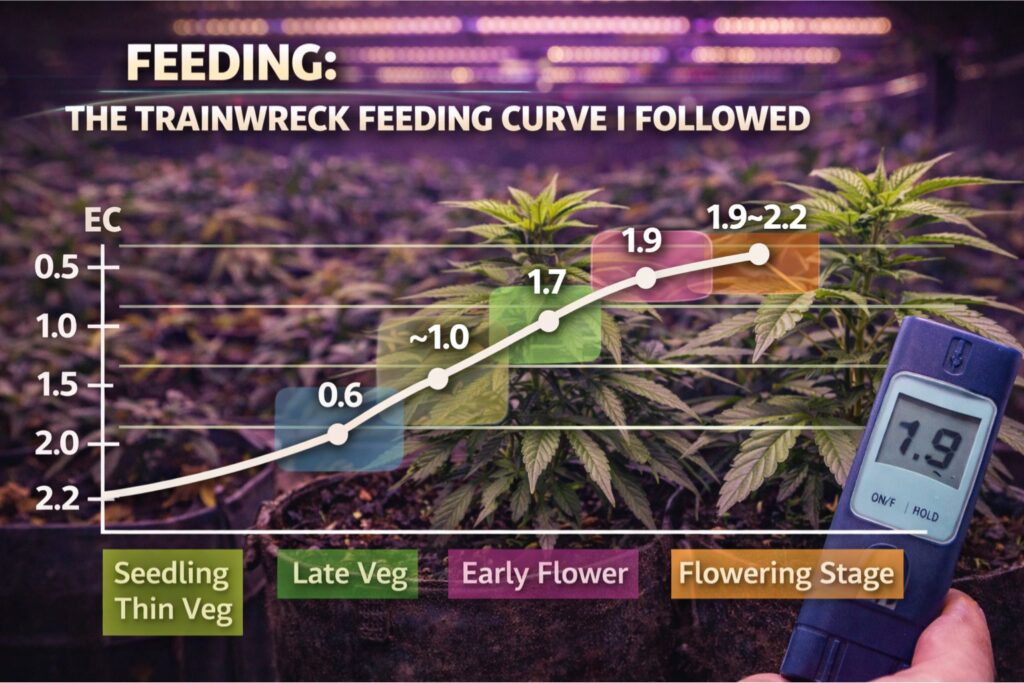
Trainwreck feeding curve is where new growers often overdo it. Fast growth can trick you into pushing EC too hard, too early.
Here’s the Trainwreck feeding curve that worked for me in coco-style feeding:
- Seedling: EC 0.6–0.9
- Mid veg: EC 1.0–1.3
- Transition (first 10–14 days of flower): EC 1.3–1.6
- Mid flower: EC 1.6–1.9
- Late flower: EC 1.4–1.7 depending on leaf color and runoff
I aimed for consistent irrigation rather than occasional heavy watering. The goal was to keep the Trainwreck feeding curve steady and prevent salt buildup.
If I saw tip burn, I didn’t panic. I checked runoff, confirmed my environment, and reduced EC slightly. The biggest lesson from this Trainwreck feeding curve is that the plant reacts to the whole system, not one bottle.
Stretch and structure: my Trainwreck flowering timeline
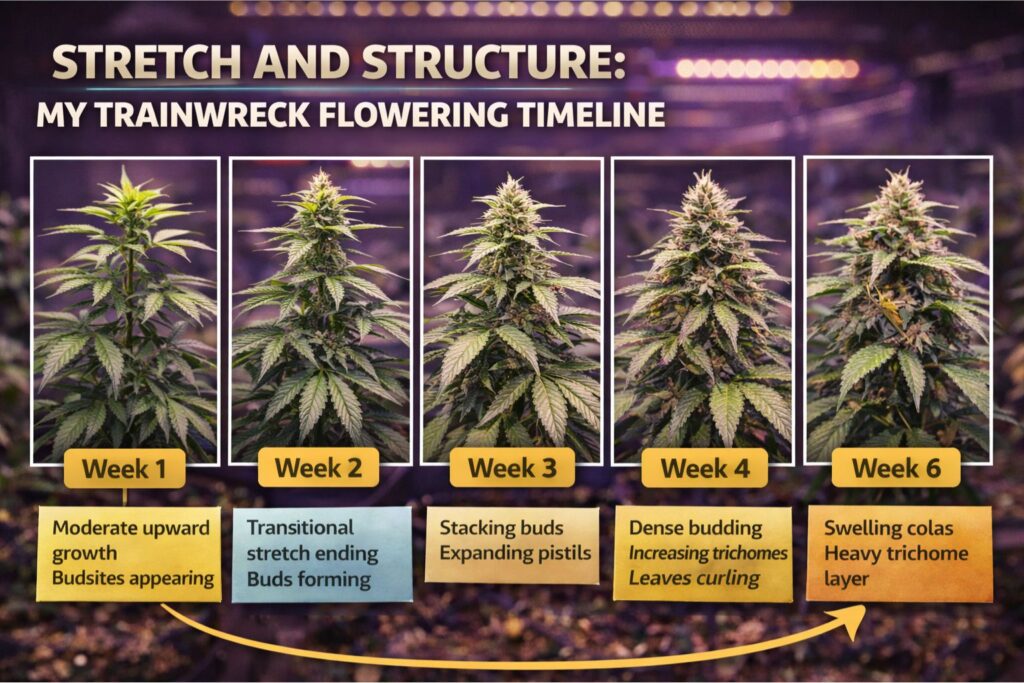
Trainwreck flowering timeline is best understood in phases, not exact dates. Here’s what I observed:
Phase 1: Transition (weeks 1–2)
- Stretch accelerates
- Branches need support and direction
- The canopy must stay flat if you want even tops
Phase 2: Building (weeks 3–5)
- Bud sites stack and swell
- Aromas become distinct by plant
- Environmental stability matters most
Phase 3: Finishing (weeks 6–8+)
- Resin production ramps up
- The plant drinks a bit less
- Humidity control becomes critical
This Trainwreck flowering timeline shifted slightly between plants, but the stretch was the most consistent trait. If you plan around the Trainwreck flowering timeline, you can avoid cramped tops and shaded lowers.
I also used the Trainwreck flowering timeline to decide when to remove lower growth. I cleaned up the bottom third after stretch so the plant focused on the best-lit sites.
Aroma development: building a Trainwreck terpene map
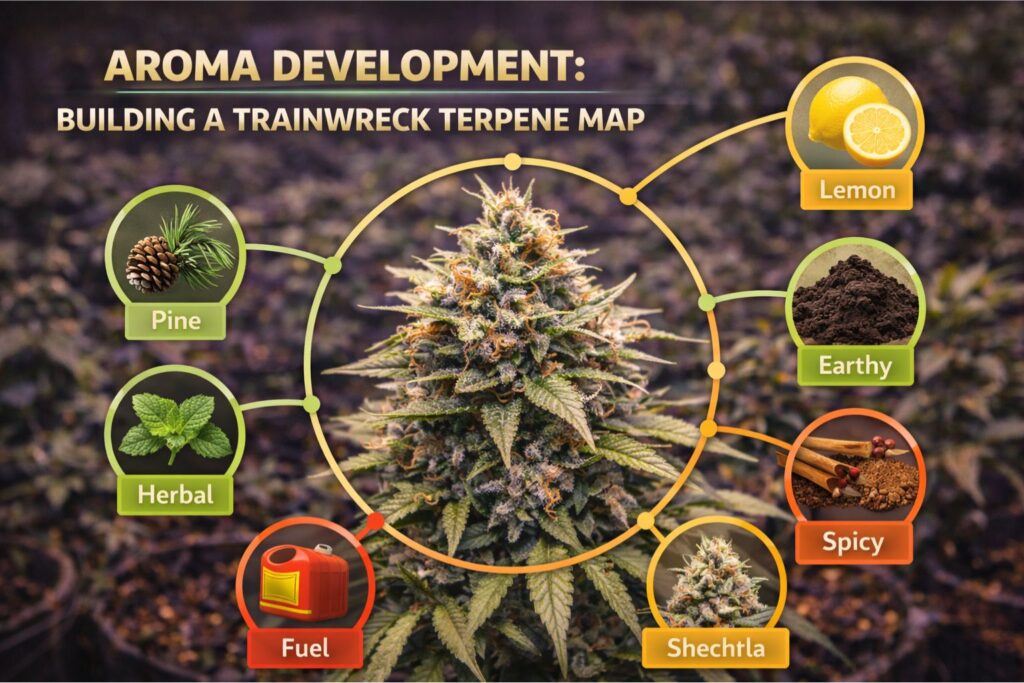
Trainwreck terpene map is my simple way of tracking smell changes across the cycle. I’m not claiming lab accuracy. I’m building a reliable record.
My Trainwreck terpene map included notes at three points:
- Late veg: stem rub and leaf touch
- Mid flower: resin and early flower scent
- Late flower: full bud aroma at peak ripeness
Across the run, the Trainwreck terpene map leaned toward citrus peel, pine, and peppery spice. One plant added a sweeter background note late in flower. Without notes, I would have forgotten which one was which once everything was trimmed.
A Trainwreck terpene map is also useful when you’re buying seeds again. If you know you prefer a sharper profile, you can pick genetics that match those notes.
What I consider the Trainwreck aroma profile
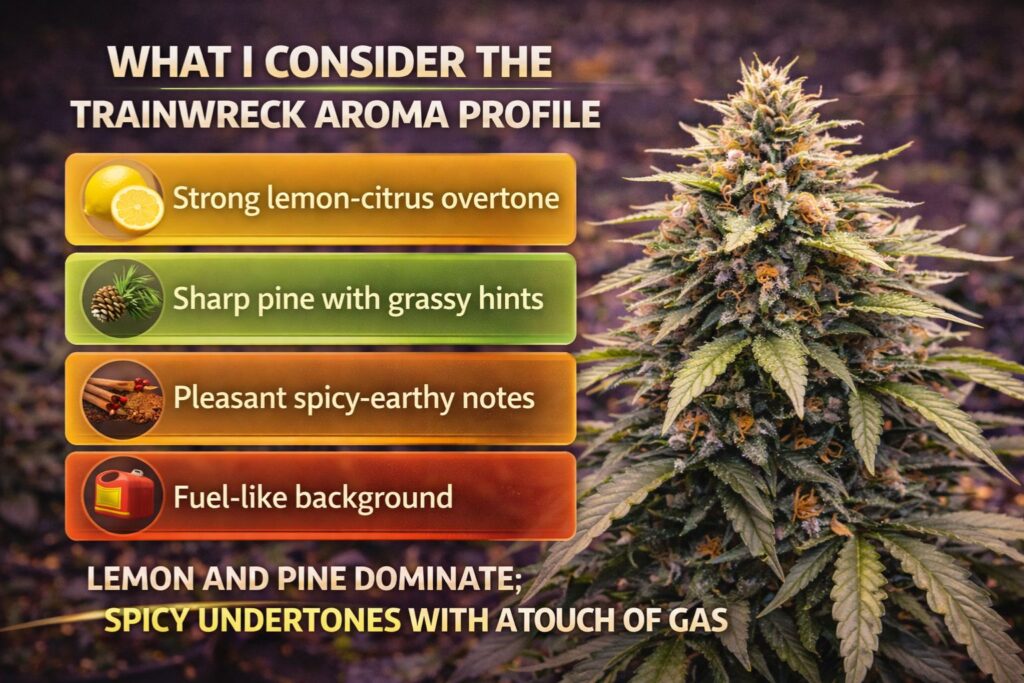
Trainwreck aroma profile can shift depending on the phenotype and your dry. For this run, my Trainwreck aroma profile was clearest when I slowed down the drying process and avoided over-warm conditions.
In late flower, the Trainwreck aroma profile smelled like:
- Bright citrus peel
- Pine and fresh herbal notes
- Pepper and spice
- A light sweetness on one plant
After curing, the Trainwreck aroma profile became smoother and less “green.” This is why I don’t judge jar smell at day three. Trainwreck aroma profile needs time to settle.
Trainwreck pest watch: how I kept it clean without drama

Trainwreck pest watch is boring, and that’s the point. I don’t wait for a crisis.
My Trainwreck pest watch routine:
- Once per week: inspect leaf undersides with a small light
- Twice per week: check the medium surface for gnats or algae
- Daily: quick scan for odd spots or twisted new growth
Prevention habits that helped my Trainwreck pest watch:
- Keep the floor clean and dry
- Avoid letting runoff sit in trays
- Maintain airflow so leaves don’t stay wet
- Quarantine any new plants or clones far away from the room
I didn’t need emergency sprays in flower. A steady Trainwreck pest watch is more effective than a last-minute rescue.
Harvest cues and the Trainwreck yield review
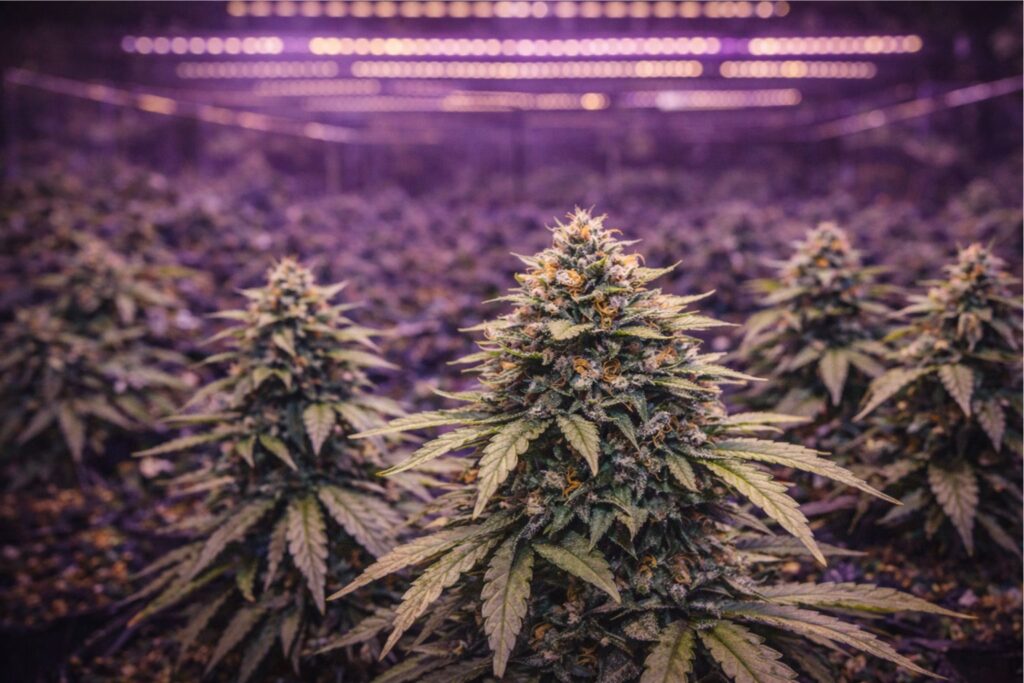
I don’t harvest by calendar alone. I look at how the plant finishes and how the flowers feel and smell. I check resin head maturity with magnification, but I also pay attention to overall ripeness.
My harvest cues:
- Flowers feel dense and mature, not airy
- Aroma is strong and layered, not grassy
- Resin is mostly cloudy with some amber
- The plant’s drinking slows and leaf color fades naturally
Trainwreck yield review for this run:
- The flat canopy improved uniformity more than any single feeding tweak.
- The plant with stronger branching held heavier tops and had fewer weak lowers.
- Drying slowly protected terpenes better than rushing for a fast trim day.
I keep a Trainwreck yield review because it tells me what actually moved the needle. It’s easy to guess; it’s better to measure.
Drying and my Trainwreck cure checklist
Trainwreck cure checklist starts before the buds go into jars. If you dry too fast, the cure can’t fully fix it.
My drying targets:
- Temperature: 18–20°C
- Relative humidity: 55–60%
- Gentle air movement in the room, not directly on the buds
- Darkness or very low light
Once small stems snapped instead of bending, I trimmed and jarred.
My Trainwreck cure checklist:
- Jar only when buds feel dry on the outside but not brittle.
- Fill jars loosely so air can move inside.
- Burp briefly once or twice per day for the first week.
- Reduce burping as moisture stabilizes.
- Store cool and dark to protect aroma.
I followed the Trainwreck cure checklist for at least three weeks before judging final quality. Each week, the jar smell improved and the smoke got smoother.
My Trainwreck smoke test notes
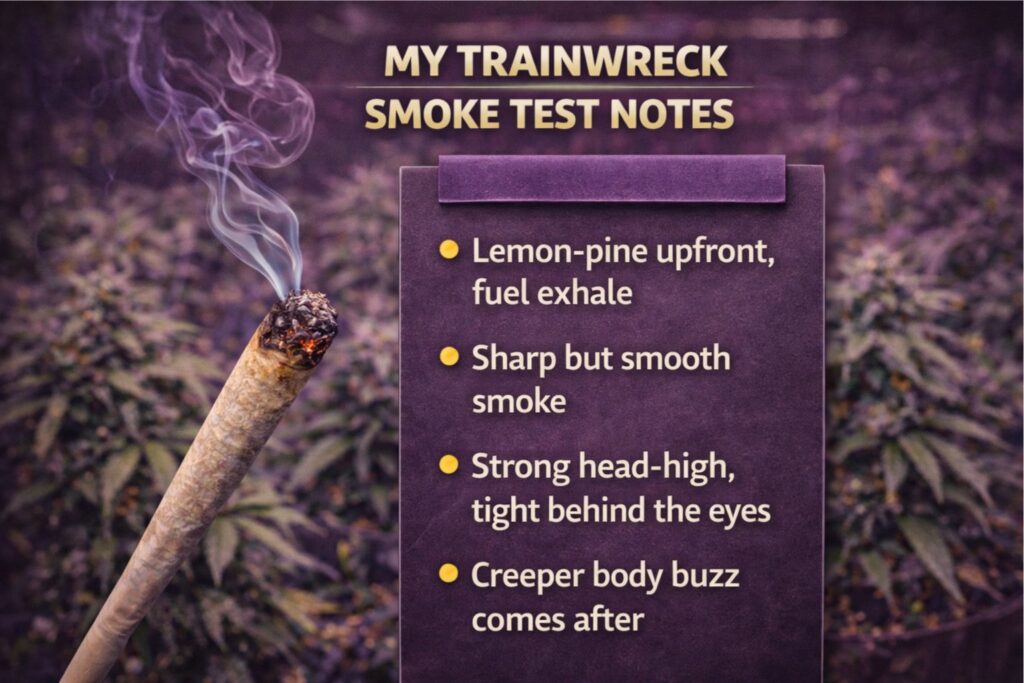
Trainwreck smoke test is the final step in my notebook. I wait until the burn is even and the aroma is stable, otherwise the result isn’t fair.
My Trainwreck smoke test notes:
- Flavor: citrus and pine with a peppery edge
- Aroma: sharper at first, then smoother after a longer cure
- Effect (personal report): mentally active and quick, with a lighter body feel than many heavy indica-leaning cultivars
Trainwreck smoke test results depend on the person. I’m not making promises about effects, and I’m not giving medical advice. I’m sharing what I experienced in this run.
Seed-shopping thoughts: how I pick Trainwreck genetics

A lot of people land on Trainwreck Cannabis Strain while comparing seed options online. Here’s how I simplify the decision.
If you want fewer surprises:
- Choose female-only seed lines so you don’t have to remove males.
- Look for a line described as indoor-friendly, not just “high yield.”
If you want speed and smaller plants:
- Consider automatic-flowering versions, but expect less control over veg length.
If you want full control:
- Photo-period plants let you extend veg, train more, and fill your canopy.
Questions I ask before ordering:
- Are reviews describing real grow behavior, or only hype?
- Does the seller list realistic delivery timelines and shipping methods?
- Do I understand the rules where I live?
Regional grow laws can be strict. I always tell growers to learn their local regulations before buying or growing marijuana. It’s not the exciting part, but it matters.
Quick checklists I used in this run
Daily checklist:
- Temperature and humidity reading
- Leaf posture and color
- Irrigation consistency
- Quick Trainwreck pest watch scan
Weekly checklist:
- Canopy height and tie-downs (Trainwreck canopy plan)
- Runoff check to confirm the Trainwreck feeding curve
- Notes update for Trainwreck phenohunt notes and Trainwreck terpene map
FAQ
How long does Trainwreck Cannabis Strain take from flip to harvest?
In my room, the Trainwreck flowering timeline landed around 8–9 weeks, but I harvest based on ripeness cues and resin maturity, not a fixed date.
What’s the easiest way to manage stretch?
Follow a Trainwreck canopy plan before the flip, install a trellis early, and adjust daily during the first two weeks of the Trainwreck flowering timeline.
What does Trainwreck Cannabis Strain smell like when it’s cured well?
My Trainwreck aroma profile leaned citrus peel, pine, and spice. After the Trainwreck cure checklist was followed for a few weeks, the aroma became smoother and more layered.
Is Trainwreck Cannabis Strain beginner-friendly?
It can be, if you keep environment stable and don’t push the Trainwreck feeding curve too hard. The plant grows fast, so mistakes show up fast.
What should I watch for to avoid pests?
A steady Trainwreck pest watch routine, clean floors, and good airflow. Prevention is easier than fixing a problem in late flower.
How did you decide which plant to keep?
I used Trainwreck phenohunt notes: structure, branch strength, and smell. Those notes lined up well with my Trainwreck yield review and Trainwreck smoke test later on.
For a complete directory of cultivars, visit our Cannabis Strain Reviews.
