Table of Contents
I grow weed because I love the craft: dialing in the environment, hunting phenotypes, and turning a jar of well-cured flower into something that smells like the living plant. When friends call it marijuana, I know exactly what they mean, but I’m usually thinking in terms of cultivar, terpene profile, and how the dried flower will actually behave in a session.
But once the harvest is trimmed and cured, the next question always comes up at home and among friends: what are the top ways to consume cannabis for this batch?
I’ve tried most cannabis consumption methods over the years using my own flower and simple kitchen-scale extractions. Some routes hit fast, some last a long time, and some are just easier on the throat after a long day in the garden. None of them are “best” for everyone, and the same strain can feel different depending on how it’s prepared and used.
This post is a practical field guide based on what I’ve learned through real sessions, mistakes, and plenty of note-taking. I’ll walk through onset time, duration, dosing, and the gear and prep choices that make each route more predictable. I’ll also weave in cultivation and post-harvest details, because the way you grow and cure affects how your marijuana behaves when you consume it.
A quick trust note: this is not medical advice and not legal advice. I’m sharing experience-driven harm reduction cannabis use tips and accepted best practices for adults in places where cannabis is legal. If you’re unsure about your local rules, check official resources in your region.
How I Evaluate Cannabis Consumption Methods
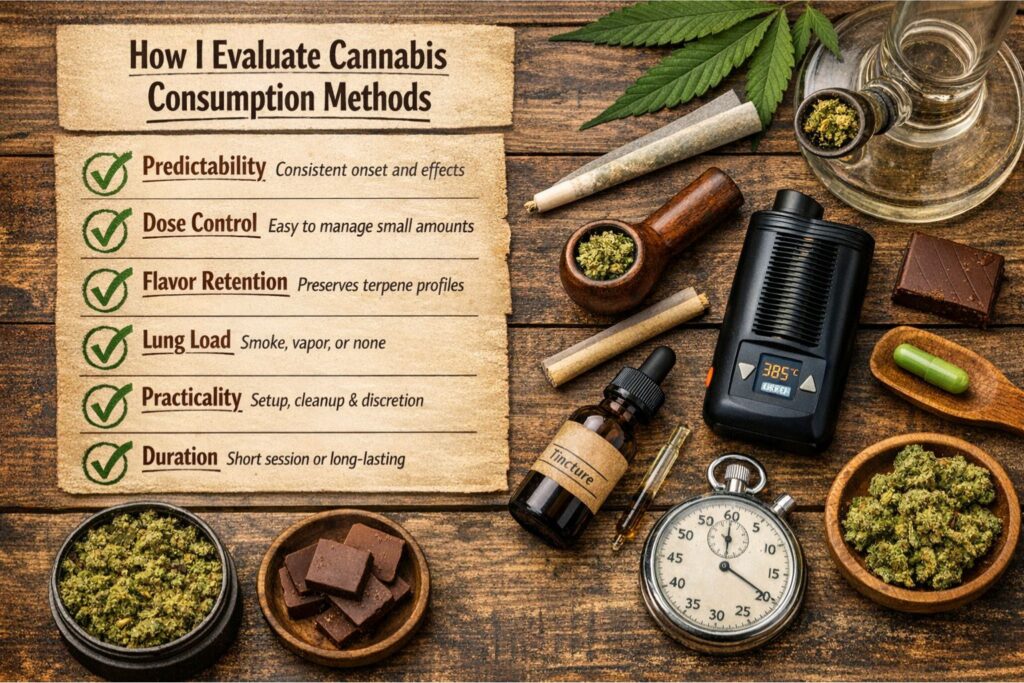
Before we talk options, here’s how I compare cannabis consumption methods in real life:
- Predictability: how consistent the onset and intensity feel from session to session
- Dose control: how easy it is to take a small amount and stop
- Flavor retention: whether terpenes come through clearly or get flattened
- Lung load: whether I’m inhaling smoke, warm vapor, or nothing at all
- Practicality: setup time, cleanup, weed smell, and discretion
- Duration: whether I want a short window or a long runway
If you’re new, the best “method” is the one that lets you learn how to dose cannabis safely with the least surprise.
From Grow Room to Final Form: What Changes the Experience
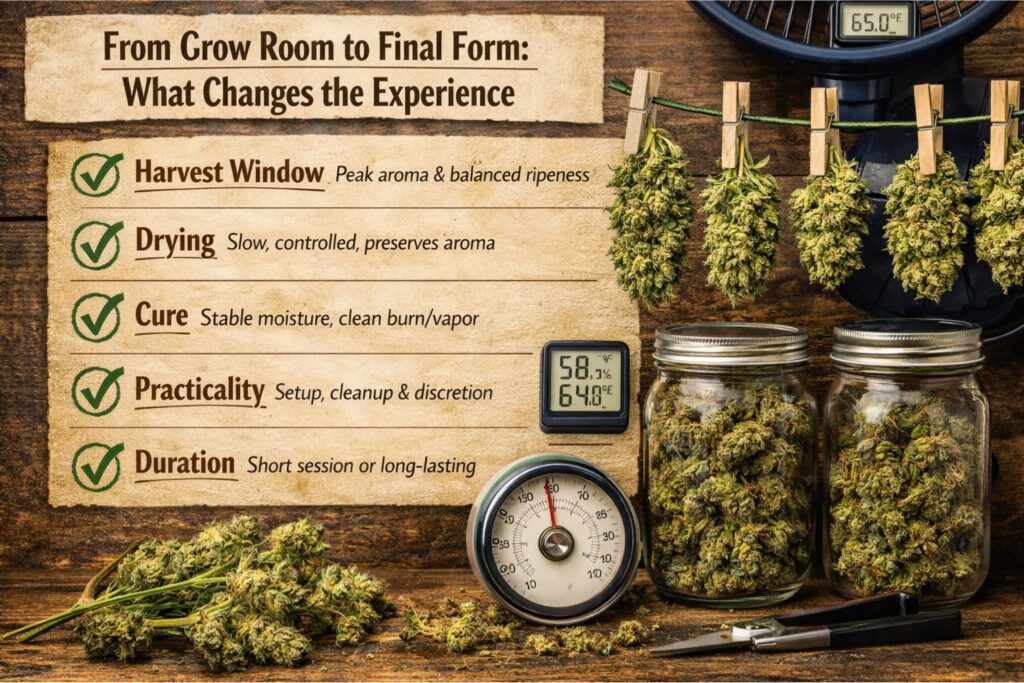
I’m writing as a cultivator because the finished product starts long before the session. Two jars can look identical and still behave differently depending on how they were grown and handled.
Flower quality basics that matter for consumption
When I’m growing for flavor and smoothness, I prioritize:
- Harvest window: I aim for peak aroma and balanced ripeness, not just maximum ambering on the resin glands. I’ll often harvest in stages if phenotypes differ.
- Drying: slow and controlled beats fast and crispy. My target is a gradual dry that preserves aroma, not a speed run.
- Cure: I want stable moisture and a clean burn or vapor. A proper cure is the difference between “green” harshness and a controlled session.
Practical cultivation ranges I use
These are typical indoor targets that have worked for me across soil and coco. They’re not rules, but they’re solid starting points:
- Vegetative lighting: 18/6 photoperiod with moderate intensity, often around 300–600 PPFD at canopy depending on plant size
- Flower lighting: 12/12 photoperiod and commonly 600–900 PPFD in mid-flower if the cultivar and environment can handle it
- Temperature: many rooms run well around 24–28°C lights on, and a few degrees cooler lights off
- Relative humidity: I usually tighten humidity as flower sets, often landing around 45–55% RH late flower to reduce mold risk
- VPD: I keep it in a workable band and adjust with leaf behavior, usually around 1.1–1.4 kPa in mid to late flower for many setups
- Nutrition: I avoid chasing high EC at the cost of flavor. In coco, many growers run roughly 1.6–2.2 EC in flower, then adjust by cultivar response
When you’re shopping seeds, I like to ask a simple question: do you want an easy plant, a fast plant, or a loud plant? That choice affects everything from training to cure, and the cure affects every consumption route.
Top Ways to Consume Cannabis: What I Actually Use and Why
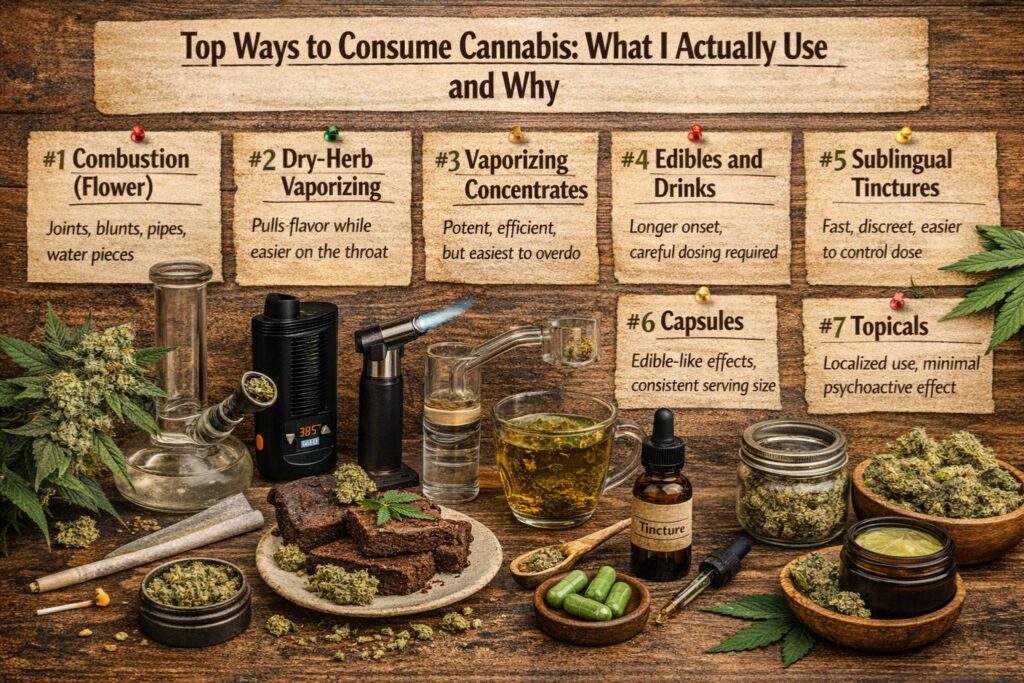
I’ve tried most cannabis consumption methods over the years using my own flower and simple kitchen-scale extractions. Some routes hit fast, some last a long time, and some are just easier on the throat after a long day in the garden. None of them are “best” for everyone, and the same strain can feel different depending on how it’s prepared and used.
1) Combustion with flower (joints, blunts, pipes, and water pieces)
Combustion is the old standby for marijuana flower. It’s immediate, it’s simple, and it lets you taste a strain’s personality in a way that’s familiar to most weed users. The trade-off is obvious: smoke is hot, it contains combustion byproducts, and it can irritate lungs and throat over time.
What I’ve noticed from my own harvests:
- Fresh, under-cured buds taste sharp and feel harsher. A longer, stable cure usually smooths the experience.
- A small joint can be more controlled than a big one, especially if you’re learning microdosing thc for beginners.
- Water filtration can cool the smoke, but it can also mute flavor if you overdo it.
My practical tips for combustion:
- Grind consistency matters. Too fine burns hot; too coarse can canoe.
- If you use paper, don’t overpack. Airflow is your friend.
- If you use a pipe, keep it clean. Old resin makes every strain taste the same.
- For water pieces, use fresh water. Stale water ruins terpene perception.
Onset and duration (what I see most often):
- Onset: usually within minutes
- Peak: often 15–30 minutes
- Total window: commonly 2–4 hours, depending on dose and tolerance
If you want a quick session and fast feedback, combustion still sits among the top ways to consume cannabis. But I treat it as an occasional tool, not my everyday default.
2) Dry-herb vaporizing (my go-to for weed flavor and control)
If I had to pick one everyday route, it’s dry-herb vapor. It’s efficient, easier on the throat than smoke for many people, and it makes cultivar differences obvious when the flower is well cured.
I keep a simple cannabis vapor temperature guide in my grow journal so I don’t chase heat out of habit.
This is where a cannabis vapor temperature guide actually matters. Temperature changes what you feel:
- Lower temps tend to highlight flavor and lighter effects.
- Mid temps feel balanced and produce reliable clouds.
- Higher temps can feel heavier and more sedating, but flavor drops and irritation can rise.
How I run it in practice:
- I start low for a few pulls to taste the strain.
- I step up temperature gradually until the vapor thins.
- I stop when the material turns a uniform light to medium brown and the taste is flat.
If you’re new and trying to figure out how to dose cannabis safely, vapor is forgiving because you can take one or two pulls and pause. For me, this is the easiest way to taste what my weed actually smells like in the jar.
Onset and duration:
- Onset: typically within minutes
- Peak: often 10–45 minutes
- Total window: commonly 2–4 hours
3) Vaporizing concentrates (high efficiency, higher risk of overdoing it)
Concentrates can be fantastic, but they’re the easiest way to take too much too quickly. I’m not talking about bravado sessions; I’m talking about the practical risk of chasing a bigger hit before you’ve felt the first one.
My own rules:
- Tiny is the right starting point, even for experienced users.
- I keep the temperature controlled and the path clean.
- I don’t use concentrates when I need to be productive or social. They can flatten my day if I misjudge.
This is still part of the cannabis consumption methods landscape, but I treat concentrates as a “special occasion” option.
Onset and duration:
- Onset: usually within minutes
- Peak: fast, sometimes within 5–20 minutes
- Total window: often 2–4 hours, but intensity can be front-loaded
4) Edibles and drinks (longer runway, careful dosing)
Edibles are where I see the most beginner mistakes, and I’ve made them myself. Pot brownies are the cliché, but any weed-infused oil can surprise you if you rush the timing. The delayed onset can trick you into taking more, and then the experience stacks.
If you want cannabis edible dosing tips that actually help, here are the ones I live by:
- Start low and wait. I treat the first session as a test, not a “real” dose.
- Keep the same product and dose for a few tries before changing variables.
- Eat a normal meal first. A completely empty stomach can feel unpredictable.
- Write it down. I track dose, time, and how long it lasts.
Edibles can also hide variability. Even when two people eat the same dose, the results can differ based on body size, metabolism, and whether they ate beforehand.
This is the place where a cannabis onset time chart is useful. My typical pattern:
- Onset: commonly 30–120 minutes
- Peak: often 2–4 hours after ingestion
- Total window: frequently 6–10+ hours depending on dose
Because edibles last, they’re not my choice for a quick session. But for sleep routines or long evenings, they can be among the top ways to consume cannabis if you respect timing and dose control.
5) Sublingual tinctures (fast, discreet, and easier to meter)
A tincture is one of my favorite practical tools because it sits between inhalation and edibles. When I make a small-batch marijuana tincture from cured trim, I’m chasing consistency more than potency. When I place a measured amount under the tongue and hold it, the onset is often quicker than eating, and I can adjust dose in small steps.
My sublingual cannabis tincture guide basics:
- Use a consistent dropper and measure in milliliters, not “drops.”
- Hold under the tongue for 60–90 seconds if possible before swallowing.
- Start with a low amount and repeat only after you’ve waited long enough.
If you’re trying to learn how to dose cannabis safely without lung irritation, sublingual dosing can be a good bridge.
Typical timing for me:
- Onset: often 15–45 minutes
- Peak: around 45–90 minutes
- Total window: commonly 3–6 hours
6) Capsules (edible-like effects with cleaner dosing)
I’m grouping capsules here because they behave similarly to edibles, but I find them easier to dose consistently. When I make or buy capsules, I know the exact amount in each one. That helps with repeatability and makes a cannabis onset time chart easier to use.
Tips I use:
- Keep the dose low until you understand your personal response
- Avoid mixing with alcohol or other substances
- Plan for a long duration and don’t schedule complex tasks
Capsules are one of the more boring cannabis consumption methods, and I mean that as a compliment. Predictability is the goal.
7) Topicals (localized use without an obvious “high” for most people)
Topicals are a different lane for cannabis and marijuana users. I’ve used balms and oils made with cannabinoids, and the results are subtle and localized for many people. The key idea is topical cannabinoid absorption: what happens on the skin is not the same as inhaling or eating. When I evaluate a balm, I’m thinking about topical cannabinoid absorption first, not the size of the jar.
My realistic expectations:
- Effects, if any, tend to be mild and focused to the area applied
- The carrier matters; some oils spread well, some feel greasy
- It’s not an instant fix. I give it time and stay consistent
Topicals are often included in lists of the top ways to consume cannabis because they’re approachable and don’t require inhaling.
A Simple Decision Framework I Use
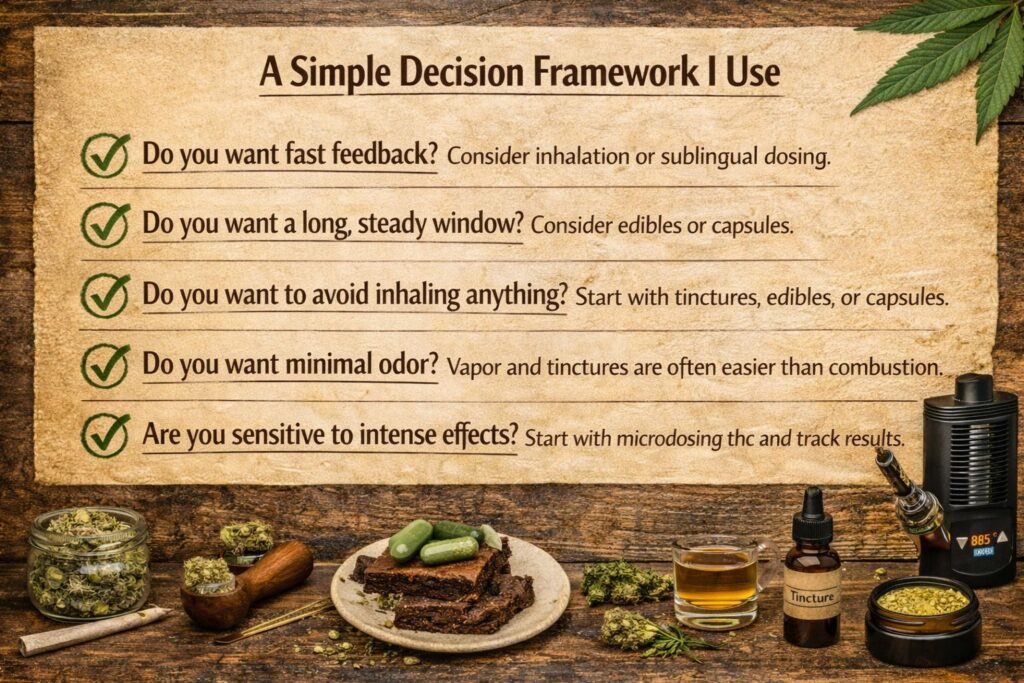
When friends ask me for a recommendation, I don’t start with the product. I start with the scenario:
- Do you want fast feedback? Consider inhalation or sublingual dosing.
- Do you want a long, steady window? Consider edibles or capsules.
- Do you want to avoid inhaling anything? Start with tinctures, edibles, or capsules.
- Do you want minimal odor? Vapor and tinctures are often easier than combustion.
- Are you sensitive to intense effects? Start with microdosing thc for beginners and track results.
This is harm reduction cannabis use in practice: choose the route that makes it easiest to stay within your comfort zone.
My Baseline Dosing Rules
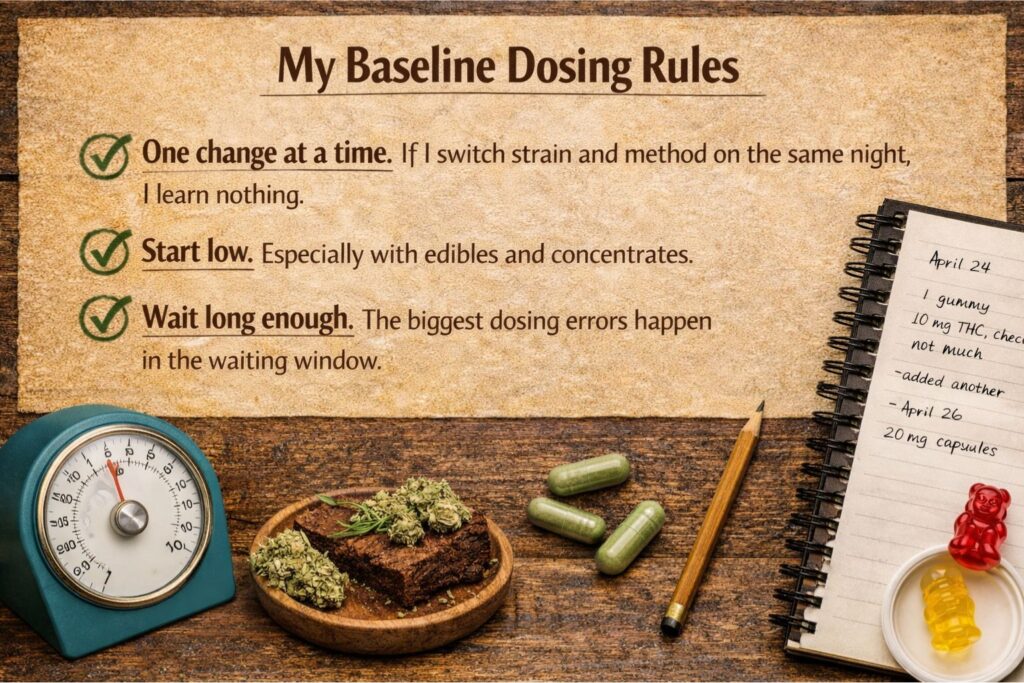
Everyone’s tolerance and sensitivity differ. Still, I rely on the same principles when I’m figuring out a new cultivar or a new product:
- One change at a time. If I switch strain and method on the same night, I learn nothing.
- Start low. Especially with edibles and concentrates.
- Wait long enough. The biggest dosing errors happen in the waiting window.
If you want a practical answer to how to dose cannabis safely, it’s this: dose like you’re collecting data. Treat your first tries as small experiments, not a challenge.
Making Better Flower for Every Consumption Route
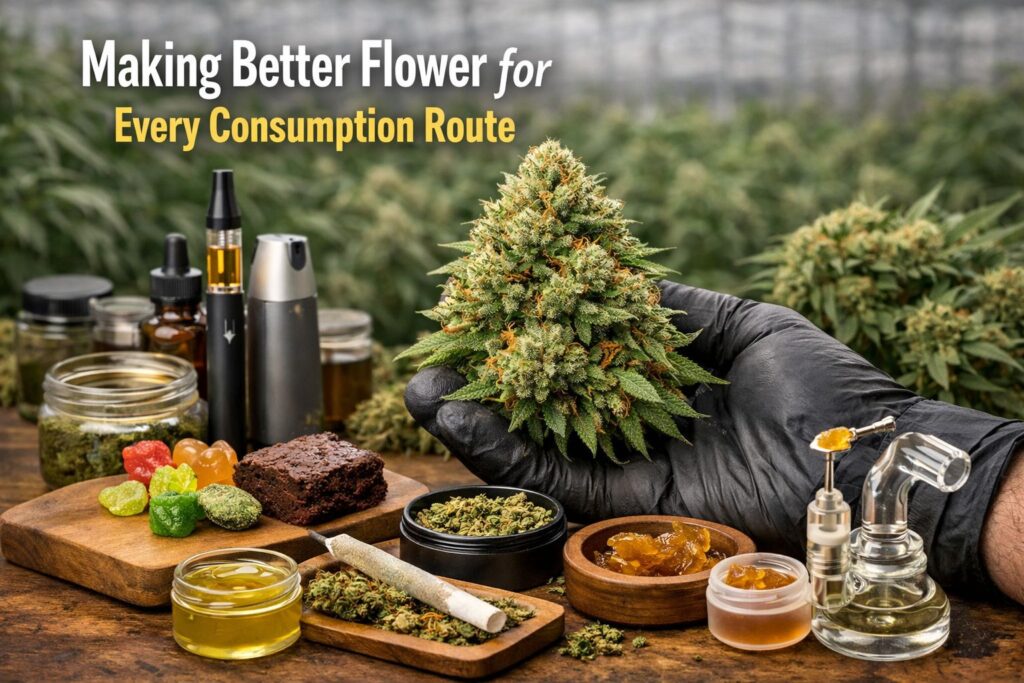
Because I grow, I can adjust my process based on how I plan to use the final product. Here are a few cultivation and post-harvest habits that reliably improve consumption quality.
Drying and curing for smoother sessions
What’s worked for me:
- Slow dry in a controlled space, not a hot room
- Avoid overdrying; brittle buds taste flat and feel harsh
- Cure in airtight containers once the exterior is dry and stems have a slight snap
- Burp as needed early on, then reduce handling once moisture stabilizes
When the cure is right, combustion is less harsh, vapor is more flavorful, and even edibles tend to have a cleaner taste.
Terpenes and why they matter
People ask me for a straight answer on aroma and effects, so I’ll say it plainly: cannabis terpene effects explained in perfect detail is hard, because experience varies and the research is still evolving. Still, I revisit cannabis terpene effects explained as a concept every harvest because it helps me stay focused on aroma preservation.
But in my own sessions, terpene-rich flower reliably changes flavor and the “shape” of the experience, especially in vapor.
My practical takeaway:
- If it doesn’t smell good in the jar, it rarely tastes good in the device.
That’s why I focus on drying and cure and avoid pushing nutrients so hard that the plant finishes stressed.
Seed Shopping and Grow Planning Without the Hype
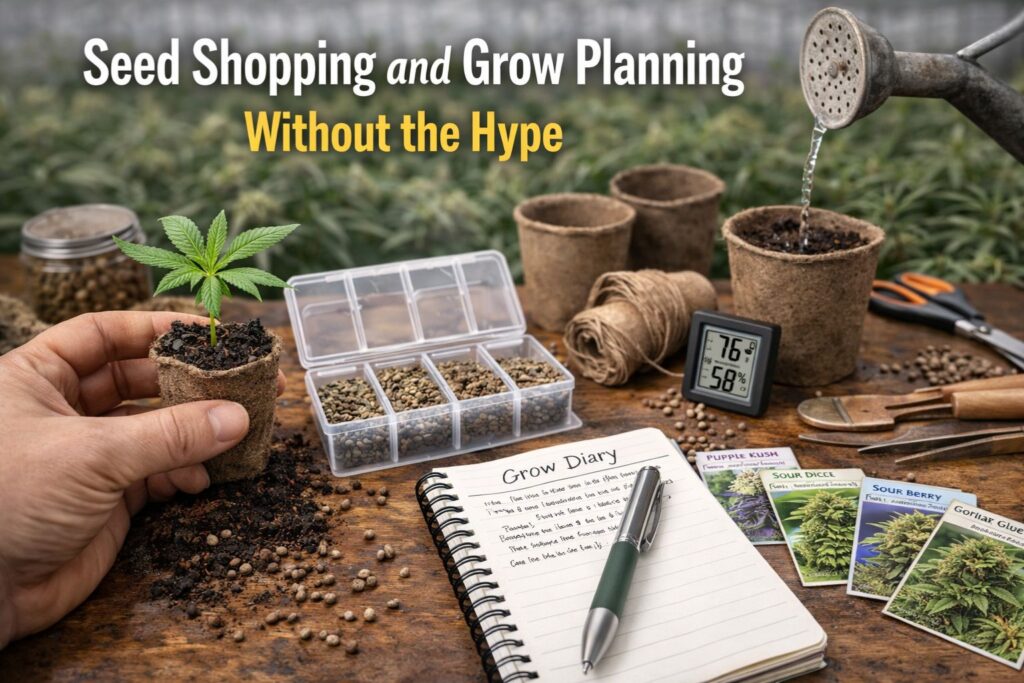
Even though this post is about consumption, most of my questions start with seeds and the kind of marijuana plant I want to run next. If you’re choosing genetics for your next run, these are the grower-focused decisions that affect what ends up in your grinder, your vaporizer, or your infusion jar.
Feminized, autoflowering, and photoperiod: what I watch for
- Feminized seeds reduce the chance of males, which is convenient for small spaces and tight schedules.
- Autoflowering plants can be a good fit for quick cycles and limited vertical room, but they can be less forgiving if you overfeed early.
- Photoperiod plants give you control over veg time and training. If you like topping, training, and cloning, they’re the classic choice.
No matter what you choose, remember that phenotype variation is real. Two plants from the same pack can finish differently and produce different aromas. I plan my dry space accordingly.
Soil vs. hydro, and how it shows up in the jar
I’ve run living soil, coco, and hydro-style feeding. Each can produce excellent cannabis, but they require different habits.
- Soil can be more forgiving with watering, but it’s easy to overdo amendments and lock out nutrients.
- Coco demands consistent irrigation and balanced EC, but it can deliver very clean results when you keep runoff in check.
- Hydro systems can push growth hard, but they punish small mistakes quickly.
If your goal is flavor for vapor, I care less about the medium and more about finishing clean: no late heavy feeding and no rushed dry.
Safer-Use Practices I Stick To
Harm reduction cannabis use is not fearmongering; it’s how you keep a plant enjoyable over years instead of burning out on bad experiences.
Here’s my checklist:
- Don’t mix cannabis with driving or risky tasks
- Keep edibles labeled and away from kids and pets, especially if they look like normal candy or baked goods from the kitchen
- Avoid combining cannabis with alcohol if you’re still learning your response
- Take tolerance breaks if your baseline dose keeps climbing
- If you feel anxious, change your setting, hydrate, and breathe. More is rarely the answer
If you’re new, microdosing thc for beginners is the smartest way to start. I’d rather take two mild sessions than one overwhelming one.
FAQ: Real Questions I Hear All the Time
How long does a cannabis edible take to kick in?
For many people, the onset is anywhere from 30 to 120 minutes. That’s why a cannabis onset time chart is useful: it forces you to wait long enough before taking more. My cannabis edible dosing tips are simple: start low, wait, and don’t stack doses early.
What’s the most efficient route if I want to use less flower?
Vapor is usually my answer. With a good cannabis vapor temperature guide and a clean device, you can extract a lot from a small amount of well-cured bud. It also makes cultivar flavor differences more obvious.
Is there a way to consume marijuana without smelling like smoke?
Dry-herb vapor is often lower-odor than combustion, especially if you manage airflow and store your device properly. Sublingual dosing can be even more discreet, which is why I like a sublingual cannabis tincture guide approach for travel-friendly routines.
What’s the safest way to start if I’m sensitive to THC?
I can’t tell you what’s “safe” for your body, but I can share harm reduction cannabis use habits: start with microdosing thc for beginners, use a route with easy stop points (like vapor or sublingual dosing), and keep the session simple. If you want to know how to dose cannabis safely, the answer is almost always “less than you think.”
Do different strains feel different when used as edibles?
Sometimes yes, sometimes less than people expect. The process of digestion can blur strain differences compared to inhalation. That’s why I keep my cannabis edible dosing tips focused on dose, timing, and consistency. If you want strong strain character, vapor tends to show it better.
Can I make tincture from flower I grew at home?
In places where it’s legal, many growers do. The key is consistency and measurement. A sublingual cannabis tincture guide should emphasize careful labeling, predictable strength, and patient testing of dose over multiple sessions.
Do topicals get you high?
For most people, topicals don’t produce the same psychoactive effect as inhalation or eating. Think of topical cannabinoid absorption as a localized route. Start with realistic expectations, patch test for skin sensitivity, and keep notes.
What should I look for when choosing seeds if I care about flavor?
I look for genetics with proven aroma and I plan my grow to preserve it. That means stable environment, reasonable PPFD, and a slow dry and cure. For cannabis terpene effects explained in a practical way, I’ll say this: terpene-rich flower tastes better and often feels more nuanced in vapor.
Can I switch methods using the same flower?
Absolutely. That’s the fun part of exploring cannabis consumption methods. I often use the same jar for vapor in the evening, and the same trim for an infusion later. Just remember that each method changes timing and intensity, so treat each route as its own dose experiment.
Final Thoughts
The top ways to consume cannabis aren’t about chasing intensity. They’re about matching a route to your goals, your schedule, and your comfort level. For me, dry-herb vapor and sublingual dosing win most days because they combine control with a clear sense of strain character. Combustion has its place, edibles and capsules are great when I want duration, and topicals are a separate tool entirely. And when I want cannabis terpene effects explained through taste and aroma rather than theory, vapor is where I notice it most.
If you’re building your stash from your own harvest, take notes. The same weed can feel completely different depending on route and dose, and that’s where a little record-keeping saves you from repeating the same marijuana mistakes. The more you treat your sessions like small experiments, the faster you’ll learn how your body responds and which cannabis consumption methods fit your life.
