
As a home cultivator who has run this line more times than I can count, Strawberry Cough cannabis strains are the ones I reach for when I want bright flavor, uplifting energy, and reliable structure in the garden. This berry scented daytime weed strain has followed me through tiny rental closets, dialed-in tents, and more than one improvised greenhouse, and it still finds new ways to surprise me.
In this guide I walk through exactly how to grow Strawberry Cough from seed based on real cycles I’ve completed, not theory. Think of it as my indoor grow diary Strawberry Cough edition: every section comes from mistakes I actually made and adjustments I dialed in over multiple runs.
Whether you are planning a small tent grow Strawberry Cough project in a spare bedroom or want to tuck a single plant into the corner of a larger room, the fundamentals stay the same: respect the vigor of a Strawberry Cough sativa dominant cultivar and give it enough light, air, and root space to express itself.
Why Grow Strawberry Cough Now

In a market full of dessert crosses and ultra-heavy indica-leaning hybrids, Strawberry Cough sativa dominant cultivar lines bring something different to the table. The high is clear and talkative for me, the aroma leans toward wild strawberries and incense, and the plants have enough vigor to handle assertive training without sulking.
For personal stash I like to keep at least one berry scented daytime weed strain around so I am not reaching for sedating flower in the middle of the day. After a few seasons of testing, Strawberry Cough cannabis strains have become that reliable jar for me; they stay functional while still delivering a satisfying, full-flavor experience.
There are trade-offs. The stretch can be serious, flowering usually runs a little longer than many hybrid lines, and these plants like a stable environment more than some rugged indicas. If you are willing to plan ahead and stay organized, though, the payoff is a fragrant, uplifting harvest that stands out from the crowd.
Genetics, Structure, And Terpenes

Most cuts and seed lines sold under this name lean heavily toward the sat-dominant side. When I describe my favorite phenotype as a Strawberry Cough sativa dominant cultivar, I mean it literally: long internodes, narrow leaflets, and a tendency to stretch two to three times after the flip.
On the nose, my keeper behaves like a berry scented daytime weed strain with layers of sweetness over earthy spice. Lab reports I have seen from similar cuts usually show a mix of myrcene, pinene, and caryophyllene, but for practical grow-room purposes what matters is that the flowers reek of ripe fruit once you get the environment dialed.
The buds themselves form stacked spears rather than golf-ball nuggets, often with a lighter green color and bright orange pistils. Trichome coverage is generous but not so sticky that trimming becomes impossible, which makes this line friendly for home growers processing by hand.
Planning Your Space For Strawberry Cough

My first successful run started as an experiment in a 2×4 tent, essentially a proof-of-concept small tent grow Strawberry Cough trial. I learned quickly that vertical space matters more than floor space; even in a short container, these plants want to shoot upward.
Since then I have logged every run in an indoor grow diary Strawberry Cough spreadsheet, tracking pot size, training style, and final yield. Looking back over those notes, the happiest plants were always the ones with plenty of headroom, strong airflow, and consistent temperature swings of no more than three to four degrees between day and night.
In my current room I still treat each new plant as another chapter in that small tent grow Strawberry Cough story: keep extraction strong, avoid cramped corners, and plan trellising before the stretch instead of after. If you are short on height, lean harder on training and early flipping instead of trying to fight the cultivar’s natural inclination to stretch.
Environment Targets At A Glance
Here are the ranges that have worked best for me in a controlled indoor space:
- Vegetative temperature: 23–26°C
- Flowering temperature: 24–26°C lights on, 20–22°C lights off
- Relative humidity: 60–70 percent in veg, 45–55 percent in flower
- VPD: roughly 0.8–1.1 kPa in veg, 1.1–1.3 kPa in bloom
- Strong, oscillating airflow across and under the canopy
These are not rigid rules, but staying close to them keeps stress low and helps Strawberry Cough cannabis strains show their full potential.
Lighting And PPFD Targets

When people ask me how bright to run their fixtures for Strawberry Cough cannabis strains, I pull up my old logs instead of guessing. Over many runs I settled on moderate to high intensity: seedlings at gentle levels, mid-range during early veg, then stronger output in flower once the roots are fully established.
In practice that means I aim for PPFD levels for Strawberry Cough plants around 250–300 µmol/m²/s for the first week after transplant, then 400–500 in late vegetative growth. Once the canopy is full and healthy, I push PPFD levels for Strawberry Cough plants into the 650–750 range in mid-flower, easing back slightly in the last two weeks to reduce stress.
These numbers assume I can keep leaf-surface temperature in check with good airflow. If your room runs hot or CO₂ sits at ambient, it is safer to keep PPFD levels for Strawberry Cough plants at the lower end of that window and focus on even coverage instead of chasing huge readings in a few hotspot zones.
Light height and dimming knobs are your friends. Rather than locking the fixture in place, I adjust weekly based on plant response: praying leaves and steady growth are good signs; canoeing or bleaching tells me to back off immediately.
Substrate, Containers, And Nutrients

I have run this line in coco, peat-based mixes, and living soil. The most forgiving setup for new growers has been a lightly amended organic soil in 3–5 gallon fabric pots. It buffers mistakes and pairs well with an organic feeding schedule for Strawberry Cough that focuses on steady inputs instead of big swings in EC.
I like to keep vegetative solution in the 1.2–1.6 EC range and bloom around 1.6–2.0 EC, but with an organic feeding schedule for Strawberry Cough that usually means top-dressing dry amendments every couple of weeks and supplementing with compost teas or low-strength liquid feeds rather than pouring on bottled nutrients at full strength.
Whatever products you use, build your own organic feeding schedule for Strawberry Cough slowly. Start lighter than the label suggests, watch leaf color and tip burn, and remember that a slightly hungry plant is easier to recover than one with locked-out roots.
Calcium and magnesium support deserve special attention, especially under powerful LED lighting. I keep a low-rate cal-mag supplement in rotation during early veg and the first half of flower, then taper off as the plant approaches its final swell.
From Germination To Strong Seedlings

Starting Seeds The Simple Way
Over the years I have tried fancy gadgets and complicated methods, but my most reliable approach for how to grow Strawberry Cough from seed now is very simple: pre-soak in room-temperature water for 12–18 hours, then move the seeds into a lightly moistened starter plug or small pot of seedling mix.
I avoid paper towels and constant handling because fragile taproots do not like being disturbed. If you are still figuring out how to grow Strawberry Cough from seed, keeping the process low-stress is more important than chasing a perfect germination rate.
Once taproots emerge and the first cotyledons open, I move the babies under gentle light and start paying closer attention to the small details that make or break seedling success.
Dialing In Seedling Care
In my notebooks, the runs that went sideways almost always started with sloppy seedling care for Strawberry Cough. Too much light, cold media, or overwatering in those first two weeks will stunt a plant in ways you cannot completely fix later.
Now my checklist for seedling care for Strawberry Cough is simple: gentle airflow, 22–25°C root-zone temperature, small but frequent waterings around the edge of the plug, and only very mild nutrition once the first true leaves appear.
If I had to summarize seedling care for Strawberry Cough in one sentence, it would be this: treat the babies like they are more precious than your mature plants, because in a way they are—the early days determine how well Strawberry Cough cannabis strains will handle stress during the rest of the cycle.
Vegetative Growth And Training

Once the roots fill out a small container, these plants take off. I rarely let them veg taller than 25–30 cm before starting Strawberry Cough training techniques, because the stretch after the flip is real and can easily double or triple plant height.
My favorite Strawberry Cough training techniques are basic but effective: top once at the fourth or fifth node, then use low-stress training to pull the main branches outward and create a wide, shallow bush. In a grid of 2×2 plants in a 4×4 tent, this gives me a level canopy and keeps colas from growing into the light.
In smaller setups I lean on even gentler Strawberry Cough training techniques, like strategic leaf tucking and soft plant ties, so I can guide each branch without snapping brittle stems. However you approach it, remember that structure is one of your main tools for controlling a tall, energetic cultivar.
During this stage I keep nitrogen available but not excessive, watch for early signs of pests under the leaves, and maintain a regular pruning schedule so interior growth does not turn into a humid jungle.
Flowering: Aroma, Stretch, And Climate Control

I usually flip Strawberry Cough cannabis strains to 12/12 when the tops are just below half the final height I am willing to manage. With good pre-training, the post-flip stretch fills the net without overcrowding, and the branches stay sturdy enough to hold dense, resinous flower.
In early bloom I keep day temperatures around 24–26°C with lights on and 20–22°C with lights off, aiming for a VPD around 1.2 kPa. As pistils start to stack, the room gradually fills with that unmistakable berry scented daytime weed strain aroma; carbon filters are mandatory if you need discretion.
By week six or seven, trichomes usually range from clear to cloudy on my favorite phenotypes. I minimize late-stage stress by avoiding heavy defoliation and keeping EC steady rather than slamming them with extra nutrients. Strawberry Cough cannabis strains seem to reward consistency more than extreme pushing at this point.
I also pay close attention to airflow under the canopy. Because the buds form long spears, stagnant air can invite mold in dense sections. A small clip fan aimed under the canopy has prevented more problems for me than any bottle on the shelf.
Harvest, Drying, And Cure
Reading The Plant
Rather than harvesting by calendar alone, I rely on trichome color and overall plant posture. When most trichomes are milky with a sprinkling of amber and the plant begins to fade gently from the bottom up, I know the cultivar has reached its sweet spot for the effect I prefer.
Drying For Smooth Smoke
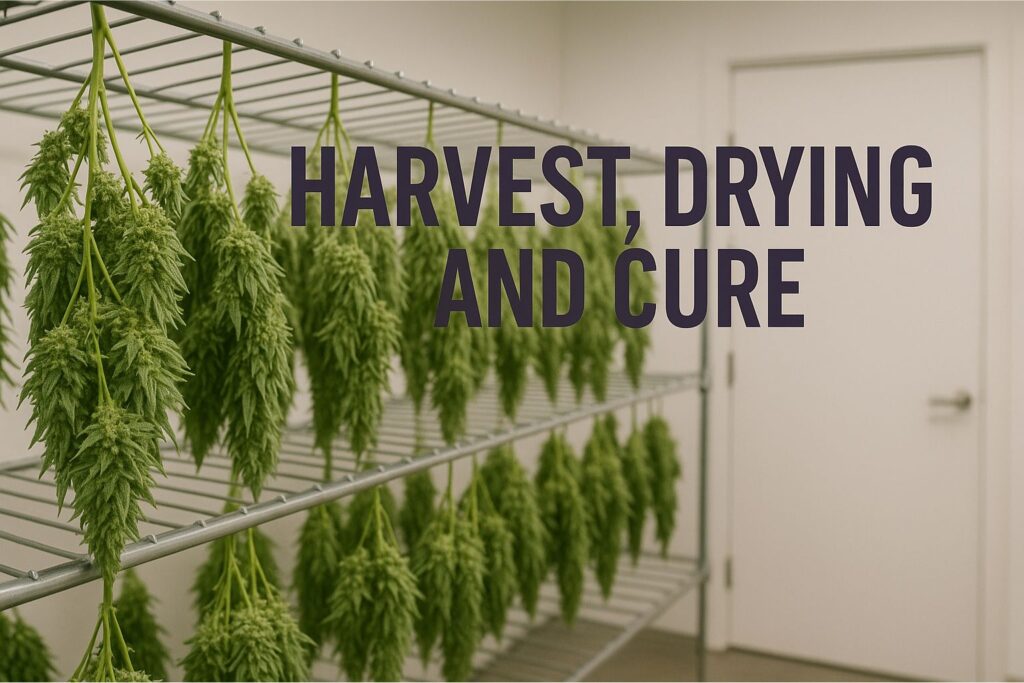
Once I am satisfied with the trichome mix, I cut the plant at the base, remove only the largest fan leaves, and hang the branches whole in a dark room at 18–20°C with 55–60 percent relative humidity. This slow approach is the foundation of drying and curing Strawberry Cough buds properly; rushing the process traps chlorophyll and ruins the bright fruit notes.
I aim for a 7–10 day dry, feeling for small stems that snap instead of bend. If the room is too dry, I use extra containers and slightly larger branches to stretch the timeline. The difference in the final jar between rushed and patient drying and curing Strawberry Cough buds is massive, especially when you care about flavor as much as potency.
Curing And Storage
After the initial dry I trim the flowers over a clean tray, saving the resinous sugar leaf for later use, then load the buds into glass jars filled no more than three-quarters full. For the first couple of weeks I burp the jars once or twice a day, checking that the surface feels dry but slightly tacky. That final stage of drying and curing Strawberry Cough buds locks in the terpene profile and keeps the experience consistent for months.
Stored in a cool, dark space, my jars keep their strawberry-forward nose for a long time, making this cultivar a staple in my personal rotation.
Troubleshooting And Common Mistakes
Looking back over my indoor grow diary Strawberry Cough notes, the same issues show up again and again: seedlings stalled by overwatering, stretch misjudged in short tents, and gardeners chasing yield with too much nutrient concentration.
If your plants look pale and weak, resist the urge to dump extra feed into the pots. Check pH, confirm that pots are not staying waterlogged, and make gradual adjustments. On the flip side, clawed, dark leaves often tell you that nitrogen is too high; easing off can restore balance before quality suffers.
Another common problem is ignoring local regulations about plant counts, outdoor visibility, or home cultivation. Before you order seeds from any seed bank, take time to understand the rules where you live. Regulations change, and staying informed is part of being a responsible grower.
FAQ: Real-World Questions About Growing Strawberry Cough
Is Strawberry Cough suitable for beginners?
If you are comfortable managing plant height and keeping your environment reasonably stable, this line is very friendly. The plant structure is forgiving, and with a simple plan for how to grow Strawberry Cough from seed you can avoid most major problems. New growers should focus on gentle seedling care for Strawberry Cough, modest nutrient levels, and early training rather than chasing huge yields on their first run.
How long does Strawberry Cough take from seed to harvest indoors?
In my room, a typical cycle runs about four to six weeks of vegetative growth followed by nine to ten weeks of flower. That puts most Strawberry Cough cannabis strains in the 13–16 week range from seed to jar, depending on how long you veg. Starting with a small tent grow Strawberry Cough plan and flipping early can shorten the total timeline without sacrificing quality.
Can I grow this cultivar in a very small tent or cabinet?
Yes, but you need a strategy. Combine careful Strawberry Cough training techniques with early flipping and consistent pruning. A small tent grow Strawberry Cough setup with strong extraction, short containers, and a tight trellis can keep everything under control, even if the cultivar wants to stretch.
What kind of smell should I expect during flower?
Expect strong, sweet, berry-heavy aroma with a bit of spice and earth underneath. This berry scented daytime weed strain gets louder each week of bloom, especially in the last third of the cycle. Carbon filters, sealed ducts, and regular maintenance on your odor-control gear are essential if you need to stay discreet.
How should I choose seeds and what about local laws?
When shopping for seeds, look for breeders who share detailed information about their Strawberry Cough sativa dominant cultivar lines, including approximate flowering time, plant height, and whether the line leans more toward classic or modern expressions. Order only from reputable sellers and always check regional rules about purchasing and germinating marijuana seeds. Laws vary widely, and it is your responsibility to stay informed before you even start thinking about how to grow Strawberry Cough from seed.
Strawberry Cough cannabis strains reward patience, planning, and curiosity. Treat each run like another page in your own indoor grow diary Strawberry Cough story, pay attention to environment and structure, and keep refining your approach. Over time you will find the phenotypes and methods that fit your space, your taste, and your goals, turning this cultivar into a dependable cornerstone of your garden.
