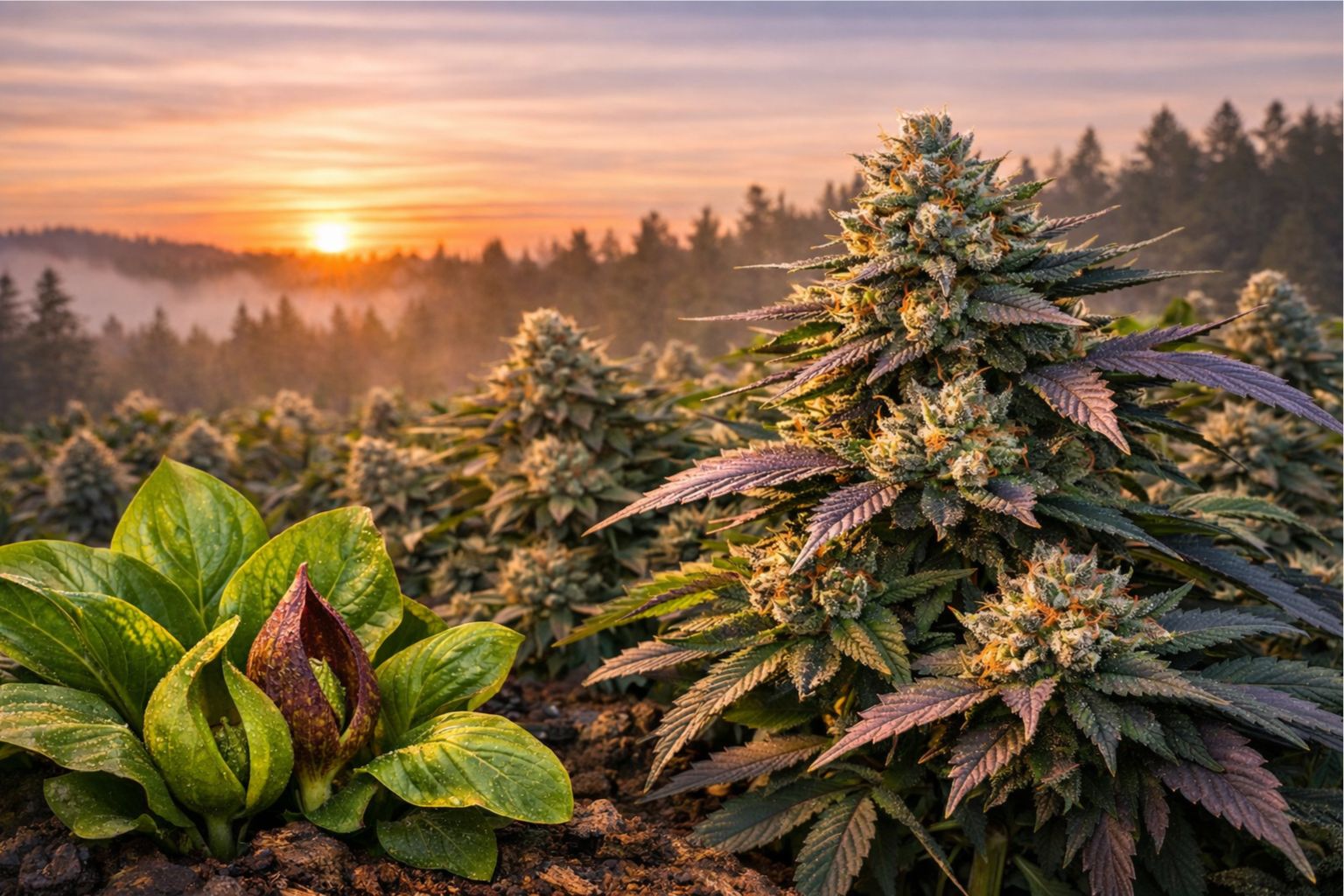
I’ve grown enough cannabis to learn that a name can be useful or it can be noise. Some names are pure marketing. Others are shorthand for a set of traits you can actually grow around: structure, vigor, aroma, and how a plant behaves when you change light, airflow, or feed strength.
This post is my personal grow log on a plant I’ve come to call “Skunk Cabbage,” and how that experience reshaped the way I think about skunk-leaning genetics inside the broader world of cannabis strains. I’m not going to promise miracles or pretend every seed pops into a trophy. What I can do is lay out what I observed, what worked, what didn’t, and the practical decisions I made from sprout to jar.
If you’re reading this from a place where cultivating marijuana or weed is illegal, treat this as general educational background and strain-selection discussion. Always follow local rules and licensed guidance where that applies.
What I mean by “Skunk Cabbage”

The “Skunk Cabbage” label started as a joke in my room. In early flower, one plant in the run threw a sharp, sulfur-forward funk that reminded me of damp greens and crushed stems, layered over that classic skunky bite. It wasn’t just “loud.” It was distinctly vegetal in a way that made the nickname stick.
When I say skunk cabbage and cannabis strains in the same breath, I’m talking about two things:
- Aroma direction: a pungent, green, slightly sulfurous edge that can read as skunk-like and “cabbagey” at the same time.
- Grow behavior: the way certain plants respond to stress, pruning, and the shift into flower, especially when you’re running modern LED lighting.
The most important thing I learned is that the name matters less than the repeatable traits. If you can describe the plant’s habits and the finished flower’s character, you can grow it better and shop smarter.
Skunk Cabbage seed selection

I start every new line the same way: with selection, documentation, and realistic expectations. Skunk cabbage seed selection is where you either set yourself up for success or you roll the dice blindly.
Here’s the short version of what I look for when ordering seeds online:
- Clear lineage notes: even if the breeder keeps some details private, they should say whether the line is mostly indica-leaning, sativa-leaning, or a balanced hybrid, and what kind of flowering window to expect.
- Stability talk that’s specific: I trust breeders who describe what they had to work through (stretch, sensitivity, slow ripening) more than breeders who call every release “perfect.”
- Germination and storage guidance: seed viability is a logistics issue as much as a genetics issue. I want to see how they recommend storage, handling, and what to do if a seed coat is stubborn.
- Shipping transparency: I care about packaging, tracking, and how they handle reships or lost parcels. A seed retailer that answers these questions clearly is usually better across the board.
I also decide up front what kind of seed format fits the project. In my case, I wanted a mostly female canopy to evaluate flower traits without managing pollen, so I chose a female-only seed line. I also ran a small side tray of autoflowering genetics just to compare timelines, but I did not expect the auto plants to match the same flavor lane.
Skunk cabbage seed selection is also about numbers. I plan to germinate enough seeds to see variation. One plant can be a fluke. A small group lets you see what the line tends to do.
Skunk cabbage phenotype hunt
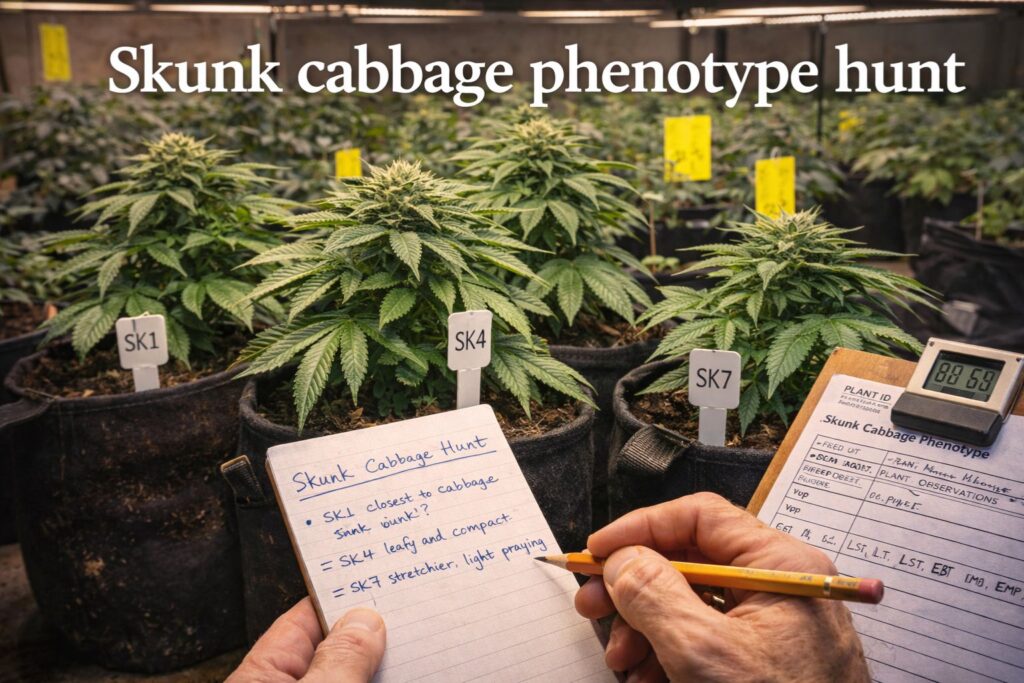
The “hunt” is the fun part, but it’s also where sloppy growers lose track of what they’re seeing. I treat a skunk cabbage phenotype hunt like a mini trial:
- Label everything from day one. Pots, tags, notes, photos.
- Keep conditions steady so differences are more likely genetic than environmental.
- Make one change at a time (training, feed strength, or light intensity) so I can connect cause and effect.
During this skunk cabbage phenotype hunt, I watched for early tells:
- Leaf posture under LED: some plants pray; others taco or claw if the environment is off.
- Internode spacing: tight spacing can be great, but it can also become a humidity trap if you don’t manage airflow.
- Stem flexibility: a plant that bends without snapping usually trains easier.
By mid-veg, two plants stood out for the cabbage-funk tendency, but only one carried it cleanly into flower. The other expressed a similar sharpness early on, then drifted toward a generic sweetness as buds matured.
Medium choice: skunk cabbage soil-to-harvest vs hydro
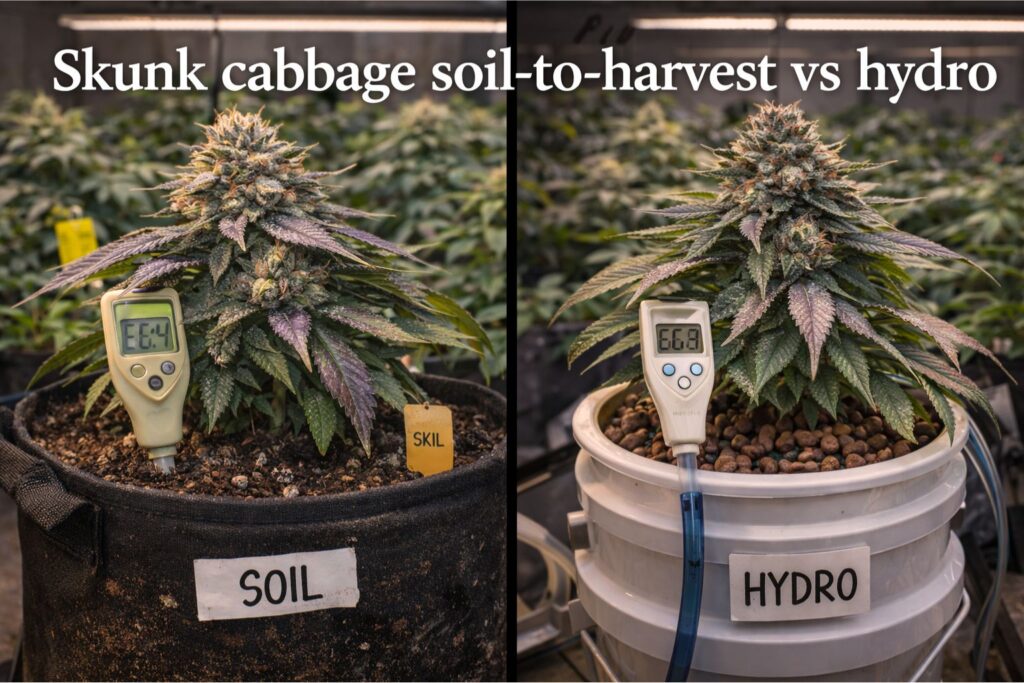
I’ve run both soil and hydroponic systems. For this project I did a skunk cabbage soil-to-harvest run in a living soil style, because I wanted a forgiving buffer while I evaluated the line. I also ran one small hydro container on the side as a comparison, mainly to observe speed and nutrient response.
Soil gave me:
- More forgiveness when the feed was slightly off
- Slower swings in root-zone moisture
- A wider “good enough” window when temperatures changed
Hydro gave me:
- Faster feedback when something wasn’t balanced
- Less tolerance for missed watering or drift
- A clearer read on whether the plant was sensitive to salts
The practical takeaway: skunk cabbage soil-to-harvest was the better choice for phenotype evaluation. Hydro is great when you already know the cultivar’s appetite and you want repeatability and speed.
Skunk cabbage indoor LED run
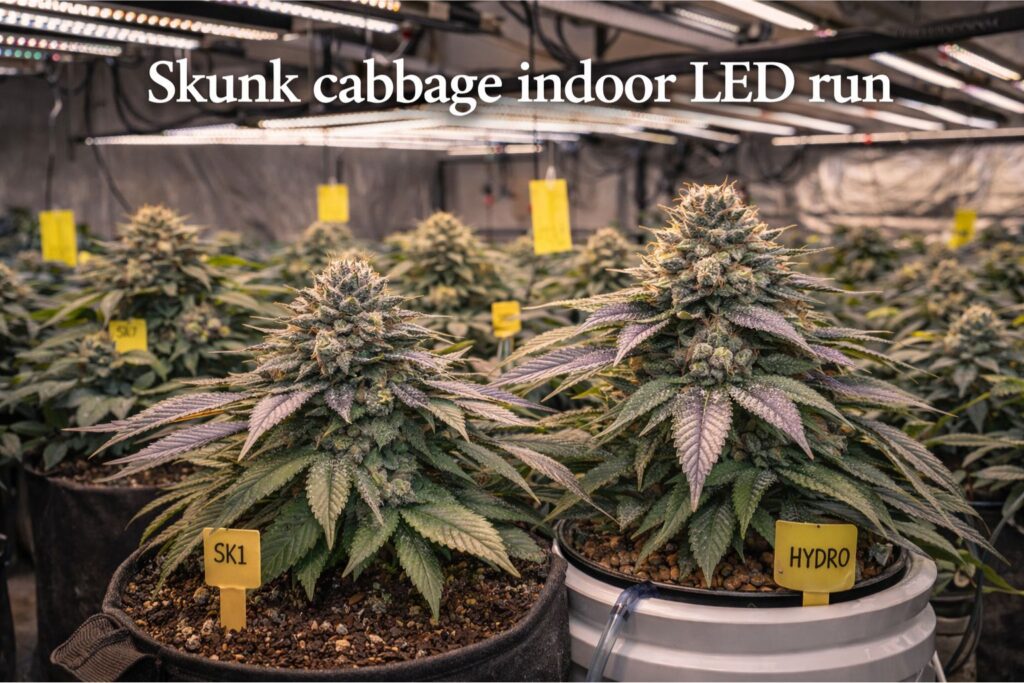
Most of my recent work has been indoors, and this skunk cabbage indoor led run reminded me that LEDs reward precision. You don’t need to chase extremes, but you do need to pay attention.
My baseline environment approach:
- Strong air exchange and active circulation at canopy level
- A stable day/night temperature rhythm (not necessarily identical, just consistent)
- Humidity set to match plant size and transpiration, not a fixed number year-round
- Clean intake filters and a simple sanitation routine
On lighting, I focus on even canopy coverage and gradual increases. When a plant is vigorous, it’s tempting to crank intensity too fast. In this run, the cabbage-funk plant was the most light-hungry of the group, but it also showed stress first when I pushed too hard. The leaves told me before the buds did.
If you want a practical check without obsessing over numbers: watch leaf edges and overall posture. When I saw slight upward curl and a subtle dullness in the upper fans, I backed off intensity and improved airflow. Within a few days, the plant looked relaxed again.
Skunk cabbage indoor led run also highlighted something about training: the plant didn’t like heavy, repeated topping. One early top was fine. Multiple tops slowed it down and increased lateral clutter.
Skunk cabbage training routine
My skunk cabbage training routine was designed to keep the canopy flat, open the center, and reduce the risk of hidden moisture pockets later in flower.
What worked best:
- One early top, then letting the plant recover fully
- Low-stress training to widen the structure without stalling growth
- Selective removal of inner growth that would never see good light
- Light defoliation in stages, instead of one aggressive strip
What I avoided:
- Repeated high-stress cuts late in veg
- Overcrowding the trellis too early
- Training on days when the plant already looked stressed from environment drift
The plant that became my “Skunk Cabbage” keeper responded well to gentle shaping. When I treated it like a sensitive athlete instead of a tank, it rewarded me with steadier growth and more uniform bud sites.
I’ll say it plainly: skunk cabbage training routine is not about forcing a plant into a shape. It’s about guiding it into a structure that fits your airflow, your light, and your dry-down plan.
Skunk cabbage nutrient cadence

I don’t believe in one nutrient recipe for every plant. I believe in observation, consistency, and slow adjustments. Skunk cabbage nutrient cadence, for me, meant staying predictable and letting the plant tell me when it wanted more.
My guiding principles:
- Keep the root zone evenly moist, not cycling between soggy and bone dry
- Increase feed strength only after the plant proves it can use it
- Avoid large swings in solution strength or pH targets
- Use leaf color and growth rate as signals, not ego
In soil, I leaned on a base mix and top-dressed lightly. In the hydro side container, I kept the solution clean and conservative. The skunk cabbage nutrient cadence that worked was steady, not aggressive. When I pushed too much nitrogen late in veg, the cabbage-funk plant produced thicker, darker leaves that later became more work to manage in flower.
When I eased back and let the plant breathe, bud initiation looked cleaner and aromas showed earlier.
Skunk cabbage pest checks
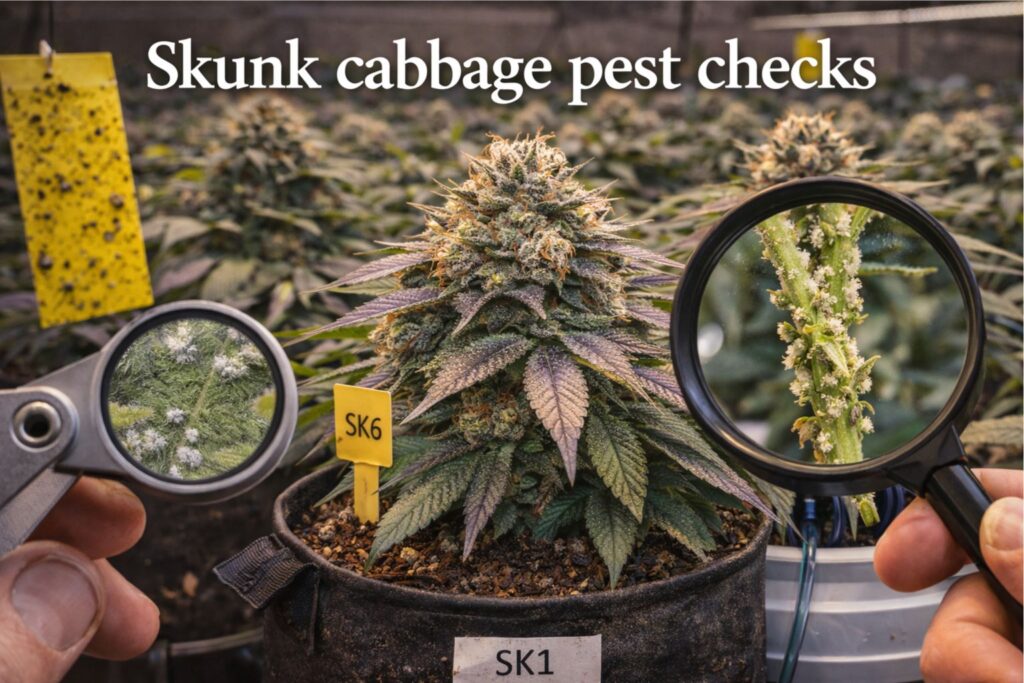
Even a small pest issue becomes a big problem once the room is sticky and fragrant. Skunk cabbage pest checks were part of my weekly routine, not a reaction to damage.
My routine is simple:
- Inspect the underside of leaves with a small light
- Look for stippling, curling, or odd patches that don’t match nutrient issues
- Check the soil surface and the lower stalk area
- Keep sticky traps as an early warning system
- Quarantine new plants and clones away from the main room
In this run, I caught a minor gnat presence early, corrected watering habits, and cleaned up the top layer. It never became a full infestation. I’ve learned the hard way that the cleanest rooms aren’t the ones with the most sprays; they’re the ones with the most consistent hygiene and environment control.
Skunk cabbage pest checks also include mold risk. A dense canopy with skunk-heavy aroma can tempt you to keep things sealed up. Don’t. Airflow is your friend.
Skunk cabbage flowering stretch
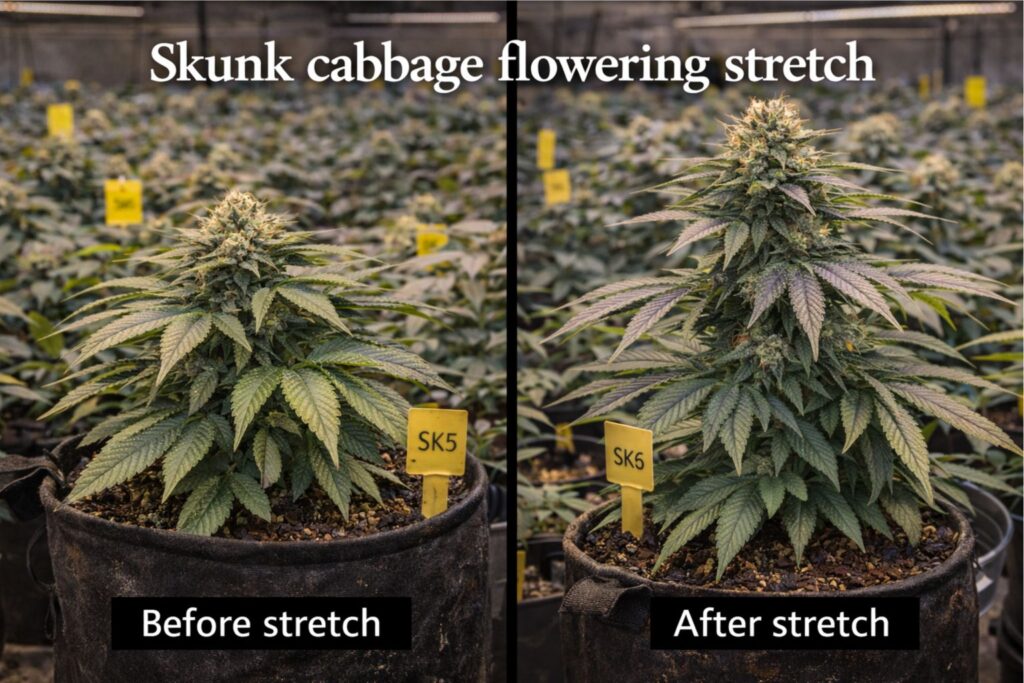
The shift into flower is where the plant tells you who it really is. Skunk cabbage flowering stretch in my room was moderate but noticeable, and it punished me when I got lazy about canopy height.
What I did during the transition:
- Adjusted training to keep tops even and avoid a spiky canopy
- Reduced inner growth that would become popcorn
- Increased airflow through the mid-canopy
- Watched for signs of stress from the light being too close after stretch
The cabbage-funk plant stacked well, but it also thickened quickly, which raised humidity risk. I spaced branches and resisted the urge to keep every bud site. Removing a few weak laterals improved the room’s air movement and made harvest easier.
Skunk cabbage flowering stretch also affected my expectations on finish time. One phenotype looked ready earlier, but the cabbage-funk plant needed more patience. If you harvest based only on calendar days, you’ll miss the peak.
Skunk cabbage terpene notes
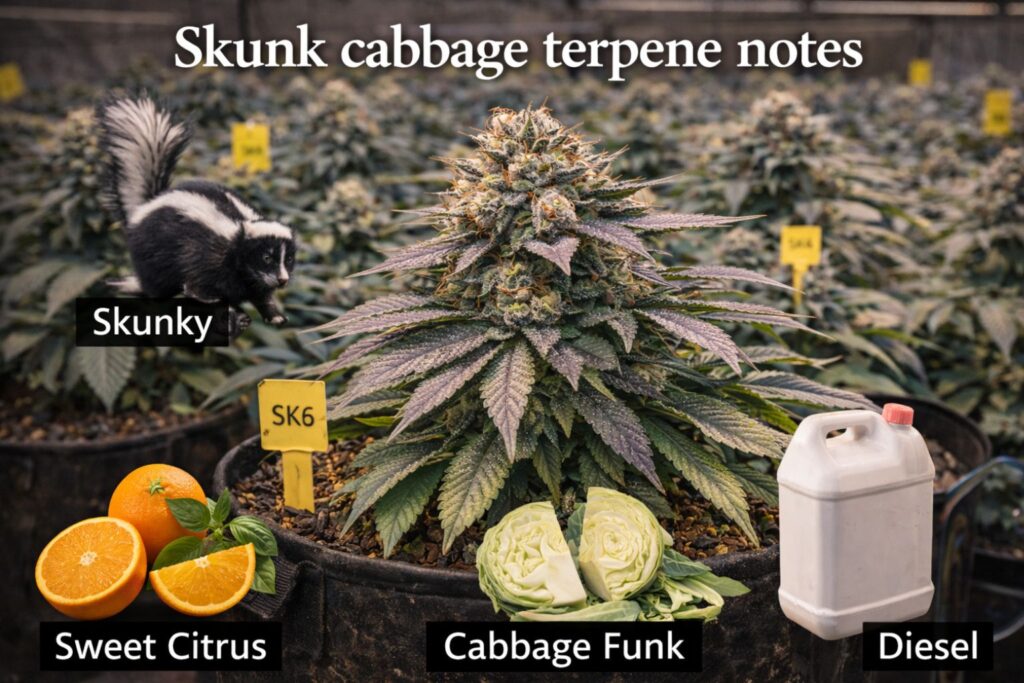
Aroma is subjective, but patterns repeat. My skunk cabbage terpene notes evolved through the cycle:
- Early flower: sharp green funk, crushed stems, and a skunk edge
- Mid flower: more depth, a savory undertone, and less “fresh cut” harshness
- Late flower: the cabbage note softened into something closer to fermented greens and spice
I’m careful with odor management. Not because I’m ashamed of the plant, but because smell travels. Carbon filtration and good sealing matter, especially if you live close to neighbors. If you can’t control odor, don’t grow anything that leans skunky. That’s a practical reality.
When I say skunk cabbage and cannabis strains, I’m also talking about why people chase these profiles. They’re distinctive. They don’t get lost in a jar. But they’re not always easy. These plants can be loud, and that comes with responsibility.
Harvest timing: how I decided
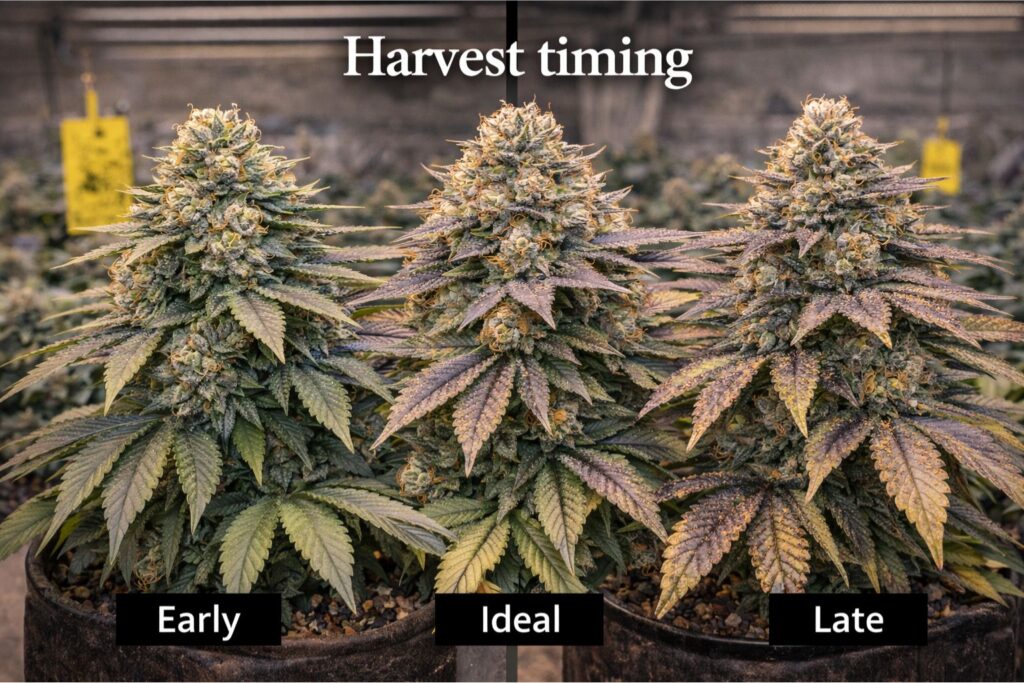
I don’t harvest by trichomes alone, and I don’t harvest by pistils alone. I use a mix:
- Overall plant fade and nutrient drawdown signals
- Bud firmness and calyx swelling
- Resin development and aroma maturity
- A quick microscope check as a confirmation, not the whole decision
The cabbage-funk plant held onto fresh green notes longer than I expected. Waiting a bit longer brought out more depth in the smell and a smoother smoke later.
Skunk cabbage dry and cure

If there’s one place growers lose quality, it’s post-harvest. Skunk cabbage dry and cure is where I either preserve that distinct aroma or I turn it into hay.
My non-negotiables:
- A slow dry in a dark space with steady airflow, never blasting directly onto buds
- Branches hung with space between them, not crowded
- A clean room with no strong odors, dust, or fresh paint
- Patience before trimming too tight
Once the outside felt dry but the inner stem still had a little flex, I moved flower into containers and “burped” them briefly, then extended the rest periods as moisture stabilized. That’s the point where the cabbage note mellowed and the skunk edge became more refined.
Skunk cabbage dry and cure also taught me that this profile punishes shortcuts. Quick-drying made the aroma harsher and flatter. Slow and steady preserved nuance.
How I compare skunk cabbage and cannabis strains in general
I hear growers say they want “skunk,” but they often mean different things:
- Some want sharp, gassy funk
- Some want a sweet-skunk balance
- Some want a savory, green punch like my cabbage phenotype
The lesson from this run is to define your goal in sensory terms, then choose seeds accordingly. Don’t buy based on the loudest description. Buy based on whether the breeder’s notes sound like your target.
When I talk about skunk cabbage and cannabis strains, I also think about how the same genetics can express differently depending on your environment. A warmer room can amplify certain aromas and speed up finish, while cooler conditions can preserve sharper notes and slow development. Neither is “right.” It depends on your objective.
A practical checklist for new runs
Here’s the checklist I use before I pop any new line, including when I’m doing a skunk cabbage phenotype hunt.
Before germination
- Confirm the legal status of cultivation where you live
- Decide on medium (soil-to-harvest style or hydroponics) based on your experience
- Prepare labels, a notebook, and a simple photo log plan
- Set up airflow and odor control before anything smells
In veg
- Keep environmental changes gradual
- Build structure early with a measured skunk cabbage training routine
- Start skunk cabbage pest checks before you see damage
- Keep feed strategy conservative and consistent
In flower
- Expect skunk cabbage flowering stretch and plan headroom
- Reduce interior clutter to avoid trapped humidity
- Track aroma changes with quick skunk cabbage terpene notes
- Plan post-harvest space early so you don’t rush the finish
FAQ
Is “Skunk Cabbage” a real cultivar name?
In my case, “Skunk Cabbage” is a nickname for a particular plant expression I observed during a skunk cabbage indoor led run. Breeders and seed sellers use names differently, so I focus on traits and consistency more than labels.
What should I look for during skunk cabbage seed selection?
I look for clear breeder notes, transparency about variation, and straightforward shipping and support policies. Skunk cabbage seed selection is less about chasing hype and more about choosing a line that fits your space and goals.
How do I keep a skunk-leaning weed plant from becoming an odor problem?
Plan odor control before flower, maintain steady airflow, and avoid sealing a humid room. The stronger the profile, the more important skunk cabbage pest checks and airflow become, because stress and humidity can make problems worse.
Does the medium change the aroma?
It can. My skunk cabbage soil-to-harvest run produced a rounded, savory profile. The small hydro container expressed a sharper edge. I wouldn’t call one “better,” but the difference was noticeable.
What was the biggest mistake you made?
I pushed intensity too fast in the skunk cabbage indoor led run and saw stress cues in the upper leaves. Backing off, improving airflow, and keeping skunk cabbage nutrient cadence steady fixed it, but it cost me a week of smooth momentum.
How long should skunk cabbage dry and cure take?
Long enough that the flower stabilizes and the aroma shifts from sharp green to more mature notes. Skunk cabbage dry and cure is where patience pays off, especially with funky profiles.
