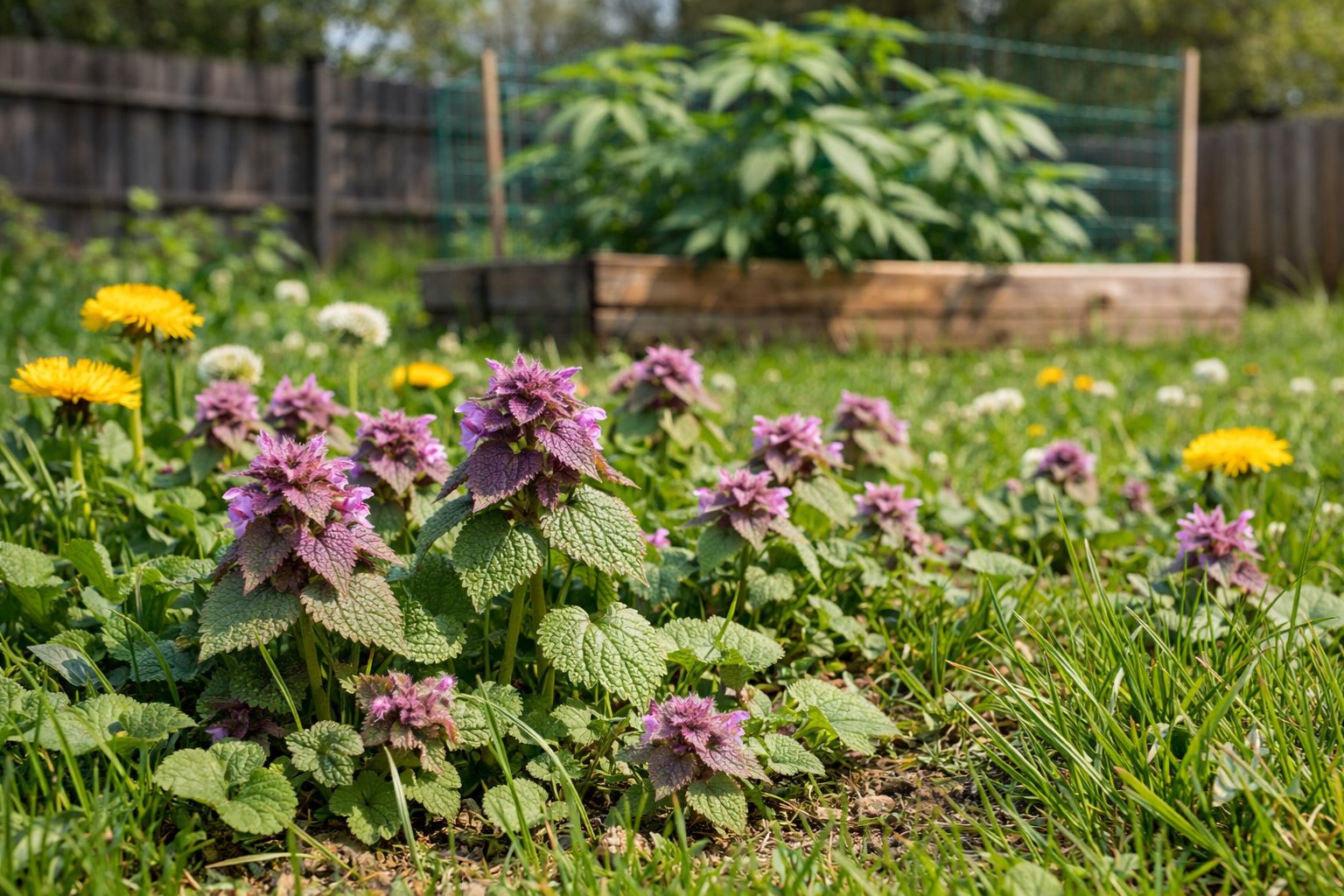
When I say I pay attention to lawn weeds, it is not because I want a perfect, golf-course yard. I pay attention because weeds tell me what my soil is doing, what my drainage looks like, and what pests are waking up. Those things matter when I am raising cannabis, marijuana, and weed plants for a full season outdoors. The first weed that reliably shows up in my yard is purple dead nettle, and it is the one that taught me how to think in seasons instead of reacting in panic.
In this post I am going to walk through how I handle purple dead nettle from first sighting to cleanup, using the same mindset I use in my grow: observe, measure, adjust, then repeat. I will cover dead nettle in lawns, how to tell it apart from a henbit lookalike, when winter annual weeds are actually germinating, and why pre-emergent timing matters even if you prefer minimal inputs. I will also connect the lawn side of the yard to the grow side with a practical outdoor cannabis perimeter plan, because the same early-season decisions that keep a lawn thick also reduce problems around the garden beds where I place my plants.
My first lesson: purple dead nettle is a calendar, not an emergency

Purple dead nettle is a winter annual. That means it usually germinates in the fall, survives winter as a small rosette, then takes off in late winter and early spring. By the time most people notice the purple tops, it has already been in the lawn for months. This is why dead nettle in lawns feels sudden even though it is not sudden at all.
The first time I saw purple dead nettle, I tried to fix it the way a new grower tries to fix everything: I threw tools at it. I pulled clumps, I mowed low, and I spot sprayed randomly. I got temporary results and then it came right back the next year. The shift happened when I started writing down dates, the same way I track a cannabis run by week.
Here is what my notes look like now:
- Late September to November: I assume winter annual weeds are germinating if there is bare soil and mild moisture.
- December to February: I watch for small rosettes in thin turf, especially along edges and compacted spots.
- Late February to April: purple dead nettle flowers, sets seed, and drops a new generation if I let it.
- May onward: it usually dies back as heat rises, leaving gaps that other weeds will exploit.
Once I treated purple dead nettle like a seasonal signal, my control got easier and my lawn stayed thicker.
Purple dead nettle identification that I actually use in the yard
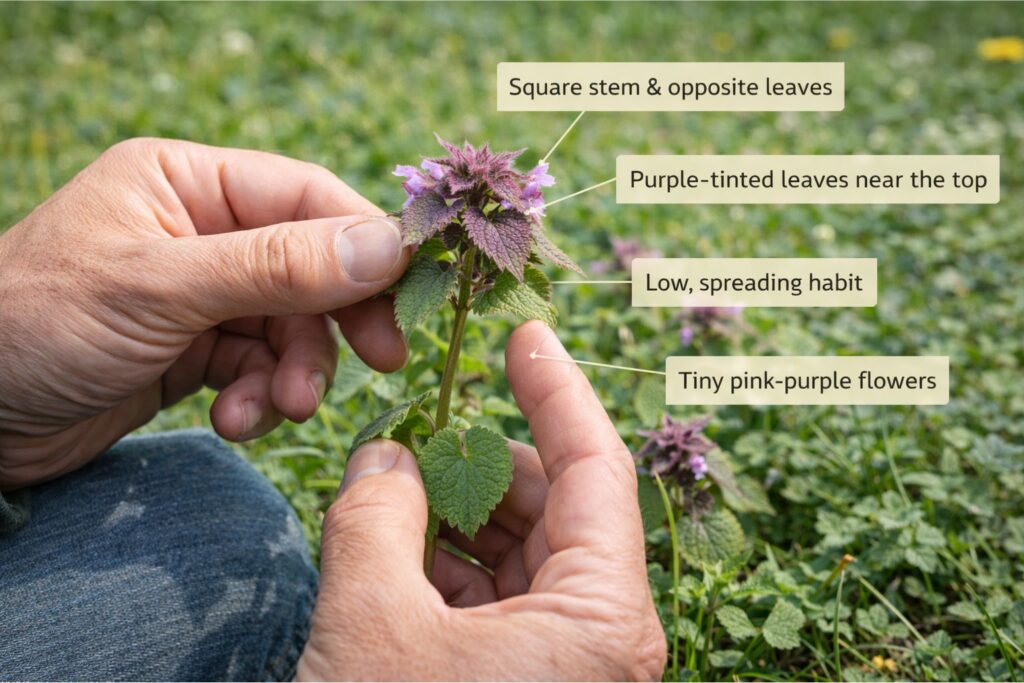
The most useful purple dead nettle identification method is the one you will do while holding a coffee and walking the yard. I do not rely on a single trait. I look for a pattern of traits, then confirm with a quick pull of a plant.
What I look for when confirming purple dead nettle identification
- Square stems and opposite leaves
Purple dead nettle is in the mint family, so the stem feels square and the leaves sit opposite each other on the stem. - Leaves that get smaller and more purple near the top
- The upper leaves often take on a purple tint, especially in cool weather.
- Low, spreading habit
In dead nettle in lawns, it tends to form little mats or patches rather than standing tall by itself. - Tiny pink-purple flowers
When it starts flowering, it is much easier to confirm.
If you are unsure, do a quick pinch test with gloves. Unlike stinging nettle, purple dead nettle does not sting. That simple note is part of my purple dead nettle identification routine because people hear nettle and assume pain.
The henbit lookalike that confuses people
Henbit is the classic henbit lookalike scenario and it shows up at the same time. The easiest difference in my yard is leaf attachment. Henbit leaves tend to clasp the stem more, while purple dead nettle leaves look more like they have little handles (petioles). Henbit also tends to have rounder, more scalloped leaves.
I still write henbit lookalike in my notes because the management calendar is similar, and either one signals the same turf weaknesses. To keep it practical: if you treat it as winter annual weeds and focus on thickness, mowing height strategy, and pre-emergent timing, the difference between the two matters less than the timing.
Why purple dead nettle keeps showing up in the same spots
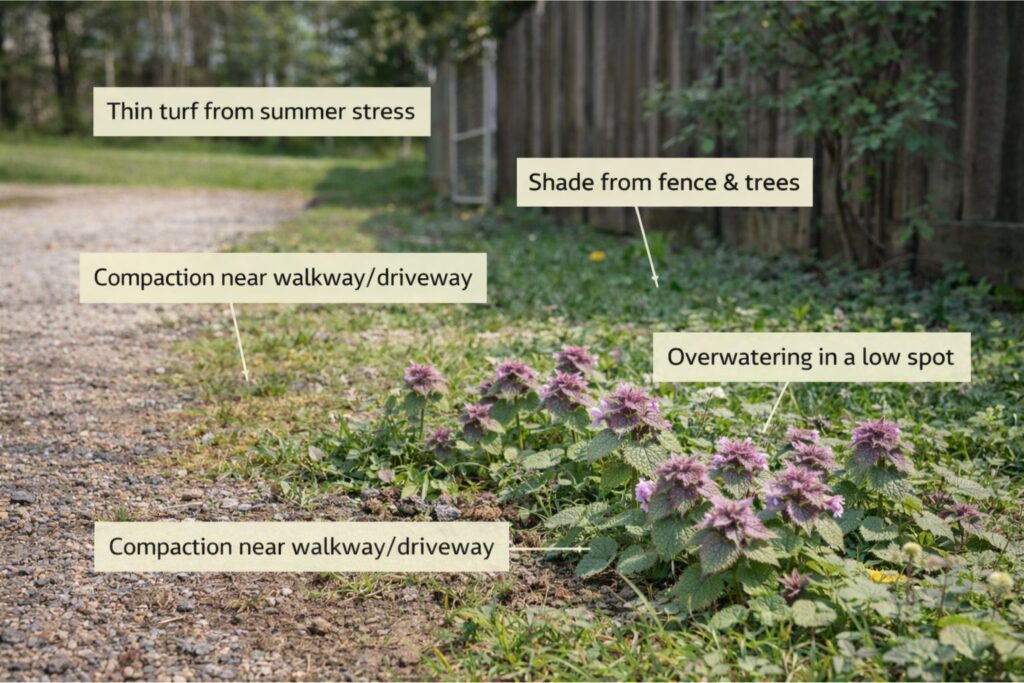
When I map dead nettle in lawns, it almost always overlays with one of these conditions:
- Thin turf from summer stress
- Compaction near walkways, driveways, and gates
- Shade from fences or trees
- Overwatering in a low spot
- Nutrient imbalance where grass struggles
This is similar to what happens in a cannabis bed when I keep seeing the same deficiency or pest. The problem is rarely the symptom. It is usually the environment, plus a small habit that repeats every year.
My lawn diagnostics checklist
I walk the yard and ask:
- Is the grass thin enough that I can see soil between blades?
- Does the soil feel hard and crusted (compaction)?
- Is there standing water after rain?
- Is it shaded for more than half the day?
- Is the mowing height strategy too short for the grass type?
If I answer yes to any of those, I treat the weed patch as a data point, not just a nuisance.
Control options I have actually used for purple dead nettle
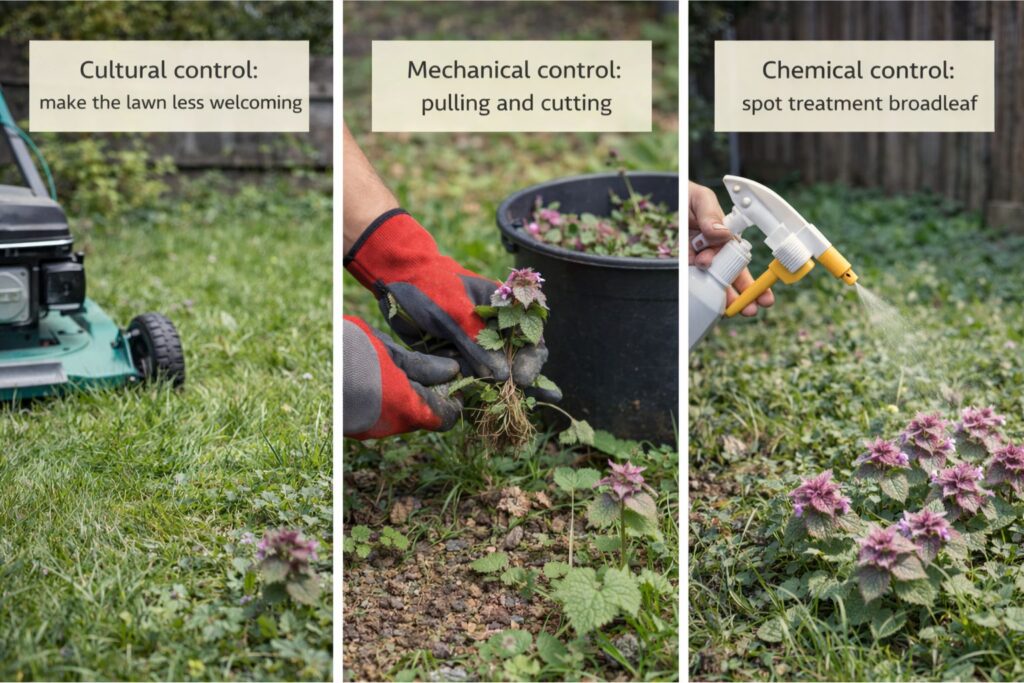
There is no single best method. I use a layered approach: cultural controls first, then targeted intervention if needed. That is the same principle I use in cannabis cultivation and weed cultivation indoors. The closer I can stay to prevention, the less I need rescue actions.
Cultural control: make the lawn less welcoming
- Adjust mowing height strategy
For most cool-season lawns, mowing too short is an invitation for winter annual weeds. I set my mower higher than my neighbors. A taller canopy shades the soil and reduces germination opportunities. Mowing height strategy is not glamorous, but it is the easiest long-term lever for dead nettle in lawns. - Feed the grass, not the weed
I use a soil test if I can, then feed based on what the turf needs. When I cannot test, I keep nitrogen moderate and focus on consistency, not spikes. Thick turf crowds out purple dead nettle. - Fix compaction
In my yard, the purple dead nettle hotspots are often where the soil is hard. Core aeration in early fall is one of the most effective steps for winter annual weeds because it improves root growth and helps overseeding thin turf succeed. - Improve drainage in low spots
Sometimes the fix is simple, like redirecting a downspout or adding organic matter. Waterlogged zones are a magnet for dead nettle in lawns.
Mechanical control: pulling and cutting, with realistic expectations
Hand pulling works best when the soil is moist and the plants are young. If you wait until flowering, you will still reduce seed production, but you will also disturb soil and create gaps. If I pull, I try to do it early and then immediately cover or repair the soil.
Mowing will not eliminate purple dead nettle, but mowing height strategy can prevent it from seeding heavily. The goal is to interrupt reproduction while the turf thickens and closes the space.
Chemical control: spot treatment broadleaf, done carefully
I am not here to sell you a bottle of anything. I will just share what has worked for me when the patch is too big to hand pull.
- For established purple dead nettle in early spring, I rely on spot treatment broadleaf products labeled for the lawn type. I read the label and follow it exactly.
- I avoid drift, especially near my garden beds and the outdoor cannabis perimeter.
- I avoid applying on windy days or when rain is likely to move product where it does not belong.
- I focus on small patches, not blanket spraying. Spot treatment broadleaf is about precision.
The key is timing. Many products work best when the weed is actively growing and temperatures are in the recommended range. Random spraying on a cold day is wasted money and risk.
Organic-leaning options and what I do instead
People ask about vinegar, salt, or boiling water. Those can injure plants, but they also injure turf and soil biology. In a lawn, they often create bare spots that bring back winter annual weeds even harder.
If I want an organic-leaning approach, I do two things:
- I treat soil biology boost as a long-term project by improving soil structure and microbial activity.
- I focus on overseeding thin turf so grass is occupying the space.
Pre-emergent timing: the step most people miss
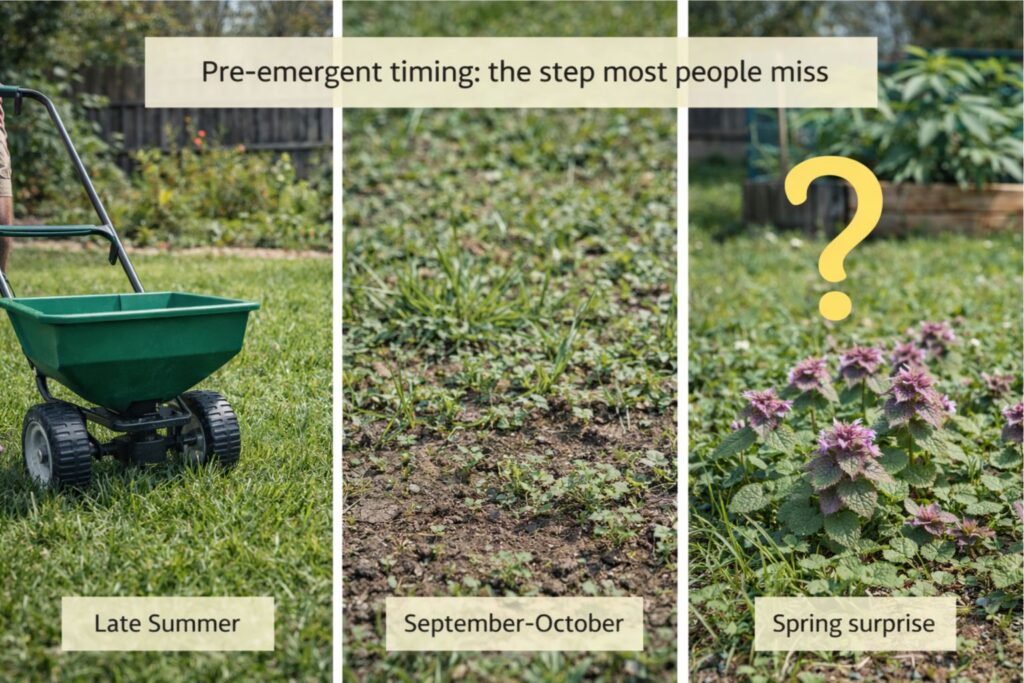
If purple dead nettle is a winter annual, the real battle happens before you see it. Pre-emergent timing for winter annual weeds is typically late summer into fall, depending on your region and weather. That was my big aha moment.
I used to think pre-emergent products were only for crabgrass. Once I understood the life cycle, I started setting a reminder for pre-emergent timing in early fall. If you choose to use a pre-emergent, understand one important trade-off: it can also inhibit your overseeding. That means you have to decide what your priority is.
Here is the decision tree I use:
- If the lawn is thin, I prioritize overseeding thin turf and skip pre-emergent in that area.
- If the lawn is thick but I had a bad weed year, I prioritize pre-emergent timing and plan overseeding in a different window.
This is the same kind of trade-off I make when choosing between aggressive training and faster finish times in a cannabis run. You cannot optimize everything at once, so you pick the lever that makes the next season easier.
Overseeding thin turf after weed pressure drops
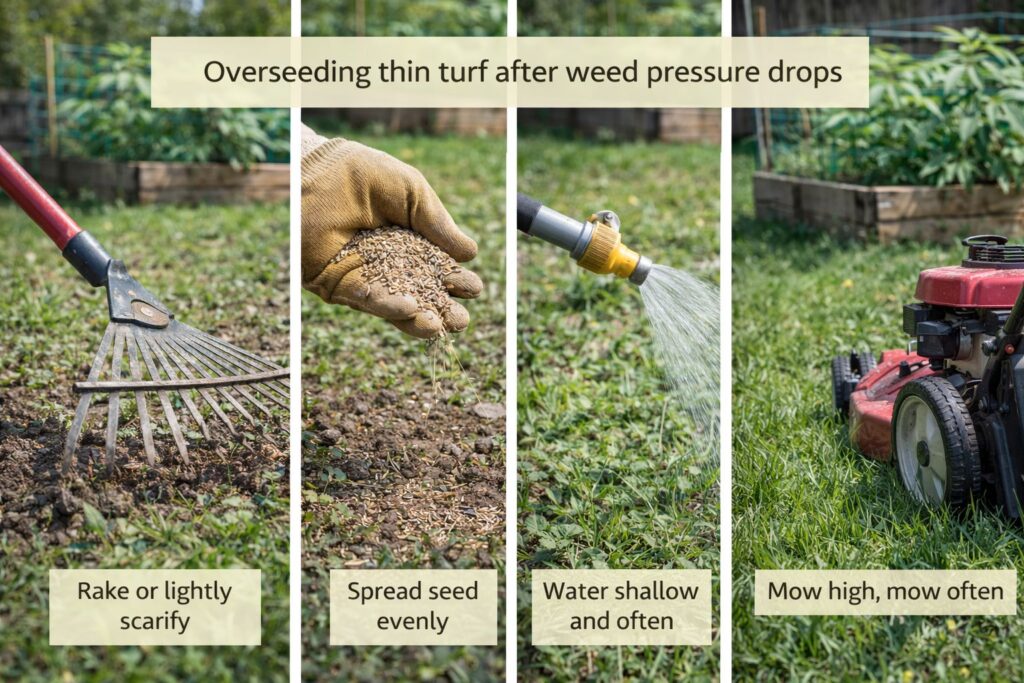
Overseeding thin turf is the step that made my results stick year to year. Removing purple dead nettle is only half the work. If I leave open space, something else will take it.
My overseeding thin turf process
- Rake or lightly scarify
I want seed-to-soil contact without tearing the yard apart. - Spread seed evenly
I use a calibrated spreader and walk in two directions. - Topdress lightly
A thin layer of compost or screened topsoil helps moisture retention and supports soil biology boost. - Water shallow and often
For germination, I water lightly once or twice per day for the first week or two, then transition to deeper watering. - Mow high, mow often
The mowing height strategy stays high while the seedlings establish. That extra leaf area helps the grass win the light war against winter annual weeds.
If you only do one big thing, do overseeding thin turf. It changes the whole playing field and reduces dead nettle in lawns more than any single intervention.
The connection growers miss: the outdoor cannabis perimeter
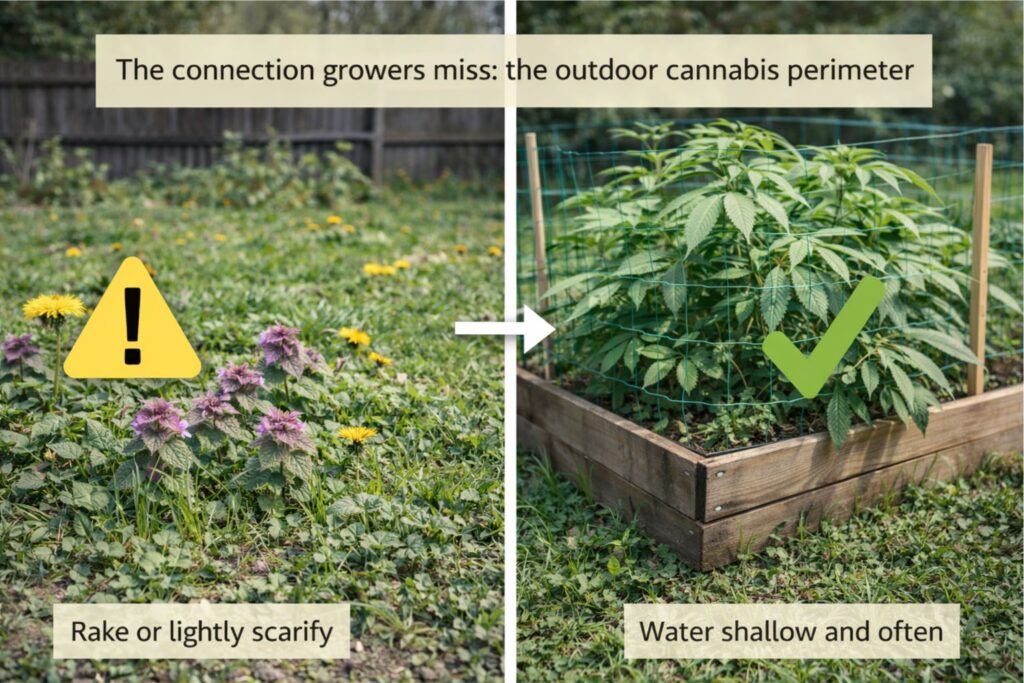
If you grow outdoors, your yard is part of your grow. The outdoor cannabis perimeter is the buffer zone that reduces pest pressure, keeps soil splash down, and simplifies watering and maintenance.
When purple dead nettle blooms, it can attract beneficial insects, but it can also be a host for pests like aphids. I do not assume it will cause problems, but I also do not gamble when I have tender cannabis plants coming outside in late spring.
Here is how I set up my outdoor cannabis perimeter:
- A mulch strip around beds to reduce weeds and soil splash
- Clear edges so I can see crawling pests early
- A separate tool bucket for lawn work so I do not drag turf pathogens into beds
- A clean-shoe habit when moving from lawn to garden
- A simple scouting route every few days during spring
That mulch strip is not just for aesthetics. It reduces the turf/bed interface where dead nettle in lawns and other weeds thrive, and it keeps any spot treatment broadleaf work well away from my beds.
I also pay attention to how wind and irrigation move. If you apply anything in the lawn, even organic products, keep drift and runoff away from cannabis, marijuana, and weed plants.
What I do in the grow while purple dead nettle is popping
Early spring is when I am usually starting or transplanting seedlings indoors. This is where the lawn calendar and grow calendar overlap, and where my notes stay honest.
My indoor baseline for young cannabis plants looks like this:
- Light schedule: 18/6
- PPFD: 200–350 at seedling stage, ramping up slowly
- Temperature: 24–26 C lights on, 20–22 C lights off
- Relative humidity: 60–70% early, then down to 55–60% as plants harden
- VPD: roughly 0.8–1.1 kPa for seedlings, adjusted by leaf response
- Nutrient strength: EC 0.8–1.2 depending on cultivar and medium
- Watering: I let the medium partially dry to keep roots oxygenated
I mention this because the same discipline helps on the lawn. If you can track PPFD and EC, you can track dates, mowing height strategy, and pre-emergent timing. The tools are different, but the mindset is identical.
Soil biology boost without turning your lawn into a science project
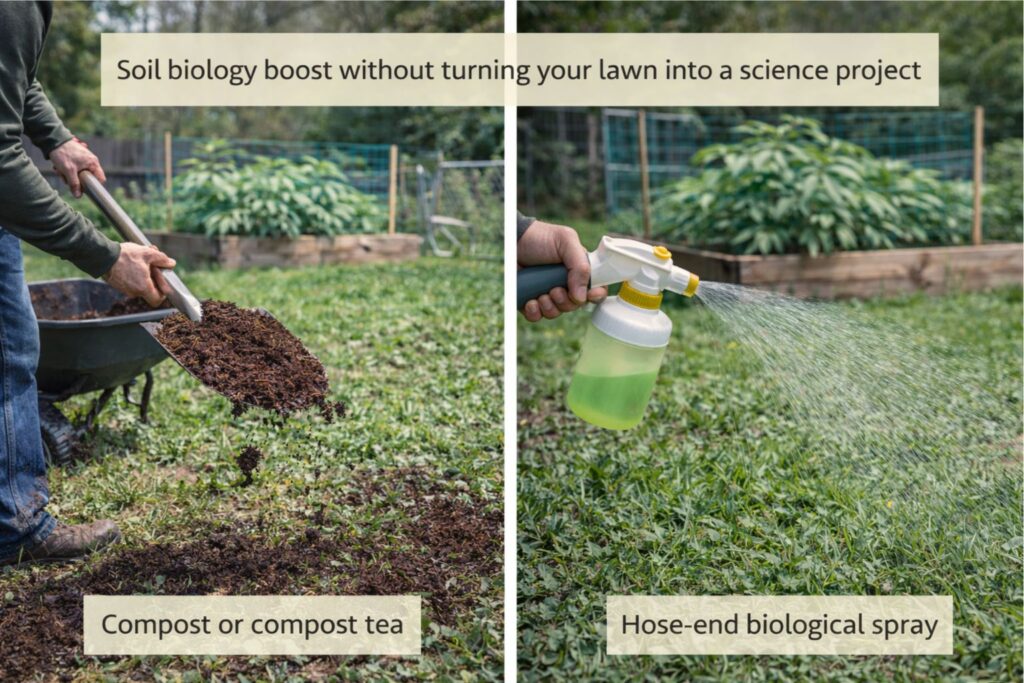
I care about soil biology boost because living soil behaves differently. It holds moisture better, drains better, and supports thicker turf. That means fewer winter annual weeds and fewer bare spots for dead nettle in lawns to exploit.
My simple soil biology boost routine:
- Add organic matter (compost topdressing) once or twice per year
- Mulch clippings when possible instead of bagging
- Avoid overusing harsh products that burn the soil
- Water deeply, less frequently once established
If you are also running living soil in cannabis containers, you already understand this concept. Biology is slow, but it is durable.
Practical field notes: what purple dead nettle tells me about my yard
Purple dead nettle is not just a weed. It is a message. Over the years, I have learned:
- It shows up where grass is weak. Thick turf is the best herbicide.
- It reminds me to plan fall work. Pre-emergent timing is a fall conversation, not a spring panic.
- It highlights compaction. Aeration plus overseeding thin turf is a strong combo.
- It pushes me to tidy the outdoor cannabis perimeter before transplant time.
If you want one actionable takeaway, start writing down when you see it. Once you match the dates to your yard conditions, purple dead nettle becomes predictable.
Seed shopping and cultivation questions I hear every spring
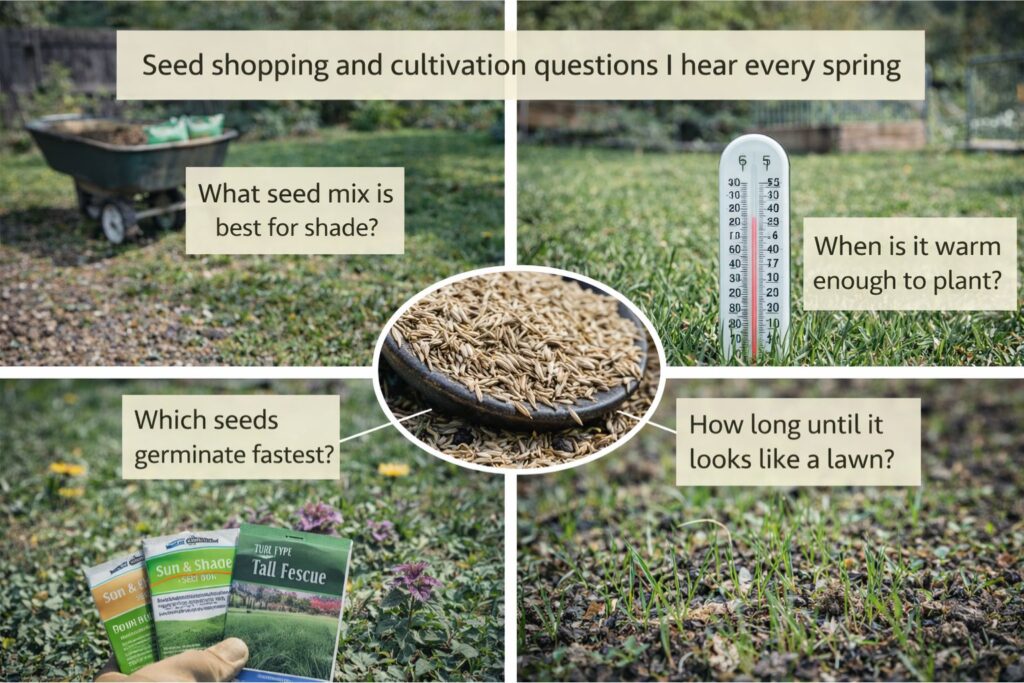
As soon as lawns green up, people also start thinking about cannabis genetics and seed buying. I cannot give legal advice, but I can share the practical questions I ask before I place an order and before I start germination.
Natural-language questions people actually type into Google
- Which cannabis seeds finish fast enough for a short outdoor summer?
- What is the difference between feminized seeds and regular seeds for a first-time grow?
- Are autoflowers a better choice than photoperiod plants for a small backyard?
- How do I store marijuana seeds long term without losing germination rates?
- What should I look for in a seed bank when I care about stealth shipping and tracking?
Questions I ask before buying seeds
- Will this cultivar finish outdoors in my climate window?
- Do I want photoperiod plants or autoflowers for the schedule I have?
- Am I choosing feminized seeds because I cannot risk males, or do I want regular seeds for selection?
- What is the seller’s shipping process and packaging like for my region?
- How should I store seeds so they stay viable until I pop them?
How I connect seed choices to the yard
If my lawn is full of winter annual weeds and I know pests are active early, I lean toward starting plants inside longer and hardening off carefully. If I want a simpler season, I choose genetics with strong vigor and plan the outdoor cannabis perimeter before I transplant. That perimeter work (mulch, clean edges, scouting) is the part that pays off even if weather or schedules shift.
FAQ
Is purple dead nettle bad for lawns?
Purple dead nettle is a sign your turf has openings and your fall prevention plan may be missing. In small amounts it is mostly cosmetic, but heavy patches can crowd out grass and leave gaps later.
When should I deal with dead nettle in lawns?
For active patches, early spring is a good time for pulling or spot treatment broadleaf if you choose that route. For long-term control, focus on fall pre-emergent timing and overseeding thin turf so you remove the open space it needs.
How do I tell purple dead nettle from a henbit lookalike?
Look at how the leaves attach and how the plant grows. Henbit often has clasping leaves and a slightly different leaf shape. In practice, treat both as winter annual weeds and address the turf conditions that allow them.
What is the safest way to protect an outdoor cannabis perimeter while fixing lawn weeds?
Keep a buffer like a mulch strip, avoid drift, and do any spot treatment broadleaf work far from your beds. Use separate tools for lawn and garden work, and plan lawn applications when cannabis, marijuana, and weed plants are not nearby.
What are good beginner questions to ask before ordering cannabis seeds online?
Ask about climate fit, flowering time, whether you want feminized seeds or regular seeds, whether autoflowers match your schedule, and how shipping is handled for your location. Also read up on local rules before you grow.
Can lawn weeds affect indoor cannabis grows?
Indirectly, yes. If you track pests on the outdoor cannabis perimeter, you can prevent hitchhikers from coming inside on clothes, tools, or pets. I treat the lawn as part of my overall sanitation plan.
My quick action checklist for the season
- Confirm purple dead nettle identification and map patches.
- Raise your mowing height strategy for the next few cuts.
- Decide whether spot treatment broadleaf is necessary for your lawn and follow labels.
- Plan overseeding thin turf for the best window in your climate.
- Set a reminder for fall pre-emergent timing to reduce winter annual weeds next year.
- Clean up and define the outdoor cannabis perimeter before transplant season.
- Keep your indoor parameters steady (PPFD, VPD, EC) while the yard catches up.
If you take one idea from my experience, it is this: purple dead nettle is easiest to manage when you stop treating it like a surprise and start treating it like a seasonal marker.
