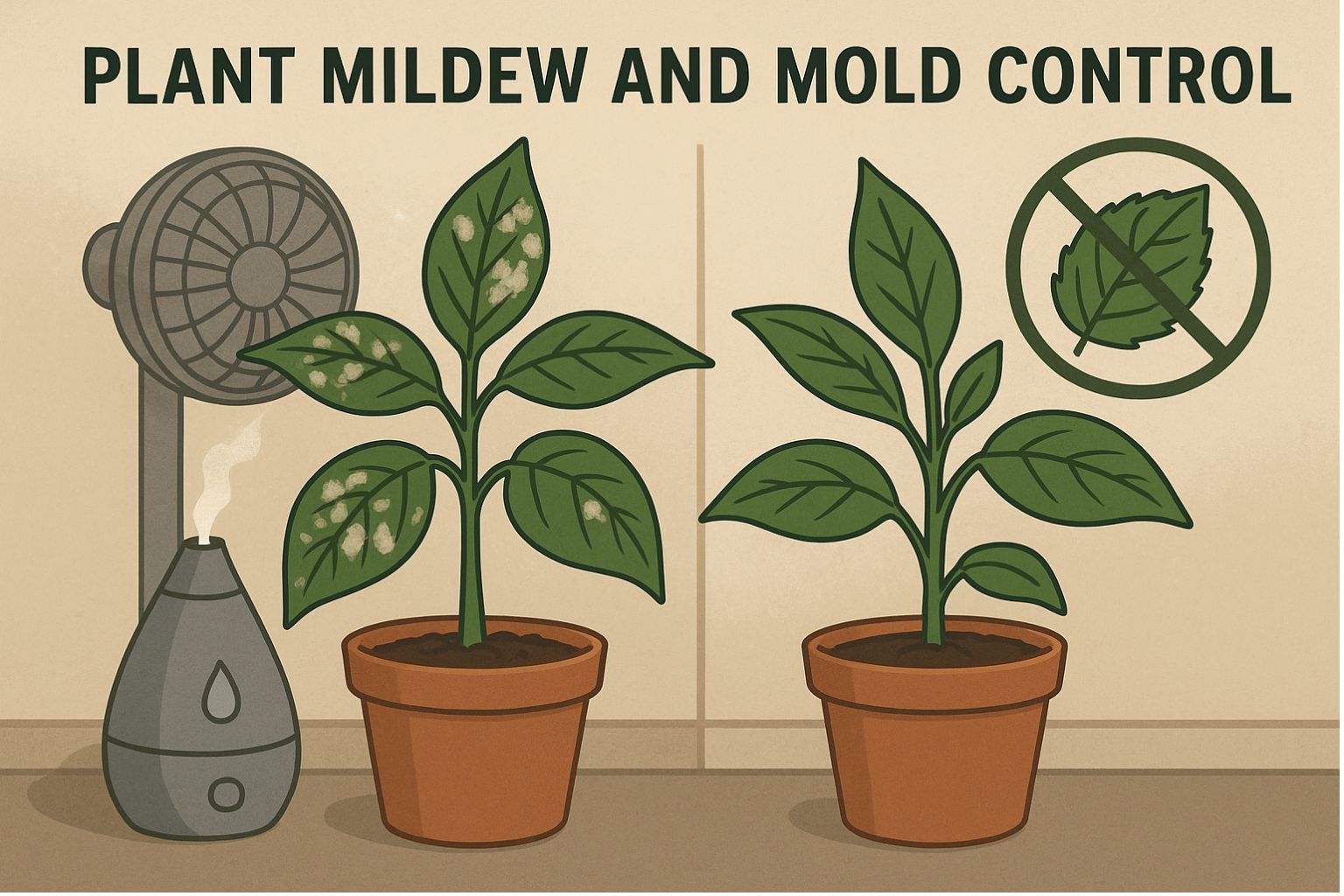
Why Mold And Mildew Matter So Much In A Cannabis Grow
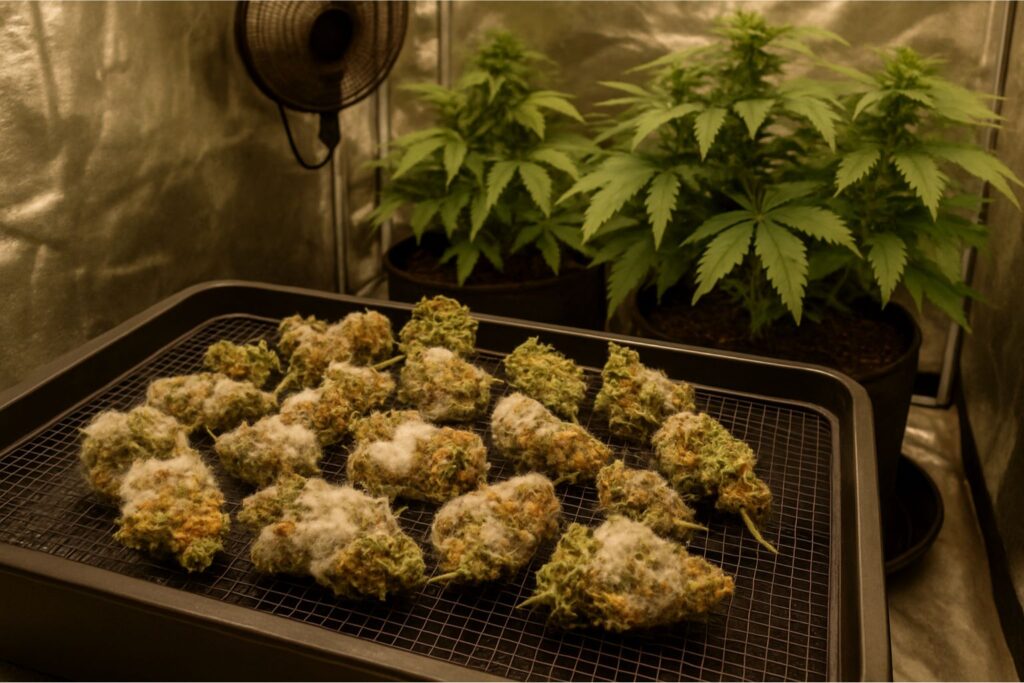
If you grow long enough, you will eventually meet mold. My own wake-up call came a decade ago when I opened a drying tent and watched white fuzz creep across what should have been my best harvest. That single mistake taught me more about plant mildew and mold control than any forum thread ever could.
Mold does not just reduce yield. It can ruin months of work, compromise safety, and force you to throw away entire plants. For home growers limited by plant counts or regional grow laws, losing even one plant is a big deal, so mold prevention is not optional.
In this guide I share how I now approach plant mildew and mold control from seed to cure: how I tune my environment, choose genetics, and respond quickly when I see trouble. I will reference both my own trials and the environmental ranges that research and commercial grows rely on for success.
How I First Lost A Harvest To Mold
My first major indoor run was a mixed tent of indica-leaning hybrids from feminized cannabis seeds. I was thrilled with the structure: dense colas, tight internodes, strong aroma. I pushed nutrients hard, kept temperatures warm, and thought I was on track for a personal-best yield.
Then I made three classic mistakes:
- I kept humidity high late in flower to “boost terpenes.”
- I underestimated how much airflow was blocked by big buds.
- I overloaded the drying tent with too many branches.
The result was powdery mildew on cannabis leaves during late flower and, later, patches of bud rot in weed hanging in the dark. That moment taught me to treat environmental control as seriously as lighting or genetics. It also pushed me to study VPD, air exchange, and what proper cannabis plant hygiene actually looks like in a working grow.
Understanding The Main Culprits: Powdery Mildew And Bud Rot
Effective plant mildew and mold control starts with knowing exactly what you are fighting.
Powdery mildew on cannabis
Powdery mildew on cannabis looks like someone dusted your leaves with flour. It often starts on lower, shaded foliage where airflow is weak. Unlike many fungal diseases, powdery mildew can thrive even when the leaf surface is not visibly wet, especially in moderate temperatures with high relative humidity.
Across my grows, powdery mildew on cannabis has almost always appeared when:
- Nighttime humidity spikes above my daytime range
- Canopy leaves are stacked tightly with little space between them
- Old, unpruned fan leaves touch tent walls or the medium
Once powdery mildew on cannabis shows up, it spreads aggressively through spores that stick to clothing, tools, and nearby plants. You cannot ignore it or “ride it out.” You either remove affected material and improve conditions immediately or prepare to lose flowers.
Bud rot in weed (Botrytis)
Bud rot in weed, usually caused by Botrytis cinerea, is more insidious. It starts inside big, dense flowers where humidity stays trapped. From the outside, buds may look fine, but when you gently pry them open you see brown or grayish mush surrounded by dead pistils and sometimes fuzzy growth.
In my experience, bud rot in weed appears when:
- Humidity remains high during late flower
- Temperature swings are large, causing condensation in the canopy
- Fans only move air across the tent, not through the bud structure
The worst thing about bud rot in weed is how fast it can spread unnoticed. A single infected cola can contaminate neighbors, and once you see it, the safest response is to cut generously around the affected tissue and discard it away from the grow.
Environmental Basics: Dialing In Cannabis Humidity Control And VPD
You cannot talk about plant mildew and mold control without talking about climate. Early in my journey I focused only on relative humidity numbers, but what truly changed my results was understanding VPD (vapor pressure deficit).
VPD combines temperature and humidity into a single value that reflects how strongly the air “pulls” moisture from leaves. Too low, and leaves stay wet, inviting mildew. Too high, and plants stress, drink excessively, and become prone to issues.
I now use this approach to cannabis humidity control:
- Seedlings and clones: Warmer temps with higher humidity, VPD around 0.6–0.8 kPa
- Vegetative stage: Moderate humidity, VPD around 0.8–1.2 kPa
- Early flower: Slightly drier, VPD around 1.1–1.3 kPa
- Late flower: Even drier, VPD around 1.3–1.5 kPa to protect buds
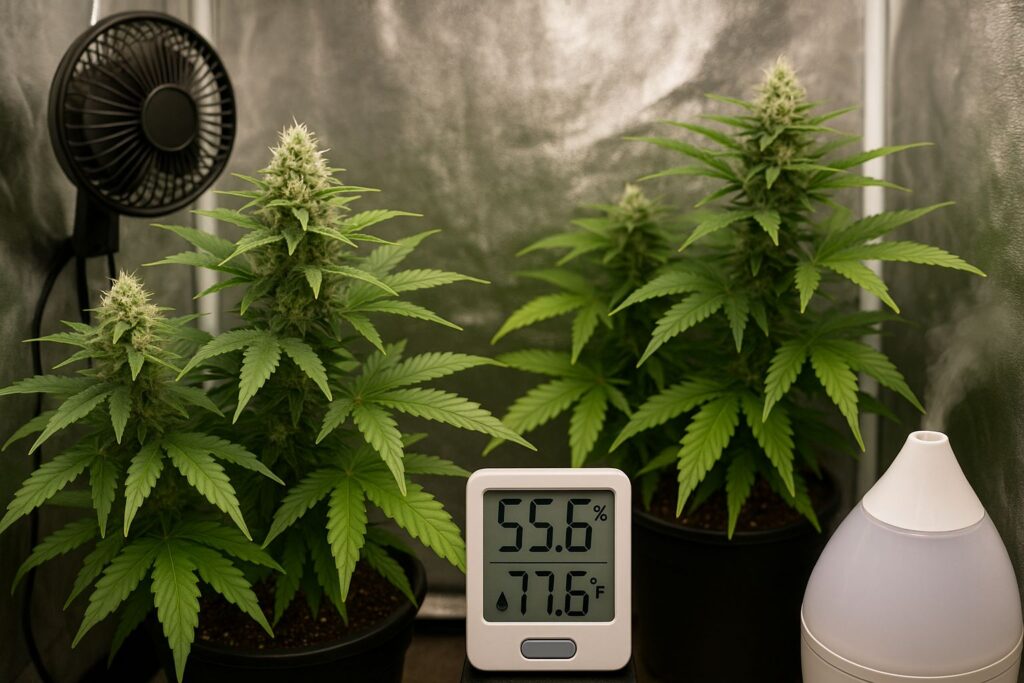
Good cannabis humidity control starts with basic tools: a reliable hygrometer, a thermostat, a humidifier or dehumidifier as needed, and controllers or timers that create stable conditions. I also position sensors at canopy level instead of on the floor so readings reflect what the plants feel.
Whenever I slack on cannabis humidity control, I can see leaves holding moisture after lights off, and my mildew risk jumps. Keeping daily charts of temperature and humidity helped me identify recurring spikes and adjust equipment before mold ever appeared.
The Role Of Cannabis Grow Room Ventilation
If humidity is the “what,” cannabis grow room ventilation is the “how.” Early on, I underestimated how much fresh air a tent actually needs. Now I treat cannabis grow room ventilation as its own design problem.
Here is my current approach to cannabis grow room ventilation:
- Oversized exhaust fan with variable speed controller
- Passive or active intake sized at least as large as the exhaust
- Oscillating fans above and below canopy level
- Clear intake path free of dust, fabric, or clutter
I want every leaf to dance gently. When cannabis grow room ventilation is dialed in, CO₂ is replenished, heat is removed from lights, and microclimates inside the canopy disappear. When cannabis grow room ventilation is poor, pockets of still, warm, humid air cling to the plant surfaces – perfect conditions for mildew and mold.
In rooms rather than tents, I also consider air changes per hour, making sure my exhaust can replace all the air in the space several times each hour during lights-on.
Cleanliness As A Culture: Practicing Cannabis Plant Hygiene
Once environment is under control, the next pillar of cannabis mold and mildew control is cleanliness. Over time I have turned cannabis plant hygiene into a routine rather than an occasional chore.
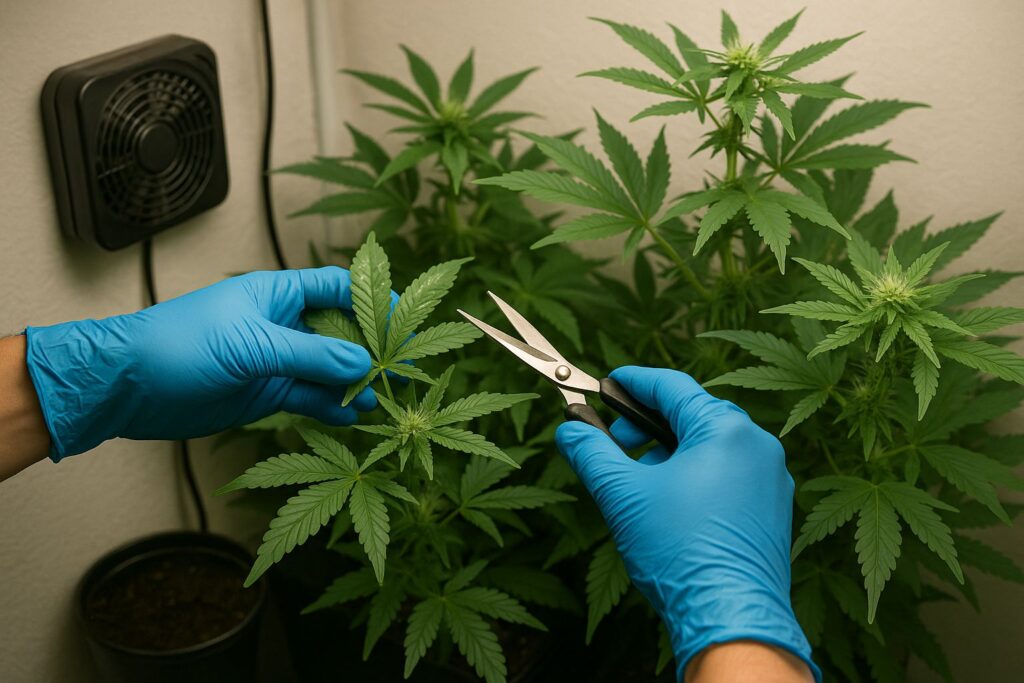
My cannabis plant hygiene checklist includes:
- Removing dead leaves or dropped debris from pots and floors daily
- Sterilizing scissors and tools between plants with alcohol
- Avoiding outside garden clothes inside the grow room
- Washing hands before touching plants or equipment
- Wiping down tent walls and equipment between cycles
When cannabis plant hygiene is taken seriously, spores have fewer places to hide and reproduce. I have seen grows with perfect environmental numbers still struggle, simply because leaves were allowed to pile up or old media sat open in the room. Repeating the phrase cannabis plant hygiene to myself reminds me that prevention is a continuous behavior, not a one-time fix.
Integrated Pest Management Cannabis: Building A System, Not A Single Spray
At some point I realized I needed a structured approach rather than reacting to issues as they appeared. That is where integrated pest management cannabis strategies come in.
For me, integrated pest management cannabis means combining:
- Environmental control (VPD, temperature, cannabis humidity control)
- Sanitation (the cannabis plant hygiene habits above)
- Biological controls (beneficial insects, microbial inoculants)
- Mechanical controls (trimming infected tissue, sticky traps)
- Minimal, targeted treatments when necessary
I try to avoid spraying flowering plants whenever possible, but an integrated pest management cannabis plan recognizes that early, mild interventions often prevent stronger actions later. The key is to observe plants closely, respond at the first sign of powdery mildew on cannabis leaves, and then adjust root causes such as airflow rather than relying on products alone.
Organic Mildew Treatments That Have Actually Helped Me
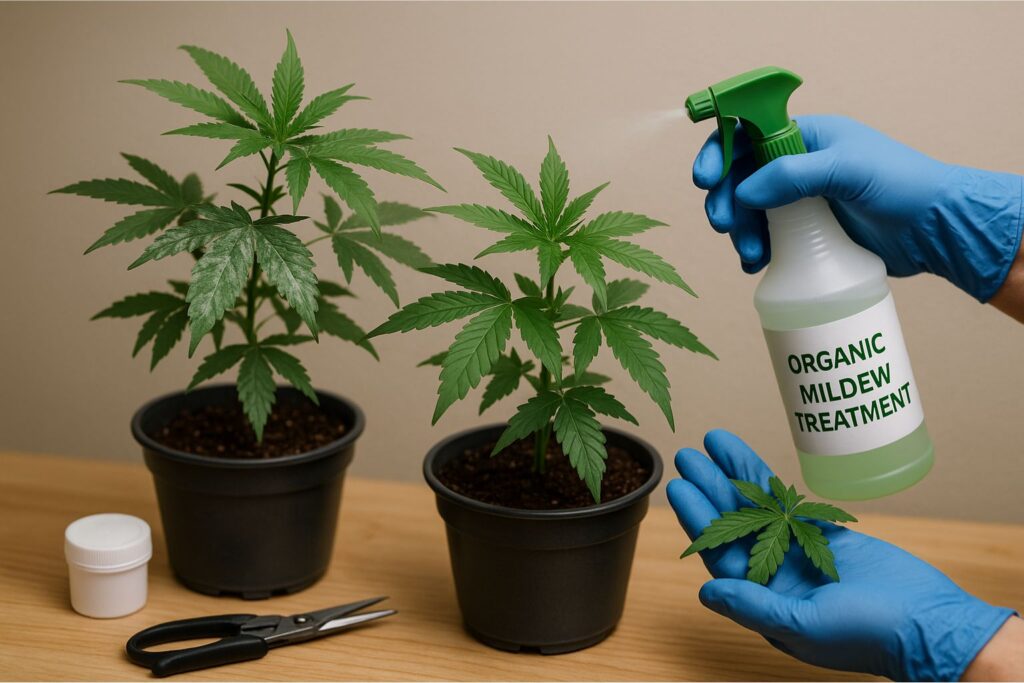
Even with prevention, issues can appear. When they do, I reach first for organic mildew treatments while I simultaneously improve environment and airflow.
Across several cycles, these organic mildew treatments have been most useful for me:
- Diluted potassium bicarbonate foliar sprays in early veg and pre-flower
- Biological fungicides featuring Bacillus subtilis or similar microbes
- Wettable sulfur used cautiously in veg (never late flower)
When I apply organic mildew treatments, I test on a small area first, spray with lights dimmed or off to avoid leaf burn, and always follow up the next day to check for stress. Organic mildew treatments are not magic; they work best when combined with lower humidity, better cannabis grow room ventilation, and removal of heavily infected leaves.
I never rely on organic mildew treatments alone to fix bud rot in weed. Once Botrytis has colonized dense buds, the only responsible choice is to cut and discard, then lower humidity and increase airflow so remaining flowers stay clean.
Genetics And Seeds: Choosing Plants That Resist Mold
Some plants simply cope better with environmental stress. Over time I have learned to factor cannabis mold and mildew control into my seed selection.
When ordering feminized cannabis seeds, I look for strain descriptions or breeder notes that mention mold resistance, open flower structure, or suitability for humid climates. Feminized cannabis seeds with sativa-leaning genetics often stack slightly looser buds, which can help in damp regions, while dense indica hybrids need stricter control late in flower.
I also pay attention to how autoflower cannabis strains behave. Many autoflower cannabis strains finish quickly, which can help outrun late-season rains outdoors. In cool, wet climates, choosing autoflower cannabis strains with shorter flowering windows has saved entire outdoor cycles for me.
Regardless of whether I am choosing regular, feminized cannabis seeds or autos, I always:
- Order from reputable seed banks with clear germination practices
- Consider indoor vs outdoor cannabis growing suitability for each strain
- Match flowering times to my region’s typical humidity and temperature
Genetics alone will not solve mildew, but starting with resilient feminized cannabis seeds and thoughtfully selected autoflower cannabis strains gives you more room to make small mistakes without losing a harvest.
Indoor Vs Outdoor Cannabis Growing And Mold Risk
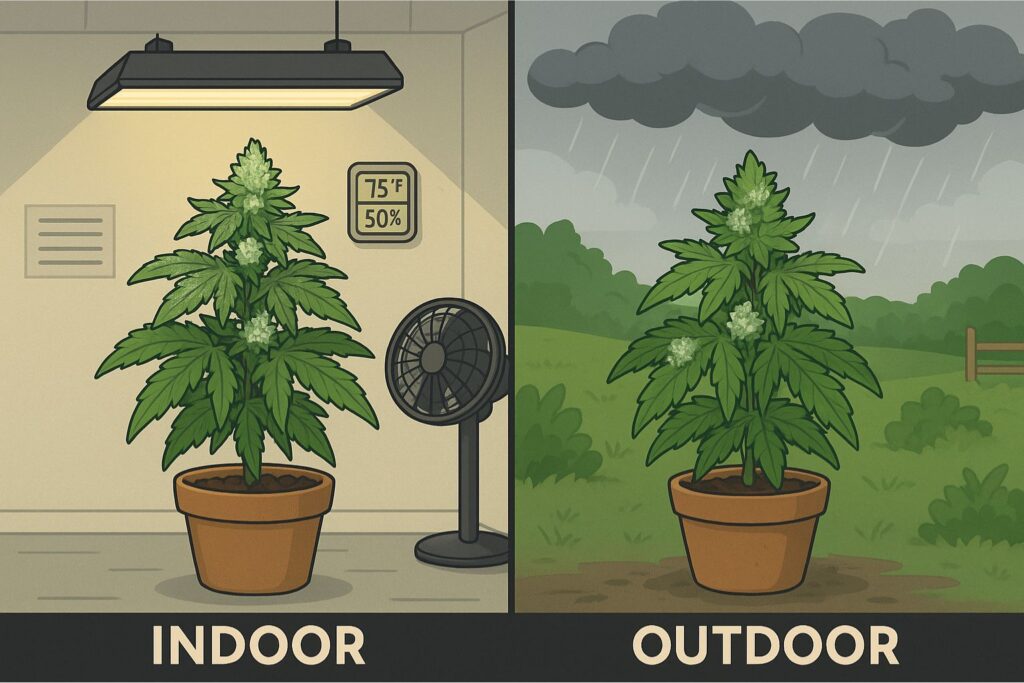
I have run both tents and garden beds, and the contrast taught me a lot about indoor vs outdoor cannabis growing when it comes to mold.
With indoor vs outdoor cannabis growing, the main trade-off is control versus scale. Indoors, I can dial in cannabis humidity control, temperature, and cannabis grow room ventilation precisely, which hugely benefits plant mildew and mold control. Outdoors, I benefit from sunlight and natural air movement, but I am at the mercy of seasonal rains and cold nights.
When I weigh indoor vs outdoor cannabis growing for a season, I ask:
- Does my region have long, damp autumns that favor bud rot in weed?
- Can I bring plants into a shelter or greenhouse when storms hit?
- Do local rules limit plant size or number, making loss more painful?
In wet coastal climates, indoor vs outdoor cannabis growing often leans indoor for serious flower production, while outdoor plants may be better suited for hash or extraction material where a bit more risk is acceptable. Whatever you choose, cannabis mold and mildew control must shape your plan from the start.
Nutrients, Medium, And Irrigation: Quiet Contributors To Mold
Environment is the star, but nutrients and irrigation play supporting roles. Over-fertilized, overly lush plants with constant wet media are magnets for powdery mildew on cannabis leaves.
Here is how I manage these factors:
- I track nutrient strength in EC or PPM, aiming for modest levels that match plant size.
- I avoid keeping coco or soil constantly saturated; roots need oxygen.
- I water at lights-on so excess moisture is removed during the day.
- In living soil, I favor topdress mixes and teas that encourage microbial diversity without pushing excessive nitrogen.
Medium also influences risk. Hydroponic setups with high water temperatures can promote root pathogens, while poorly aerated soil mixes can stay soggy for days. I choose well-draining media and, when possible, slightly warmer root zones to keep plants actively transpiring. Healthy roots mean better uptake and more stable responses to environmental changes that affect plant mildew and mold control.
From Harvest To Cure: Preventing Mold After The Chop
One of the most heartbreaking lessons I learned is that you can execute perfect cannabis mold and mildew control during the grow and still lose buds while drying and curing.
My drying and curing guidelines:
- Aim for a dark, well-ventilated room with gentle air movement
- Target temperatures in the low 20s °C and relative humidity around 50–55%
- Avoid stacking branches; leave space between them for air flow
- Use mesh racks only for smaller buds; big colas hang individually
- Jar only when stems snap, not bend, to reduce risk of hidden moisture
During cure, I monitor jar humidity with small hygrometers and “burp” jars if readings sit above about 65% RH. Consistent readings in the mid-50s to low 60s indicate a stable cure that discourages mold while keeping flowers from getting too brittle.
Step-By-Step Cannabis Mold And Mildew Control Checklist
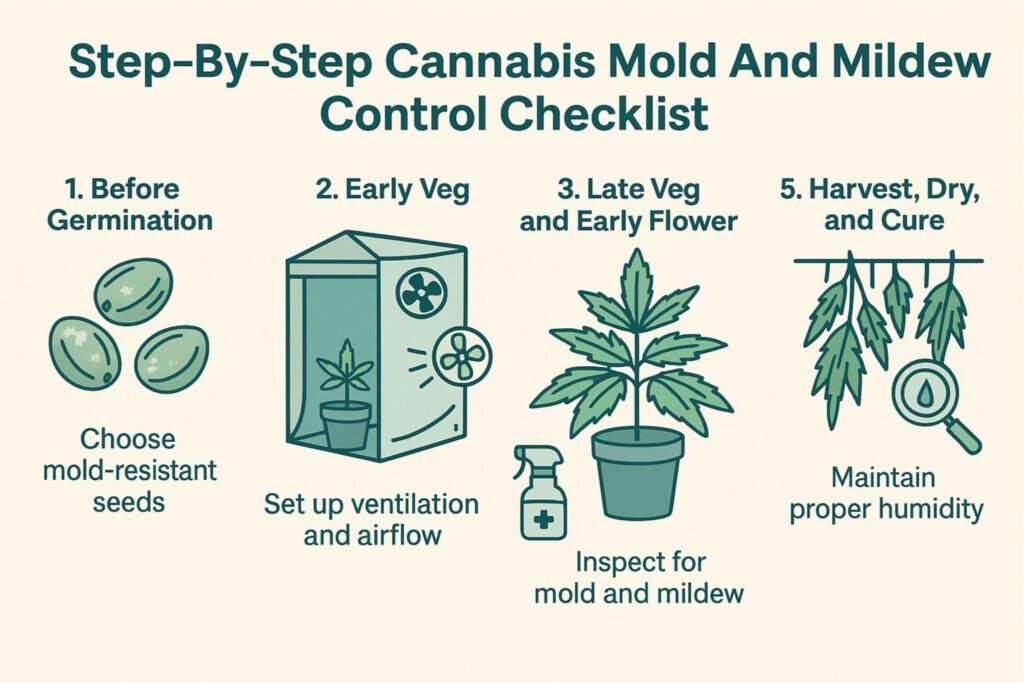
Over the years I have condensed my approach into a simple checklist that covers the entire cycle of cannabis mold and mildew control:
- Before germination
- Confirm regional grow laws and personal plant limits.
- Choose feminized cannabis seeds or autoflower cannabis strains known for mold resistance.
- Plan whether you will focus on indoor vs outdoor cannabis growing and design your space.
- Early veg
- Set up cannabis grow room ventilation with strong exhaust and gentle circulation.
- Dial in cannabis humidity control and temperature using a VPD chart.
- Start cannabis plant hygiene habits: clean tools, tidy floors, no clutter.
- Late veg and early flower
- Thin inner growth and remove low, shaded branches.
- Implement integrated pest management cannabis strategies, including scouting and beneficials.
- Apply preventative organic mildew treatments in veg if your environment is high-risk.
- Mid to late flower
- Lower humidity and increase airflow through the canopy, not just over it.
- Inspect buds closely for powdery mildew on cannabis leaves or early bud rot in weed.
- Remove any suspect tissue promptly and review environmental logs for patterns.
- Harvest, dry, and cure
- Harvest in a clean space; keep cannabis plant hygiene standards high.
- Maintain steady cannabis humidity control in the dry room.
- Use your nose and eyes during cure; if you ever suspect mold, err on the side of safety.
Following this checklist does not guarantee perfection, but it dramatically reduces surprises. Every time I skip a step – usually out of laziness – I am reminded why the system exists.
FAQs: Real-World Questions About Mold In The Grow Room
How can I prevent powdery mildew on cannabis indoors?
Start with strong cannabis grow room ventilation and stable cannabis humidity control. Keep humidity in appropriate ranges for each growth stage, avoid overcrowding the canopy, and practice strict cannabis plant hygiene. In high-risk environments, consider preventative organic mildew treatments in veg and early flower, combined with an integrated pest management cannabis plan.
What should I do if I find bud rot in weed late in flower?
Cut at least several centimeters beyond the visible infection and dispose of affected material away from the grow. Do not try to wash or save bud rot in weed for consumption. Lower humidity, increase airflow, and inspect all neighboring buds carefully. If multiple spots appear, you may need to harvest early to protect what remains.
Are autoflower cannabis strains better for avoiding mold outdoors?
Autoflower cannabis strains often finish faster than photoperiod plants, which can help outdoor growers avoid the wettest part of the season. When selecting autoflower cannabis strains for a rainy climate, focus on breeders who test outdoors and mention mold resistance in their descriptions.
Do feminized cannabis seeds increase mold risk?
Feminized cannabis seeds do not inherently increase mold risk. What matters more is the specific cultivar’s bud structure, flowering time, and vigor. Many modern feminized cannabis seeds are bred for resilience and perform extremely well when combined with good cannabis humidity control and integrated pest management cannabis practices.
Is indoor vs outdoor cannabis growing safer when it comes to mold?
Neither option is automatically safer. Indoor vs outdoor cannabis growing is a trade-off: indoors you control climate and cannabis grow room ventilation precisely, while outdoors you benefit from natural light and air but accept weather risks. In very humid regions, indoor grows or protected greenhouses often make cannabis mold and mildew control easier.
Final Thoughts
Mold is not a sign that you are a bad grower; it is a sign that nature is relentless. The difference between losing a harvest and learning from a scare is how quickly you respond and how systematically you approach cannabis mold and mildew control.
For me, success has come from combining:
- Smart strain selection, with feminized cannabis seeds and autoflower cannabis strains matched to my environment
- Thoughtful decisions about indoor vs outdoor cannabis growing each season
- Reliable cannabis humidity control, strong cannabis grow room ventilation, and disciplined cannabis plant hygiene
- A calm, structured integrated pest management cannabis program backed by targeted organic mildew treatments when needed
Treat mold as a teacher instead of an enemy. Each cycle you run with cleaner plants, steadier climate, and healthier roots will show you how much control you truly have over mildew and mold in your garden.
