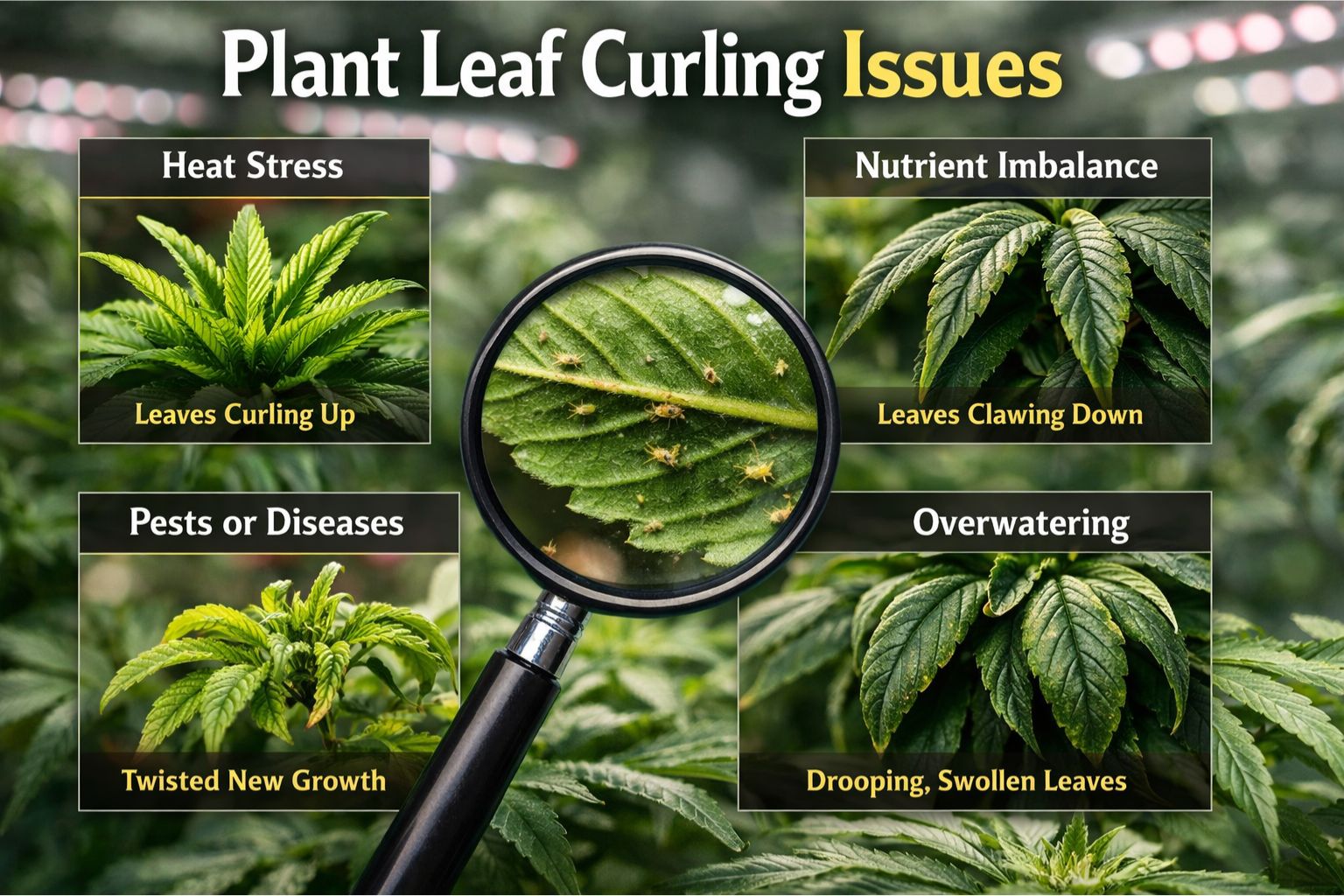
I still remember the first time I saw a healthy-looking cannabis canopy go sideways overnight. The plants were in mid-veg, leaves were broad and glossy, and I felt like I finally understood my room. Then I walked in at lights-on and half the tops were curled like little tacos. A day later, one plant started clawing down, and another was twisting new growth in a way that made me think something was wrong with the genetics. That week taught me a lesson I still rely on: leaf curl is not a diagnosis. It is a signal.
This post is about Plant Leaf Curling Issues from a hands-on cultivator’s perspective. I grow cannabis in soil and coco, and I’ve run small hydro setups too. I’ve seen leaf curl on weed plants outdoors when a heat wave hits, and I’ve seen it on marijuana indoors when I pushed lights too hard or let my irrigation get sloppy. What follows is exactly how I troubleshoot, what measurements I trust, and what changes actually solved the problem for me.
The three curl patterns that guide my next steps
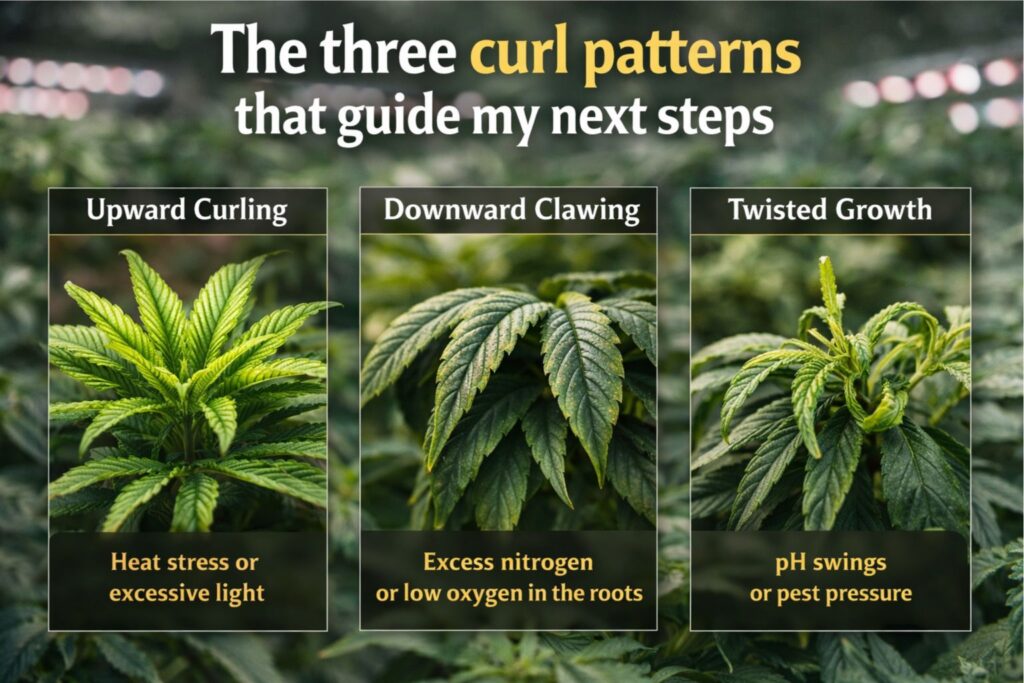
When I’m facing Plant Leaf Curling Issues, I start by naming the pattern. It keeps me calm and prevents me from dumping bottles into the mix.
Upward canoeing on the tops
Upward curl usually starts closest to the light. The leaf edges lift, the blade cups, and the surface can feel drier than normal. In my rooms, the most common causes are excess light, high leaf temperature, low humidity for the stage, or a fan blasting the same spot all day. This is where a canopy microclimate check matters, because one hot corner can fool you into thinking the whole room is fine.
Downward clawing with dark, thick leaves
Downward clawing is the classic “too much nitrogen” look, but I’ve created it with oxygen-starved roots too. If the pot stays heavy for too long, the plant can’t breathe and it responds with a droop that looks like clawing. This is why irrigation dryback timing is on my short list of things to fix first.
Twisted, crinkled, or deformed new growth
This pattern is where I slow down and gather more data. Twisted new growth can be pH instability, calcium issues, pest pressure, or simply a sensitive phenotype. I do not guess. I run a pest lens inspection, check my input pH, and review my notes for any recent changes that could cause a root-zone pH swing.
My order of operations for troubleshooting leaf curl
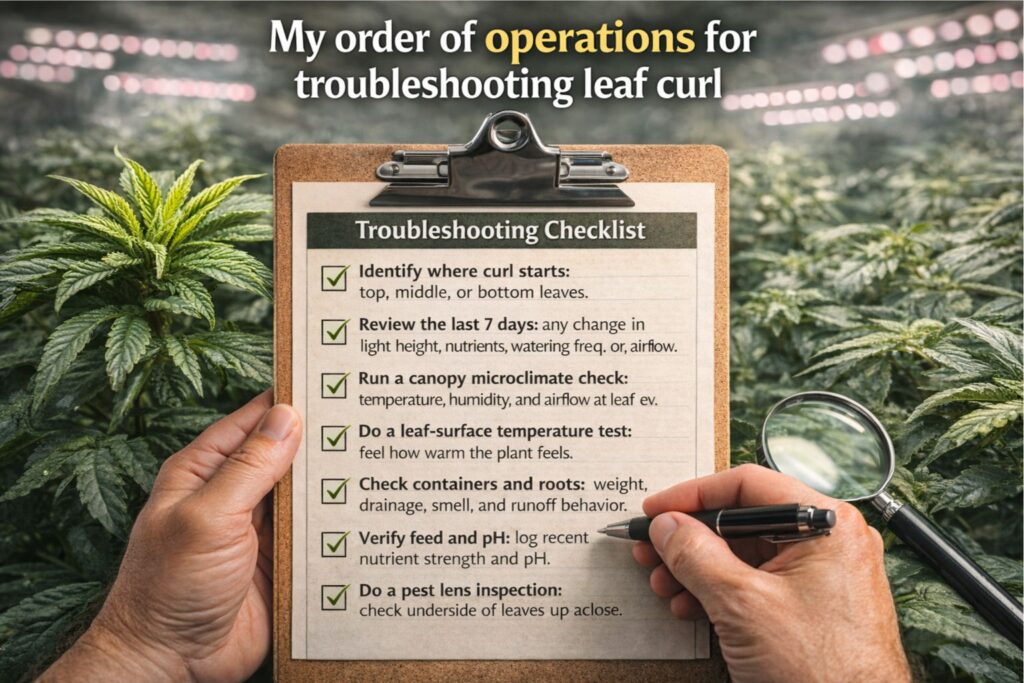
Whenever Plant Leaf Curling Issues show up, I follow the same steps in the same order. You can do this in a tent, a room, or outdoors with a little adaptation.
- Identify where the curl starts: top, middle, or bottom leaves.
- Review the last 7 days: any change in light height, nutrients, watering frequency, or airflow.
- Run a canopy microclimate check at leaf level: temperature, humidity, and airflow.
- Do a leaf-surface temperature test to confirm what the plant is actually feeling.
- Check containers and roots: weight, drainage, smell, and runoff behavior.
- Verify feed and pH: I rely on nutrient strength logging so I’m not working from memory.
- Do a pest lens inspection even if I “don’t have pests.”
- Change one variable, then wait 48 hours to judge new growth.
That last point is the hardest for most growers. But in my experience, the best fixes for Plant Leaf Curling Issues come from controlling variables, not from reacting emotionally.
Environment: the fastest place to get real improvement

Temperature, humidity, and the microclimate you don’t notice
In a grow space, the sensor on the wall tells you the room’s story, not the leaf’s story. I’ve measured a 3–5°C difference between the general room and the top of a dense canopy. That’s why I do a canopy microclimate check at the level of the tops and again near the mid-canopy.
In veg, I usually aim for temperatures around 24–27°C with a humidity level that keeps the air from pulling water too aggressively from the leaves. In flower, I gradually lower humidity for mold safety, but I still avoid big swings. Sudden drops in humidity can create light intensity stress signs that look like nutrient problems.
Leaf surface temperature beats air temperature for leaf curl
A leaf-surface temperature test takes the guesswork out of “Is this heat stress?” If I can, I use an infrared thermometer. If I can’t, I use my hand near the tops and look for consistent cues: warm, dry-feeling leaves that curl up and lose their flat posture.
When leaf surface temps are high, I treat it like a light and airflow problem first. I raise or dim the light, improve exhaust, and adjust circulation. If you fix the environment, the plant often stops worsening within a day, even if the curled leaves don’t flatten perfectly.
Air movement: enough to mix, not enough to sandblast
One of the most overlooked Plant Leaf Curling Issues is wind stress. I’ve seen fan windburn patterns that mimic heat stress and nutrient burn at the same time. The leaves curl and the edges look tired, but only in the path of the fan.
To correct fan windburn patterns, I point fans above the canopy or bounce airflow off a wall. I want gentle leaf movement across the whole plant, not one branch being punished all day.
Light intensity: measure it, don’t guess it

I grow under LEDs most of the time now. LEDs are efficient, but they can create intense hotspots if you hang them too close or if your canopy is uneven. That’s where light intensity stress signs show up first.
In veg, I usually sit around a moderate light level, then increase through early flower. If I push too hard too early, I see Plant Leaf Curling Issues on the top leaves within a couple days.
My simple approach to light troubleshooting:
- If the curl is mostly at the top, I assume light intensity is involved until proven otherwise.
- I raise the light or dim it slightly for 48 hours and watch new growth.
- I check whether the curling is worse directly under the center of the fixture.
- I re-run a canopy microclimate check after any light change, because warmer leaves can change watering needs.
If the tops improve after a small adjustment, I know I was chasing the right problem.
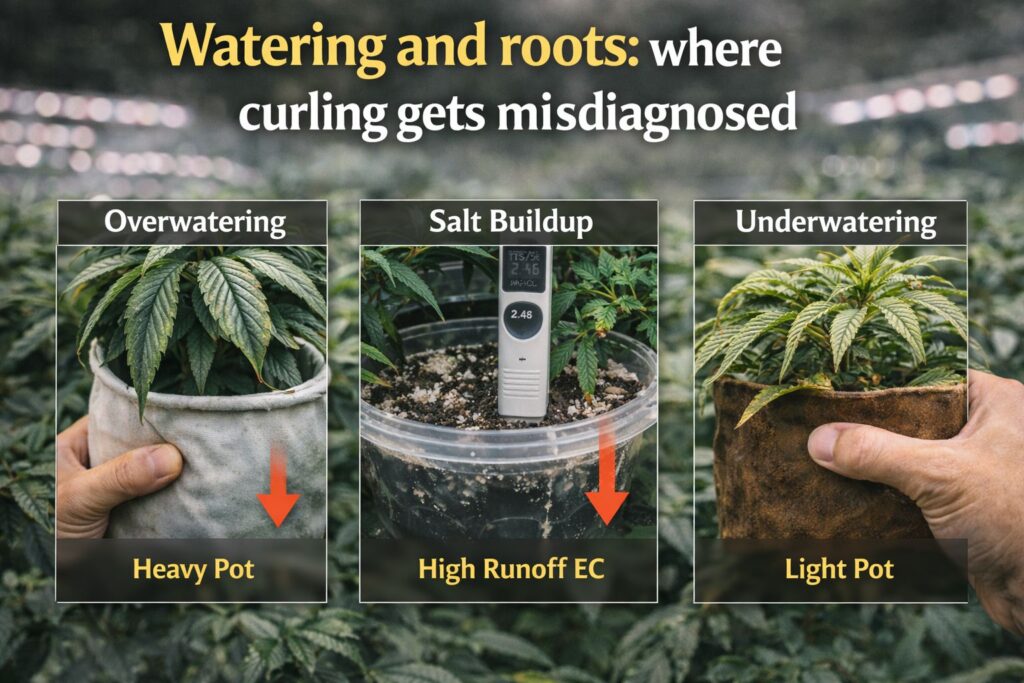
Watering and roots: where curling gets misdiagnosed
Overwatering and low oxygen
Overwatering doesn’t always look like a droopy plant. In cannabis, it can show up as stiff leaves that claw down and feel thick. That’s why irrigation dryback timing is critical. I lift pots and learn the weight difference between “freshly watered” and “ready again.”
My fixes for poor irrigation dryback timing:
- Reduce volume per watering instead of watering less often (especially in coco).
- Improve drainage and avoid letting containers sit in runoff.
- Add more aeration to the medium next cycle if soil stays wet too long.
- Keep a simple note of dryback hours so you can spot when conditions change.
Over time, these root-focused changes reduced Plant Leaf Curling Issues more than any additive.
Underwatering and salt concentration swings
Underwatering can also curl leaves, but the texture is different. Leaves feel thin and slightly brittle. The plant may show tip burn quickly because salts concentrate in the root zone. When this happens, I don’t overcorrect with a flood once. I return to steady watering and make sure I’m not bouncing between extremes.
Nutrition and pH: what I track so I don’t chase ghosts

I’m not a fan of “guess feeding.” Cannabis responds well to consistency. Nutrient strength logging is the habit that changed my outcomes, because it prevents me from accidentally increasing EC while thinking I’m being gentle.
Input strength and runoff
If my plant curls and I suspect buildup, I take a runoff reading. I’m not obsessed with runoff every day, but during Plant Leaf Curling Issues it is a useful clue. If runoff is much higher than input, I know I’m stacking salts. If runoff is much lower, I know I may be underfeeding or my medium is holding too much water.
A quick tip that saved my weed runs: when you change strength, hold it for several irrigations. Plants hate bouncing targets.
pH drift, especially in coco
Coco is a great medium, but it punishes sloppy pH. I’ve seen a root-zone pH swing create twisted new growth and edge curl even when the plant looked strong a week earlier. To prevent a root-zone pH swing, I do three things:
- Calibrate my pH meter regularly.
- Mix nutrients fully, then measure, then adjust.
- Keep the input range consistent rather than bouncing between “high” and “low” pH days.
When I fixed pH stability, Plant Leaf Curling Issues became less frequent and easier to correct.
Pests: the curl that isn’t your feed
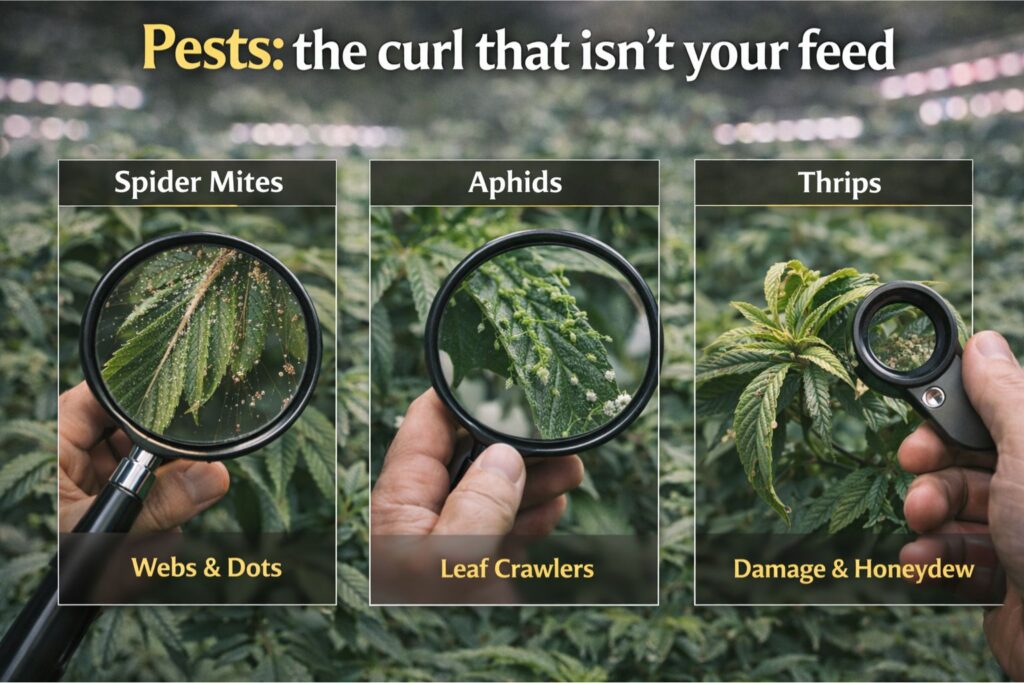
If I had to pick one “silent” cause of leaf curl, it would be pests. Thrips and mites can distort leaves before you see heavy damage. That’s why pest lens inspection is non-negotiable for me.
My pest lens inspection routine:
- Check the underside of top leaves and new growth with a loupe.
- Look for speckling, eggs, or moving dots.
- Tap a leaf over white paper to spot tiny movement.
- Use sticky cards and label them by date so you notice trends.
- Re-check after any environmental change, because stressed plants attract problems faster.
When pests are involved, Plant Leaf Curling Issues won’t resolve just by changing nutrients. You need a control plan that fits your grow style.
Genetics and phenotypes: why two plants react differently
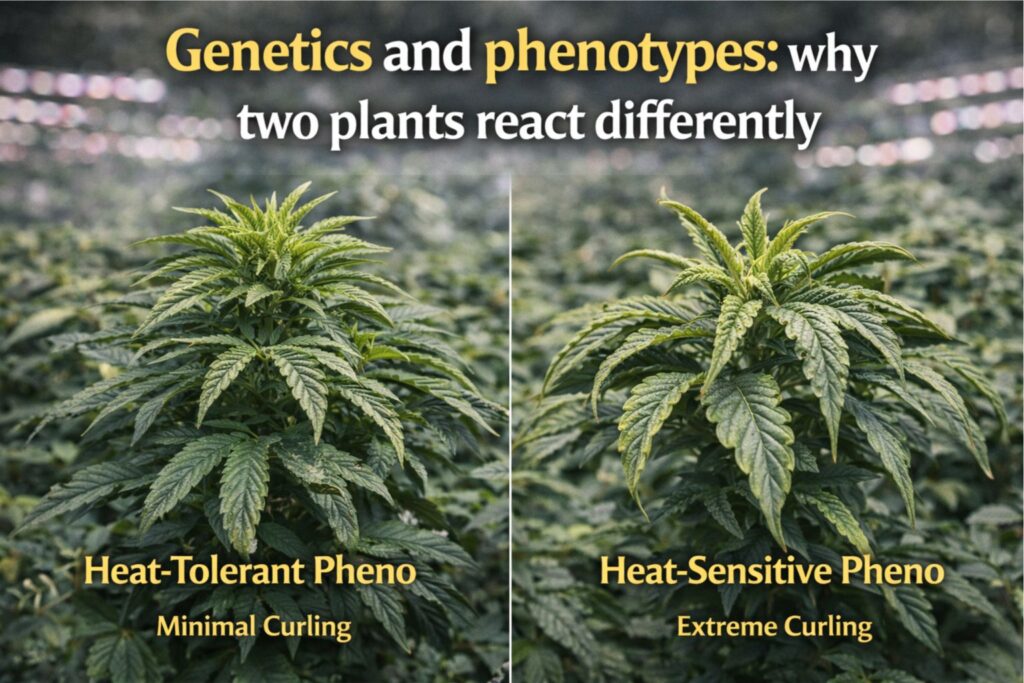
Even with stable genetics, cannabis phenotypes vary. One plant may tolerate higher feed, another curls when you push. I keep notes on each run because it helps me choose plants that match my environment.
If you’re selecting indica, sativa, or hybrid types, remember those labels are broad. What matters is how a cultivar handles light, heat, and feeding. I’ve had compact indica-leaning plants curl under intense light because the canopy was too close, and I’ve had vigorous sativa-leaning plants curl because I fed them like heavy eaters when they weren’t.
Seed buying and planning: reducing stress before the grow starts

Leaf curl troubleshooting gets easier when your whole plan fits your space. This is where seed ordering safety tips and climate-specific grow planning come in. A lot of Plant Leaf Curling Issues are really “my plan didn’t match my environment” issues.
Feminized seeds vs autoflowers: what I choose based on constraints
Feminized seeds make it easier to plan canopy structure and training because you control the photoperiod. Autoflowers can be great when you want speed or you can’t adjust light cycles easily. The key is matching the plant’s life cycle to your setup.
In small tents, I lean toward cultivars I can train and keep at a manageable height. Outdoors, I plan around local weather. That is climate-specific grow planning in practice, and it applies whether you call it cannabis, marijuana, or weed.
Seed banks, shipping, and realistic expectations
When buying cannabis seeds, I look for clear shipping policies, realistic delivery timelines, and discreet packaging standards. That’s part of my seed ordering safety tips. Delays happen, and your grow calendar should have slack built in.
Regional grow laws vary widely. I’m not offering legal advice, but I do encourage you to research your local rules before ordering seeds or starting a marijuana garden.
My 72-hour recovery plan for curling leaves
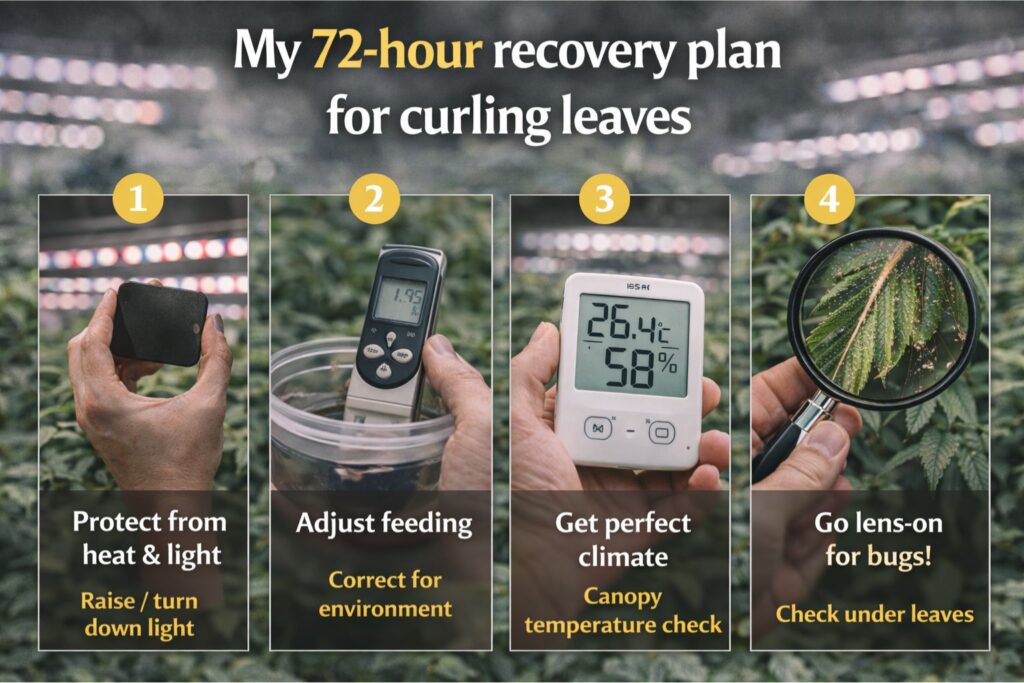
When Plant Leaf Curling Issues appear, I focus on stabilizing the system. Damaged leaves may not look perfect again, but new growth tells you if the fix worked.
First 24 hours:
- Do a canopy microclimate check and record temperature and humidity.
- Run a leaf-surface temperature test on the curled area and a healthy area.
- Look for fan windburn patterns and redirect airflow if needed.
- Confirm light intensity stress signs by raising or dimming the fixture slightly.
- Lift pots to assess irrigation dryback timing.
- Review nutrient strength logging and confirm no recent “accidental” increase.
- Do a pest lens inspection and write down what you see, even if it’s “nothing.”
Hours 24–48:
- Make one primary change: environment, watering, or feed strength.
- Keep pH stable to avoid a root-zone pH swing.
- Repeat pest lens inspection.
- Hold your inputs steady so you can judge the change.
Hours 48–72:
- Judge the newest growth, not the most damaged leaves.
- If the issue worsens, revisit leaf curling causes with fresh measurements.
Training and canopy management: preventing curl before it starts
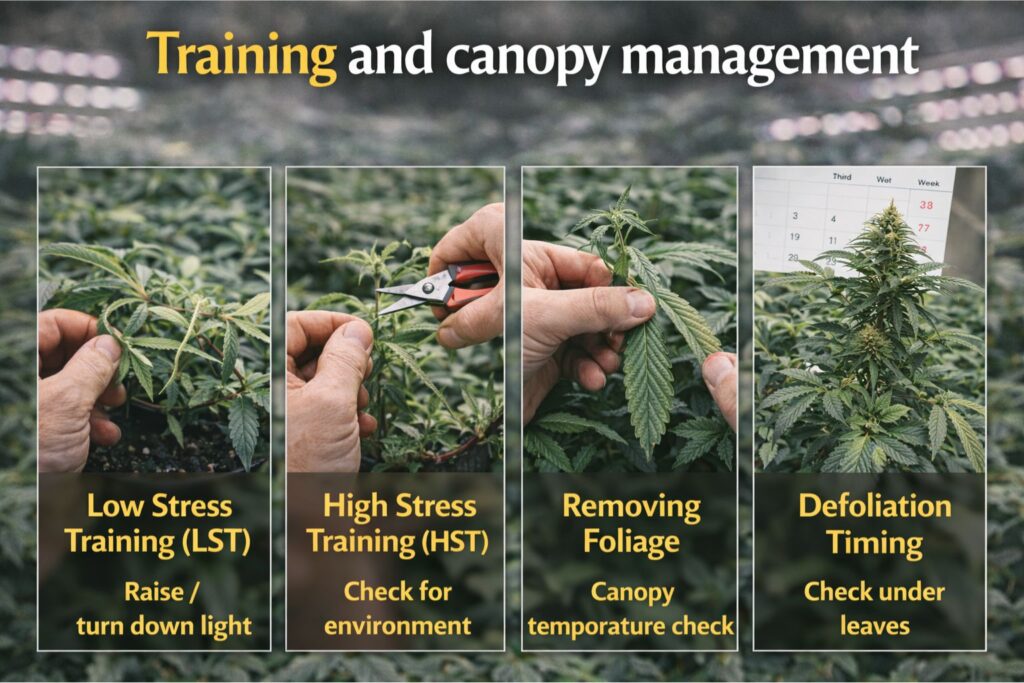
Many growers overlook that training affects microclimate. A dense canopy traps humidity and heat, creating localized stress.
My prevention habits:
- Keep a level canopy so the light distance is consistent and you avoid hotspots.
- Defoliate strategically so airflow reaches the mid-canopy.
- Avoid overcrowding plants in a space that can’t exchange air.
- Use nutrient strength logging to avoid “just a little more” feeding creep.
These steps reduce Plant Leaf Curling Issues because they reduce microclimate extremes.
Quick-reference troubleshooting in plain English
If you want a simple way to remember leaf curling causes, here’s how I translate the plant’s signals:
- Tops curling up: check light intensity stress signs, then do a leaf-surface temperature test, then a canopy microclimate check.
- Curling only where the fan hits: look for fan windburn patterns and redirect airflow.
- Clawing down with heavy pots: correct irrigation dryback timing and restore root oxygen.
- Twisted new growth: check for a root-zone pH swing and do pest lens inspection.
- Curl with burnt tips and salty runoff: review nutrient strength logging and reduce buildup gradually.
- Curl with random patches: repeat pest lens inspection and confirm you’re not missing early pest pressure.
FAQ
What are the most reliable first steps for Plant Leaf Curling Issues?
My first steps are always a canopy microclimate check, a leaf-surface temperature test, and a review of irrigation dryback timing. Those three often reveal the real problem quickly.
How do I tell if the light is the cause?
Light problems usually show as light intensity stress signs on the top leaves first, especially directly under the brightest area. Raising or dimming the light for 48 hours is a simple test.
Can pH problems cause leaf curl even if my plant looks green?
Yes. A root-zone pH swing can distort new growth without dramatic yellowing at first. Consistency and nutrient strength logging help you catch it early.
Should I change my nutrients immediately when I see curl?
Not until you check the environment and watering. Many Plant Leaf Curling Issues are not nutrient problems. I verify runoff behavior and my nutrient strength logging before I adjust feed.
How do I reduce problems when buying seeds?
Use seed ordering safety tips: choose reputable seed banks, read shipping policies, and plan around your schedule. Pair that with climate-specific grow planning so the genetics you buy actually fit your environment and your season.
Closing thoughts from my own runs
Plant Leaf Curling Issues used to feel like a mystery to me. Now they feel like a checklist. When I measure the microclimate, keep irrigation consistent, track nutrition, and stay disciplined about pests, leaf curl becomes a short detour instead of a ruined run. The biggest change was learning to fix causes, not symptoms, and to let the plant’s newest growth be the judge.
