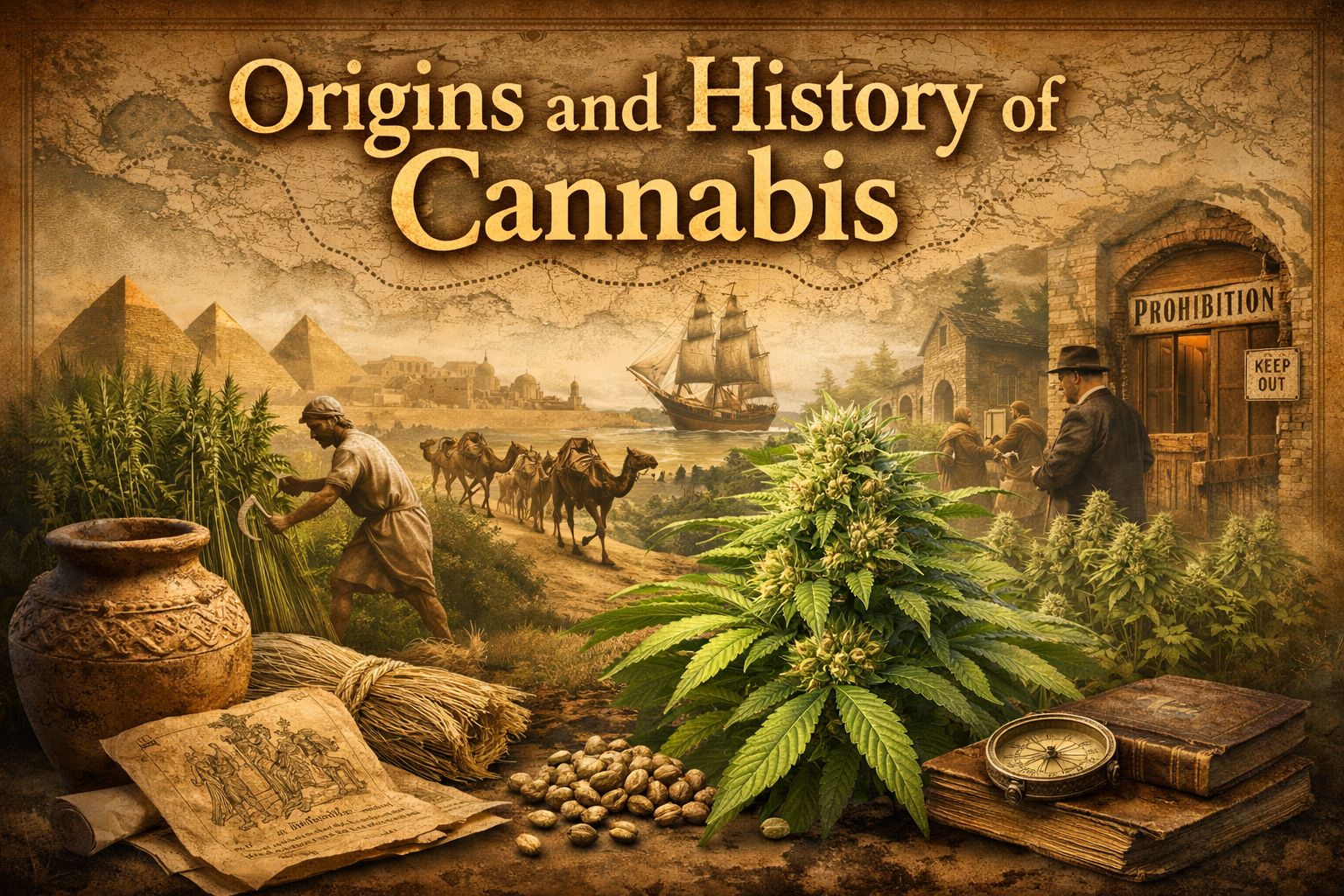
I started growing weed in a small spare room with more enthusiasm than skill. Back then, I treated every seed like a mystery box: I would germinate, hope, and react. The longer I’ve cultivated, the more I’ve realized that the best growers don’t just react to plants—they anticipate them. For me, the fastest way to build that intuition was learning the history of cannabis. It’s not trivia. It’s context for why today’s cannabis, marijuana, and weed genetics behave the way they do, why certain cultivation methods became common, and why seed-shopping has its own pitfalls.
This article is my grower’s walk through the history of cannabis, with practical takeaways I’ve used in my own rooms and tents. I’ll connect old-world cultivation to modern choices like feminized lines, autos, and how to interpret breeder claims. I’ll keep it honest: history includes breakthroughs, mistakes, and long stretches where cannabis knowledge went underground.
Why the history matters to modern growers
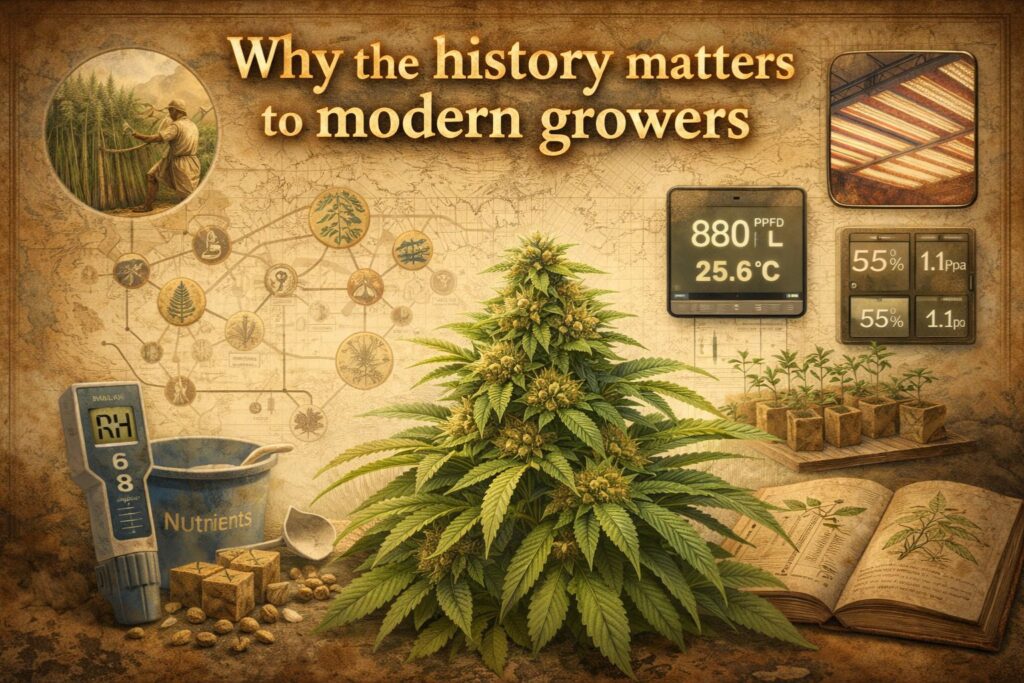
When I’m pheno-hunting or dialing in a new run, I’m really managing a conversation between genetics and environment. That conversation didn’t start with LED fixtures or bottled nutrients. It started with people selecting plants for fiber, seed, resin, and survival—sometimes deliberately, sometimes by accident. Understanding the history of cannabis helps me in three direct ways. First, I map the cannabis seed lineage behind any pack I buy, because lineage often predicts stretch, feeding behavior, and finish.
- I set expectations for vigor and flowering behavior based on broad ancestry rather than marketing names.
- I respect how environment shapes expression, because cannabis has adapted across many climates during its long spread.
- I shop for seeds with more skepticism and more clarity about what “stable,” “worked,” and “tested” should actually mean.
A lot of modern advice is excellent, but it makes more sense when you know why it exists.
From wild plant to crop: the early domestication story
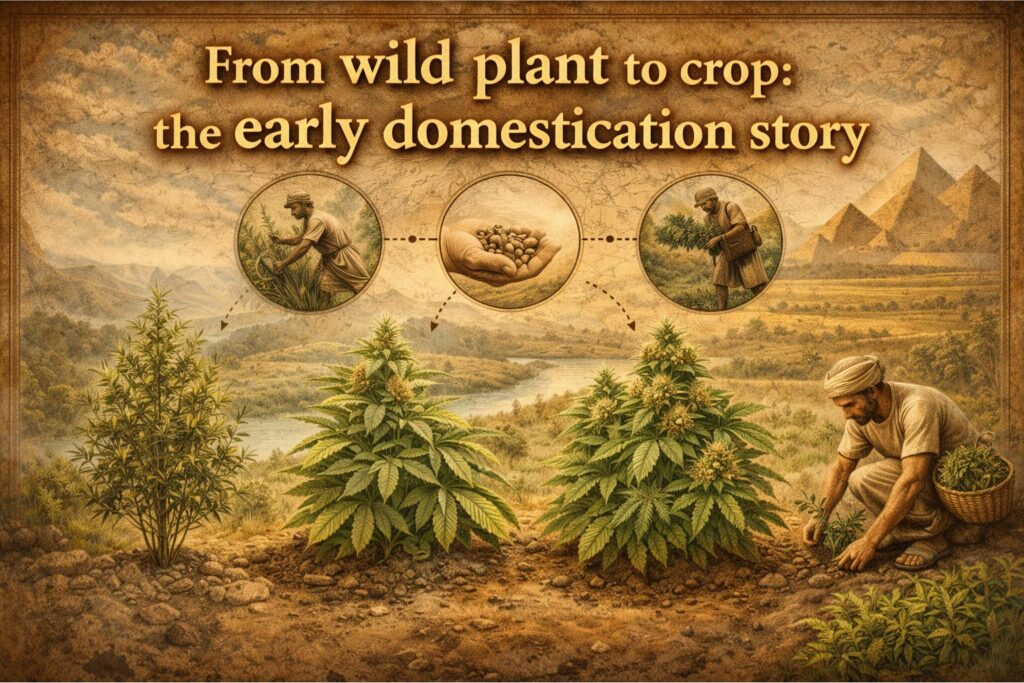
My favorite place to begin is the cannabis domestication timeline. Domestication isn’t a single moment; it’s a long process where humans repeatedly choose which plants get to reproduce. In a grow room, I do the same thing on a tiny scale: I keep the best performers, and I don’t repeat the mistakes.
In the cannabis domestication timeline, early cultivators likely favored plants that fit their needs: taller, less branching plants for fiber; bushier plants for seed; and in some regions, plants with more aromatic trichomes. This slow selection is why cannabis is so plastic today. Even with identical seeds, I can see noticeable differences in leaf shape, internode length, and terpene expression when I change temperature or VPD.
In my own side-by-side runs, I’ve watched the same genetic line show tighter internode length at higher PPFD and slightly cooler nights, and stretch harder when I let daytime temps drift up. That adaptability is part of the plant’s deep past.
Ancient hemp and the practical side of cultivation
The phrase ancient hemp farming sometimes sounds romantic, but it was practical agriculture. Hemp was valuable for rope, textiles, sails, and seed oil. In terms a grower understands, people were selecting for traits like fast vegetative growth, strong stalks, and uniformity.
Here’s what I take from ancient hemp farming in a modern context:
- Vegetative vigor is not a luxury; it’s the engine of later yield.
- Plant spacing and airflow matter, because dense stands push plants toward height and can invite disease.
- Harvest timing changes outcomes. A crop harvested for fiber is managed differently than a crop harvested for resin.
Ancient hemp farming also helps explain why some lines today are naturally tall and fast in veg. When I see a plant that wants to reach, I think about how selection pressures can persist across time.
Cannabis spreads: trade, migration, and regional adaptation
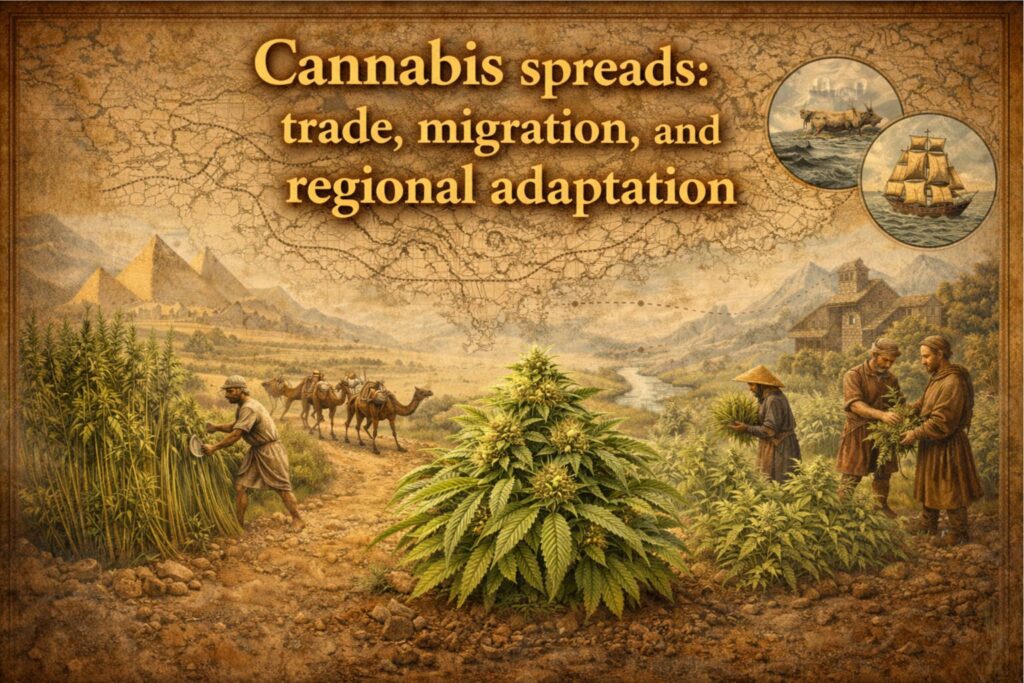
As cannabis moved, it adapted. I’m careful with sweeping claims because the record is messy, but it’s clear that cannabis traveled along human routes. I think of early marijuana trade routes the way I think of seed swaps between growers: genetics move where people move, and each new environment selects the survivors.
Early marijuana trade routes likely carried seed and plant material across regions where climate and culture differed. Over generations, that movement produced distinct local types. When growers talk about “landraces,” they’re referring to locally adapted populations shaped by both people and place.
In practice, this is why I pay attention to the conditions a breeder says they selected in. If a line was refined in hot, arid conditions, I’m not surprised when it tolerates higher leaf temps or lower humidity better than a line selected in cool, damp air.
A grower’s note on environment: what “adaptation” looks like in a tent
When I say “adaptation” in a grow room, I’m talking about expression and stress tolerance. Here are ranges I’ve repeatedly found workable for many modern photoperiod cultivars, along with the “why” rooted in adaptation:
- Veg temperature: 24–28°C, with a steady root zone.
- Flower temperature: 22–26°C, with a modest night drop if possible.
- Relative humidity: 60–70% in early veg, 45–55% in mid flower, and 40–50% in late flower.
- VPD: roughly 0.8–1.2 kPa in veg and 1.2–1.6 kPa in flower as a starting point.
- PPFD: 300–500 in early veg, 600–900 in flower depending on cultivar and CO2 use.
Different lineages handle these ranges differently. Learning the cannabis seed lineage behind what I’m growing gives me clues about which levers to pull first.
Indica, sativa, and hybrids: useful labels, messy history
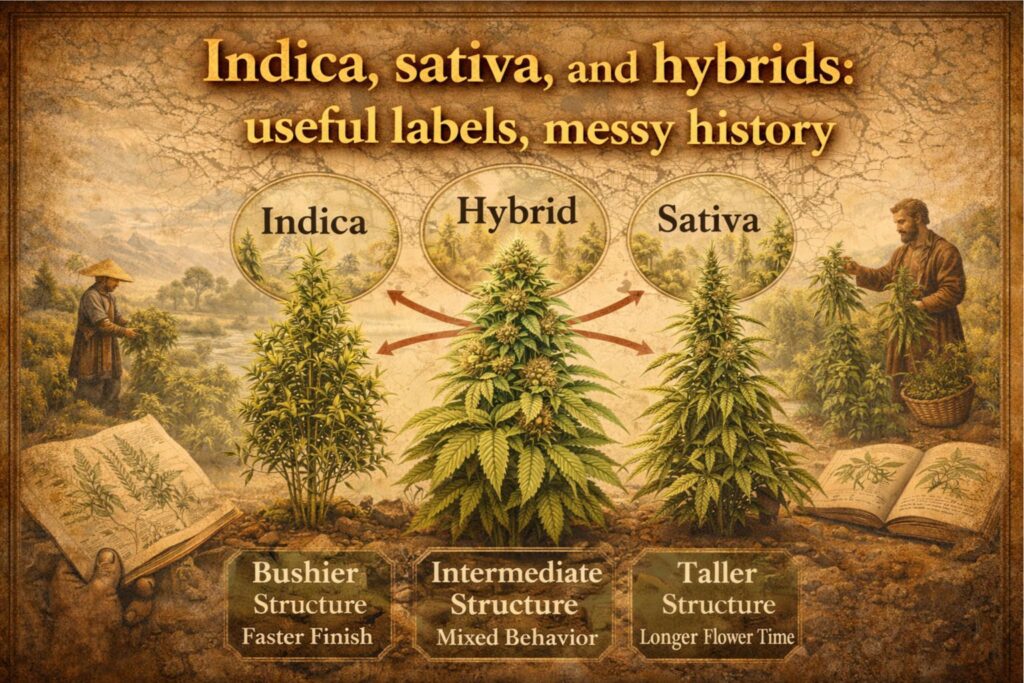
In grower talk, indica and sativa are often treated like strict categories, but in my tents they behave more like trends than rules. What I’ve seen is that “sativa-leaning” plants often stretch more under a strong canopy and can take longer to fully ripen, while “indica-leaning” plants often stack a bit tighter and finish earlier. Hybrids are where most modern packs land, blending traits in ways that don’t always match the label.
When I’m planning a run, I use these words as a starting point, not a guarantee:
- If I expect a sativa-leaning structure, I leave more headroom, start training earlier, and avoid pushing nitrogen too late in flower.
- If I expect an indica-leaning structure, I still watch stretch, but I plan for heavier flower weight and more support.
- With hybrids, I plan to see at least two distinct phenotypes and I keep notes so I can repeat the best one.
This is one place where the history of cannabis pays off. As plants moved and crossed, the boundaries blurred. Today’s “indica vs sativa” debate matters less than how a specific genetic line performs in your environment.
Cannabis in spiritual and medicinal traditions, without the myths
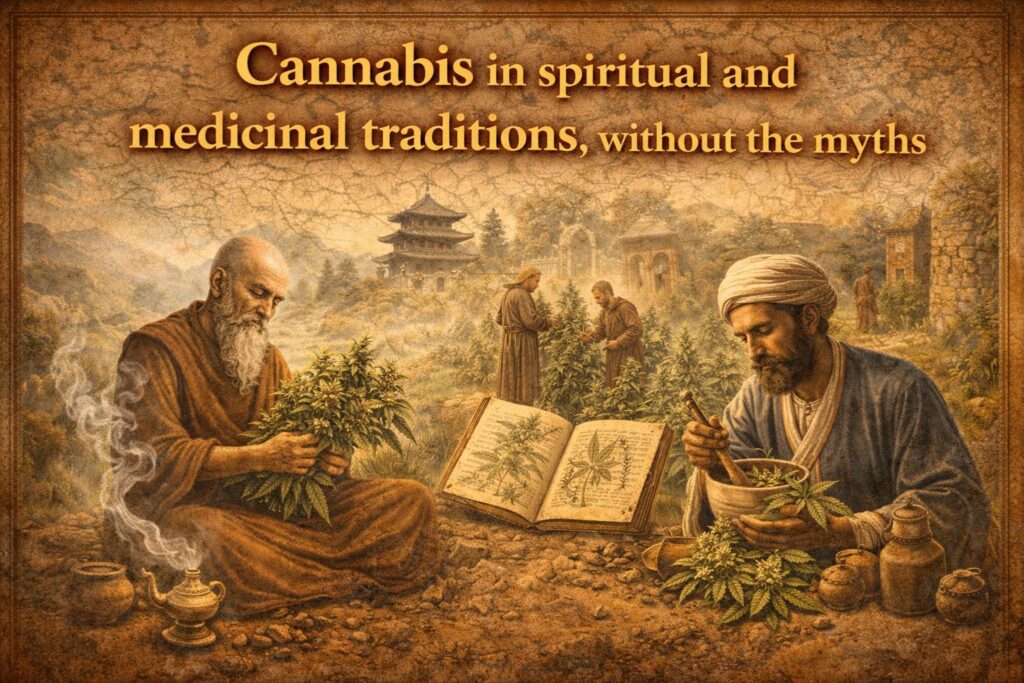
One of the more fascinating threads in the history of cannabis is how cannabis shows up in religious and cultural settings. I’m cautious here because it’s easy to drift into legend. What I do feel confident saying is that cannabis has been used in ritual contexts in various places and times, and that those uses helped preserve cultivation knowledge.
I’ve read accounts of weed cultivation in monasteries and other secluded communities where plant knowledge was shared quietly. Whether every story is accurate or not, the concept matters: when a plant is valued, people protect it. Weed cultivation in monasteries, in the broad sense, points to careful stewardship—saving seed, selecting reliable plants, and passing down techniques.
From a cultivation standpoint, stewardship is familiar. In my own garden, the biggest leaps came when I treated seeds and mothers like long-term projects instead of one-off purchases. That mindset rhymes with the idea of weed cultivation in monasteries: slow improvement, careful record keeping, and respect for the plant’s quirks.
The modern break: prohibition and the underground era
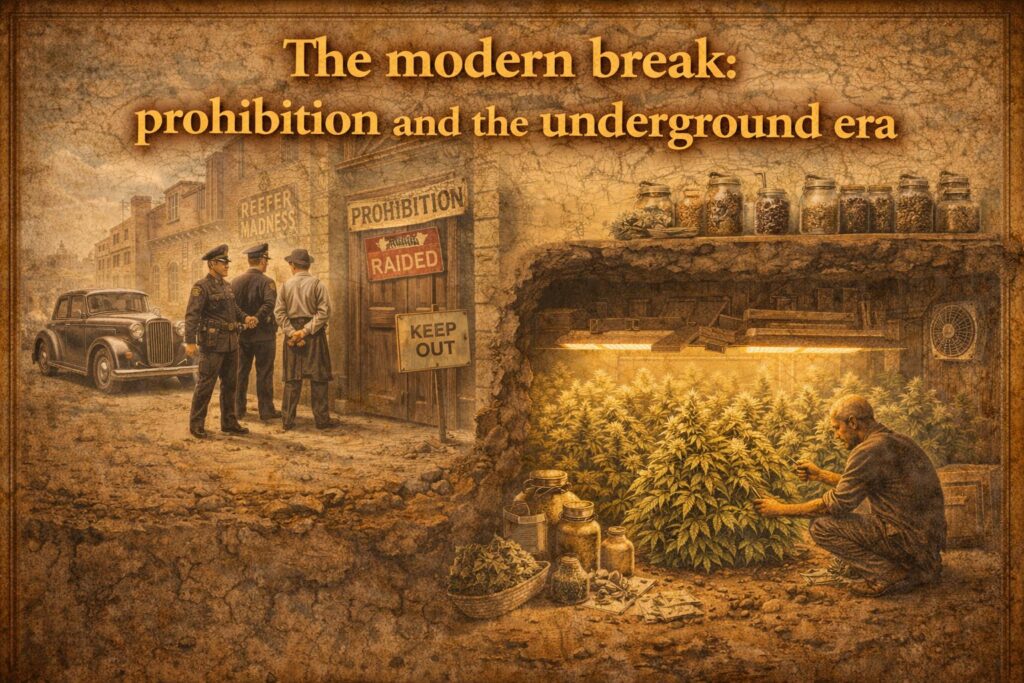
Any honest look at the history of cannabis has to address the cannabis prohibition timeline. Prohibition reshaped genetics, cultivation practices, and how information spread. When growing became risky, growers selected for traits that fit secrecy: shorter plants, faster cycles, stronger aromas, and high potency per square meter.
The cannabis prohibition timeline also pushed breeding into small circles. That had two effects I still see today:
- Some lines became very refined and powerful, because underground growers obsessed over outcomes.
- A lot of record keeping was lost or intentionally vague, which is why modern lineage claims can be hard to verify.
I learned early that “trust but verify” is the only way to shop. The cannabis prohibition timeline is part of why some seed descriptions read like folklore. It’s not always malicious; sometimes the paper trail really is thin.
How underground selection shows up in the grow room
When I run a plant that finishes fast and stays compact under a strong canopy, I see the fingerprints of selection under constraint. I also see why growers developed training methods.
My go-to training toolkit looks like this:
- Early topping or FIM in veg to build multiple mains.
- Low stress training to keep an even canopy under LEDs.
- Selective defoliation in mid flower to improve airflow, not to chase a look.
- Trellis support to prevent late-flower leaning and to keep buds in good light.
Those methods weren’t invented for social media. They were practical responses to limited space and the need for predictable harvests.
Breeding after the shadows: stability, feminization, and autos
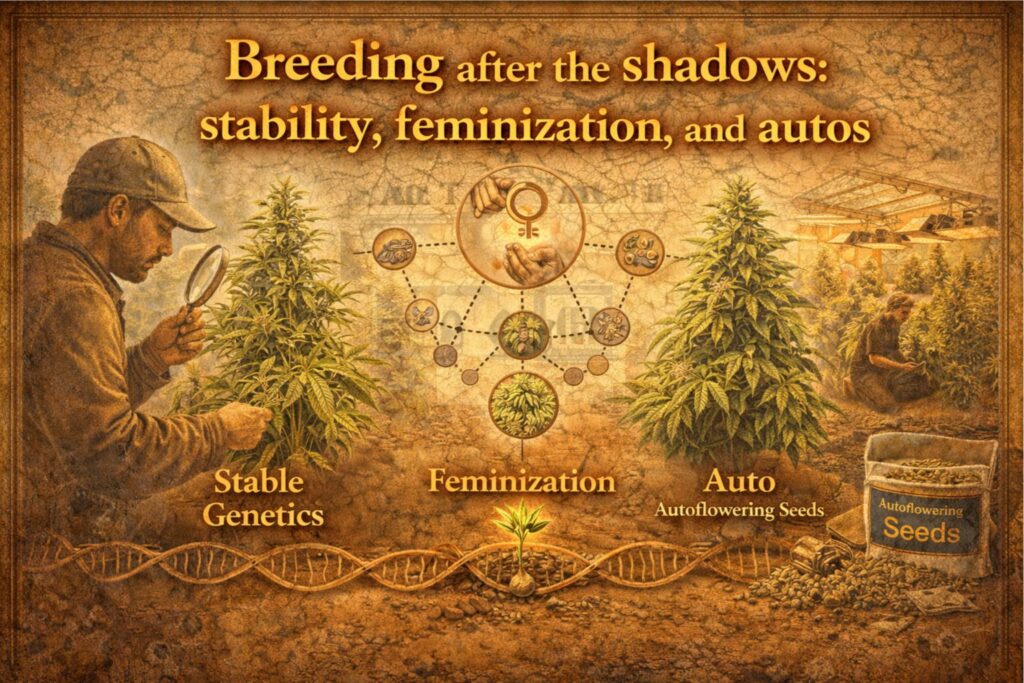
As rules changed in some places and the industry professionalized, breeding became more open. Two shifts changed home growing dramatically: feminized seed selection and the rise of autos.
Feminized seeds and what “feminized” really demands
I use feminized lines when I want efficiency and I’m not planning to make my own crosses. Done well, feminization can be a reliable tool. Done poorly, it can amplify intersex risk.
Feminized seed selection is the difference. When breeders select the right parents, test multiple generations, and cull instability, feminized stock can be extremely consistent. When they don’t, growers pay the price.
In my room, I manage risk with process:
- I avoid heavy stress in late flower, because stress can trigger intersex traits in sensitive lines.
- I keep light schedules consistent. For photoperiods, that usually means 18/6 in veg and 12/12 in flower, with no interruptions.
- I watch for early signs like odd single blades or strange flower clusters, and I remove problem plants quickly.
Feminized seed selection also affects how I shop. I look for breeders who describe testing conditions and who acknowledge trade-offs.
Autos and the autoflower timeline
Autoflowers changed what a “season” means indoors and outdoors. The autoflower genetics history is about crossing cannabis with plants that flower based on age rather than day length. For growers, that means quick cycles, smaller stature, and less dependence on perfect light schedules.
The autoflower genetics history also explains why autos can be sensitive to transplant shock. In my experience, autos reward gentle handling:
- I prefer starting in the final container or using a very careful transplant.
- I keep early EC modest and let the plant ask for more. In coco, that might mean starting around 0.8–1.2 EC depending on the nutrient line.
- I aim for consistent root-zone moisture, because swings can slow early growth and cost yield.
When people ask if autos are “easier,” I say they’re different. The autoflower genetics history produced plants that move fast; your management has to keep up.
Soil and hydro: how methods evolved and how I choose today
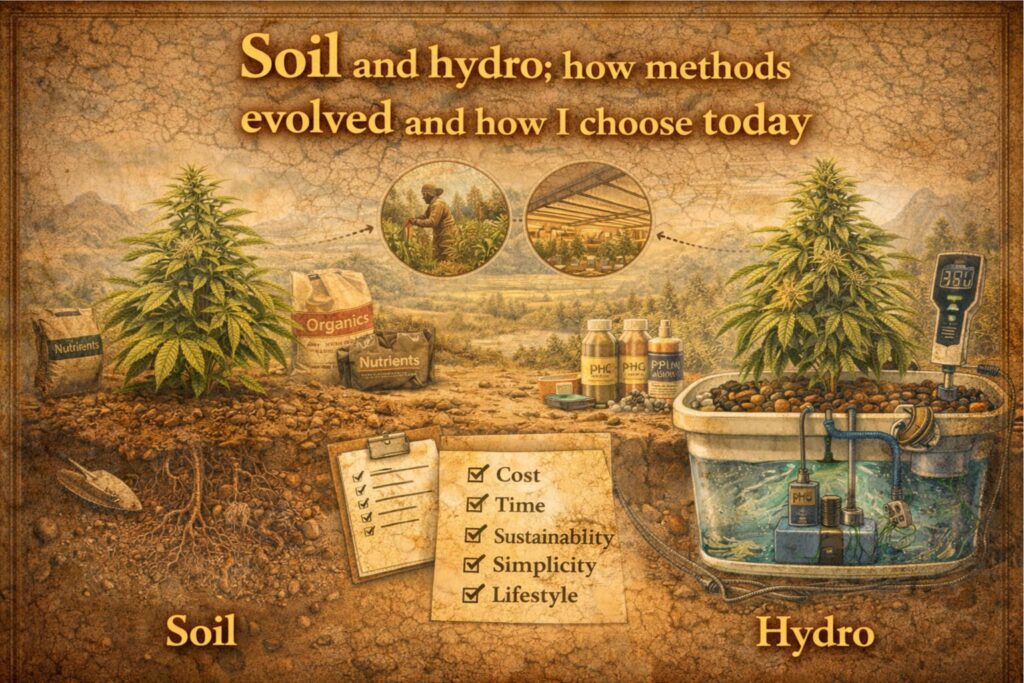
I’ve grown in living soil, peat-based mixes, and coco with drip irrigation. Each run teaches me something. The soil and hydroponic evolution in cannabis happened because growers chased control and predictability. Hydro systems let you fine-tune EC, pH, and oxygenation. Soil methods can buffer mistakes and build resilience.
The soil and hydroponic evolution also shaped the gear market: lights, meters, and additives exist because growers wanted repeatability. My rule is to match method to lifestyle:
- If I can check plants daily, coco or hydro can be incredibly consistent.
- If I travel or want more forgiveness, soil-based mixes reduce the need for constant adjustment.
I still keep the basics the same no matter the medium: good airflow, stable light intensity, and a reasonable dry-back cycle. The soil and hydroponic evolution is interesting history, but it’s also a reminder that there’s no single perfect system.
Quick checklist: a practical baseline for either medium
- pH targets: soil mixes often 6.2–6.8; coco/hydro often 5.7–6.1, depending on inputs.
- Runoff or leachate monitoring in coco/hydro to avoid salt buildup.
- Root-zone temperature stability, ideally around 20–22°C.
- Clean water source and calibrated meters.
- A plan for pests before they appear.
Seed shopping in 2025: what I look for and what I avoid
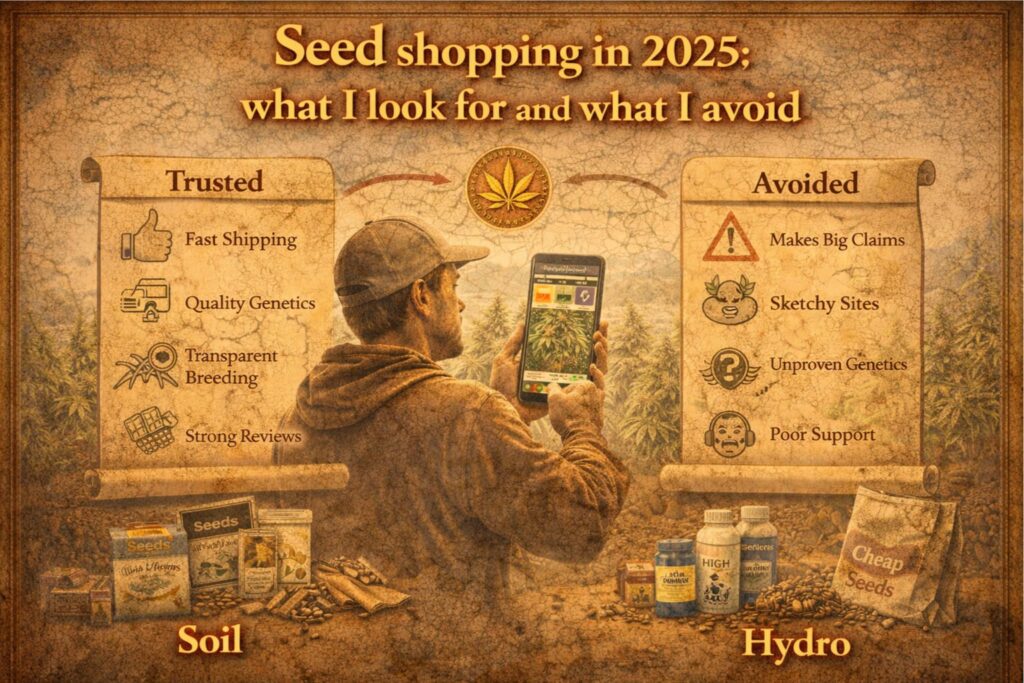
Modern seed shopping is easier than it used to be, but there are new problems: hype, fake photos, and unclear testing. When the listing is vague, I fall back to cannabis seed lineage clues such as parental traits, selection goals, and how long the breeder has worked the line. I approach seed buying the way I approach a new cultivation variable—assume nothing, document everything.
Here’s the seed shopping framework I’ve built, grounded in the history of cannabis and my own runs:
- Genetics goal first: Decide if you want fast finish, high yield, compact structure, or a specific effect profile. Don’t let a name choose for you.
- Breeder transparency: Look for clear statements about filial generations, outcrossing, and testing.
- Realistic photos: I trust photos that show variation and imperfections more than perfect, identical colas.
- Inventory and storage: Seeds are living. I prefer sellers who store cool and dry and ship quickly.
- Customer support: A real seed bank answers questions without dodging.
I also think about modern seed shipping tips because shipping is where good genetics can get ruined. Heat and moisture are the enemies.
Modern seed shipping tips I follow every time
These modern seed shipping tips are simple, but they’ve saved me frustration:
- Track the package and bring it inside promptly. Don’t let it sit in a mailbox in the sun or freezing air.
- Store seeds in a cool, dark place with low humidity. A sealed container in a refrigerator works well if you prevent condensation.
- If the seeds arrive cold, let them come to room temperature before opening the container.
- Label everything. When you’re testing multiple packs, mix-ups are easy.
I’ve learned modern seed shipping tips the hard way after receiving seeds that clearly experienced temperature swings. Germination rates can suffer, and you won’t know if it was the genetics or the journey.
Regional grow laws and shipping restrictions vary widely, so I treat compliance as part of the purchase plan rather than an afterthought.
Germination and early care: where history meets technique
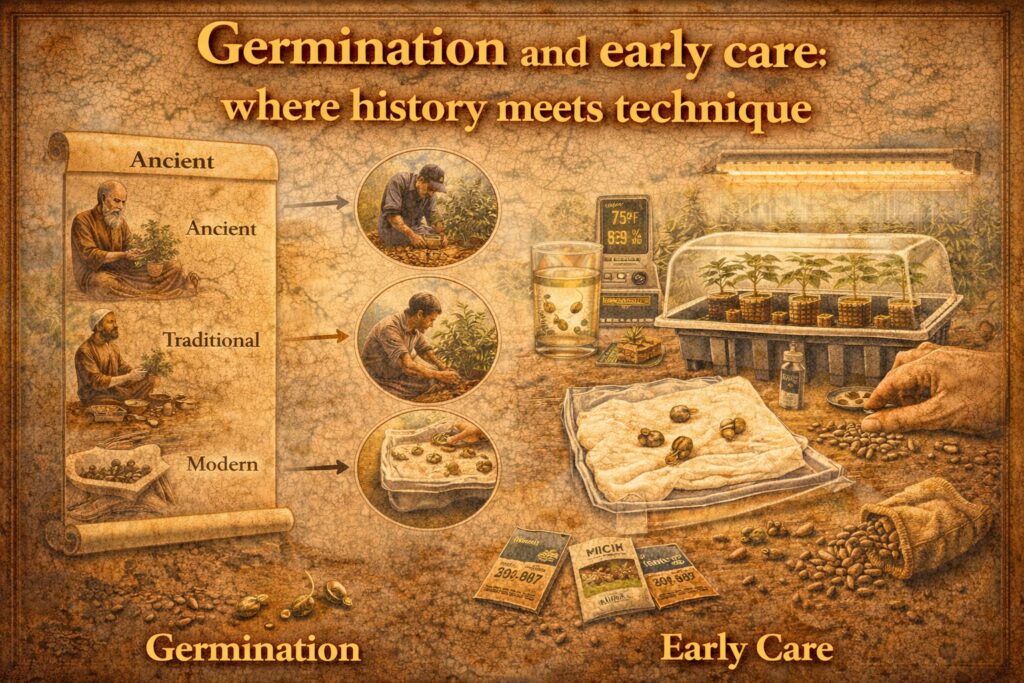
Every era of cannabis cultivation began the same way: a seed and a decision. Before I even wet a paper towel, I write down the cannabis seed lineage and a simple germination plan in the same notebook, so I can connect early behavior with later structure. Even with all the modern tools, I still keep germination simple and gentle.
My reliable approach:
- Hydrate a paper towel lightly, not soggy, and keep it around 24–26°C.
- Once the taproot appears, plant shallow, about 0.5–1 cm deep.
- Use a mild light intensity at first, then ramp PPFD as the seedling establishes.
- Avoid overfeeding. In soil, plain water is often enough early on; in coco, a light nutrient solution works.
If I’m running autos, I treat early care as sacred because the clock starts immediately.
Post-harvest: what old growers got right
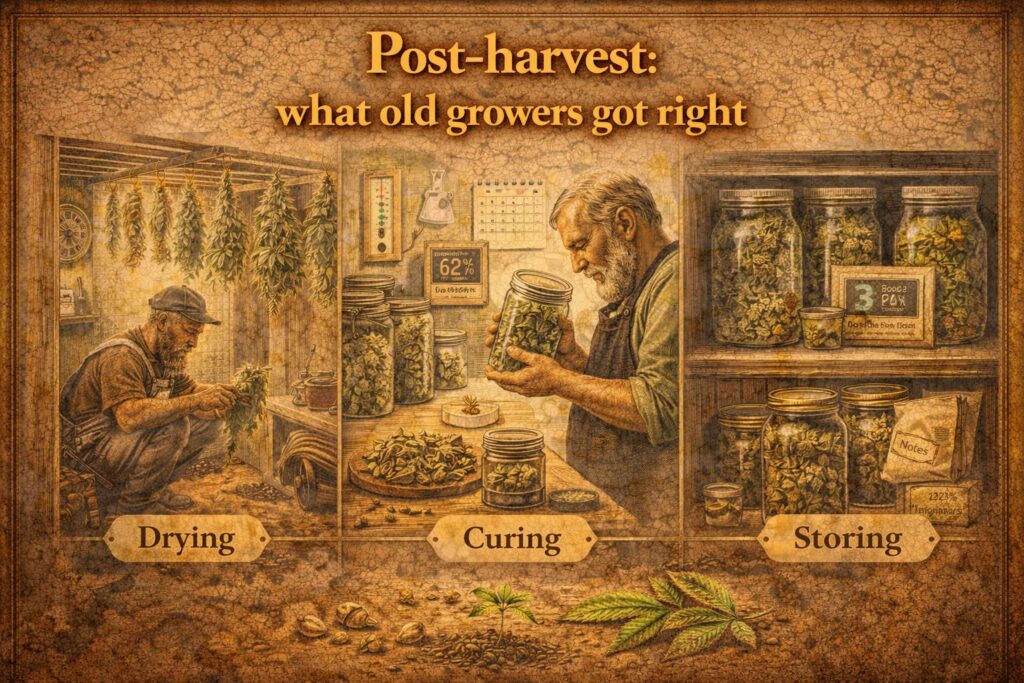
The history of cannabis isn’t only about growing; it’s also about preserving quality. Drying and curing were always essential, even before modern jars and hygrometers.
My standard process:
- Dry in darkness with gentle airflow, around 18–21°C and 50–60% humidity if I can manage it.
- Aim for a slow dry of 10–14 days, adjusting airflow rather than cranking heat.
- Cure in sealed containers, burping as needed early on, then stabilizing.
The best results I’ve had came from patience. A rushed dry can flatten aroma and harshen smoke, no matter how good the grow was.
FAQ: common questions I hear about seeds and cultivation history
How did cannabis become so diverse?
The cannabis domestication timeline and centuries of regional adaptation created diversity. Human selection for different uses and environments shaped structure, resin production, and flowering behavior.
Are feminized seeds always safe to grow?
Feminized seed selection matters more than the label. Stable feminized lines can be consistent, but stress and poor breeding can increase intersex risk. Keep conditions steady and buy from transparent breeders.
Why do autoflowers finish so quickly?
The autoflower genetics history includes breeding plants that flower based on age. That built-in schedule is why autos move fast and why early setbacks can reduce yield.
Is soil better than hydroponics for beginners?
The soil and hydroponic evolution shows both can work. Soil mixes can be more forgiving; hydro or coco can offer tighter control if you monitor pH and EC carefully.
What should I consider when ordering seeds online?
Modern seed shipping tips are key: avoid temperature extremes, store seeds properly, and buy from reputable seed banks with clear storage and shipping practices. Always review your local rules before ordering or growing.
Bringing it back to the grow room
I wrote this because the history of cannabis isn’t just a story—it’s a toolkit. When I’m deciding between photoperiods and autos, choosing between soil and coco, or comparing seed banks, I’m leaning on patterns built over centuries. The plant has traveled through ancient hemp farming, early marijuana trade routes, weed cultivation in monasteries, and the cannabis prohibition timeline to reach my grow tent.
When I remember that long journey, I grow with more humility and better discipline. I keep notes. I control what I can. And I let the plant show me, cycle after cycle, why its history still matters.
