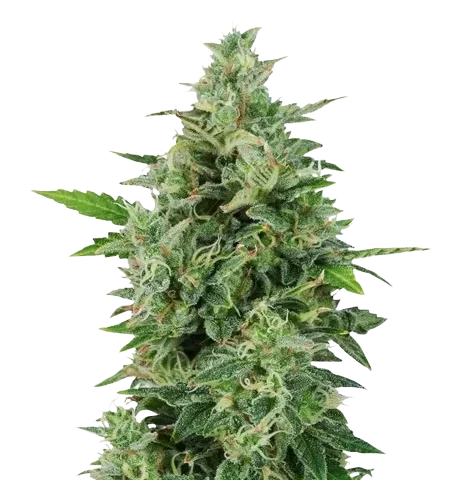
Why I Keep Coming Back To The OG Kush Strain
No matter how many new crosses hit the market, I always find myself coming back to the OG Kush strain. It is one of those classic cannabis lines that still surprises me run after run. When I first started growing OG Kush and its variants , I underestimated how much its structure and aroma would dominate my grow room. These days, I treat it as a benchmark: if a new hybrid can hang with my favorite OG Kush and its variants, it earns a place in my rotation.
From a grower’s perspective, the OG Kush strain is demanding but rewarding. It prefers a dialed-in environment, consistent feeding, and thoughtful training, but it will pay you back with dense, resin-heavy colas and a nose that cuts through a room full of jars. In this guide, I will walk through exactly how I approach growing OG Kush and its variants , how I choose OG Kush seeds and phenotypes, and how I manage its flowering time and yield across different variants.
Understanding OG Kush Variants And Lineage

OG Kush has been crossed, backcrossed, and reworked so many times that talking about OG Kush and its variants is almost a conversation about modern marijuana itself. When I open a seed catalog or browse a cannabis seed bank online, I see “OG” tagged onto everything from cookie hybrids to fruity sativas.
When I talk about OG Kush variants in my own garden, I break them into three useful groups:
- Classic cuts that stay close to the original OG Kush strain profile.
- Hybrids that blend OG gas with dessert or fruit terpenes.
- Purpose-bred lines like high-yield OG Kush variants or mold-resistant outdoor types.
This helps me decide which OG Kush seeds I bring into the grow room. A classic, indica dominant OG Kush will usually stretch less than a sativa-leaning hybrid and crave a slightly heavier feeding schedule. The more hybridized OG Kush variants might offer a shorter OG Kush flowering time or a bigger OG Kush yield, but they can drift a bit in structure and terp profile.
In practice, I keep notes on each run. If an individual plant expresses the dense, golf-ball structure and heavy gas I associate with the OG Kush strain, I label it as one of my preferred OG Kush phenotypes. Over a few cycles, this gives me a personal library of OG Kush variants that I know perform well under my conditions.
Choosing OG Kush Seeds For Your Setup
The starting point for growing OG Kush is smart seed selection. There are more OG Kush seeds on the market than any one grower could test in a lifetime, so I rely on a few criteria:
- Reputation of the breeder or cannabis seed bank
- Clear description of structure, flowering time, and yield
- Whether they offer feminized OG Kush seeds or regular seeds
- Availability of OG Kush autoflower versions for quick runs
I still enjoy working regular OG Kush seeds when I have space to hunt males and females, but in tight indoor rooms I lean heavily on feminized OG Kush seeds. Feminized OG Kush seeds simplify planning and reduce the risk of an unexpected male dropping pollen on a packed indoor OG Kush grow.
When I am shopping online, I also check how the breeder describes OG Kush flowering time and OG Kush yield. If they claim impossible numbers, I move on. Reasonable expectations and honest data help me predict how an OG Kush strain will behave in my specific environment.
Why I Prefer Feminized OG Kush Seeds Indoors
After years of trials, feminized OG Kush seeds are my default choice for flower rooms with limited plant counts. They allow me to:
- Veg fewer plants for a fuller canopy
- Spend more time dialing in environment instead of sexing plants
- Clone my favorite OG Kush phenotypes without worrying about hidden male traits
I usually start more feminized OG Kush seeds than I plan to flower, then cull down to the best individuals during early veg. Over a few runs, I have narrowed my stable to a handful of OG Kush phenotypes that consistently deliver the structure, aroma, and OG Kush yield I want.
When To Use OG Kush Autoflower Seeds
OG Kush autoflower lines have become a practical tool in my grow planning. I use an OG Kush autoflower when:
- I want a fast outdoor harvest before autumn rains
- I have a gap between photoperiod runs in my indoor OG Kush grow
- I want a lower-maintenance side project while focusing on a main flower room
Because OG Kush autoflower plants flip to flower on their own schedule, I keep them under 18 to 20 hours of light per day and avoid heavy training after the first few weeks. They are less forgiving than photoperiod feminized OG Kush seeds when it comes to transplant shock and topping, so I stick to gentle low-stress training and early pot sizing.
Setting Up An Indoor OG Kush Grow
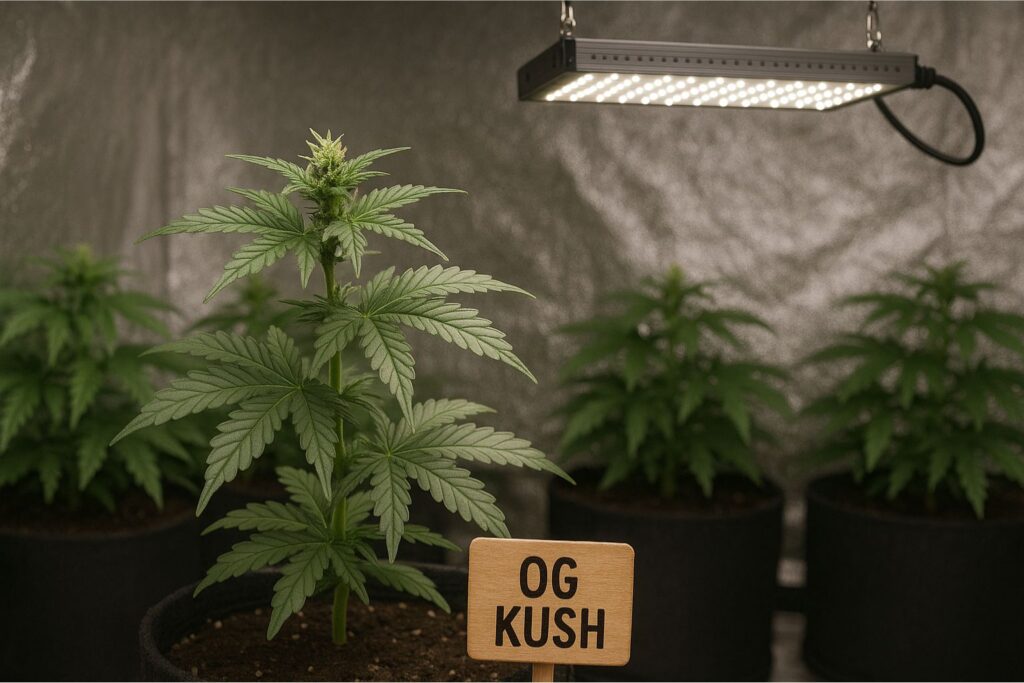
Most of my detailed experience comes from running an indoor OG Kush grow with LED fixtures. The OG Kush strain loves consistent conditions, and an enclosed grow room or tent makes it easier to keep everything in range.
Here are the baseline environmental targets I use:
- Veg temperature: 24–27°C (75–81°F)
- Flower temperature: 23–26°C (73–79°F)
- Relative humidity: 60 percent in veg, tapered down to 45–50 percent by mid-flower
- Root-zone temperature: 18–22°C (64–72°F)
With modern LEDs, I aim for 400–600 µmol/m²/s PPFD in veg and 800–950 µmol/m²/s in flower for the OG Kush strain, depending on CO₂ levels and plant health. In my experience, OG Kush phenotypes handle higher PPFD well as long as VPD stays in a comfortable zone and the root zone is well-oxygenated.
Strong air exchange and circulation are essential for any indoor OG Kush grow. I use:
- An exhaust fan sized to replace tent air every 1–3 minutes
- A carbon filter to keep OG Kush variants from broadcasting their aroma
- Oscillating fans above and below the canopy to prevent microclimates
These basics alone go a long way toward preserving healthy leaves and preventing mold issues that can ruin an otherwise beautiful OG Kush yield.
Medium, Nutrients, And Feeding The OG Kush Strain
I have run the OG Kush strain in soil, coco, and hydroponics. Each medium works if you understand how OG Kush responds to nutrition and root moisture.
These days my default is buffered coco with a simple two-part nutrient line. I keep electrical conductivity around:
- 0.8–1.2 mS/cm (400–600 ppm) for early veg
- 1.4–1.8 mS/cm (700–900 ppm) for late veg and early flower
- 1.8–2.0 mS/cm (900–1000 ppm) during peak bloom if plants are asking for more
Indica dominant OG Kush plants usually tolerate slightly heavier feeding than lankier hybrids, but I watch leaf tips instead of chasing numbers. Burnt tips tell me to back off; pale, hungry leaves tell me to feed more often.
No matter the medium, I avoid letting pots stay waterlogged. OG Kush phenotypes hate cold, soggy roots. I water to healthy runoff, then wait for the top inch or two of coco or soil to dry before the next irrigation. In hydro, I keep reservoirs well-aerated and change solution on a consistent schedule to prevent salt buildup.
Training Techniques For Better OG Kush Yield
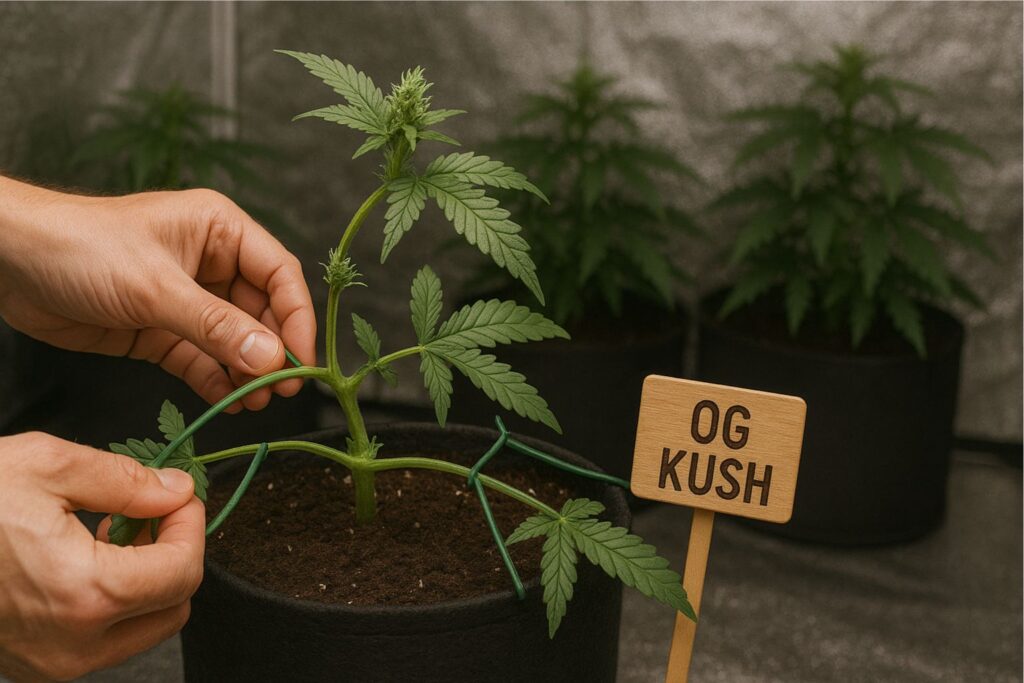
The raw potential of the OG Kush strain only shows up when you shape the canopy. Left alone, many OG Kush variants stretch heavily and stack their best buds at the top, leaving lower branches underdeveloped. To maximize OG Kush yield, I rely on a mix of topping, low-stress training, and sometimes a trellis.
Here is my typical sequence when growing OG Kush from seed:
- Top once above the fourth or fifth node.
- Gently tie out the main branches to open the center of the plant.
- Clean out weak lower growth that will never reach strong light.
- In larger tents, weave branches into a simple screen of green.
This approach keeps an indoor OG Kush grow even across the canopy and prevents tall tops from shading lower colas. It also allows light to penetrate deeper, which helps reduce moisture pockets that could cause mold during late OG Kush flowering time.
For OG Kush autoflower plants, I am much more conservative. I usually skip topping and instead use gentle bending and selective defoliation. An OG Kush autoflower simply does not have time to recover from aggressive training the way a photoperiod plant does.
What To Expect From OG Kush Flowering Time
Most of the OG Kush variants I run indoors finish in 8–10 weeks of 12/12 light, but exact OG Kush flowering time depends on the individual phenotype and breeder.
In my room, a typical OG Kush flowering time looks like this:
- Weeks 1–2: Stretch phase; plants can double in height.
- Weeks 3–5: Bud sites stack and resin begins to form.
- Weeks 6–8: Aromas intensify and calyxes swell.
- Weeks 9–10: Trichomes turn cloudy with some amber; leaves may fade.
I rely on trichome color and overall plant health rather than the calendar alone. Each OG Kush strain and phenotype ripens on its own schedule, and some of my favorite OG Kush phenotypes push closer to the full 10 weeks. Patience at this stage often improves both OG Kush yield and bag appeal.
Outdoor OG Kush flowering time depends heavily on latitude and climate. In warm, dry regions, indica dominant OG Kush cuts can make it to the finish line, but in wetter climates I often prefer an OG Kush autoflower or a hybrid bred for earlier finishing.
Harvest, Drying, And Curing For Maximum OG Kush Yield And Quality
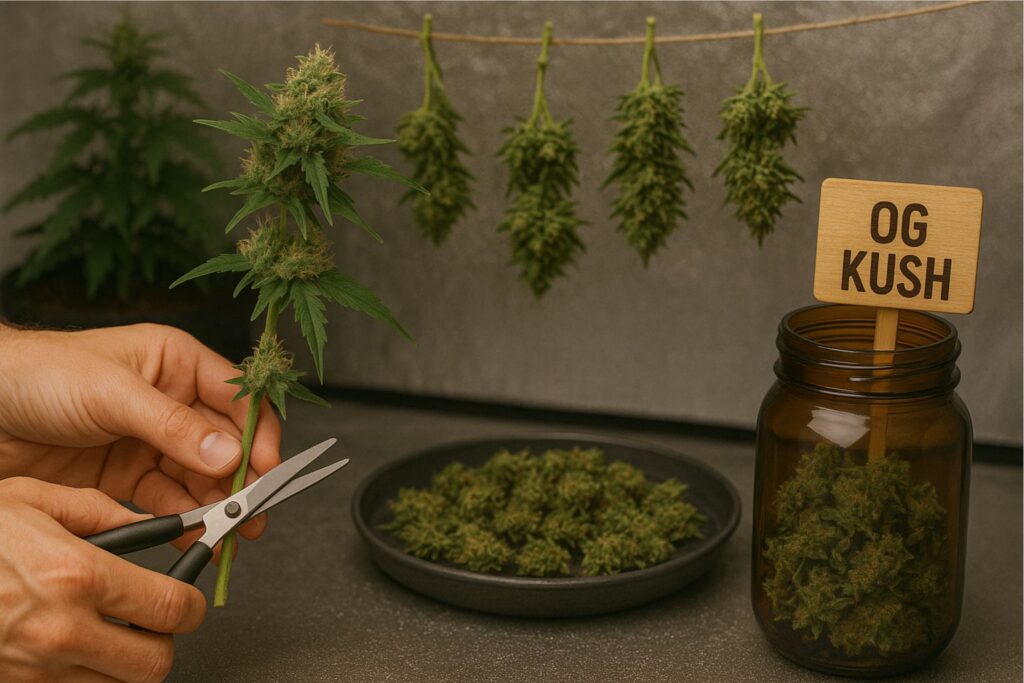
Once trichomes are mostly cloudy with a sprinkling of amber, I plan my harvest. At this stage, small decisions can make a big difference in both OG Kush yield and quality.
My preferred approach is:
- Harvest whole plants or large branches to slow the dry.
- Maintain 18–21°C (65–70°F) and 55–60 percent humidity in the dry space.
- Provide gentle air movement that does not blow directly on the buds.
The OG Kush strain carries a strong aroma that can fade if you dry too fast. I aim for 10–14 days of drying before trimming and jarring. During cure, I “burp” jars daily for the first week, then less frequently as humidity stabilizes.
After a good cure, the various OG Kush variants reveal their personalities. Some lean toward lemon and fuel, others toward earthy pine. I label jars by cut and date so I can compare how each of my OG Kush and it variants phenotypes performs across multiple runs.
Dealing With Pests And Diseases In OG Kush Grows
Like any dense-flowering marijuana, OG Kush can attract pests and pathogens if you slip on cleanliness or environment. Spider mites, powdery mildew, and bud rot are the three main threats I watch for.
My prevention plan in an indoor OG Kush grow looks like this:
- Quarantine new clones before they ever enter the main room.
- Never bring outdoor plants, unwashed clothing, or pets into the grow space.
- Keep humidity under control, especially during late OG Kush flowering time.
- Use yellow sticky traps and regular leaf inspections to detect issues early.
If I see pests, I respond with targeted biological controls or mild sprays that are safe for use in veg. I avoid heavy treatments in flower whenever possible. The earlier you catch a problem, the easier it is to protect your OG Kush yield without resorting to harsh interventions.
Some OG Kush variants show slightly better resistance than others, which is why I keep cloning standout OG Kush phenotypes. Over time, you can build your own lineup of sturdy, indica dominant OG Kush cuts that thrive in your exact environment.
Outdoor Growing OG Kush: When It Makes Sense
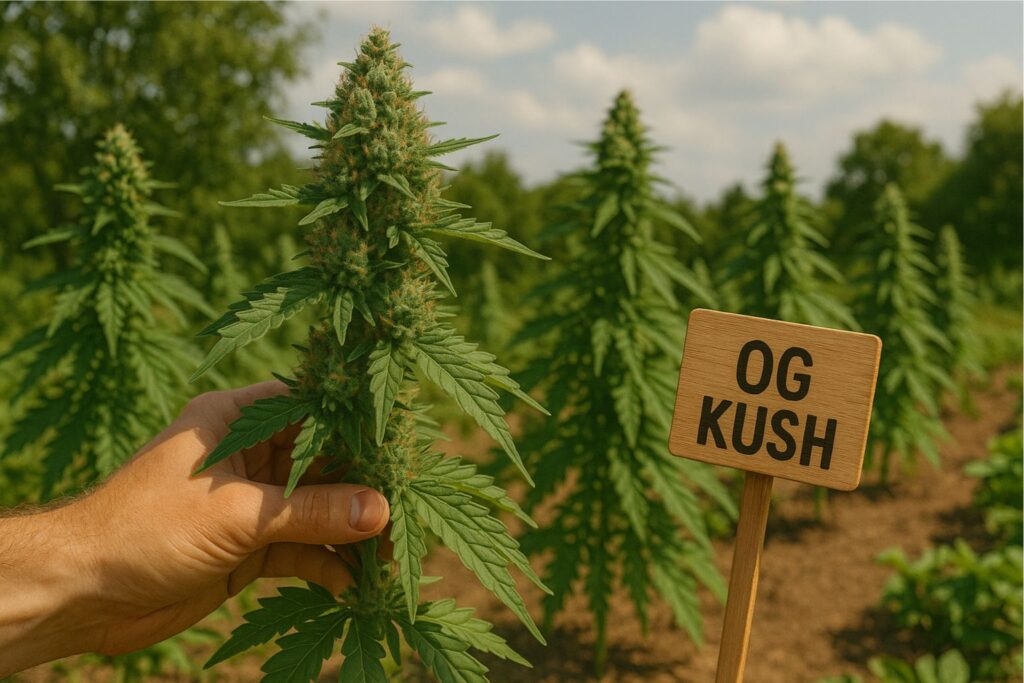
While my focus is indoor, I have run the OG Kush strain outdoors in a few warm, dry seasons. The key outdoors is matching the right OG Kush variants to your climate and understanding local rules.
Before planting, I always check:
- Regional weather patterns during flowering months
- Local regulations on marijuana plant counts and visibility
- Whether my chosen OG Kush flowering time will beat autumn rains
In shorter, cooler seasons, I usually lean on OG Kush autoflower seeds for outdoor beds or containers. An OG Kush autoflower can finish in as little as 10–12 weeks from germination, which sometimes means harvesting before the worst of the weather. In long, hot summers, a full-season, indica dominant OG Kush can produce impressive colas, but you must stay on top of nutrition, irrigation, and training.
Whatever the setup, I always order OG Kush seeds from reputable vendors that clearly explain shipping policies and do not make unrealistic promises. Cannabis laws change frequently, so each grower needs to understand what is allowed in their own region before buying seeds or planting outdoors.
FAQ: OG Kush Strain And Its Variants
What is the best environment for growing OG Kush?
In my experience, the OG Kush strain thrives in a stable indoor environment: 23–26°C during flower, 45–50 percent humidity, and strong but not scorching LED lighting at 800–950 µmol/m²/s PPFD. Good airflow and clean intake air are critical. These same principles apply whether you are running classic OG Kush variants or newer hybrids.
How long does OG Kush flowering time usually take?
Most OG Kush variants I have grown finish in 8–10 weeks under a 12/12 light cycle. Some indica dominant OG Kush cuts are ready in about 8 weeks, while more hybrid OG Kush phenotypes often show their best terpene and resin expression closer to 9 or 10 weeks. I always confirm with a loupe, checking for mostly cloudy trichomes before harvest.
Are feminized OG Kush seeds better than regular seeds?
Feminized OG Kush seeds are not “better,” but they are more convenient for many home growers. If you have strict plant limits or limited space, feminized OG Kush seeds let you focus on training and canopy management instead of sexing plants. Regular OG Kush seeds are still valuable for breeders and anyone who wants to hunt males and females, but they are not necessary for a reliable indoor OG Kush grow.
Should I try an OG Kush autoflower as my first grow?
If your goal is speed and simplicity, an OG Kush autoflower can work for a first grow, especially outdoors in summer. Just keep in mind that an OG Kush autoflower gives you less time to correct mistakes. For absolute beginners indoors, I often recommend feminized OG Kush seeds because they give you control over when to flip to flower and how large to grow the plant before that point.
What kind of OG Kush yield can I expect?
OG Kush yield depends on genetics, environment, and skill. In a well-run indoor OG Kush grow with good training, I commonly see 400–600 grams per square meter from photoperiod plants. Some specially bred OG Kush variants can push higher, but I focus more on consistent quality than chasing maximum numbers. Outdoors, in ideal conditions, a big plant from strong OG Kush seeds can easily exceed indoor yields.
Final Thoughts
The OG Kush strain has earned its reputation by delivering complex aroma, dense buds, and a distinct growing style that keeps cultivators engaged. With thoughtful seed selection, careful attention to environment, and a willingness to learn from each run, growing OG Kush becomes less of a challenge and more of a long-term craft.
Whether you are dialing in your first indoor OG Kush grow, experimenting with OG Kush autoflower lines on the balcony, or hunting through new OG Kush variants from your favorite seed bank, the fundamentals stay the same. Respect the plant, observe your OG Kush phenotypes closely, and keep your environment dialed. Do that, and the jars you fill at the end of each season will remind you why this classic marijuana line still sits at the top of so many growers’ lists.
-
OG Kush Cannabis Seeds
OG Kush cannabis seeds carry the genetic essence of a …From: $24.99 BUY NOW This product has multiple variants. The options may be chosen on the product page