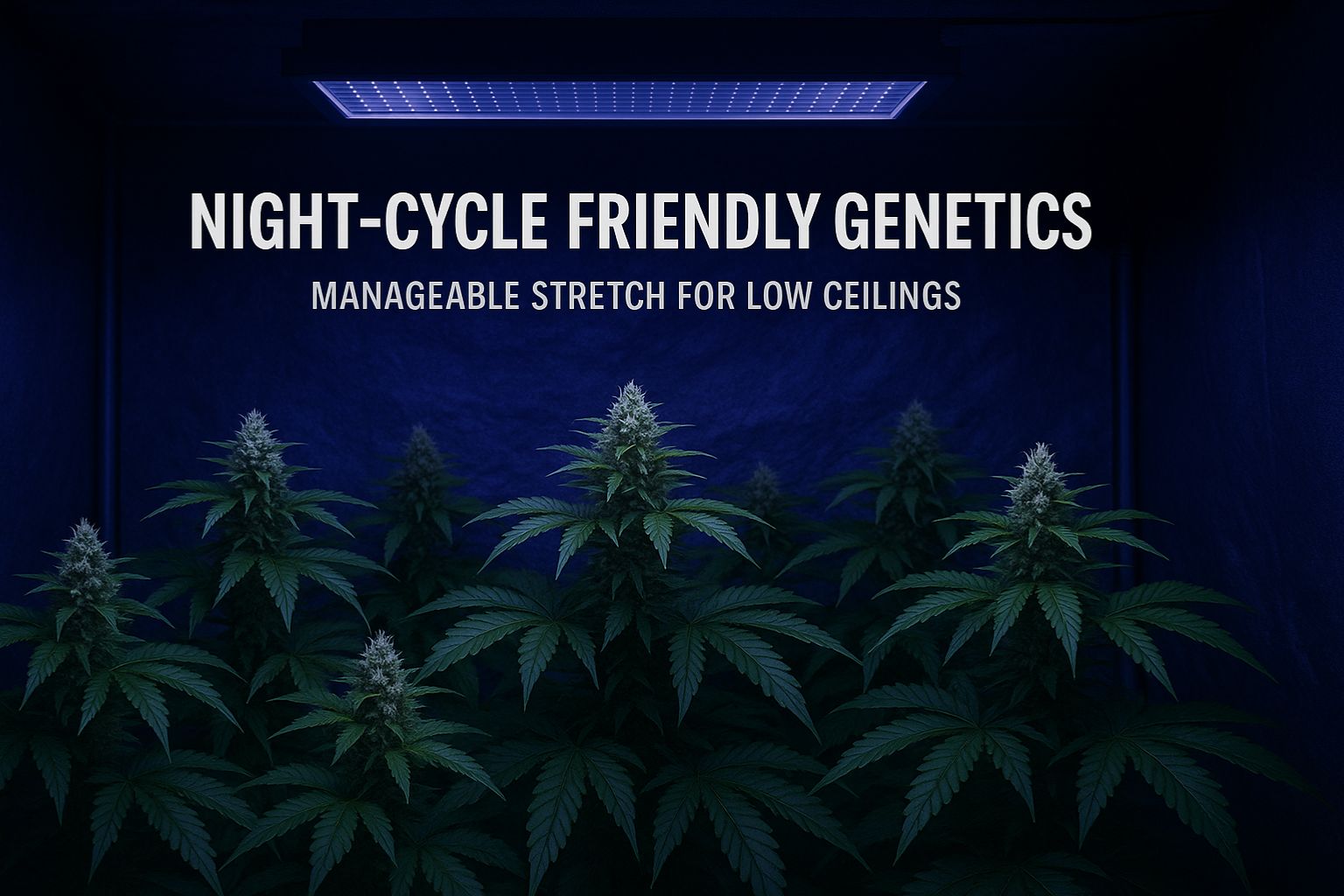
Growing indoors with limited headroom has taught me that genetics, timing, and light management matter just as much as nutrient schedules. Over the last decade I have run dozens of small tents and cabinets in spare closets, basements, and converted storage spaces. Along the way, I have come to rely heavily on night-cycle friendly seeds that can handle cooler, darker hours without exploding in height. These night-cycle friendly seeds let me flower healthy plants under tight vertical limits while keeping the whole operation quieter, cooler, and easier to hide.
This guide walks through how I choose and run low ceiling cannabis seeds that stay compact, finish strong, and work well with a lights-off daytime schedule. I will share what has actually worked in my rooms: specific plant traits I look for, environmental ranges that keep stretch under control, and practical indoor weed grow tips you can apply on your next run.
Why grow at night in tight spaces?
I started flipping my rooms so the main light cycle ran at night for one reason: heat. My earliest runs were in a small upstairs bedroom using budget LEDs and a very basic exhaust fan. In the middle of summer, daytime temps would creep over 30°C even with the window cracked, which pushed the canopy into stress. Switching the timer so lights came on at 8 p.m. instead of 8 a.m. immediately dropped peak temperatures by a few degrees and gave me more stable vapor pressure deficit.
Running lights at night also helps with stealth cannabis cultivation. Fans and air pumps blend into normal evening noise. Windows leak less light because it is dark outside anyway. And power companies often offer cheaper off-peak rates in the evening, though that varies by region. Night-cycle friendly seeds are a natural fit here, because they respond predictably to the cooler, denser air of the night without stretching out of control.
If you are working with a 2 x 4 foot tent, a converted wardrobe, or a discreet attic crawlspace, you quickly learn that not all genetics behave the same under a night schedule. Some tall sativa-leaning lines will double or even triple in height after the flip. Others, especially indica-leaning hybrids and modern compact cultivars, stay manageable with a bit of training. Choosing true low ceiling cannabis seeds right from the start saves you from desperate late flower bending and broken stems.
What I look for in night-cycle friendly genetics
Over time, I have developed a short checklist for picking night-cycle friendly seeds that behave well in low tents. When I evaluate a new line from a seed bank, I pay closer attention to structure notes than to THC percentages. Here is what I focus on.
Compact frame and moderate internode spacing
The first trait I look for is a naturally compact plant. Breeders will often describe these as bushy, stocky, or medium height. For truly low ceiling cannabis seeds, I prefer advertised heights of 60–100 cm indoors. In practice, with good cannabis training techniques, I can keep those plants around 45–60 cm above the pot by the end of stretch.
Internode spacing is just as important. Short marijuana strains with tight nodes stack buds into dense, efficient colas under LEDs. Long, lanky spacing means the plant wants to race toward the light, which is the opposite of what we want for manageable stretch.
Flowering time and stretch profile
Different cultivars express stretch very differently in the first three weeks after the flip. On average, most photoperiods will gain 50–100 percent in height, but short marijuana strains bred for micro-grows often stay closer to the lower end of that range.
Seed banks rarely publish exact stretch data, so I rely heavily on grow reports and my own logs. If several growers report that a strain “barely stretches,” that is a green flag for tight spaces. When in doubt, I run new lines alongside proven night-cycle friendly seeds so I can compare their behavior under identical conditions.
Indica, sativa, and hybrid balance
In my experience, indica-dominant hybrids make the most reliable low ceiling cannabis seeds. They usually carry broader leaves, faster flowering times, and a squat structure that responds well to topping and scrogging. Pure sativas can be tamed, but they demand more aggressive cannabis training techniques and tighter environmental control.
That said, I do not ignore sativa influence completely. Many of my favorite short marijuana strains are 60/40 or 70/30 hybrids where the sativa side adds aroma and effect while the indica side keeps things compact.
Feminized and autoflower options
For stealth cannabis cultivation in small spaces, I almost always run feminized cannabis seeds. In a low tent, losing half your canopy to males is brutal. Feminized cannabis seeds let me fill every square inch of the net without worrying about rogue pollen.
Autoflower cannabis seeds can also be excellent night-cycle friendly seeds, especially for growers who cannot fully lightproof their space. Because autos flower based on age rather than photoperiod, light leaks during the night phase are less of a concern. I like compact autoflower cannabis seeds that top out around 70 cm and finish in 70–85 days from seed. These slot nicely into small cabinets, windowside boxes, and balcony stealth cannabis cultivation projects.
Dialing in the environment for low ceilings
Once I have my genetics chosen, I treat environmental control as my main tool for cannabis stretch control. Plants stretch hardest when they are reaching for light or reacting to big swings in temperature and humidity. Keeping conditions steady during the transition into flower makes a noticeable difference.
Tent size, pot choice, and root zone
Most of my night-cycle grows happen in either a 2 x 4 or 3 x 3 foot tent with an internal height of about 160–180 cm. After subtracting space for the filter, LED grow light setup, and gap above the canopy, I realistically have 60–90 cm of vertical canopy room to play with.
To keep plants compact, I pair low ceiling cannabis seeds with moderate pot sizes. In coco or soilless mixes I typically run 11–15 liter containers; in living soil I may go up to 20 liters. Oversized pots give roots more room, which can increase vigor and contribute to extra stretch.
At the root zone I aim for a media temperature of 20–22°C during the night cycle. Cool, but not cold. That range keeps metabolism active without pushing excess growth.
Lighting: PPFD and hanging height
Modern LEDs make it much easier to run a cool, efficient LED grow light setup in small rooms. For veg I target 300–500 µmol/m²/s PPFD at canopy level, and for early flower I gradually bump that to 700–800 µmol/m²/s. Pushing over 900 in a very low tent can be risky because the light has to sit so close to the tops.
I always test a new LED grow light setup by running it at full power over an empty tent and measuring temperature at canopy height. If the difference between lights-off and lights-on exceeds 6–7°C, I dial back the dimmer or improve exhaust before adding plants. Stable temperatures are a big part of cannabis stretch control.
During transition, I start with the light slightly higher and the dimmer a bit lower, then slowly lower the fixture and raise intensity over the first two weeks of 12/12. This gentle ramp keeps internodes tighter compared to blasting full intensity from day one.
Temperature, humidity, and VPD at night
When the room is dark outside but my tent is lit, I shoot for 24–26°C canopy temperature in veg and early flower, dropping to 22–24°C later in bloom. Nighttime relative humidity around 55–65 percent in veg and 45–55 percent in flower usually keeps my vapor pressure deficit in a comfortable range without needing complex controllers.
Because the house itself cools down at night, heaters can matter just as much as exhaust fans. A small oil-filled radiator or a thermostatically controlled space heater outside the tent smooths out dips and keeps night-cycle friendly seeds from slowing down too much between lights-off periods.
Good air movement is non-negotiable. I like two oscillating fans in opposite corners, one sweeping over the canopy and another blowing below it. This prevents stagnant pockets of damp air that can encourage disease, especially in compact short marijuana strains with tight bud structure.
Cannabis training techniques that keep plants below the light
Genetics and environment set the stage, but cannabis training techniques are what actually shape the canopy. In a low tent you are essentially sculpting living hedges, trying to create an even, shallow sea of tops.
Early topping and low stress training
With most night-cycle friendly seeds I top once or twice in veg. My usual pattern is to top at the 4th or 5th node, let the two main branches grow out, then top those again once they have 3–4 nodes. This quickly creates 4–8 primary branches.
As soon as those branches are long enough to bend, I tie them down toward the edges of the pot using soft coated wire. This low stress training spreads growth horizontally instead of vertically and is one of the simplest tools for cannabis stretch control. By the time I flip to 12/12, the plant already resembles a flat bush rather than a Christmas tree.
Screen of green for maximum stealth
If I am pushing yield in a small space or doing stealth cannabis cultivation in a loft or shared house, I install a screen of green (SCROG) net about 20–30 cm above the pots. As branches grow through the net, I gently tuck them sideways to fill empty squares. Short marijuana strains take especially well to this approach because their stiff branches hold position once woven into the grid.
With a well-timed SCROG, the final canopy height often ends up only 20–30 cm below the LED grow light setup. Every bud site sits in the sweet spot for light and airflow, and there is no single dominant cola trying to burn itself on the diodes.
Pruning, defoliation, and airflow
Under a dense net, airflow can become an issue. I lollipop the bottom third of each plant shortly before the flip, removing small interior branches that will never reach the screen. During stretch, I selectively pluck fan leaves that block multiple bud sites or lie directly on top of each other.
These small interventions reduce humidity pockets and focus the plant’s energy on the most productive sites. In combination with thoughtful cannabis training techniques, they help low ceiling cannabis seeds produce surprisingly heavy harvests without towering colas.
My step-by-step 2 x 4 foot night grow
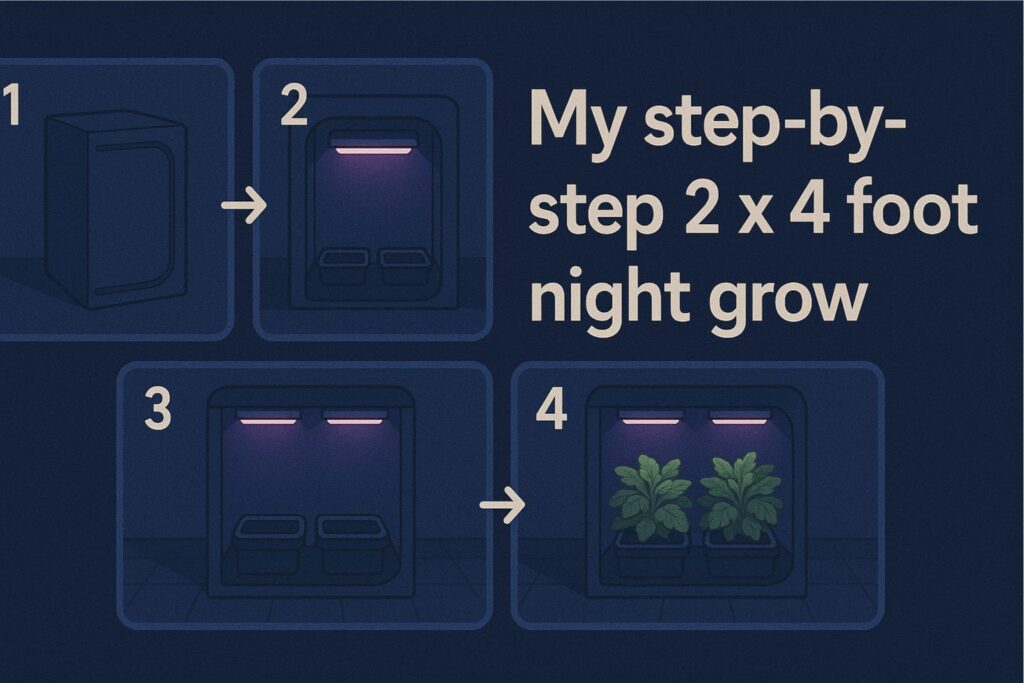
To make this more concrete, here is how I typically run a 2 x 4 foot tent using four night-cycle friendly seeds in 11 liter fabric pots filled with coco and perlite. This is not the only way to do it, but it is a reliable baseline that readers often adapt to their own spaces.
Week 1–2: Germination and seedling stage
I soak the seeds for 12–18 hours in room temperature water, then move them into pre-moistened starter cubes. For feminized cannabis seeds and autoflower cannabis seeds alike, I keep the cubes under low-intensity light at around 200 µmol/m²/s with temps of 24–26°C and humidity near 70 percent.
Once the first true leaves appear, I transplant into 1 liter pots and place them under the main LED grow light setup at 50 percent power. At this stage I start a mild nutrient solution around 0.6–0.8 EC, focusing on calcium and magnesium support to match my soft water.
Week 3–5: Vegetative growth and training
By week three the seedlings have turned into small bushes. I top them for the first time, begin low stress training, and gradually raise EC to 1.2–1.4 while keeping pH between 5.8 and 6.0 in coco. Short marijuana strains often show very tight nodes here, which is exactly what I want.
During this period I run an 18/6 light schedule with lights on from 8 p.m. to 2 p.m. the next day. That gives me a long, stable night window when the tent is dark and cool. It is also when the house is quieter, which helps with stealth cannabis cultivation.
By the end of week five, the net is installed and about 60 percent full. Canopy height sits around 25–30 cm, and each plant has 6–10 strong tops ready for the flip.
Week 6–8: Transition and stretch
I flip to 12/12 while keeping the same night-based schedule. Over the next two weeks, I watch closely for stretch and adjust ties every couple of days. Most night-cycle friendly seeds in this setup will gain 50–70 percent height, landing the canopy right where I want it: roughly 40–50 cm above the pots, about 30 cm below the LED grow light setup.
Nutrients gradually shift toward higher phosphorus and potassium, with EC peaking around 1.8–2.0 depending on how hungry the cultivar appears. Good cannabis stretch control during this window is all about steady light intensity, consistent temperatures, and staying ahead of fast-growing tops with gentle bending.
Week 9–11: Bulk and aroma
By this point stretch has mostly stopped, and the tent smells like a mix of ripe fruit, earth, and fresh pine. I keep airflow high, humidity closer to 45–50 percent, and temperatures around 24°C.
Autoflower cannabis seeds grown in the same space follow a similar timeline but may start flowering a bit earlier on their own. I often stagger autos and photoperiods together, using autos as a way to test new lines while my main feminized cannabis seeds hold the majority of the screen.
Week 12 and beyond: Ripening and flush
In the final two weeks I lower EC, keep pH stable, and avoid making big environmental changes. Low ceiling cannabis seeds that have been well-trained by this stage focus entirely on swelling buds rather than throwing new stretch. I harvest based on trichome maturity rather than breeder date ranges, taking notes on how long each cultivar truly needed.
Post-harvest: Keeping compact plants high quality
Short plants can still produce large, dense colas, which means post-harvest handling matters just as much as the grow itself. I have learned the hard way that rushing drying and curing is the fastest way to ruin months of careful work with night-cycle friendly seeds.
After cutting the plants at the base, I remove only the largest fan leaves and hang whole branches in a dark, well-ventilated room at 18–20°C and 55–60 percent humidity. This slower dry preserves terpenes and keeps colors rich. Once small stems snap rather than bend, buds move into glass jars for post-harvest cannabis curing.
During the first week of post-harvest cannabis curing I burp jars twice a day, briefly opening them to exchange air and monitor moisture. After that, I reduce burping to a few times a week. Within three to four weeks, aromas deepen and harsh edges disappear. Even low ceiling cannabis seeds grown under intense LEDs smooth out beautifully when post-harvest cannabis curing is not rushed.
For stealth cannabis cultivation, jars are easy to hide in closets or storage bins, and their lids contain odor far better than drying racks out in the open. Small, evenly sized buds from short marijuana strains stack nicely in jars and make portioning simple.
Common mistakes when growing in low ceilings
Looking back at my earlier runs, a few patterns stand out that repeatedly caused problems until I adjusted my approach.
The first was underestimating stretch. I used to assume every cultivar would double in height and planned around that rule of thumb. In reality, some lines tripled in size, especially lanky sativas. Now I deliberately favor short marijuana strains and night-cycle friendly seeds with documented compact structure, and I flip to flower earlier if plants are growing faster than expected.
The second mistake was mismanaging light distance. Early on I would hang fixtures as high as possible and run them at full power, thinking more light always meant more bud. In a low tent this just encourages plants to race upward while also risking light stress. A carefully tuned LED grow light setup, with measured PPFD and an adjustable dimmer, is far more effective.
The third recurring issue was skipping cannabis training techniques because I felt short on time. Any grow where I neglected topping, low stress training, or a simple SCROG ended up with uneven canopies and wasted light. A few extra hours of training early in veg now saves me days of troubleshooting later.
Finally, I once viewed feminized cannabis seeds and autoflower cannabis seeds as “beginner tools” and tried to prove myself with regular photoperiods only. After a few heartbreaking male-heavy runs in tiny tents, I reconsidered. Today, both feminized cannabis seeds and well-bred autoflower cannabis seeds are core parts of my low ceiling strategy.
FAQ: Night-cycle friendly seeds and low ceilings
What makes a seed “night-cycle friendly”?
When I talk about night-cycle friendly seeds, I mean genetics that stay compact, handle slightly cooler nighttime temperatures, and do not react badly to minor swings when lights switch on and off. Many modern low ceiling cannabis seeds fit this description because breeders intentionally selected for controlled stretch and sturdy structure.
Are autoflowers or photoperiods better for small spaces?
Both can work. Autoflower cannabis seeds are more forgiving of light leaks and offer faster turnaround, which is helpful for stealth cannabis cultivation when you want to harvest and reset quickly. Photoperiod feminized cannabis seeds provide more control over veg length and size. I often run a mix, using autos for quick personal jars and photos for dialed-in SCROG harvests.
How early should I flip short plants to flower?
In a typical 160–180 cm tent, I aim to flip when the canopy is 25–30 cm above the pots for most short marijuana strains. This gives enough headroom for a 50–70 percent stretch without touching the light. If you are working with particularly vigorous genetics, flip even earlier and rely on cannabis training techniques to fill out horizontal space.
What are your top indoor weed grow tips for low ceilings?
My core indoor weed grow tips are simple: choose the right genetics, invest in a dimmable LED grow light setup, keep temperature swings under control, and train aggressively but gently. Combine those with a solid nutrient plan and regular pruning, and your night-cycle friendly seeds will reward you.
Can I still grow sativa-leaning cultivars in a short tent?
Yes, but be realistic. Look for sativa-leaning hybrids that breeders specifically describe as compact or suited to micro-grows. Plan for extra cannabis stretch control using topping, bending, and a firm SCROG net. Accept slightly lower plant counts if necessary so each plant has enough horizontal room to spread.
Is growing at night more risky legally?
I avoid giving legal advice because laws change frequently and vary widely between regions. From a purely practical standpoint, running lights during cooler night hours can reduce heat signatures and noise, which some growers appreciate for stealth cannabis cultivation. Always research and follow the regulations in your area before germinating a single seed.
Do these methods apply to larger rooms?
Absolutely. While I developed most of these indoor weed grow tips in tents and closets, the same principles scale to bigger rooms: stable environment, intentional genetics, thoughtful cannabis training techniques, and patient post-harvest cannabis curing. Larger spaces simply give you more margin for error.
