Table of Contents
Neptune OG is an indica-dominant hybrid strain known for its powerful sedative effects, deep earthy aroma, and therapeutic benefits. Named after the Roman god of the sea, this strain carries a potent punch of relaxation, making it a sought-after choice among both medical and recreational cannabis users. With THC levels ranging between 22-28%, Neptune OG is not for the faint-hearted and is primarily used for pain relief, stress reduction, and sleep enhancement.
Genetic Lineage and Composition
Neptune OG is a result of careful crossbreeding, although its exact lineage remains somewhat mysterious. However, experts speculate that it derives from a mix of classic OG Kush phenotypes and possibly another potent indica strain, such as Afghani or Hindu Kush. The strain is often recognized for its high myrcene content, which contributes to its sedative properties.
- THC Content: 22-28%
- CBD Content: <1%
- Dominant Terpenes: Myrcene, Limonene, Caryophyllene
- Flavonoids Present: Quercetin, Apigenin, and Kaempferol
Physical Characteristics
Neptune OG is easily recognizable due to its dense, tightly-packed buds coated with a thick layer of resinous trichomes. The flowers exhibit deep green hues interwoven with occasional purple streaks due to anthocyanin presence, which becomes more pronounced in colder growing conditions. The strain emits a pungent, skunky, and earthy aroma with hints of citrus and pine.
- Bud Structure: Compact, dense
- Color: Dark green with purple tinges
- Trichome Density: High
- Aroma: Earthy, piney, citrus, skunky
Terpene Profile and Effects
The effects of Neptune OG are largely driven by its dominant terpenes, each contributing unique properties to the strain.
Primary Terpenes and Their Effects:
- Myrcene: Enhances sedative and muscle relaxant properties, contributing to the strain’s strong body high.
- Limonene: Provides a citrusy aroma and mood-enhancing, anti-anxiety benefits.
- Caryophyllene: Offers anti-inflammatory and pain-relieving effects, binding to CB2 receptors in the endocannabinoid system.
Effects on the Body and Mind:
- Physical Relaxation: Users report deep physical sedation, making it an ideal nighttime strain.
- Euphoria: A slight euphoric lift occurs before transitioning into full-body relaxation.
- Sleep Induction: Effective for individuals struggling with insomnia and restless sleep.
- Couch-Lock: Due to its potency, users often experience an inability to stay physically active for prolonged periods.
Medical Applications of Neptune OG
Neptune OG has a variety of medical uses, making it a go-to strain for patients suffering from chronic conditions.
Pain Management:
- Beneficial for long-term pain disorders such fibromyalgia, migraines, and arthritis.
- The high THC and caryophyllene content provide long-lasting pain relief.
Neurological and Psychological Disorders:
- Insomnia: Myrcene and THC promote deep, restful sleep.
- Anxiety and Depression: Limonene offers mood-enhancing effects, reducing stress and anxiety.
- PTSD: Helps regulate mood swings and intrusive thoughts.
Inflammatory Conditions:
- Beneficial for multiple sclerosis (MS) and other autoimmune diseases with inflammation-based symptoms.
- May alleviate Crohn’s disease and IBS (Irritable Bowel Syndrome) by soothing gastrointestinal inflammation.
Recreational Uses of Neptune OG
While Neptune OG is highly valued for its medicinal properties, recreational users also find the strain desirable for its relaxing and immersive effects.
Best Scenarios for Use:
- Evening or Nighttime Use: Due to its sedative effects, it is not ideal for daytime consumption.
- Movie Nights & Relaxation: Perfect for unwinding after a long day.
- Deep Meditation or Contemplation: Ideal for introspective activities.
- Social Relaxation: Can enhance conversation in a laid-back setting, though too much may lead to drowsiness.
Potential Side Effects:
- Dry Mouth (Cottonmouth): A common effect of high THC strains.
- Dry Eyes: Can be relieved with hydrating eye drops.
- Dizziness or Lightheadedness: Often occurs with novice users or those consuming excessive amounts.
- Paranoia or Anxiety: Only seen in individuals highly sensitive to THC.
Cultivation and Growing Information
Genetic Optimization & Phenotype Selection
Since Neptune OG is an indica-dominant hybrid, growers focus on selecting phenotypes that exhibit:

- High THC content (22-28%)
- Resin-dense flowers
- Robust terpene expression (Myrcene, Limonene, Caryophyllene)
- Resistant to pests and mold
Tissue Culture Propagation (Micropropagation)
A cutting-edge method for maintaining genetic stability:
- Uses sterile lab conditions to propagate identical plants from a single cell.
- Eliminates pathogens and ensures disease-free clones.
- Produces vigorous plants with optimal THC and terpene expression.
Environmental Control for Optimal Growth
Neptune OG thrives in a carefully controlled environment. Scientific methods ensure consistent growth conditions through:
Light Spectrum Optimization
- Vegetative Stage: Uses blue light spectrum (400-500nm) to encourage compact, bushy growth.
- Flowering Stage: Switch to red light spectrum (600-700nm) to promote dense bud formation and high resin production.
- Best Light Source: Full-Spectrum LED or HPS (High-Pressure Sodium)
- Daily Light Exposure: 18 hours (vegetative) → 12 hours (flowering)
Temperature & Humidity Control
- Vegetative Stage: 70-80°F (21-27°C) | RH: 60-70% (Prevents leaf dehydration)
- Flowering Stage: 65-75°F (18-24°C) | RH: 40-50% (Prevents mold & bud rot)
- Late Flowering (Final 2 Weeks): Drop RH to 30-40% to increase trichome production.
CO₂ Enrichment for Maximum Yield
- Increasing CO₂ levels to 1200-1500 ppm in the grow room boosts photosynthesis, resulting in:
- Faster growth
- Denser buds
- Increased cannabinoid & terpene production
Soil vs. Hydroponic Methods
Both methods can be used, but each has specific benefits.
Soil Cultivation (Organic Living Soil)
- Preferred for terpene enhancement (better flavor & aroma).
- Requires nutrient-rich, microbial-active soil with:
- Humic & Fulvic Acid (Boosts nutrient uptake)
- Mycorrhizal Fungi & Beneficial Bacteria (Enhances root growth & disease resistance)
- Organic Compost (Worm Castings, Bat Guano, Fish Emulsion) (Provides slow-release nutrients)
Hydroponic Cultivation (Deep Water Culture or Drip Systems)
- Faster growth and higher yields (up to 30% more than soil).
- Requires precise pH (5.5-6.5) and EC monitoring.
- Nutrient Solution Formula:
- Nitrogen (N) – Higher in veg (3:1:2 ratio)
- Phosphorus (P) – Higher in bloom (1:3:2 ratio)
- Potassium (K) – Essential for resin & terpene development.
Pruning & Training Techniques
Low-Stress Training (LST)
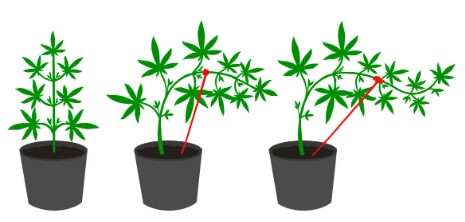
- Involves bending and securing branches to maximize light exposure and increase bud sites.
- Prevents “popcorn” buds by allowing uniform canopy development.
Screen of Green (SCROG)
- Uses a horizontal trellis net to spread branches, ensuring even bud growth.
- Enhances yield by redirecting plant energy to primary colas.
Defoliation
- Removes excess fan leaves to increase air circulation and light penetration.
- Essential for preventing mold in high-humidity environments.
Enhancing Cannabinoid & Terpene Production
Flushing (Last 10-14 Days)
- Growers use pure water or mild-flushing agents to remove excess nutrients.
- Ensures a cleaner, smoother smoke without harsh chemical residues.
Cold Shock Technique (Final Week)
- Lowering nighttime temperatures to 55-60°F (13-16°C) enhances anthocyanin production, increasing purple hues in buds.
- Can increase terpene retention by slowing evaporation of volatile compounds.
UV-B Light Exposure (Last 2 Weeks)
- Adding UV-B light (280-315nm) stresses the plant to increase THC production.
- Mimics natural high-altitude sunlight conditions.
Harvesting & Curing for Maximum Potency
Harvest Timing (Trichome Inspection)
- Use a jewelers’ loupe (30-60x magnification) to observe trichomes:
- Clear Trichomes = Too early
- Milky Trichomes = Peak THC potency
- Amber Trichomes = More sedative, higher CBN levels (ideal for medical use)
Slow Drying Process
- Hang buds upside down in a dark room at 60-65°F (15-18°C) with 50-55% humidity.
- Slow drying over 7-14 days preserves cannabinoids & terpenes.
Curing (Minimum 3-4 Weeks)
- Store buds in glass jars, burping them daily to release moisture.
- Ideal Storage Conditions: 60°F (15°C) | RH: 55-62% (Boveda humidity packs help)
- Proper curing enhances terpene profile, making the strain more flavorful & potent.
Scientific Testing & Quality Control
After harvest, scientific testing ensures Neptune OG meets medical and recreational standards.
Cannabinoid & Terpene Testing
- Labs test for THC, CBD, CBG, and minor cannabinoids.
- Gas Chromatography (GC) and High-Performance Liquid Chromatography (HPLC) are used for precise chemical profiling.
Contaminant Testing
- Checks for pesticides, heavy metals, mold, and residual solvents.
- Ensures the final product is safe for consumption.
Methods of Ingestion
A. Inhalation (Smoking & Vaping)
How It Works:
- Cannabinoids enter the lungs and pass directly into the bloodstream through alveolar absorption.
- Peak plasma levels are reached in 5-10 minutes.
- Effects onset: 1-5 minutes
- Duration: 1.5 – 3 hours
- Bioavailability: ~30-40% THC absorption
Scientific Analysis:
- Pros: Rapid onset makes it ideal for immediate relief (e.g., pain, anxiety, nausea).
- Cons: Combustion can produce harmful byproducts (carbon monoxide, tar).
- Vaping Advantage: Vaporizers heat cannabis at lower temperatures (320-428°F), preserving terpenes and reducing harmful byproducts.
B. Sublingual (Tinctures & Sprays)
How It Works:
- Cannabis extract is placed under the tongue, allowing cannabinoids to be absorbed directly into the bloodstream via the sublingual mucosa.
- Effects onset: 15-30 minutes
- Duration: 4-6 hours
- Bioavailability: ~50-70% (higher than smoking)
Scientific Analysis:
- Pros: Avoids combustion-related toxins; higher efficiency than smoking.
- Cons: Absorption efficiency depends on saliva pH and time held under the tongue.
- Enhancement Tip: Holding the tincture for at least 60 seconds improves absorption.
C. Oral (Edibles, Capsules, Beverages)
How It Works:
- Cannabinoids are metabolized in the liver (first-pass metabolism), converting Δ9-THC into 11-Hydroxy-THC, a more potent psychoactive metabolite.
- Effects onset: 30-90 minutes
- Duration: 6-8 hours (or longer for high doses)
- Bioavailability: ~4-20% (lower due to metabolism)
Scientific Analysis:
- Pros: Long-lasting effects; ideal for chronic pain, sleep, and sustained relief.
- Cons: Slow onset may lead to overconsumption; unpredictable absorption due to stomach contents and metabolism variations.
- Lipid Enhancement: Consuming edibles with fats (butter, MCT oil, coconut oil) increases absorption of cannabinoids.
D. Topical & Transdermal Patches
How It Works:
- Cannabinoids are absorbed through the skin into local tissue (topicals) or directly into the bloodstream (transdermals).
- Effects onset: 15-60 minutes
- Duration: 4-12 hours (depends on formula & skin permeability)
- Bioavailability: Variable (higher for transdermals; limited for topicals)
Scientific Analysis:
- Pros: Non-psychoactive for localized topicals (good for arthritis, muscle pain).
- Cons: Transdermals are expensive; topicals do not reach the bloodstream.
- Enhancement Tip: DMSO-based transdermals improve THC penetration into the bloodstream.
Onset, Duration, and Peak Effects by Method
| Method | Onset Time | Peak Effects | Duration | Bioavailability |
|---|---|---|---|---|
| Smoking/Vaping | 1-5 min | 15-30 min | 1.5 – 3 hours | 30-40% |
| Sublingual (Tinctures/Sprays) | 15-30 min | 45-90 min | 4 – 6 hours | 50-70% |
| Edibles/Capsules | 30-90 min | 2-3 hours | 6 – 8 hours | 4-20% |
| Topical (Local Absorption) | 15-60 min | 1-2 hours | 4 – 6 hours | Low (Local) |
| Transdermal Patches | 30-60 min | 2-4 hours | 6 – 12 hours | High (Bloodstream) |
Factors Affecting Absorption & Duration
Several physiological and environmental factors influence the onset and duration of Neptune OG’s effects:
A. Individual Metabolism & Genetics
- Fast metabolizers: Experience shorter high durations but quicker onset.
- Slow metabolizers: Prolonged effects due to slower THC breakdown.
B. Food Intake
- Empty Stomach: Faster onset but lower bioavailability.
- High-Fat Meal: Enhances THC absorption and prolongs duration.
C. Tolerance Levels
- Frequent users experience faster THC clearance, leading to shorter durations.
- Tolerance reset can occur with 2-3 weeks of abstinence.
D. Hydration & Body Composition
- Dehydration: Can intensify THC effects, leading to stronger psychoactive responses.
- Body Fat Percentage: THC is fat-soluble and stored in adipose tissue, affecting release rates.
Enhancing the Effects of Neptune OG
To optimize the onset and duration of effects, consider the following:
A. Bioavailability Boosters
- Black pepper (Caryophyllene): Increases cannabinoid absorption and modulates THC effects.
- Mango (Myrcene): Enhances THC penetration across the blood-brain barrier, increasing potency.
- Fatty acids (Omega-3s): Support the endocannabinoid system (ECS) and improve cannabinoid efficiency.
B. Metabolism Control for Longer Highs
- Slower metabolism prolongs effects: Consider grapefruit juice (CYP450 enzyme inhibitor) to slow THC breakdown.
- Faster metabolism reduces duration: Consuming caffeine or green tea can accelerate THC metabolism.
Scientific Insights into Neptune OG’s Cannabinoid Profile
Neptune OG is notable for its high THC content and minimal CBD. Its effects are driven by how cannabinoids interact with the body’s endocannabinoid system (ECS).
Key Cannabinoids and Their Actions:
- THC (Tetrahydrocannabinol): The primary psychoactive compound, responsible for pain relief, euphoria, and sedation.
- CBD (Cannabidiol): Present in trace amounts; provides minor anti-inflammatory benefits but does not counteract THC’s effects.
- CBG (Cannabigerol): May enhance neuroprotective properties and contribute to muscle relaxation.
- CBC (Cannabichromene): Works synergistically with THC to enhance pain relief.
Potential for Medical Research and Future Applications
Given its high THC levels and diverse terpene profile, Neptune OG has potential for use in:
- Cancer-related research: As THC and other cannabinoids exhibit anti-nausea and appetite-stimulating effects, this strain could benefit cancer patients undergoing chemotherapy.
- Pain Management Studies: Its efficacy in treating chronic pain conditions positions it as a candidate for further clinical trials.
- Neurological Disorders: Research on THC’s effects in neurodegenerative diseases (e.g., Alzheimer’s, Parkinson’s) could benefit from strains like Neptune OG.
Conclusion: Is Neptune OG the Right Strain for You?
Neptune OG is an incredibly potent indica strain that excels in relaxation, pain relief, and sleep enhancement. It is highly recommended for:
- Medical users seeking relief from chronic pain, insomnia, stress, and inflammation.
- Recreational users who enjoy deep relaxation and euphoric tranquility.
- Experienced cannabis consumers due to its high THC content and sedative effects.
However, individuals sensitive to THC or those requiring daytime productivity should approach Neptune OG with caution. If used responsibly, Neptune OG stands out as a premium strain that delivers therapeutic benefits and deep relaxation.
Final Thoughts:
As cannabis research continues to expand, strains like Neptune OG play a crucial role in understanding the plant’s medicinal and recreational potential. Whether you’re a patient looking for relief or a cannabis enthusiast seeking a powerful experience, Neptune OG offers a unique and rewarding journey into the world of cannabis.
For a complete directory of cultivars, visit our Cannabis Strain Reviews.
