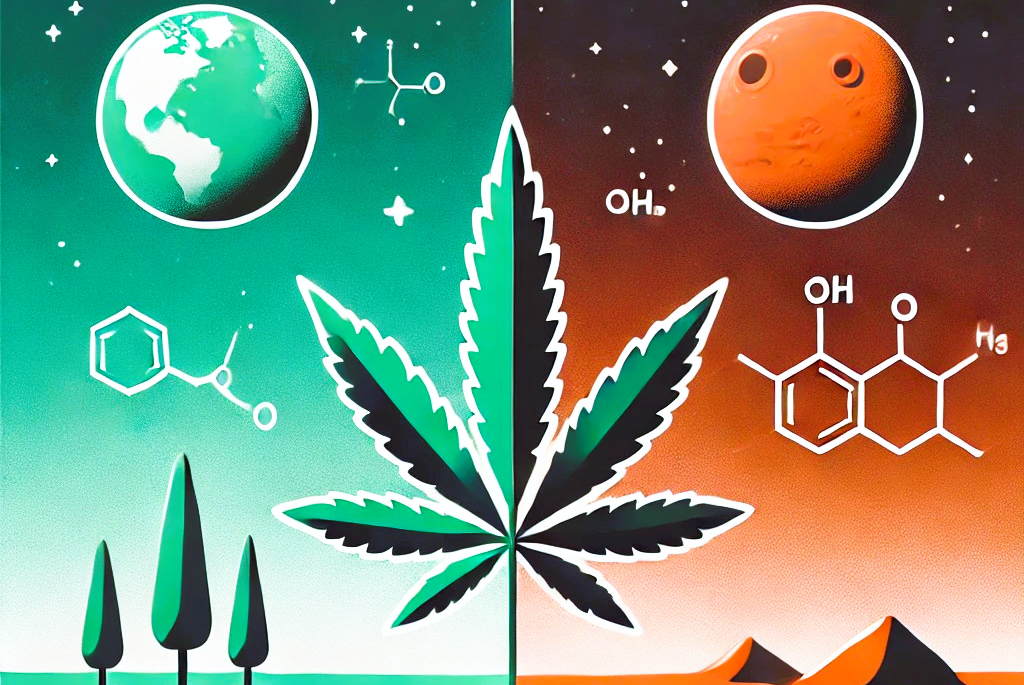
Cannabis Cultivation on Mars vs. Earth: Theoretical Feasibility and Impact on Chemical Profiles
Cannabis sativa has been studied for its therapeutic properties for decades, with medical applications ranging from pain management to anxiety relief and anti-inflammatory treatments. However, as humanity sets its sights on Mars, the cultivation of cannabis for medical purposes on extraterrestrial soil presents unique challenges and opportunities. This comprehensive analysis examines the feasibility of cultivating cannabis on Mars compared to Earth, with a focus on medical use, and explores how extraterrestrial environmental conditions might impact the plant’s chemical profile.
Earth: The Baseline for Cannabis Cultivation
Earth provides an ideal environment for cultivating cannabis due to its atmospheric composition, gravitational pull, and established agricultural systems. Cannabis cultivation on Earth is supported by centuries of research and refinement, which have allowed growers to optimize conditions for producing plants with specific cannabinoid and terpene profiles tailored to medical needs.
Cannabis grown on Earth for medical purposes is highly regulated and cultivated in controlled environments to ensure consistency in chemical composition and quality. Indoor facilities and greenhouses dominate the medical cannabis industry, as they allow growers to manipulate key variables, including light cycles, temperature, humidity, nutrient delivery, and pest control.
Controlled Environments and Optimization
In medical cannabis cultivation on Earth, indoor grow operations provide the highest level of control over environmental variables. This allows for the precise modulation of growth phases, from vegetative to flowering, ensuring consistent levels of cannabinoids such as tetrahydrocannabinol (THC) and cannabidiol (CBD), as well as terpenes like myrcene, limonene, and linalool. Advanced techniques like hydroponics and aeroponics further enhance control over nutrient delivery, improving plant health and increasing yields.
Cannabis plants are highly responsive to light, with specific wavelengths impacting their growth and chemical profiles. Earth-based growers have the advantage of utilizing high-intensity LED systems tailored to the light absorption spectrum of cannabis, ensuring optimal photosynthesis and cannabinoid production.
Soil and Microbial Symbiosis
Soil plays a critical role in cannabis cultivation, as it provides not only physical support but also a medium for nutrient uptake and microbial symbiosis. On Earth, organic cultivation methods often rely on living soils rich in beneficial microbes and fungi, which enhance nutrient availability and contribute to the plant’s overall health and resilience. This interaction between cannabis roots and soil microbes is known to influence the production of secondary metabolites, including cannabinoids and terpenes.
Challenges on Earth
Despite its advantages, cannabis cultivation on Earth is not without challenges. Environmental factors such as climate change, soil degradation, and water scarcity can impact crop yields and quality. Additionally, the energy-intensive nature of indoor growing operations contributes to carbon emissions, raising concerns about sustainability. These challenges highlight the need for innovative approaches to cannabis cultivation, which may inform strategies for growing on Mars.
Mars: An Unforgiving Frontier for Cultivation
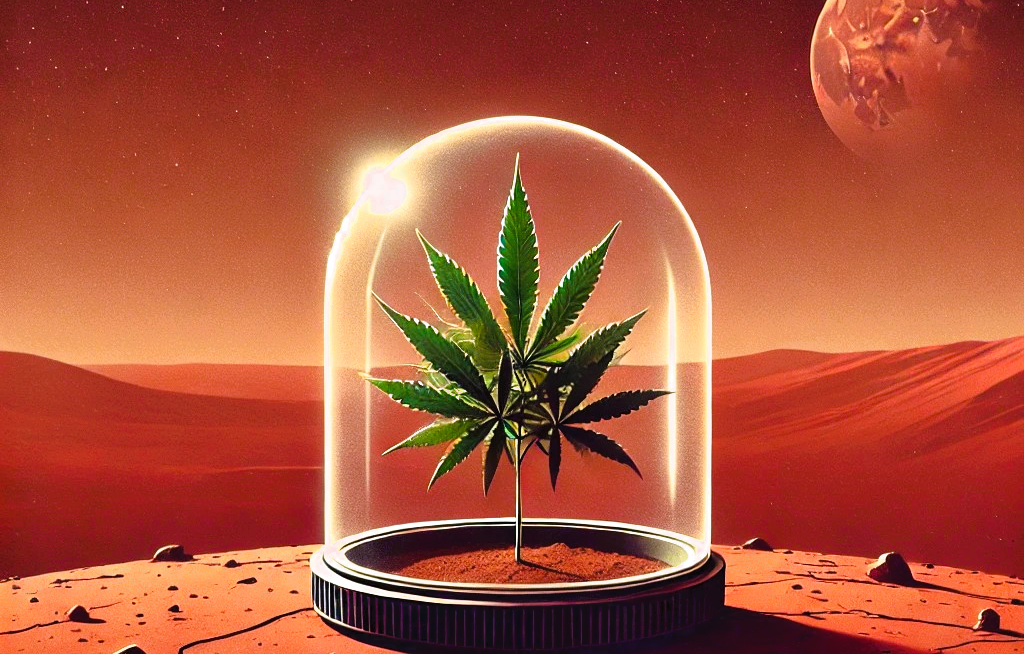
The prospect of cultivating cannabis on Mars for medical purposes raises numerous challenges due to the planet’s harsh environmental conditions. Unlike Earth, Mars has a thin atmosphere composed primarily of carbon dioxide, significantly lower gravity, extreme temperature fluctuations, and high levels of radiation. These factors necessitate the development of entirely artificial growing environments to sustain any form of agriculture, including cannabis.
Atmospheric and Environmental Conditions
The Martian atmosphere, with only 0.6% of Earth’s atmospheric pressure and a composition of over 95% carbon dioxide, is inhospitable to terrestrial plants. Cannabis, like all photosynthetic organisms, relies on atmospheric oxygen and a balanced mix of gases for respiration and growth. To cultivate cannabis on Mars, enclosed habitats with controlled atmospheric composition would be required. These habitats would need to replicate Earth’s conditions as closely as possible, including maintaining oxygen levels, humidity, and temperature within optimal ranges.
Mars’ gravity, at 38% of Earth’s, could also affect plant growth and development. Studies on plant growth in microgravity environments, such as those conducted on the International Space Station (ISS), suggest that reduced gravity alters cellular structure, nutrient transport, and hormone signaling in plants. Cannabis plants grown on Mars may exhibit differences in height, leaf morphology, and root structure compared to their Earth-grown counterparts, which could, in turn, influence cannabinoid and terpene production.
Radiation Challenges
One of the most significant challenges to cannabis cultivation on Mars is the planet’s high radiation levels. Mars’ surface is vulnerable to solar radiation and dangerous cosmic rays because it lacks a protective magnetic field and has a considerably thinner atmosphere than Earth. This radiation can damage plant DNA, potentially leading to mutations that affect growth and chemical composition. To mitigate this risk, cultivation facilities on Mars would need to be shielded with materials such as regolith (Martian soil), water, or polyethylene, or placed underground.
Radiation could also have unexpected effects on the secondary metabolites produced by cannabis. While some level of environmental stress, such as UV-B radiation on Earth, has been shown to enhance cannabinoid and terpene production, the extreme radiation on Mars could push plants beyond their adaptive capacity, potentially reducing yields or altering chemical profiles in unpredictable ways.
Water Availability and Soil Composition
Water is a scarce resource on Mars, with evidence of frozen water and subsurface ice but no readily accessible liquid water. Cultivating cannabis on Mars would require advanced water recycling and extraction systems to provide a consistent supply of clean water for irrigation. Hydroponic or aeroponic systems, which use water more efficiently than soil-based cultivation, would likely be the preferred methods for growing cannabis in Martian habitats.
Martian soil, or regolith, poses additional challenges. Regolith contains toxic perchlorates and lacks the organic matter and microbial life essential for supporting plant growth. While it might be possible to modify Martian soil through processes such as washing, nutrient enrichment, and microbial inoculation, this would require significant technological input and energy. Alternatively, completely artificial growth mediums could be used, bypassing the need to rely on Martian soil altogether.
Impact on Chemical Profiles
The unique environmental conditions on Mars would inevitably impact the chemical profiles of cannabis plants, potentially altering their therapeutic properties. Cannabinoid and terpene production in cannabis is influenced by a variety of factors, including light, temperature, nutrient availability, and environmental stress.
Light and Photosynthesis
Light is a critical factor in cannabis cultivation, as it drives photosynthesis and regulates the plant’s growth cycles. On Mars, the intensity and spectrum of natural sunlight are different from those on Earth due to the planet’s greater distance from the Sun and its thin atmosphere, which filters less radiation. While sunlight on Mars is weaker than on Earth, it includes higher levels of UV radiation, which could impact cannabinoid synthesis.
Research has shown that UV-B radiation stimulates the production of THC, likely as a protective mechanism against DNA damage. Cannabis plants on Mars, exposed to elevated UV levels, might produce higher THC concentrations, potentially altering the balance between THC and other cannabinoids like CBD. This could pose challenges for medical applications that require precise cannabinoid ratios.
To address this, cultivation facilities on Mars would likely rely on artificial lighting systems capable of replicating Earth’s solar spectrum or optimizing light wavelengths for specific cannabinoid and terpene profiles. Advances in LED technology could play a critical role in achieving this level of control.
Stress Responses and Secondary Metabolites
Environmental stress is a well-known driver of secondary metabolite production in plants, including cannabinoids and terpenes. On Mars, factors such as radiation, low gravity, and limited water availability would likely impose significant stress on cannabis plants. While some stress can enhance metabolite production, excessive stress may have detrimental effects, reducing overall yields or leading to the production of unwanted compounds.
Cannabis plants on Mars might also produce novel metabolites not typically found in Earth-grown plants, as a response to the unique environmental conditions. These metabolites could have unknown effects on the plant’s therapeutic properties, requiring extensive research to evaluate their safety and efficacy for medical use.
Nutrient Availability
The availability and composition of nutrients play a critical role in shaping the chemical profile of cannabis. On Earth, growers can tailor nutrient regimens to promote the production of specific cannabinoids and terpenes. On Mars, nutrient delivery would depend on the cultivation system used. Hydroponic systems, for example, allow for precise control over nutrient concentrations and pH levels, which could help mitigate some of the challenges posed by Mars’ harsh environment.
However, the lack of organic matter and microbial life on Mars means that plants would not benefit from the symbiotic relationships with soil microbes that enhance nutrient uptake on Earth. This could impact the plant’s overall health and its ability to produce secondary metabolites, requiring innovative approaches to nutrient management in Martian habitats.
Medical Applications and Implications

The potential differences in chemical profiles between cannabis grown on Earth and Mars have significant implications for medical use. Medical cannabis formulations often rely on specific ratios of cannabinoids and terpenes to achieve desired therapeutic effects. Variations in these profiles could necessitate adjustments in dosing or the development of new formulations to account for the unique properties of Martian-grown cannabis.
Additionally, the production of novel metabolites on Mars could open new avenues for medical research. These compounds, if found to have therapeutic value, could lead to the development of new treatments for a range of conditions. However, extensive testing would be required to ensure their safety and efficacy.
The challenges of cultivating cannabis on Mars also highlight the need for robust quality control systems. Standardized testing protocols would be essential to ensure consistency in cannabinoid and terpene levels, as well as to screen for contaminants such as heavy metals or radiation-induced mutations.
Sustainability and Scalability
Sustainability is a critical consideration for any agricultural system on Mars, including cannabis cultivation. The energy-intensive nature of indoor growing operations on Earth serves as a cautionary example, underscoring the importance of developing efficient and sustainable cultivation methods for Mars.
Renewable energy sources, such as solar or nuclear power, would be essential to support the energy demands of artificial lighting, climate control, and water recycling systems in Martian habitats. Advances in automation and AI could also improve the efficiency of cultivation processes, reducing labor requirements and resource consumption.
Scalability is another key factor, particularly if cannabis is to play a role in supporting the health and well-being of Martian colonists. Modular cultivation systems that can be expanded as needed would be critical to meeting the demand for medical cannabis in a growing Martian community.
Restrictions on Growing and Using Cannabis in the Medical Field: A Last-Resort Approach
The use of cannabis in the medical field has grown significantly in recent years, but its integration into healthcare is heavily restricted and regulated to ensure patient safety and ethical use. Cannabis is often regarded as a treatment of last resort, prescribed only after conventional therapies have proven ineffective. These restrictions are particularly relevant in both Earth-based and theoretical Martian medical cannabis cultivation, especially given the potential variations in the plant’s chemical profiles due to environmental conditions on Mars.
Regulatory Constraints and the “Last-Resort” Principle
Medical cannabis is generally subject to strict legal frameworks, requiring doctors to justify its use only when other treatment options fail to address the patient’s condition. Conditions such as chronic pain, multiple sclerosis, chemotherapy-induced nausea, and epilepsy are among the limited list of ailments for which cannabis is prescribed. Governments often mandate evidence-based guidelines, compelling physicians to exhaust all conventional medications before considering cannabis. This approach seeks to minimize reliance on cannabis while protecting patients from potential misuse or dependency.
On Mars, the restrictions could become even tighter. With limited medical infrastructure in a Martian colony, cannabis prescriptions would likely require rigorous oversight to ensure its use aligns strictly with medical necessity. Furthermore, differences in chemical profiles of Martian-grown cannabis, caused by environmental factors such as higher radiation and altered gravity, might introduce new risks or necessitate further testing to confirm the efficacy and safety of cannabinoids and terpenes under such conditions.
Monitoring THC Levels to Prevent Psychoactive Effects
THC, the primary psychoactive compound in cannabis, poses a challenge in medical applications due to its potential to impair cognitive and motor functions. To address this, strict monitoring of THC levels in medical cannabis products is essential. Governments typically set maximum allowable THC concentrations to minimize psychoactive effects and ensure the therapeutic benefits of cannabis are prioritized.
For example, high-CBD, low-THC formulations are preferred in treating conditions like epilepsy, as CBD lacks psychoactive properties while offering significant therapeutic potential. On Mars, THC levels in cultivated cannabis would need to be closely monitored and regulated, especially given the possibility of elevated THC concentrations due to increased UV radiation exposure.
Conclusion
The cultivation and use of medical cannabis represent a unique intersection of agriculture, medicine, and science, especially when extended to the prospect of growing it on Mars. While Earth has provided an optimal environment for refining cannabis cultivation techniques to achieve precise therapeutic outcomes, the harsh and unfamiliar environment of Mars poses numerous challenges and opportunities that could redefine how we grow and use this plant for medical purposes.
On Earth, the well-established systems of controlled cultivation enable growers to regulate environmental variables such as light, temperature, humidity, and nutrient availability. These optimized conditions ensure consistent production of cannabinoids like THC and CBD, as well as terpenes, which contribute to the plant’s therapeutic effects. However, even on Earth, the cultivation of medical cannabis is highly regulated to ensure its use remains focused on legitimate medical needs, often as a last-resort treatment. Governments and medical authorities strictly monitor THC levels to prevent psychoactive effects while maximizing therapeutic benefits, further ensuring patient safety and ethical application.
In contrast, cultivating cannabis on Mars would require a radical rethinking of agricultural practices. Mars’ thin atmosphere, high radiation levels, reduced gravity, and scarcity of water present unique challenges that necessitate artificial growing environments. Advanced hydroponic and aeroponic systems, along with tightly controlled atmospheric and lighting conditions, would be crucial to simulate Earth-like conditions for cannabis cultivation. However, these environmental stressors—particularly elevated radiation and reduced gravity—are likely to influence the plant’s growth and chemical profile. The possibility of increased THC concentrations due to higher UV radiation levels, or the emergence of novel secondary metabolites, underscores the need for rigorous research and regulation in extraterrestrial cannabis cultivation.
The differences in chemical profiles between cannabis grown on Earth and Mars could have significant implications for its medical use. The therapeutic efficacy of cannabis often relies on precise ratios of cannabinoids and terpenes, which could shift under Martian conditions. This raises the need for continuous monitoring, testing, and adaptation of cultivation methods to ensure consistent and safe medical cannabis production for Martian settlers. Additionally, its use would likely be even more restricted than on Earth, given the limited medical infrastructure and the critical need to avoid psychoactive side effects in a high-risk, off-planet environment.
In conclusion, while cultivating cannabis on Mars presents numerous challenges, it also offers opportunities to innovate and deepen our understanding of how plants respond to extreme conditions. The lessons learned from this endeavor could not only enable the production of safe, effective medical cannabis in space but also advance sustainable agricultural practices for Earth and beyond. However, rigorous oversight, adherence to medical restrictions, and careful monitoring of chemical profiles will remain paramount to ensuring the ethical and effective use of cannabis in any environment.
