I pay attention to marijuana legalization worldwide for the same reason I watch my tent’s humidity: when the environment changes, the outcomes change. Policy shifts don’t just affect headlines. They affect whether a home grow can be planned calmly, whether a seed order is worth the risk, and how openly a cultivator can share troubleshooting notes without putting themselves in a bad situation.
I’m writing this as a hands-on grower who has run small indoor cycles in soil, coco, and simple hydro. I’m not a lawyer and this is not legal advice. Rules vary by country, by region, and sometimes by building or landlord policy. My goal is to translate marijuana legalization worldwide into practical decisions you can make: how to choose genetics, how to design a safe environment, and how to reduce mistakes that waste time and seeds.
If you only read one section, read the checklists. They’re the parts I wish I had earlier.
What “legal” really means when you’re holding a seed pack
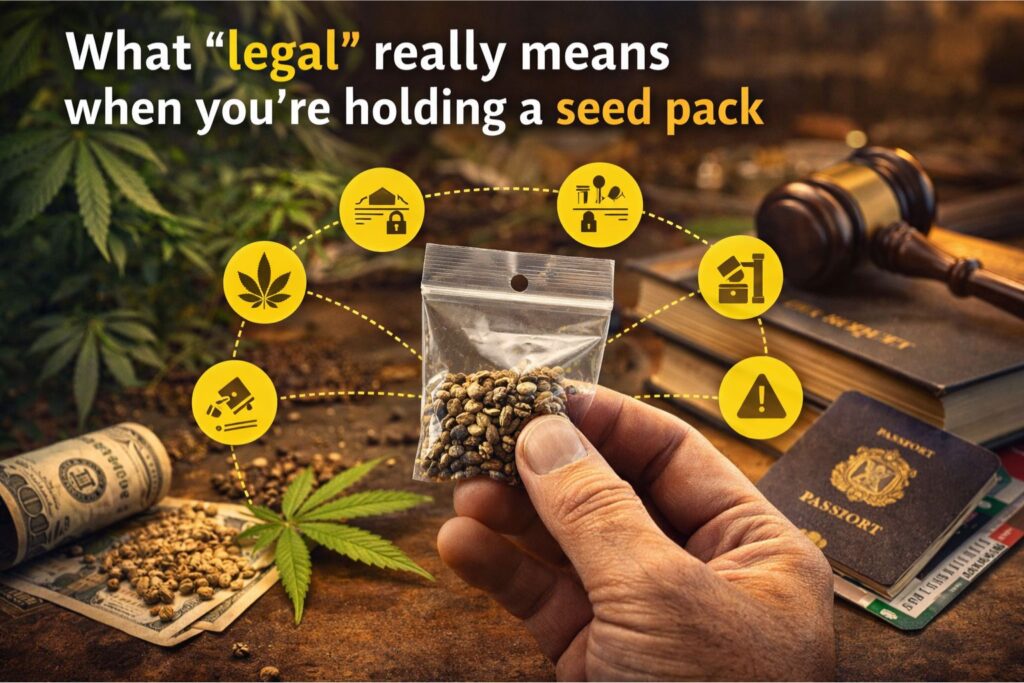
When people talk about marijuana legalization worldwide, they often lump very different realities under one word: legal. I separate it into three categories before I change anything about my grow plan.
Legalization, decriminalization, and medical access
- Legalization usually means adult possession is permitted under a regulated framework. Sometimes that includes home cultivation and retail access; sometimes it does not.
- Decriminalization often reduces penalties for personal possession but may keep cultivation and sales illegal.
- Medical programs can be generous or restrictive. Some allow home cultivation under registration; some only allow dispensary access.
A grower’s risk and options depend on which category applies. This is why “Is weed legal there?” is never enough information for planning.
The five questions I ask before I buy anything
Before I spend money on genetics, equipment, or nutrients, I try to answer:
- Is home cultivation explicitly allowed, and what are the plant limits?
- Are limits per person or per household?
- Are there rules about visibility, odor, or whether plants must be secured?
- Are seeds treated differently than flower in local law and at the border?
- What are the consequences for getting it wrong: a warning, a fine, confiscation, or criminal charges?
Those questions keep me grounded. They also keep me from confusing “less enforced” with “allowed.”
How I read a marijuana legalization map 2025 like a grower
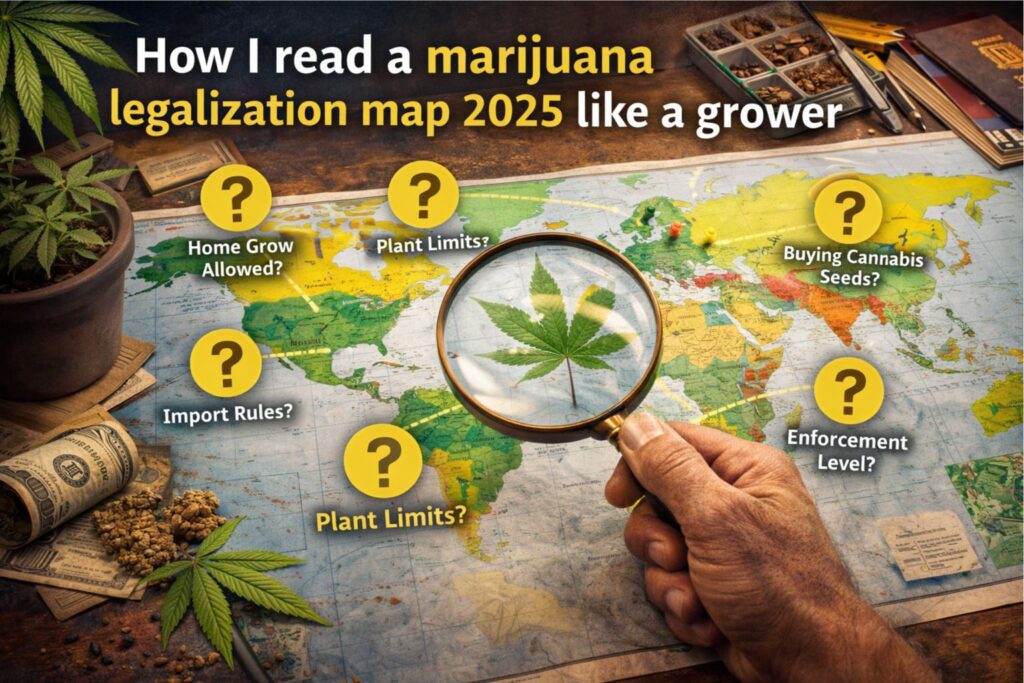
The internet loves a colorful marijuana legalization map 2025. I use one too, but only as a starting point. A map can’t show enforcement culture, border screening intensity, or the fine print about home cultivation.
When I open a marijuana legalization map 2025, I treat it like a rough weather forecast: it tells me where to look, not what to do. Then I verify the rules for my exact location using official sources.
Here’s the grower-focused way I read a marijuana legalization map 2025:
- I look for home cultivation language first, not retail.
- I confirm whether “home grow” means plants, flowering plants, or total plants including seedlings.
- I check whether plant counts reset by person or by address.
- I check whether seeds can be bought domestically and what the policy says about importing.
Later in this post, I’ll return to marijuana legalization map 2025 again in the FAQ with a simple method for double-checking what a map doesn’t show.
Countries where weed is legal to grow at home: what matters more than the list
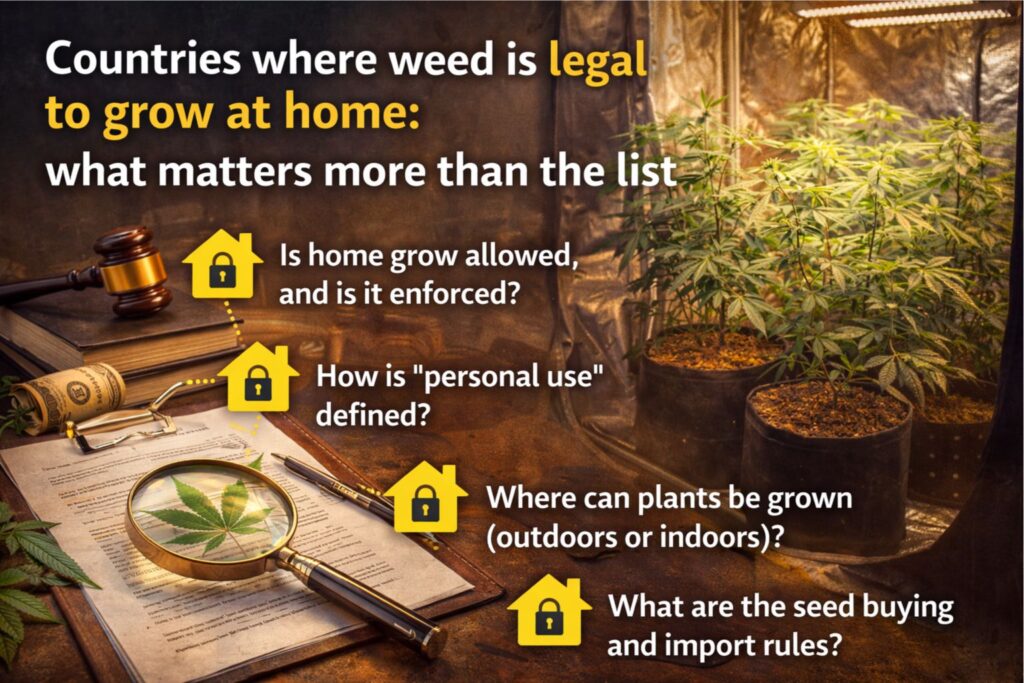
People ask for countries where weed is legal to grow at home as if a list is the answer. Lists go stale fast. What stays useful is learning what details to verify and how those details change your grow strategy.
When you research countries where weed is legal to grow at home, focus on:
- The plant-count rule (and whether it’s enforced)
- The definition of “personal use”
- Any rules about where plants can be grown (indoors only, fenced yard, out of public view)
- Whether you can legally obtain seeds and what the rules say about importing them
I’ve learned that the phrase countries where weed is legal to grow at home is less important than the exact number and the exact definition behind it. I’ll mention countries where weed is legal to grow at home again later because it’s a common search phrase, but I want you to treat it as a research prompt, not a final answer.
How legalization changes the way I set up my grow room
When marijuana legalization worldwide moves toward clearer rules in a region, I see growers improve. Not because they become different people, but because they can work like gardeners instead of like fugitives. In my own grows, clarity changes three decisions.
1) I invest in safety and consistency, not shortcuts
If you’re running lights and fans for months, you want predictable airflow and safe wiring. My baseline indoor targets:
- Vegetative temperature: 24–27°C lights on, 20–22°C lights off
- Vegetative RH: 55–65%
- Flower temperature: 24–26°C lights on, 20–22°C lights off
- Flower RH: 45–55% (lower if buds are dense)
- VPD: about 0.9–1.2 kPa in veg, 1.2–1.5 kPa in flower (adjust for leaf temperature)
- Flower PPFD: 650–850 µmol/m²/s at the canopy (measured with a meter)
- Photoperiod for photoperiod plants: 18/6 in veg, 12/12 in flower
I also keep a simple rule: if I can’t explain why a setting helps the plant, I don’t do it.
2) I choose genetics based on limits, not hype
Legal plant limits push you toward efficiency. If I can only run a small number of plants, I usually choose feminized seeds for photoperiod runs, because every plant slot matters. When time is tight, I’ll run autoflowers, but I accept the trade-off: a shorter vegetative window means training has to be gentler and earlier.
I also treat indica/sativa/hybrid labels as a starting clue, not a guarantee. What matters in the room is structure (stretch, internode spacing, branching) and how a phenotype responds to your environment.
3) I document and improve cycle to cycle
Clarity allows learning. I keep notes on:
- Germination timing and method (paper towel vs direct to medium)
- Medium choice (soil vs hydro vs coco) and why it worked
- Nutrient strength (EC/PPM) and how the plant responded
- Training decisions and recovery time
- Pest observations and what actually solved the problem
- Harvest and dry-room conditions
That notebook is how I turn one successful harvest into a repeatable approach.
Cannabis seed shipping rules by country: the practical reality
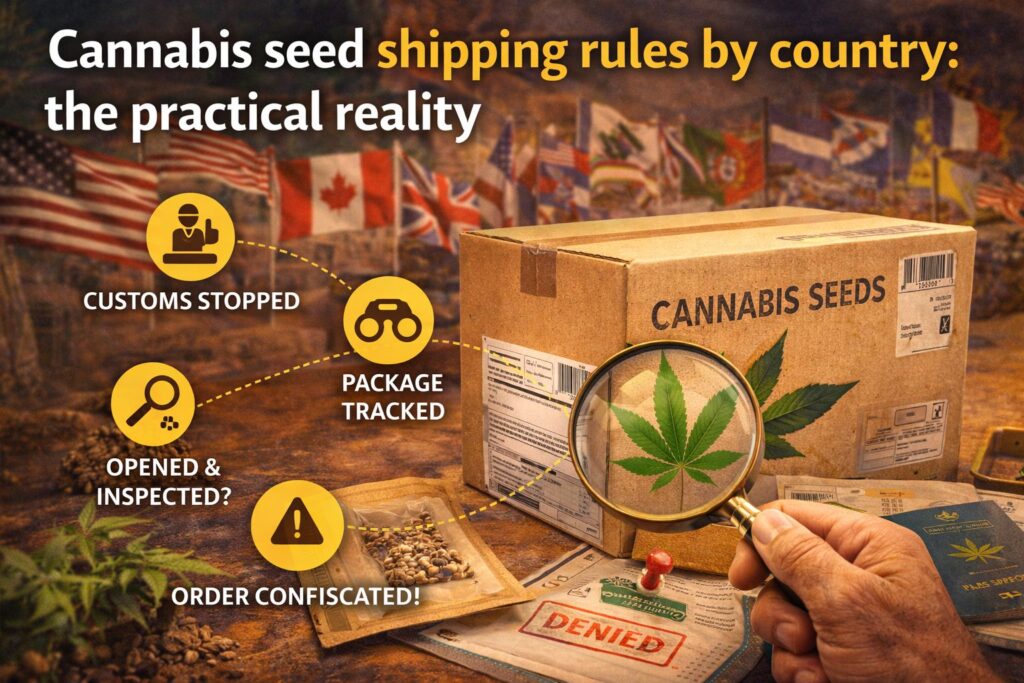
If there is one topic that creates confusion under marijuana legalization worldwide, it’s shipping. I hear the same assumption constantly: “They’re just seeds.” In many places, that assumption fails at customs.
Because cannabis seed shipping rules by country vary widely, I plan conservatively:
- I prefer domestic purchasing whenever possible.
- I treat cross-border delivery times as unpredictable.
- I don’t build my grow schedule around a delivery date unless I have local backup options.
The phrase cannabis seed shipping rules by country sounds simple, but it includes multiple layers: how the destination classifies seeds, how carriers handle restricted goods, and how border inspections work in practice. I’ll repeat cannabis seed shipping rules by country later with a short checklist you can use before ordering.
Legal risks of importing marijuana seeds: why timing matters
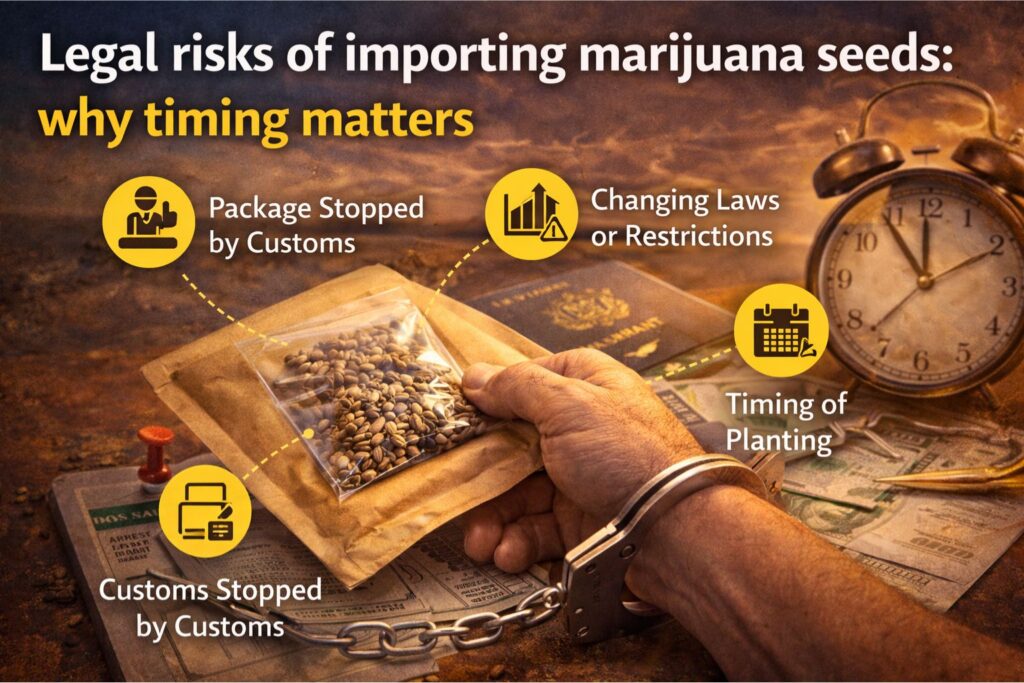
Most growers think about the legal risks of importing marijuana seeds as penalties. In my experience, the first “risk” is often simpler: your package disappears or shows up too late to matter. If you’re planning an outdoor season or a timed indoor cycle, delays can cost you a whole run.
When I evaluate the legal risks of importing marijuana seeds, I ask three questions:
- Can I get comparable genetics locally?
- If this order is delayed by 30–60 days, does my plan still work?
- If the order never arrives, am I okay financially and emotionally?
If the answers are uncomfortable, I adjust the plan. I’ll mention legal risks of importing marijuana seeds again in the FAQ, because it’s a common search and it’s where people make rushed choices.
Seed bank ordering tips for international customers: how I reduce surprises
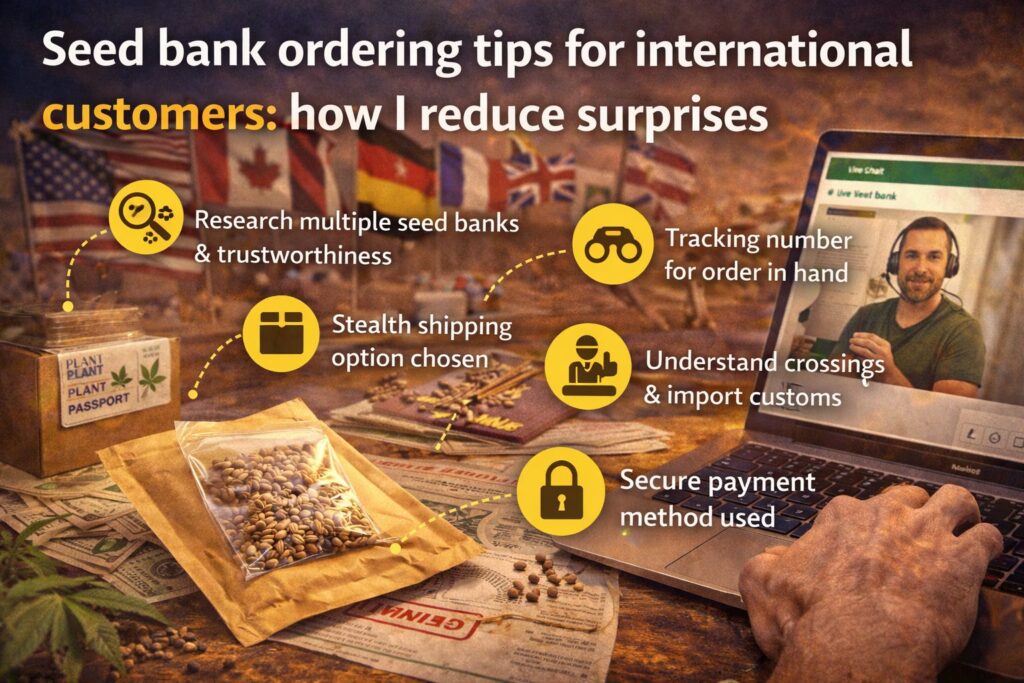
I can’t tell anyone how to bypass laws. I can share seed bank ordering tips for international customers that focus on planning and seed viability.
Here are seed bank ordering tips for international customers that I use:
- Order earlier than you think you need to, especially before seasonal peaks.
- Read the vendor’s replacement and germination policy before you buy.
- Start with a small test order to learn how delivery behaves in your region.
- Choose genetics that match your climate and space, not just THC claims.
- Keep your germination plan simple so you can start promptly when seeds arrive.
Good seed bank ordering tips for international customers also include budgeting for mistakes. Every grower wastes time at least once by trying to force a schedule that doesn’t fit reality.
Home grow limits by country: how I plan a high-quality harvest with fewer plants
I’ve seen home grow limits by country range from “a few plants per household” to “registered medical only.” Whatever the number is, it changes your strategy.
Under strict home grow limits by country, I plan for fewer, larger plants:
- Bigger containers (especially in soil) to buffer feeding mistakes
- Longer veg time to fill the canopy
- Low-stress training to spread branches evenly
- A trellis or soft ties to keep light distribution consistent
- Conservative defoliation so airflow improves without stalling growth
If you’re working within home grow limits by country, the goal is not to maximize plant count. The goal is to maximize consistency per plant.
Recreational vs medical marijuana laws: a grower’s comparison checklist
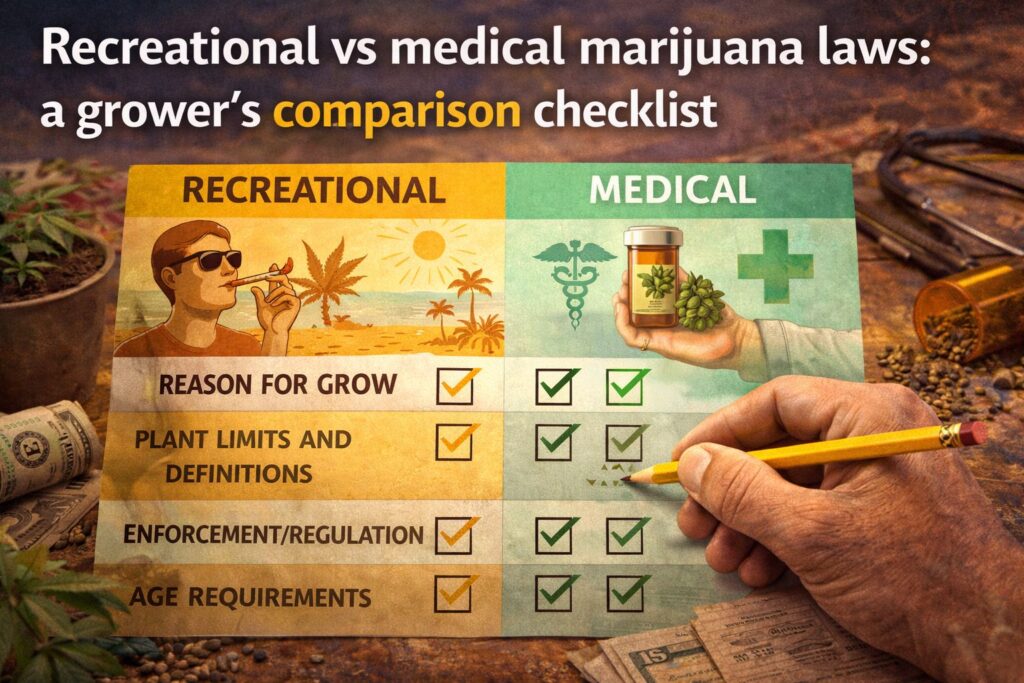
I’m often asked about recreational vs medical marijuana laws and which system is “better.” The honest answer is: it depends on your goals and your comfort with compliance.
When comparing recreational vs medical marijuana laws, I check:
- Whether home cultivation is allowed under adult-use, medical, or both
- Whether plant counts differ between medical and adult-use
- Whether registration is required and what documentation is needed
- Whether there are restrictions on where you can source cannabis or seeds
- Whether inspections or reporting are part of the program
The biggest difference I see in recreational vs medical marijuana laws is predictability. Clear rules reduce anxiety and improve decision-making.
Best practices for discreet seed storage: seed health first
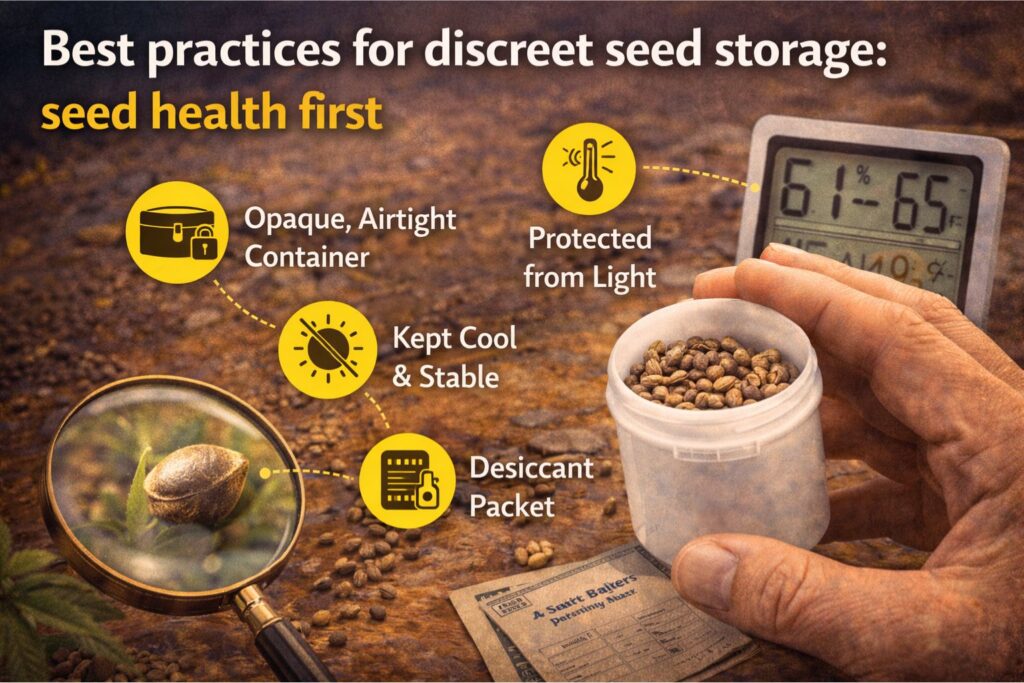
Discreet does not mean sneaky. It means organized, protected, and not left on a sunny windowsill where heat and humidity ruin viability. My best practices for discreet seed storage are about seed longevity.
My best practices for discreet seed storage checklist:
- Airtight container (small jar or vial)
- Desiccant pack to keep humidity stable
- Dark storage (cupboard, not a shelf)
- Stable temperature (avoid kitchens, grow rooms, and electronics)
- Label by cultivar and date so older stock is used first
I repeat best practices for discreet seed storage three times in this article because people underestimate how quickly heat and humidity can lower germination rates.
How to store cannabis seeds for long trips: the method I trust
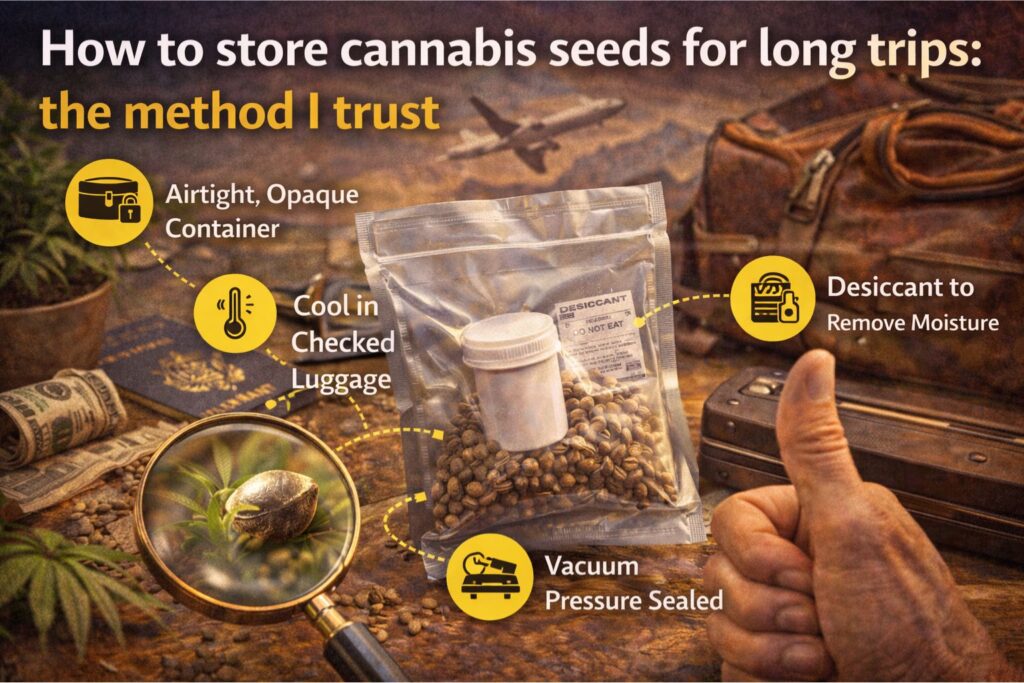
When I’m away from home or between cycles, how to store cannabis seeds for long trips becomes a real question. Seeds don’t need fancy treatment, but they do need stability.
Here’s my how to store cannabis seeds for long trips routine:
- Place seeds in an airtight container.
- Add a small desiccant pack.
- Store in the dark at a stable, cool temperature.
- Avoid repeated warming and cooling, which can create condensation.
This is also my answer for how to store cannabis seeds for long trips if you’re simply waiting for the next season. A stable environment is more important than a special gadget.
Traveling with cannabis seeds legality: the rule I follow
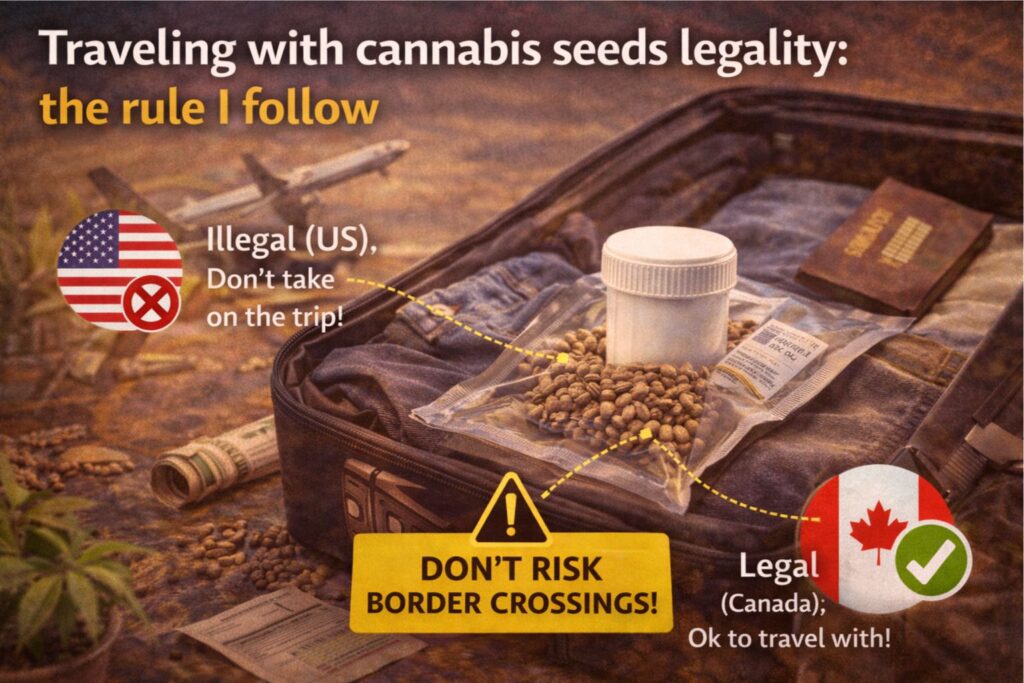
I’m careful about traveling with cannabis seeds legality because border rules are not the same as local possession rules. Even if two places are “legal,” the act of crossing a border can change the legal context.
My personal rule on traveling with cannabis seeds legality is simple:
- I do not cross borders with seeds unless I can confirm it is legal for that specific route and documentation is clear.
That approach reduces stress. It also prevents a small decision from turning into a large problem. I’ll mention traveling with cannabis seeds legality again in the FAQ because it’s one of the most searched questions I see.
My real-world grow workflow for a small indoor run
When plant counts are limited, my favorite approach is to fill a small footprint well and keep the environment stable. Here’s what that looks like in practice.
Seedling to early veg
- Light: gentle intensity, gradually increased
- Watering: small amounts, avoid waterlogging
- Feeding: minimal in soil; measured and conservative in coco/hydro
- Targets: stable temps, higher RH, and good airflow without blasting the plant
Veg to flower transition
- Training: topping once or twice, then low-stress bending to flatten the canopy
- Light: bring PPFD up gradually; don’t jump intensity overnight
- Nutrients: increase EC slowly; watch leaf tips and overall color
- Pest checks: daily leaf inspection, especially undersides
Flower and finish
- Keep airflow consistent to reduce mold risk
- Lower RH as flowers bulk up
- Maintain stable light distance and avoid hot spots
- Watch for nutrient drift; in coco/hydro, measure runoff or reservoir EC/PPM
Dry and cure (the part that makes or breaks quality)
If you want flavor and smooth smoke, don’t rush the dry. My best results come from a slow dry in a cool, steady space, followed by a patient cure. If you can control it, aim for a gentle dry that doesn’t crisp the outside while the inside stays wet.
FAQ: common searches I hear from seed buyers and growers
How do I use a marijuana legalization map 2025 without being misled?
Use a marijuana legalization map 2025 to identify regions, then verify local rules with official sources. A marijuana legalization map 2025 can’t capture local enforcement or border policies. I treat a marijuana legalization map 2025 like a compass, not a rulebook.
Are there reliable countries where weed is legal to grow at home?
The phrase countries where weed is legal to grow at home is a moving target because rules evolve. When researching countries where weed is legal to grow at home, look for official guidance on plant limits, where cultivation is permitted, and whether seeds can be obtained legally. If you’re searching countries where weed is legal to grow at home, verify your exact region, not just the country name.
What should I check about cannabis seed shipping rules by country before I order?
Because cannabis seed shipping rules by country vary, confirm three things: how your destination classifies seeds, whether the seller ships legally to your region, and whether delays would disrupt your schedule. I keep the phrase cannabis seed shipping rules by country on my planning checklist specifically to avoid last-minute ordering.
What’s the simplest way to think about recreational vs medical marijuana laws?
With recreational vs medical marijuana laws, focus on home cultivation permissions, plant limits, and compliance requirements. The details of recreational vs medical marijuana laws differ widely, so verify your local rules and decide which system aligns with your risk tolerance and needs.
How to store cannabis seeds for long trips so they stay viable?
For how to store cannabis seeds for long trips, prioritize stable temperature and low humidity: airtight container, desiccant pack, dark storage, and no temperature swings. That’s my repeatable method for how to store cannabis seeds for long trips.
Is traveling with cannabis seeds legality ever straightforward?
Sometimes, but often it’s complicated. For traveling with cannabis seeds legality, remember that border rules can override local rules. If you can’t confirm legality from official guidance, don’t travel with seeds. That conservative approach to traveling with cannabis seeds legality prevents avoidable problems.
How do home grow limits by country change what I should grow?
Under strict home grow limits by country, choose genetics you can manage well and plan fewer, larger plants with longer veg time and careful training. home grow limits by country also shape whether autoflowers or photoperiod plants make more sense for your timeline.
What are best practices for discreet seed storage at home?
My best practices for discreet seed storage are simple: airtight container, desiccant, dark storage, stable cool temperature, and clear labeling. Repeatable best practices for discreet seed storage protect viability and prevent accidental loss.
Any seed bank ordering tips for international customers who want fewer surprises?
My seed bank ordering tips for international customers are: start small, order early, read replacement policies, choose genetics suited to your environment, and avoid building your schedule around delivery dates. Strong seed bank ordering tips for international customers keep the grow plan realistic.
What are the legal risks of importing marijuana seeds beyond penalties?
The legal risks of importing marijuana seeds include delays, confiscation, and schedule disruption. If you’re weighing the legal risks of importing marijuana seeds, ask whether your grow plan still works if the order arrives late or never arrives.
Final thoughts from the grow room
I don’t follow marijuana legalization worldwide to argue politics. I follow it because it changes planning. Clear rules tend to produce safer setups, cleaner grows, and more honest knowledge-sharing. Unclear rules push growers into rushed choices and wasted time.
If you’re building your next cycle, take a conservative approach: verify local rules, design a stable environment, pick genetics that fit your space and limits, and don’t let shipping uncertainty dictate your schedule. That mindset has helped me navigate marijuana legalization worldwide without losing sight of what matters most: healthy plants, safe practices, and consistent results.
