How to Identify Male Cannabis Plants: A Comprehensive Guide
Cannabis cultivation has gained popularity not only for its recreational and medicinal uses but also for the horticultural challenge it presents. One crucial aspect of cannabis cultivation is identifying the sex of your plants. Male cannabis plants, unlike their female counterparts, do not produce buds and are often removed from grow operations to prevent pollination of female plants, which can result in seeded buds and reduced potency. This guide will delve deeply into how to identify male cannabis plants, ensuring you can effectively manage your grow space.
Understanding Cannabis Plant Sex
Cannabis is a dioecious plant, meaning it can produce separate male and female plants. Occasionally, you may also encounter hermaphrodite plants, which possess both male and female reproductive organs. Identifying the sex of your plants early in the growth cycle is essential for maintaining a productive garden.
The Importance of Identifying Male Plants
- Preventing Pollination: Male plants produce pollen, which can fertilize female plants and lead to seed production. While seeds are necessary for breeding, they are undesirable in most bud production settings as they reduce the quality and potency of the harvest.
- Resource Management: Removing male plants early allows you to focus resources on female plants, which produce the valuable buds.
- Space Optimization: Male plants take up space that could otherwise be used to grow female plants, maximizing your yield per square foot.
The Life Cycle of Male Cannabis Plants
Understanding the life cycle of male cannabis plants is essential for growers aiming to manage their crops effectively. While both male and female cannabis plants go through similar growth stages, the key differences in their development, especially in the flowering stage, are crucial for identification and management. This comprehensive guide will walk you through each stage of the male cannabis plant’s life cycle, highlighting specific characteristics and growth patterns.
1. Germination Stage
Duration: 3-10 days
The life cycle of a male cannabis plant begins with germination. A cannabis seed is activated during this stage so that it can sprout and grow into a seedling. Here’s what happens during germination:
- Water Absorption: The seed absorbs water, which triggers the expansion of the seed coat.
- Radicle Emergence: The embryonic root, known as the radicle, breaks through the seed coat and anchors into the growing medium.
- Cotyledon Development: The seedling produces its first leaves, called cotyledons, which are small and round.
2. Seedling Stage
Duration: 2-3 weeks
During the seedling stage, the plant develops its initial set of true leaves and establishes its root system. Key characteristics of this stage include:
- Leaf Development: The plant produces its first sets of serrated leaves.
- Root Establishment: A strong root system begins to form, anchoring the plant and absorbing nutrients.
- Vulnerability: Seedlings are sensitive to environmental conditions, requiring proper light, humidity, and temperature control.
3. Vegetative Stage
Duration: 4-8 weeks or longer
The vegetative stage is marked by rapid growth as the plant focuses on developing stems, leaves, and a robust root system. During this stage, pre-flowers begin to form, allowing for early sex identification.
- Growth Focus: The plant’s energy is directed towards foliage and structural development.
- Node Formation: Nodes, where branches meet the main stem, become more pronounced.
- Pre-Flower Development: Around the fourth to sixth week, pre-flowers start to appear at the nodes. In males, these will eventually develop into pollen sacs.
- Taller and Thinner: Male plants often grow taller and more spindly compared to females, a trait that aids in the dispersal of pollen.
4. Pre-Flowering Stage
Duration: 1-2 weeks
The pre-flowering stage is a transitional phase where the plant begins to show signs of its sex more clearly. For male plants, this stage involves the initial formation of pollen sacs.
- Sex Identification: Male pre-flowers appear as small, round structures at the nodes. These are the early signs of pollen sacs.
- Increased Height: Males may exhibit a noticeable increase in height and stretching.
- Stem Development: The main stem and branches continue to thicken, preparing to support the reproductive structures.
5. Flowering Stage
Duration: 6-10 weeks
The flowering stage is when the plant fully develops its reproductive organs. For male cannabis plants, this means the growth and maturation of pollen sacs.
- Pollen Sac Formation: Pollen sacs cluster at the nodes and eventually open to release pollen. These sacs look like small balls or grapes and grow in clusters.
- Pollen Release: Once mature, the pollen sacs open and release pollen into the air. This pollen can travel considerable distances to fertilize female plants.
- Reproductive Focus: The plant’s energy is primarily directed towards the production and release of pollen.
6. Late Flowering and Senescence
Duration: 2-4 weeks
In the late flowering stage, male plants complete their reproductive cycle and begin to deteriorate.
- Pollen Sac Maturity: All pollen sacs open and release their contents.
- Senescence: After the release of pollen, male plants start to age and lose vitality. Leaves yellow and fall off, and the plant’s overall structure weakens.
- End of Life Cycle: Eventually, the plant dies, having fulfilled its reproductive purpose.
Step-by-Step Process to Identify Male Cannabis Plants
Identifying male cannabis plants early in the growth cycle is crucial for maintaining a productive and high-quality cannabis garden. Here’s a detailed step-by-step guide to help you accurately identify male plants and manage them effectively.
Step 1: Understand the Growth Stages
Understanding the stages of cannabis plant growth is crucial before beginning the identification process:
- Germination: The seed sprouts and forms a seedling.
- Seedling Stage: The plant develops its first leaves.
- Vegetative Stage: The plant focuses on growing stems and leaves.
- Pre-Flowering Stage: Early signs of sex (pre-flowers) begin to appear.
- Flowering Stage: The plant fully develops its reproductive organs.
Step 2: Monitor the Vegetative Stage Closely
During the vegetative stage (4-8 weeks or longer), your plants will grow rapidly, developing stems and leaves. This is the time to start looking for pre-flowers.
- Inspect Nodes Regularly: Nodes are where branches meet the main stem. These areas will develop pre-flowers that indicate the plant’s sex.
- Use Tools: Employ a magnifying glass or jeweler’s loupe (30x magnification or higher) to get a clear view of the small structures forming at the nodes.
Step 3: Identify Pre-Flowers
Around the fourth to sixth week of the vegetative stage, pre-flowers will begin to form. Here’s what to look for:
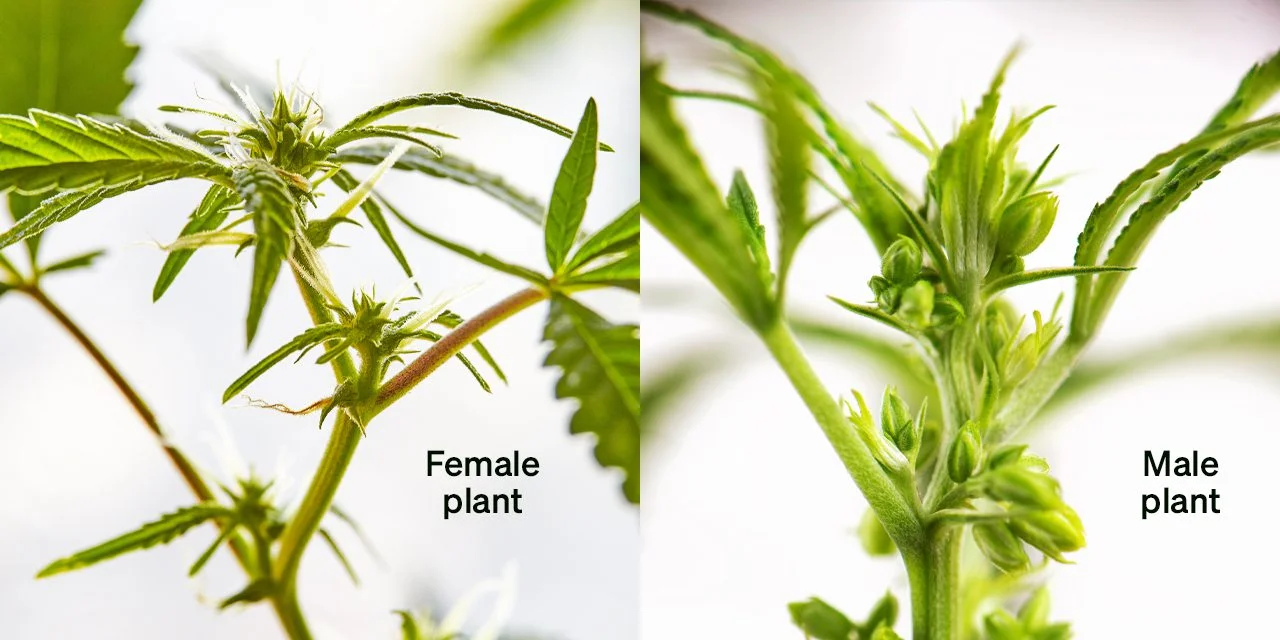
- Female Pre-Flowers:
- Appearance: Small, hair-like structures called pistils emerging from a calyx.
- Color: Typically white and fuzzy.
- Male Pre-Flowers:
- Appearance: Small, ball-like structures that resemble tiny grapes or balls.
- Lack of Hairs: These structures will not have the hair-like pistils seen in females.
Step 4: Monitor Pollen Sac Development
As your plants transition from the vegetative stage to the flowering stage, male plants will further develop their pollen sacs.
- Cluster Formation: Male pollen sacs will start to cluster at the nodes. These clusters look like small bunches of grapes.
- Growth Patterns: Male plants often grow taller and more spindly than female plants. This trait helps them disperse pollen more effectively.
- Leaf Characteristics: Male plants may have fewer leaves compared to females, although this is not a definitive indicator.
Step 5: Confirm Male Identification
To ensure accurate identification, continue to observe the suspected male plants closely as they enter the flowering stage.
- Pollen Sac Growth: The pollen sacs will grow larger and become more pronounced.
- No Pistils: Confirm that there are no hair-like pistils emerging from the structures.
- Cluster Maturity: As the pollen sacs mature, they will eventually open to release pollen.
Step 6: Remove Male Plants
Once you have confirmed that a plant is male, it’s time to remove it from your grow space to prevent pollination of female plants.
- Careful Handling: Be gentle when removing male plants to avoid shaking and releasing pollen.
- Disposal: Dispose of the male plants away from your growing area to ensure no accidental pollination occurs.
- Isolation for Breeding: If you plan to use male plants for breeding, isolate them in a separate area to collect pollen without risking fertilization of your main crop.
Tools and Techniques for Identification
- Magnifying Glass: A handheld magnifying glass or jeweler’s loupe (30x or higher) can help you see small pre-flowers more clearly.
- Digital Microscope: For the tech-savvy grower, a digital microscope connected to your computer can provide detailed images of the plant’s nodes.
- Labeling: Use labels to mark suspected male plants. This helps in tracking their development and making timely decisions.
Common Mistakes and How to Avoid Them
- Premature Identification: Avoid removing plants too early. Wait until you are certain of the sex before making any cuts.
- Confusing Hermaphrodites with Males: Hermaphrodite plants have both male and female sex organs. Be sure to identify these correctly to avoid unwanted pollination.
- Inconsistent Inspection: Regularly check your plants throughout the vegetative and early flowering stages. Consistency is key to accurate identification.
Advanced Identification Techniques
- Genetic Testing: Some companies offer genetic testing kits that can determine the sex of your plants from a small leaf sample. This is a more scientific and accurate method but can be costly.
- Microscopic Examination: More advanced growers might use microscopes to examine the cells of the pre-flowers for definitive identification.
Dealing with Male Plants
- Removal: Once identified, male plants should be carefully removed from the grow space. Be gentle to avoid shaking the plants, which can release pollen.
- Disposal: Dispose of male plants away from your growing area to ensure no pollen accidentally fertilizes female plants.
- Breeding: If you plan to breed plants, isolate male plants in a separate space where their pollen can be collected and used selectively.
Hermaphrodite Identification and Management
- Identifying Hermaphrodites: Hermaphrodite plants have both male pollen sacs and female pistils. These can appear simultaneously or develop later in the flowering stage.
- Managing Hermaphrodites: Remove hermaphrodites to prevent accidental pollination. If discovered late in flowering, remove the male parts carefully to salvage the female buds.
Preventing Hermaphroditism
- Stress Management: Avoid stressing your plants, as stress can cause hermaphroditism. Common stress factors include light leaks during the dark cycle, extreme temperature fluctuations, and irregular watering schedules.
- Genetic Stability: Choose stable strains known for their resilience to stress and lower tendency to turn hermaphrodite.
Practical Tips for Beginners
Tip 1: Understand the Basic Differences Between Male and Female Plants
- Female Plants: Produce buds (flowers) rich in cannabinoids (e.g., THC, CBD) and develop pistils (hair-like structures) from the calyx.
- Male Plants: Produce pollen sacs (small, ball-like structures) instead of buds. They do not develop pistils.
Tip 2: Start Early with Identification
Begin monitoring your plants for sex identification as early as the vegetative stage. Male pre-flowers can appear around the fourth to sixth week of growth.
Tip 3: Examine Nodes Regularly
Nodes are where branches meet the main stem. This is where pre-flowers (indicators of sex) will first appear.
- Tools Needed: Use a magnifying glass or jeweler’s loupe (30x magnification or higher) for a clear view.
Tip 4: Look for Pre-Flowers
- Female Pre-Flowers: Small, white, hair-like structures (pistils) emerging from the calyx.
- Male Pre-Flowers: Small, ball-like structures (pollen sacs) that resemble tiny grapes. They will not have pistils.
Tip 5: Monitor Growth Patterns
Male plants tend to grow taller and more spindly than female plants. This is an evolutionary trait to help disperse pollen over a wider area.
- Taller Plants: If you notice a plant growing significantly taller and more spindly than others, it might be male.
Tip 6: Check Leaf Characteristics
While not a definitive indicator, male plants sometimes have fewer leaves compared to their female counterparts. This trait can be more noticeable in some strains.
Tip 7: Be Patient and Consistent
- Regular Inspections: Check your plants regularly throughout the vegetative and early flowering stages.
- Avoid Premature Removal: Wait until you are certain of the plant’s sex before removing it.
Tip 8: Use Labeling
Label plants that you suspect to be male. This helps in tracking their development and making informed decisions.
Tip 9: Remove Male Plants Carefully
Once confirmed, remove male plants from your grow space to prevent pollination of female plants.
- Careful Handling: Be gentle when removing male plants to avoid shaking and releasing pollen.
- Disposal: Dispose of male plants away from your growing area to ensure no accidental pollination occurs.
Tip 10: Learn from Experienced Growers
Don’t hesitate to seek advice from experienced growers or online communities. Sharing pictures and getting feedback can accelerate your learning curve.
Tip 11: Keep a Grow Journal
Document your observations and experiences. This can help you learn and improve your identification skills over time.
- Record Details: Note the development stages, when you first noticed pre-flowers, and your final identification decision.
Tip 12: Consider Genetic Testing
For a more scientific approach, you can use genetic testing kits that determine the sex of your plants from a small leaf sample. While this method is more accurate, it can be costly.
Tip 13: Practice Patience
Becoming adept at identifying male cannabis plants takes practice. Don’t rush the process; take your time to ensure accurate identification.
Conclusion
Identifying male cannabis plants is a critical skill for any grower. By closely observing your plants during the pre-flowering and early flowering stages, using the right tools, and understanding the growth patterns of male plants, you can effectively manage your grow space. Removing male plants promptly ensures that your female plants can produce high-quality, seedless buds, maximizing the yield and potency of your harvest.
Whether you are a novice or an experienced cultivator, mastering the identification of male cannabis plants will enhance your gardening success and contribute to a more fruitful and satisfying growing experience.
