Table of Contents
How to germinate marijuana seeds
Germination is the biological process in which a seed transitions from dormancy to active growth, developing into a seedling. In cannabis (Cannabis sativa, Cannabis indica, and hybrids), successful germination is a critical first step toward producing healthy, high-yielding plants. This process involves the activation of metabolic pathways, water uptake, and cellular differentiation that leads to root (radicle) emergence and shoot development.
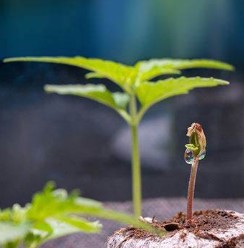
Why Germination Matters
- Establishes Growth Potential: Proper germination ensures that plants develop a strong taproot system and robust stems.
- Determines Yield: Weak germination can lead to stunted growth and lower yield potential.
- Strain Preservation: Reliable germination is vital for preserving rare genetics or phenotypes.
Seed Anatomy and Biology
Key Seed Structures
- Seed Coat (Testa): A protective outer layer that prevents damage and desiccation.
- Embryo: The young plant consisting of the radicle (root), hypocotyl (stem), and cotyledons (seed leaves).
- Endosperm: A nutrient-rich tissue that feeds the embryo during early development.
Dormancy and Activation
Cannabis seeds exhibit physiological dormancy, which is broken through a combination of moisture, temperature, and oxygen. Hormonal changes—particularly a decrease in abscisic acid (ABA) and an increase in gibberellins (GAs)—initiate the germination cascade.
Germination Requirements
1. Water (Moisture)
Water imbibition is the first physical step. It activates enzymatic pathways and softens the seed coat. Key effects include:
- Enzyme Activation: Catalases and hydrolases become active, breaking down stored food into energy.
- Cell Expansion: Water allows cell walls to loosen, enabling expansion and division.
Optimal Condition: Seeds should be moist, but not submerged. Overhydration can lead to anoxia (oxygen deprivation).
2. Temperature
Cannabis seeds germinate best in temperatures between 22°C to 26°C (72°F to 79°F).
- Low temperatures slow metabolic activity and delay germination.
- High temperatures may encourage fungal growth or stress the embryo.
3. Oxygen
Oxygen is essential for aerobic respiration, which provides ATP energy for growth. Seeds should not be buried too deep in dense substrates or oversaturated, which can restrict gas exchange.
4. Darkness vs. Light
Although light is not essential during the initial phase of germination, darkness or low light conditions are generally preferred. Once the radicle appears, light becomes more important for shoot development and photosynthesis initiation.
Germination Techniques
1. Paper Towel Method
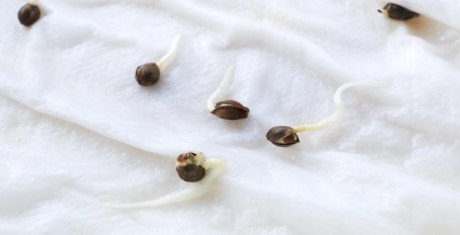
Materials Needed:
- Paper towels (non-toxic, unscented)
- Two plates or a plastic container
- Water (preferably distilled or pH-balanced to ~6.0-6.5)
Procedure:
- Moisten two paper towels until damp (not dripping).
- Place seeds evenly between the towels.
- Enclose towels between two plates to block light and maintain humidity.
- Store in a warm, dark location (~24°C).
- Check daily for root emergence.
Pros:
- High visibility
- Easy to monitor
Cons:
- Risk of damaging the taproot during transplanting
- Susceptible to fungal contamination if overmoist
2. Direct Soil Germination
Procedure:
- Prepare a small pot with lightly moistened seed-starting mix.
- Plant the seed 0.5 to 1.0 cm deep (1/4–1/2 inch).
- Cover lightly and maintain temperature.
- Water gently using a spray bottle.
Pros:
- Minimizes transplant shock
- Natural environment
Cons:
- Slower monitoring
- Risk of seed rot if soil is too wet
Ideal Soil Conditions:
- pH: 6.0 to 6.5
- Low salinity
- High aeration (use coco coir or peat-based mixes with perlite)
3. Soaking in Water
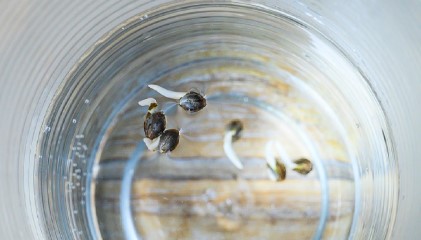
Procedure:
- Place seeds in a glass of clean, room-temperature water.
- Leave for 12 to 24 hours (up to 48 max).
- Once the seed cracks or sinks, transfer to paper towel or soil.
Pros:
- Accelerates water uptake
- Good for hard-coated seeds
Cons:
- Risk of drowning seed if left too long
4. Germination in Jiffy Pellets
Procedure:
- Hydrate peat pellets in warm water.
- Insert seed about 1 cm deep.
- Cover with a humidity dome and place in a warm, dark place.
Pros:
- Easy transplanting
- Encourages strong root growth
Cons:
- More expensive
- Risk of overwatering
Scientific Factors Influencing Germination Success
Seed Viability
Viability is the potential of a seed to germinate under favorable conditions. This is affected by:
- Age: Seeds older than 2-3 years may lose viability unless stored properly.
- Storage Conditions: Ideal storage is in a cool, dry, and dark environment with humidity below 10% and temperatures around 4°C.
- Seed Quality: Mature seeds are typically darker, often with tiger stripes, and firm to the touch.
Seed Dormancy Breaking Techniques
For stubborn seeds, consider:
- Scarification: Light sanding of the seed coat to enhance water penetration.
- Stratification: Cold-treatment (e.g., storing in fridge for 1-2 weeks) to mimic winter and break dormancy.
- Hydrogen Peroxide Soak: A 1–3% solution can sterilize and soften the seed coat.
Timeline of Germination Stages
- 0–24 Hours: Water imbibition and swelling.
- 24–72 Hours: Activation of metabolic pathways, seed coat splits, radicle emerges.
- Day 3–5: Hypocotyl elongation; seedling begins to push upward.
- Day 5–7: Cotyledons unfold; early photosynthesis begins.
Common Problems and Solutions
| Problem | Cause | Solution |
|---|---|---|
| No Germination | Old or non-viable seeds | Try scarification or fresh batch |
| Mold Formation | Excess moisture, poor airflow | Use sterile tools, proper humidity |
| Taproot Rot | Waterlogged medium | Reduce watering, increase aeration |
| Stuck Seed Shell | Low humidity during emergence | Mist with water or gently remove with tweezers |
Post-Germination Care
Once the seedling has emerged:
- Lighting: Use a low-intensity grow light (e.g., fluorescent or LED at ~200-300 PPFD) for 18 hours daily.
- Humidity: 65–75% RH during early seedling stage.
- Temperature: Maintain at 22–26°C.
- Watering: Use a spray bottle or light hand watering. Avoid soggy media.
- Nutrients: Wait until the first true leaves appear before applying diluted nutrients (¼ strength).
Advanced Tips and Innovations
Hormonal Priming
Pre-soaking seeds in gibberellic acid (GA3) solutions (typically 250–500 ppm) can enhance germination rates and synchronize sprouting.
Biostimulants
Substances like kelp extracts, fulvic acid, or humic acid can be used in soak solutions to stimulate early root growth and microbial symbiosis.
Mycorrhizal Inoculation
Incorporating beneficial fungi like Rhizophagus irregularis in the seed medium can improve root colonization and nutrient uptake post-germination.
Tissue Culture and Synthetic Seed Tech
In high-tech breeding programs, synthetic seed coating (encapsulation in alginate gels) or tissue culture propagation is used to bypass traditional seed germination, offering sterile, uniform propagation.
Safety and Legal Considerations
In some jurisdictions, the germination of cannabis seeds is regulated or illegal. Always ensure compliance with local laws before germinating seeds.
Conclusion
Germinating cannabis seeds is both a science and an art, requiring an understanding of biological processes and environmental management. By leveraging the right techniques, maintaining ideal conditions, and monitoring carefully, cultivators can ensure strong starts for high-yielding, potent cannabis plants.
