Table of Contents
Why I’m revisiting the History of White Widow today

I’ve grown this cultivar family enough times that I don’t think of it as a legend on a poster anymore. I think of it as a living plant with repeating patterns: a steady appetite for light, an easy willingness to branch, and a finish that can turn the room into a sticky mess if I’m not disciplined about airflow and humidity.
This article is my attempt to write the History of White Widow in the way growers actually use history: as a practical context for what you’ll see in your tent. I’ll share a clear timeline of how the story is commonly told, then connect that story to hands-on traits I’ve observed—stretch behavior, resin timing, feeding sensitivity, and how the aroma changes from harvest to jar.
I’ll use cannabis, marijuana, and weed naturally throughout, because people search with all three words. I’ll also touch on shopping questions—feminized seeds versus regular seeds, autoflowering versions, and what to look for when you’re buying genetics online—without giving legal advice about grow laws.
The short version of the White Widow origin story

When growers say “the History of White Widow,” they usually mean three things:
- The cultivar emerged in the Netherlands in the early 1990s during a fast-moving breeding scene tied to Dutch coffee shops.
- It’s widely described as a cross that blends a Brazilian sativa landrace with an indica line from southern India.
- It gained major fame after a prominent competition win in 1995.
That summary is the foundation for this White Widow origin timeline, but there’s a catch: modern seed markets treat “White Widow” as a family name. Different breeders sell versions that share a theme—heavy resin and balanced growth—but they are not always genetically identical. As a grower, I care less about arguing over a single origin and more about recognizing the repeating traits that survive across versions.
White Widow origin timeline: the dates that show up again and again
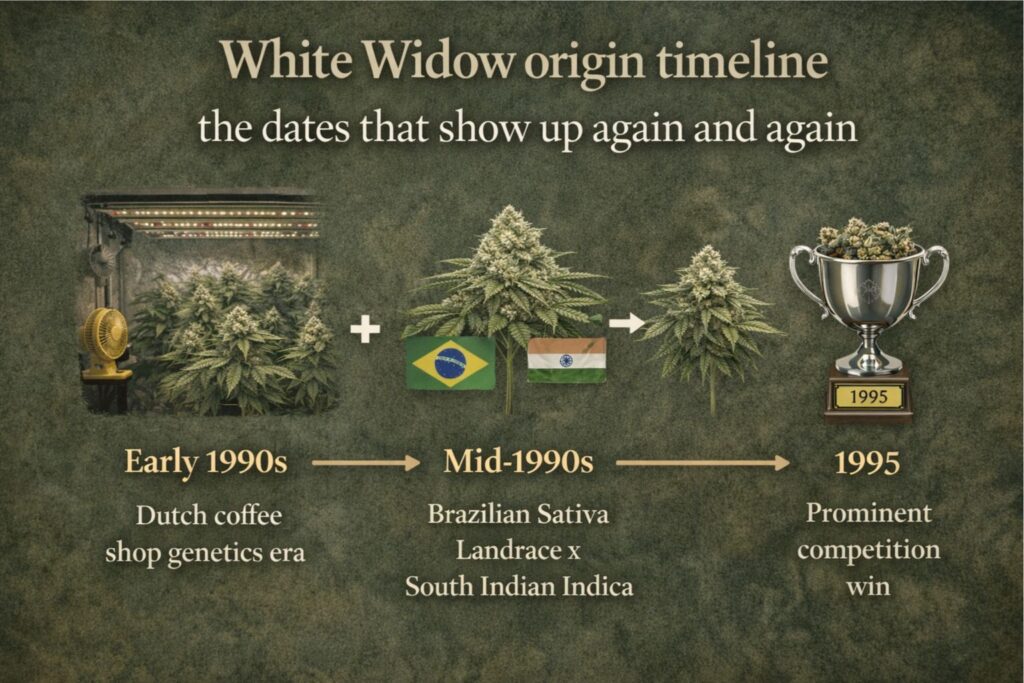
Here’s how I lay out the White Widow origin timeline when I’m explaining it to another grower.
Early 1990s: a Dutch breeding moment
The Dutch coffee shop genetics era matters because it shaped what breeders were selecting for: fast indoor cycles, manageable height under lights, and standout resin for hash and extracts. When you grow in a tight indoor space, traits like branch angle, internode spacing, and mold tolerance become economic traits, not just botanical details.
Mid-1990s: the cross that gets repeated in retellings
The most repeated lineage description is simple: Brazilian landrace influence on the sativa side, and South Indian indica heritage on the indica side. That blend is often used to explain why many plants show both a bright, active “head” feel and a calmer, heavier body finish—though effects vary wildly by person and batch, and I avoid medical promises.
1995: the win that made the name stick
The 1995 Cannabis Cup backstory is what turned a popular cultivar into a reference point. It’s one thing to be loved in a few circles; it’s another to be named publicly as the one to beat. After that, the name spread, and so did copies, selections, and reworkings by different seed companies.
Genetics and selection: what the lineage suggests, and what the plant actually does
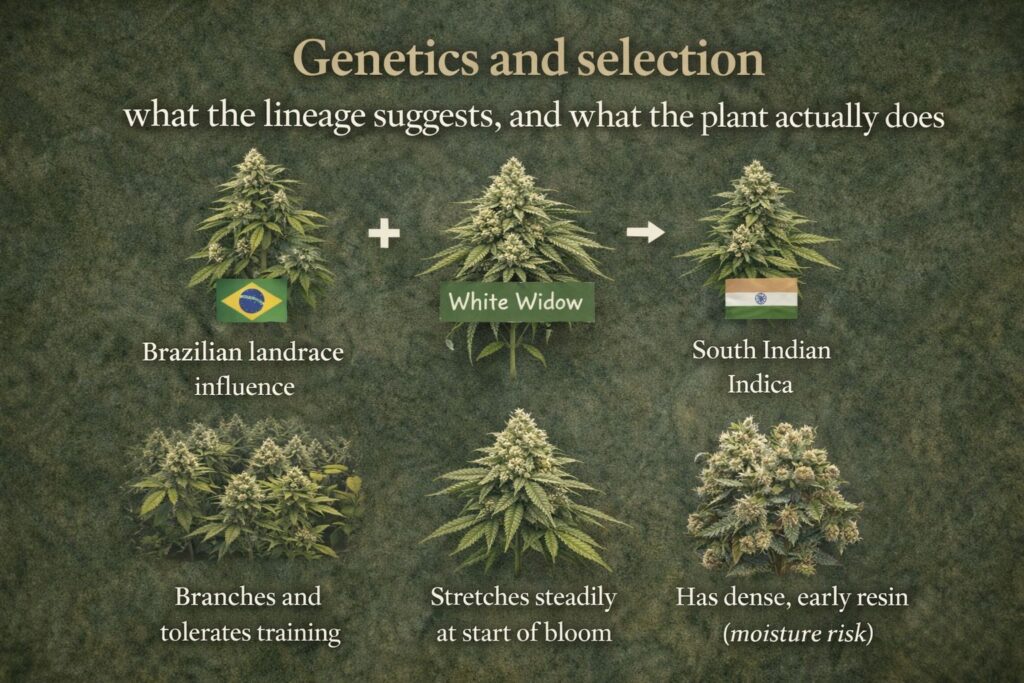
The Brazilian landrace influence and South Indian indica heritage are often used as shorthand for the plant’s “balanced hybrid” reputation. In the garden, what I actually see is this:
- Many phenotypes branch eagerly and tolerate training.
- Stretch exists, but it’s usually manageable with a level canopy.
- Resin builds early and keeps thickening late, which creates both quality potential and moisture risk.
That last point is where resin production selection shows up clearly. Breeders didn’t just stumble onto a frosty plant; the story implies repeated selection for trichome density. In my runs, I can often predict how “white” the flower will look by week three of bloom. When the early sugar leaves look like they’ve been rolled in fine grit, I know I’m on a resin-forward path.
My hands-on traits list: what I watch for in week-by-week growth
When I run any “White Widow” pack, I expect White Widow phenotype differences. I look for patterns that tell me which plant I’m dealing with.
White Widow phenotype differences I’ve seen indoors
I’ve seen three common phenotype lanes:
- A compact, quick-finishing plant that stacks tight flower and stays easy to manage.
- A medium-height plant with a more open structure that fills a net beautifully.
- A taller plant that stretches harder and wants a longer finish, often with a brighter top note in aroma.
Those White Widow phenotype differences matter more than the marketing description. I label plants and keep notes on stretch, leaf shape, and when resin becomes visible. When the pack throws a standout plant, I can decide whether it’s worth keeping around for future runs.
Stretch and canopy behavior
I plan for stretch during the first two weeks after switching to 12/12. The “balanced hybrid” label doesn’t mean no stretch—it means the stretch is usually trainable. If I’m running a net, I weave tops outward during the stretch window to keep the canopy flat.
Resin timing and moisture management
Resin production selection shows up as early shine and later frost. But the price of trichomes is humidity control. Dense, sticky buds can trap moisture, especially if leaves are crowding the interior.
My practical humidity rule is simple:
- As flowers get denser, I bring humidity down and airflow up.
I don’t chase a single number. I watch leaf posture, room dew point, and the way the buds “feel” when I squeeze them gently in late bloom. If they feel too spongy and the room is humid, I treat it like a warning.
How I grow it indoors: soil and inert media, with realistic targets
This isn’t a pure cultivation guide, but the History of White Widow only matters if it helps you succeed. Here’s what I actually do indoors, and how I adjust for different media.
Light and environment: what I consider “safe push” without CO2
If you’re running LED lighting in a tent, you can push intensity, but only if the environment supports it. My typical approach:
- Veg: moderate intensity, building a strong frame.
- Early bloom: ramp intensity gradually over 7–10 days.
- Mid bloom: hold steady if leaves look relaxed and not bleached.
- Late bloom: reduce heat and humidity pressure rather than chasing extra intensity.
I measure intensity when I can. If I can’t, I rely on a proven fixture map and keep the canopy level. Uneven canopies cause uneven maturity, and that makes harvest timing messy.
Feeding: steady, not aggressive
Some growers try to “power feed” resinous genetics. In my experience, that backfires more often than it helps. I aim for steady nutrition and avoid big swings.
In soil, I keep it simple: a balanced base and small adjustments. Overcorrecting in soil often creates more problems than it solves.
In inert media, I’m consistent with EC and pH. If I’m sloppy, the plant shows it quickly—edges burn, tips crisp, and growth slows.
indoor hydro performance notes: where hydro shines, and where it bites
I’ve run this cultivar family in recirculating systems and in drain-to-waste setups. My indoor hydro performance notes are consistent:
- Hydro can deliver very even growth and clean flower when the system is stable.
- Hydro punishes neglect faster than soil.
If the pump fails or the solution drifts, the plant can look tired in hours, not days. If you like measuring and maintaining systems, hydro is rewarding. If you prefer forgiving margins, soil may fit you better.
Aroma, flavor, and finishing: what I can say without hype

Different phenotypes carry different aromatic profiles, but I most often notice a mix of citrus, pine, and spice. The aroma can be sharp right at chop and become more rounded after a slow cure.
The biggest quality lever after genetics is post-harvest handling. That’s why I keep repeating curing to preserve pine citrus terpenes as a priority, not an afterthought.
Drying: my approach for clean smoke and stable jars
If you dry too fast, you can lock in harshness and flatten aroma. If you dry too slow in a humid room, you raise mold risk. My baseline:
- Cool, controlled drying space.
- Gentle, indirect air exchange.
- Patience.
I don’t rush just because the outside feels dry. I wait for the internal moisture to equalize.
curing to preserve pine citrus terpenes: what changed my results
Here’s the simple routine that improved my jars:
- Keep the dry slow and controlled.
- Jar only when small stems snap, not bend.
- Burp daily early on, then taper as humidity stabilizes.
I’m careful with this because dense, resinous weed can feel dry on the surface while still holding moisture inside. If you jar too early, you can trap that moisture and create off smells. If you jar too late, you can lose volatile aromatics. Curing is a balance.
I’ll repeat it because it’s the difference between “good” and “memorable”: curing to preserve pine citrus terpenes is mostly about avoiding extremes—no speed drying, no wet jars, no hot rooms.
Shopping for seeds: how to avoid common mistakes without legal claims

People read the History of White Widow and then ask the same shopping questions. I’m going to answer them in a practical way that applies whether you’re new or experienced.
buying White Widow seeds online safely: what I check before I pay
When I’m buying White Widow seeds online safely, I look for:
- Clear breeder info and consistent descriptions across multiple pages.
- Freshness and storage guidance.
- Transparent shipping and refund policies.
- Payment security and a track record of customer support.
I also watch for misleading numbers. If a listing claims extreme cannabinoid percentages without context, I treat it as marketing, not data.
Feminized seeds, regular seeds, and autoflowering options
If you’re limited on space, feminized seeds reduce the chance of ending up with male plants in a small tent. If you want to hunt and select, regular seeds give you more options but require more space and time.
Autoflowering versions exist in the market, but they’re a different project. Autos have their own rhythm, and you don’t control bloom timing with 12/12. If you’re specifically learning the classic indoor cycle, I suggest running photoperiod plants first.
Indica, sativa, hybrid: how I interpret those labels
I treat those labels as rough growth and effect hints, not scientific categories. With this cultivar family, I usually get hybrid behavior: manageable stretch, good branching, and a finish that can lean either brighter or heavier depending on phenotype, harvest timing, and cure.
Why the 1995 Cannabis Cup backstory still matters in 2025

In the Dutch coffee shop genetics era, winners weren’t just judged on hype; they had to perform in real indoor rooms with real constraints—space, smell, and consistency.
The 1995 Cannabis Cup backstory matters because it explains why this name persists. Competition wins create a reference point, and reference points become benchmarks.
As a cultivator, I use that benchmark in a simple way:
- If a “White Widow” listing doesn’t show resin potential in photos or descriptions, I’m skeptical.
- If a breeder’s version consistently throws low-resin plants, it’s not meeting the expectation that made the name famous.
That doesn’t mean every plant must be identical. It means the theme should be there: resin, vigor, indoor practicality.
Risks and trade-offs I’ve learned to respect

The History of White Widow isn’t all upside. Here are the trade-offs I’ve personally had to manage.
- Dense flowers can trap moisture
Resin-heavy, chunky cannabis buds are great until humidity spikes at night. If you ignore airflow and humidity, you can lose flower to mold. - Phenotype variance can surprise you
White Widow phenotype differences are real. You might get a plant that finishes quickly and another that needs extra time. Plan your schedule with buffer. - Strong light demands stable climate
If you push light intensity but your room runs hot or dry, you can trigger stress symptoms that look like nutrient problems. In my indoor hydro performance notes, most “mystery deficiencies” were actually climate or root-zone issues. - Post-harvest work decides final quality
You can grow great flower and then ruin it with a rushed dry. Curing to preserve pine citrus terpenes is not optional if you care about aroma.
FAQ: long-tail questions I hear from growers and shoppers
How long does it take from seed to harvest indoors?
It depends on veg time and phenotype. In my tents, I think in phases: about two weeks to establish seedlings, several weeks of veg to build a canopy, and a bloom window that can vary by plant. I schedule flexibility because White Widow phenotype differences can shift finish time.
Is this cultivar family better in soil or hydro?
Both can work. Soil is forgiving if you respect dry-down cycles. Hydro can be faster and more uniform if you keep the system stable. My indoor hydro performance notes say the biggest risk in hydro is neglect; the biggest risk in soil is overcorrecting.
How do I reduce mold risk in late bloom?
Increase airflow, reduce humidity as flowers thicken, and avoid overcrowding the canopy. Dense, resinous marijuana flowers need breathing room.
What’s the best way to keep the aroma strong?
Slow, controlled drying and a patient cure. If you want a clean jar that keeps its character, focus on curing to preserve pine citrus terpenes instead of rushing to smoke it.
How do I tell if a listing is reputable?
When buying White Widow seeds online safely, prioritize clear breeder information, realistic descriptions, and transparent policies. Avoid listings that rely on extreme claims without context.
Does the old history guarantee the same plant today?
No. The History of White Widow explains why the name became famous, but modern versions vary. Use the name as a theme, then judge each breeder’s work by consistency and the traits you see in your room.
Closing note: using history as a grow tool
If you take one thing from this, let it be this: the History of White Widow is useful only if it helps you make better decisions. Use the White Widow origin timeline to understand why indoor traits were selected. Use resin production selection to anticipate humidity risk. Use the 1995 Cannabis Cup backstory to understand why the benchmark is high. And treat White Widow phenotype differences as a normal part of seed-grown cannabis—something to observe, label, and learn from.
I’ll keep updating these field notes as I run new packs, because history is not just what happened in the 1990s. For growers, history is what repeats in the tent today.
