Table of Contents
Why I started building around fast finishes
I’ve run plenty of cannabis cycles where the calendar felt like it moved in slow motion. The tent is full, the plants are healthy, and yet I’m still waiting for pistils to darken and trichomes to turn cloudy. When I started optimizing for faster turnarounds, I learned quickly that shaving time off a grow is less about rushing and more about choosing the right genetics and running the environment tightly.
This post is written from my own cultivation notes: indoor LED runs, a small greenhouse season, and a couple of “learning the hard way” harvests where I let plants go too long or pushed feed too hard. If you’re shopping for seeds or planning your next run and you want predictable timing, this guide will help you make better decisions with fast flowering strains and avoid the common pitfalls.
I’m publishing this on December 24, 2025, and while gear and cultivars evolve, the fundamentals have stayed steady: stable environment, sensible training, and careful harvest timing.
What I mean by fast flowering strains (and what I don’t)
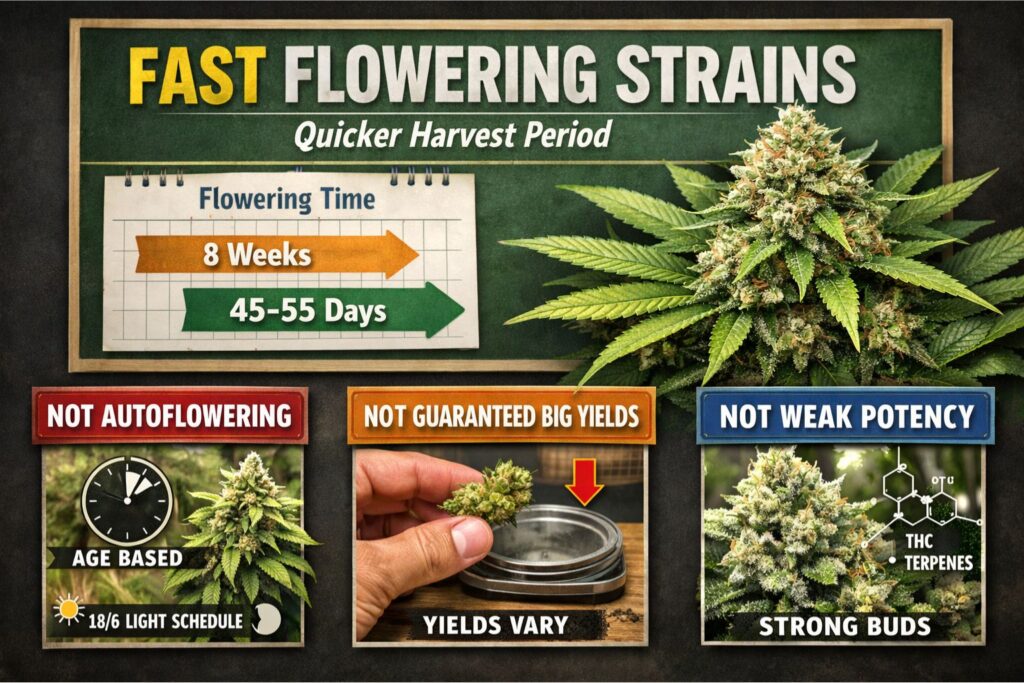
When I say fast flowering strains, I’m talking about photoperiod cultivars that reliably complete flower in a shorter window than the “average” modern hybrid. In my own grows, the practical difference shows up as fewer days from the flip to harvest, less time managing late-flower humidity, and faster turnover of the same footprint.
A few clarifications that matter:
- Fast finish is not the same thing as autoflowering. Autos can be quick, but their clock is set by age rather than the light schedule.
- “Fast” isn’t a guarantee of bigger yields. The plant still has to build biomass and stack flowers.
- Shorter flowering does not automatically mean weaker buds. In my experience, potency and aroma are more dependent on genetics, light intensity, and the way you handle harvest and drying.
If you’re specifically searching for quick harvest cannabis genetics, keep in mind that some cultivars finish early only under ideal conditions. Stress, poor lighting, or improper watering can stretch the timeline.
Why growers chase quicker finishes

There are plenty of reasons I plan around early finishes, and most of them are practical:
- Reducing risk in humid seasons. Late flower can be a mold magnet outdoors or in a greenhouse if you can’t control dew and airflow.
- Faster rotation in a small space. A fast turnaround indoor grow helps me keep my tent productive without feeling like every run is a long commitment.
- Timing around life. Vacations, work peaks, or a moving date are real constraints, and a shorter cycle helps.
- Dialing in a perpetual setup. If you run staggered plants, a consistent finish window makes scheduling much easier.
That said, speed is not always the right priority. If a longer-flowering cultivar delivers the flavor profile you want, forcing the timeline can create disappointment. For me, the best approach is choosing early finishing weed varieties when speed matters, and running longer bloomers only when I have the time and environmental control.
The genetics piece: what I look for before I buy seeds

I used to buy seeds based on name recognition. Now I buy based on how the plant is likely to behave in my room. If you want fast flowering strains to actually finish fast, selection matters.
Here’s my shortlist for evaluating quick harvest cannabis genetics:
- Flowering window. I favor cultivars that are described as finishing in the 45–55 day range in controlled conditions.
- Structure. I prefer plants that stretch moderately and set a manageable canopy, whether they’re indica-leaning, sativa-leaning, or a balanced hybrid, because they’re easier to finish cleanly.
- Flower tightness and airflow. Very tight flowers can be great, but they demand tighter humidity control late in flower.
- Feeding tolerance. Some early finishers are light feeders and punish heavy EC.
- Phenotype variability. Seeds can throw different expressions. I plan for that, and I don’t assume every plant will hit the advertised number of days.
If I’m shopping as a customer, I also pay attention to whether the breeder or seed bank shares realistic ranges and cultivation notes. Vague marketing copy is a red flag.
Photoperiod vs autoflower in a speed-focused plan
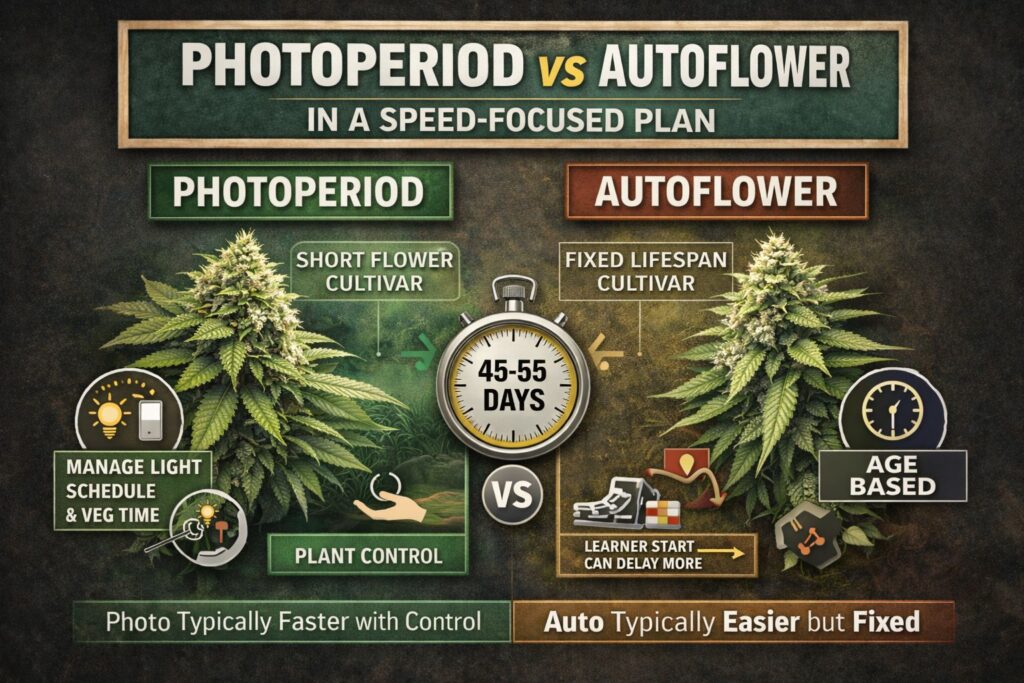
I grow both, and they solve different problems.
Photoperiod cultivars give me control. I can shorten veg, flip early, and run a tight finish. If your goal is short flower photoperiod strains, photoperiod is usually the best fit because you can train and shape the plant before bloom and then drive flower hard.
Autoflowers are great for simplicity and timing outdoors, but they’re less forgiving if you stunt them early. A slow start on an auto can cost you more time than you save.
If you’re asking “which finishes faster, photo or auto?” my honest answer is: it depends on how well you can avoid early stress and how long you plan to veg the photoperiod plant. A well-run photoperiod plant with a short flowering cultivar can beat many autos in total time, especially if you keep veg tight.
My fastest repeatable timeline: a realistic example
When everything is going well, I plan my fastest repeatable cycle around a predictable rhythm rather than a rigid promise. Here’s the general structure I use for a fast turnaround indoor grow with fast flowering strains:
- Germination and seedling: 7–14 days
- Early veg and training: 14–21 days
- Flower: 45–55 days (variety-dependent)
- Drying and cure: at least 10–14 days dry plus a gradual cure
That’s not a “rush job.” It’s a planned cycle where each phase has a purpose.
If you’re looking for a 7 week flowering schedule, I treat it as a target window, not a guarantee. In my notes, the plants that actually hit a clean seven-week finish are the ones with stable root zones, consistent VPD, and enough light to keep metabolism high.
Germination and seedling setup for speed
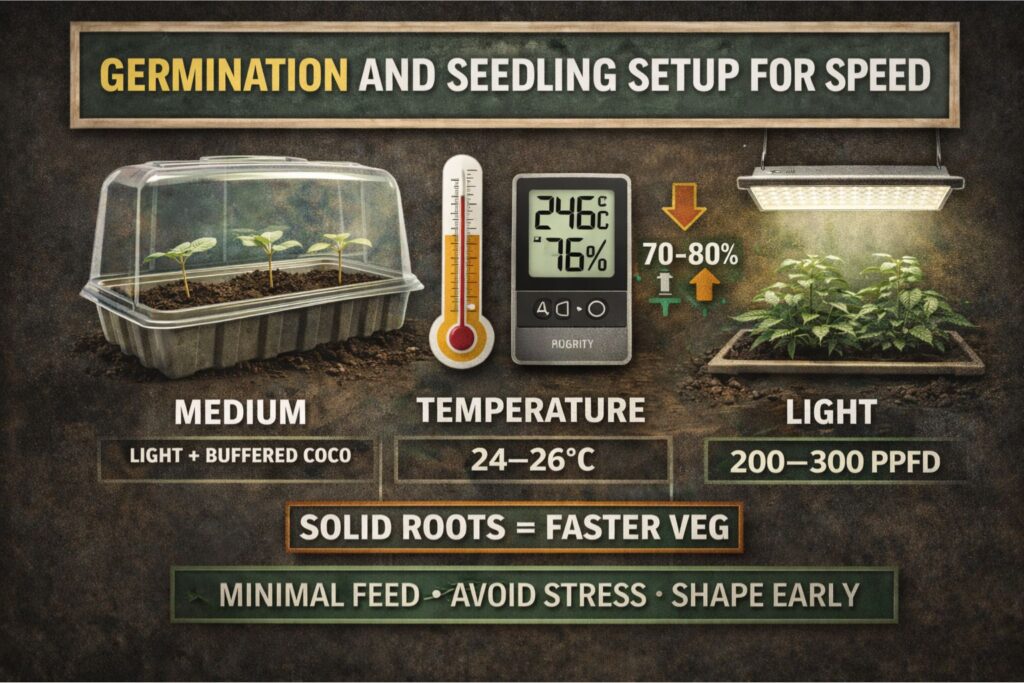
The quickest way to lose time is to start with a weak root system. My method is boring, repeatable, and gentle.
My seed-start approach:
- Medium: lightly amended seed-start mix or buffered coco with low EC.
- Temperature: 24–26°C for germination and early seedling.
- Humidity: 70–80% RH early, then gradually down.
- Light: gentle intensity. I aim roughly 200–300 PPFD for seedlings under LED, increasing slowly.
I keep feed minimal at this stage. In coco, I’ll run a light nutrient solution with calcium and magnesium present, but I keep overall strength modest. Overfeeding seedlings is the fastest route to slow growth and long recovery.
This is also where I start planning for compact plant quick finish. If I want a compact canopy, I top early only if the plant is vigorous and has multiple nodes established. Otherwise, I use bending and light height to shape growth without shocking the seedling.
Vegetative strategies that shorten total time
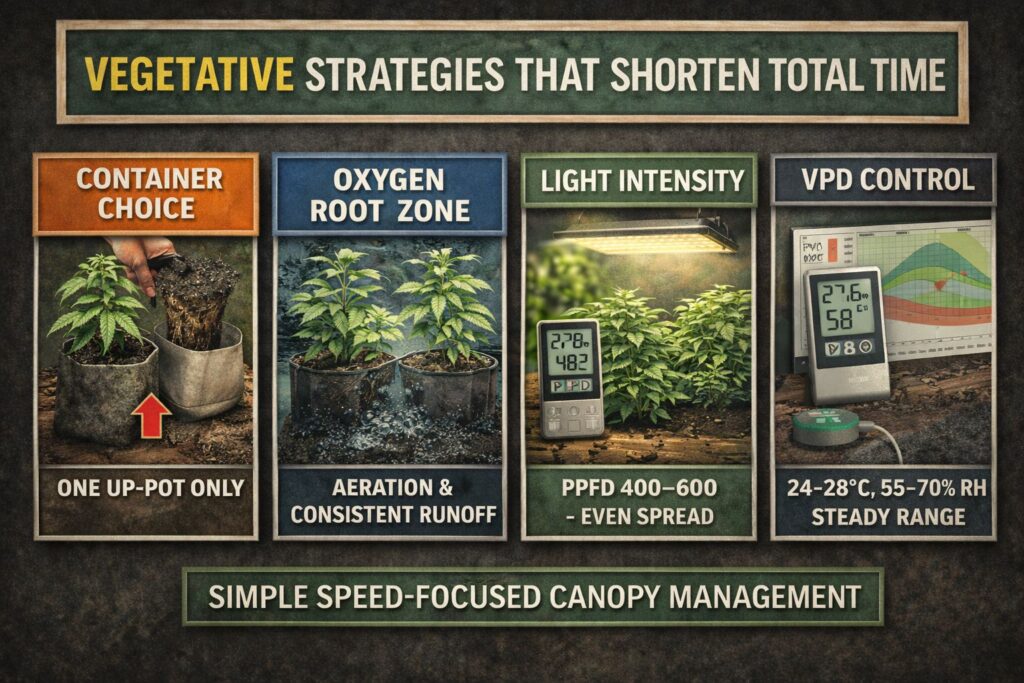
The veg stage is where you can really influence the total cycle length. I’ve learned that a short veg doesn’t mean no veg; it means purposeful veg.
My go-to tools:
- Container choice. I up-pot once, not three times. Multiple transplants can stall growth.
- Root zone oxygen. In soil, I use aeration amendments. In coco, I avoid overwatering and keep runoff sensible.
- Light intensity. In veg, I like 400–600 PPFD once plants are established, with a good light spread. Too low and you waste days; too high and you can stress a young plant.
- VPD control. I aim for a VPD that encourages steady transpiration. In practice, that often looks like 24–28°C with 55–70% RH depending on plant size and airflow.
- Speed-focused canopy management. I shape plants early so the flip happens with an even canopy, not a jungle.
If you want speed-focused canopy management to actually save time, keep it simple. Every recovery period is a delay.
Training techniques I use for quick finishes
Training is where people often overdo it. For fast flowering strains, my rule is: minimal stress, maximum light exposure.
I rotate through these methods:
- Low-stress training (LST) with soft ties
- Early topping on vigorous plants (once, not repeatedly)
- Light defoliation to open airflow, especially before flower
- A tight canopy with consistent light distance
I’ll also run a high-density layout sometimes, but only when I have strong airflow and a plan for humidity late in flower. If your environment is humid, a dense canopy is risky.
This is also where the rapid bud stacking technique starts long before bloom.
I also find the rapid bud stacking technique improves when I keep the canopy uniform and avoid big swings in feed or temperature.
Bud stacking is improved by an even canopy and consistent light intensity across tops.
Soil, coco, or hydro: choosing a medium when speed matters
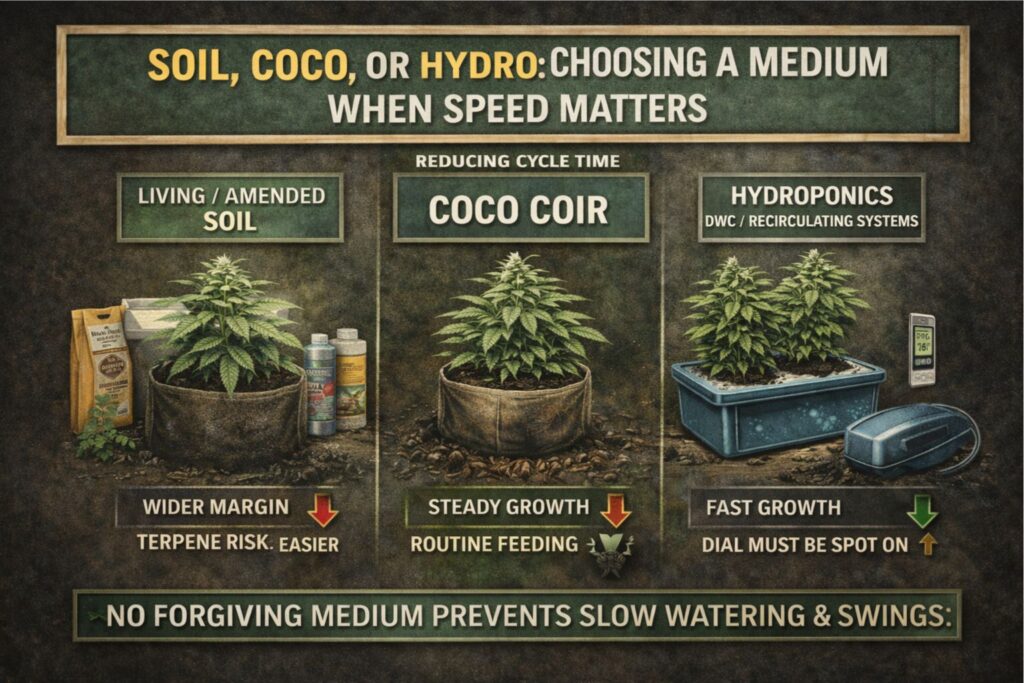
I get asked about soil vs hydro a lot, especially by growers trying to reduce total cycle time. I’ve finished fast flowering strains in soil, coco, and simple hydroponic setups, and each has trade-offs.
- Living or amended soil: The margin for error can feel wider, and terpene quality can be excellent. The downside is that correcting a mistake (overwatering, pH drift, nutrient deficiency) often takes longer, which can stretch a tight schedule.
- Coco coir: This has been my most repeatable path for a fast turnaround indoor grow. Because the root zone is fed frequently with a controlled solution, growth can be very steady. The downside is you need routine irrigation and you must watch EC and runoff so you don’t trigger nutrient burn.
- Hydroponics (DWC or recirculating systems): When dialed, hydro can be very fast, but it’s less forgiving. Water temperature, oxygenation, and reservoir stability have to be consistent, or plants can stall quickly.
If you’re newer, I usually suggest starting in soil or coco and learning plant signals before going fully hydro. No medium makes up for inconsistent environment, but the medium you choose does affect how quickly you can correct problems.
Flowering: dialing the environment so plants actually finish on time
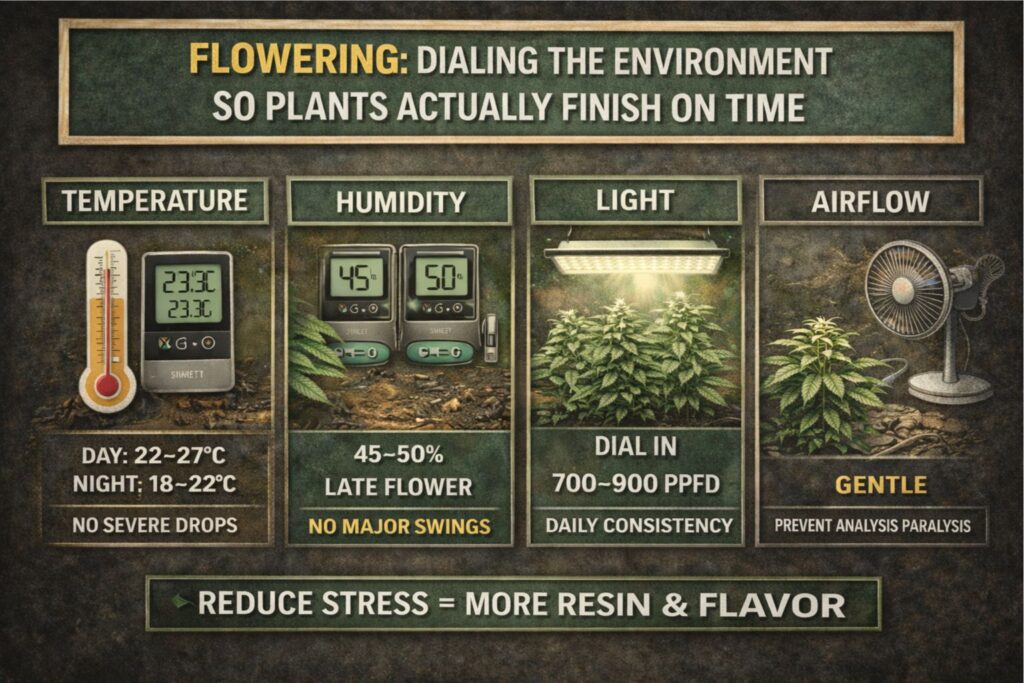
Most “fast” cultivars are only fast when the room is run correctly. Flower speed is driven by metabolism, and metabolism depends on light, temperature, humidity, and nutrition.
Here are the targets that have worked best for me:
Light intensity and photoperiod
During flower, I run a consistent day/night schedule and avoid sudden changes. Under LED, I typically push 700–900 PPFD for the upper canopy once plants are settled in flower. I’ve run higher, but higher PPFD demands perfect nutrition and CO2 strategy, and I’m not going to pretend every home grower has that setup.
If you’re targeting a 7 week flowering schedule, you want enough intensity to avoid slow ripening. Weak light tends to stretch harvest later because the plant can’t finish building resin and density efficiently.
Temperature and humidity (VPD in plain language)
In early flower, I’m comfortable around 24–27°C with 50–60% RH, then I gradually lower humidity into the 40–50% range as flowers densify. Late flower, I’d rather run slightly cooler and drier than warm and humid.
For early finishing weed varieties, late-flower humidity control is often the difference between a clean finish and a stressed plant. When humidity runs high, the plant often slows down, and you also increase mold risk.
Airflow and plant spacing
I’m aggressive with airflow. I want leaves moving, not flapping, and I want stagnant pockets eliminated. A compact plant quick finish is easier when air can move through the canopy.
If you’ve ever had a plant finish “fast” but smell muted, airflow and humidity are often part of the story.
Nutrition: keeping the plant fueled without delaying ripening
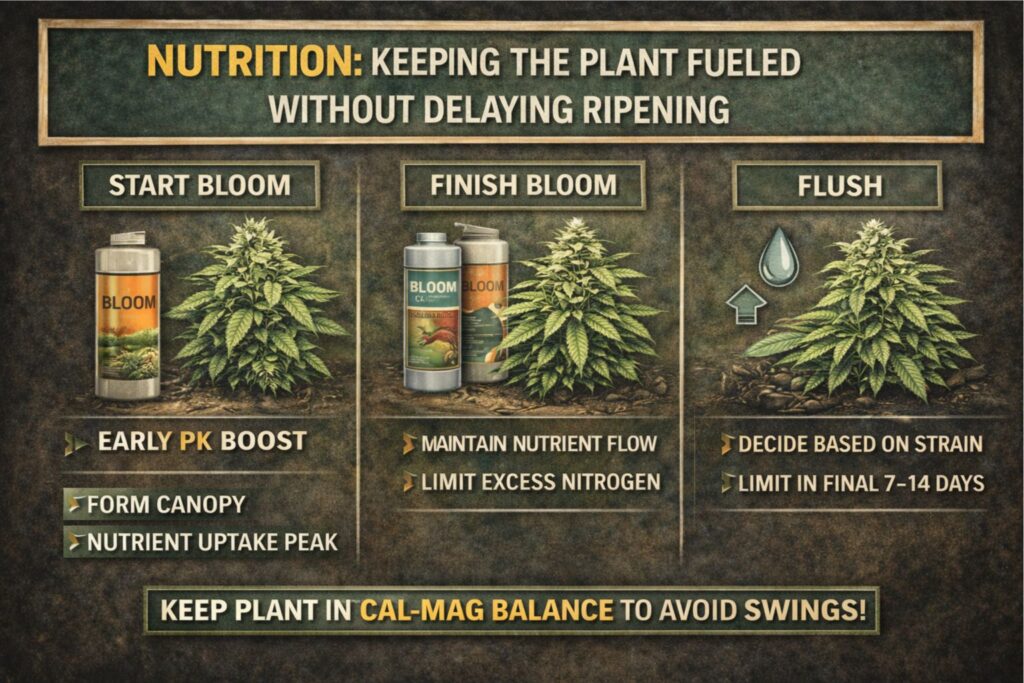
Feeding is where I see growers unintentionally add weeks. Too much nitrogen late in flower can keep plants green and pushing new growth instead of finishing.
I’ll share my practical approach rather than pretending there’s one universal recipe.
EC/PPM targets that have worked for me
In coco, my general range looks like this:
- Early veg: around 0.8–1.2 EC depending on the cultivar and water quality
- Mid veg to early flower: around 1.2–1.8 EC
- Mid flower: around 1.6–2.2 EC if the plant is hungry and the environment supports it
- Late flower: I taper down, watching leaf color and overall vigor
In soil, I feed lighter and focus on keeping the root zone stable. Overfeeding soil can create salt buildup and stalls.
With fast flowering strains, I watch for nutrient burn and nutrient deficiency early because the timeline is tighter; there’s less time to recover. If tips are frying, I back off quickly and prioritize stable watering.
Reading the plant (not the bottle)
The fastest way to stay on schedule is to respond to the plant’s signals:
- Pale new growth in veg can indicate underfeeding or pH issues, but also check light intensity.
- Dark clawed leaves in flower often mean excess nitrogen.
- Slow water uptake can signal root issues, not just “they need more feed.”
If you’re trying to build a fast turnaround indoor grow, consistency beats intensity. A moderate feed the plant can use will outpace an aggressive feed that causes stress.
Integrated pest management for short cycles
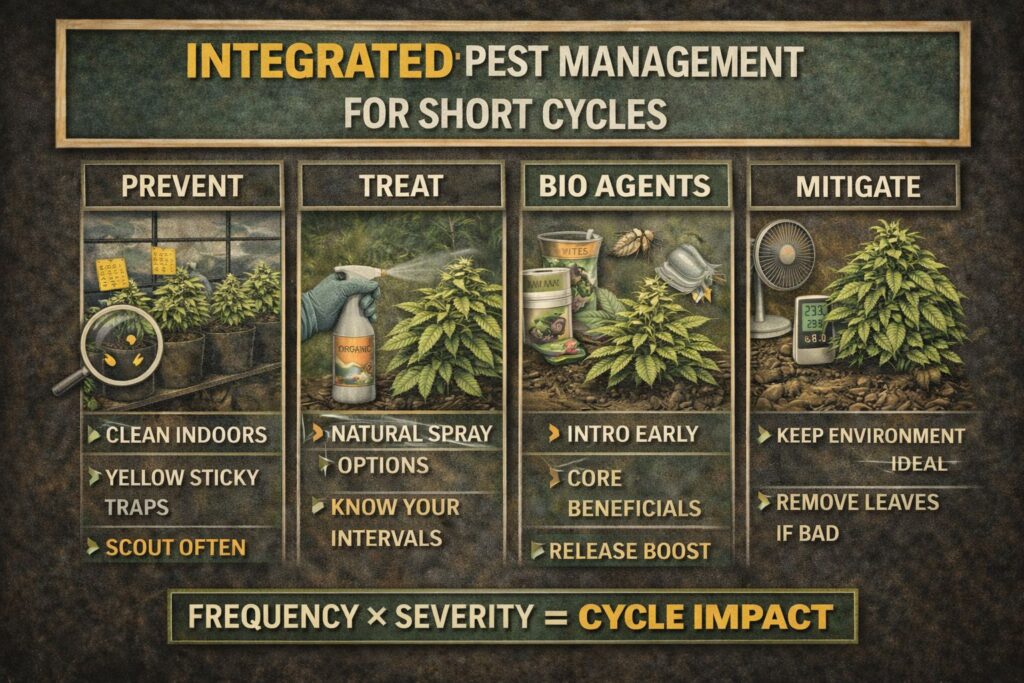
Fast finishes don’t mean you can ignore IPM. In fact, short cycles can hide problems until late flower, when you have fewer safe options.
My baseline IPM habits:
- Inspect leaves twice a week with a loupe.
- Keep the grow area clean, especially floors and intake filters.
- Quarantine new plants and clones.
- Use beneficial insects when appropriate, especially in greenhouse grows.
- Avoid heavy sprays in flower. If I need intervention, I prefer early action.
If you run early finishing weed varieties specifically to avoid late-season outdoor mold, remember that pests can still show up quickly, and stress can stretch the finish.
Harvest timing: how I avoid the “too early” and “too late” trap
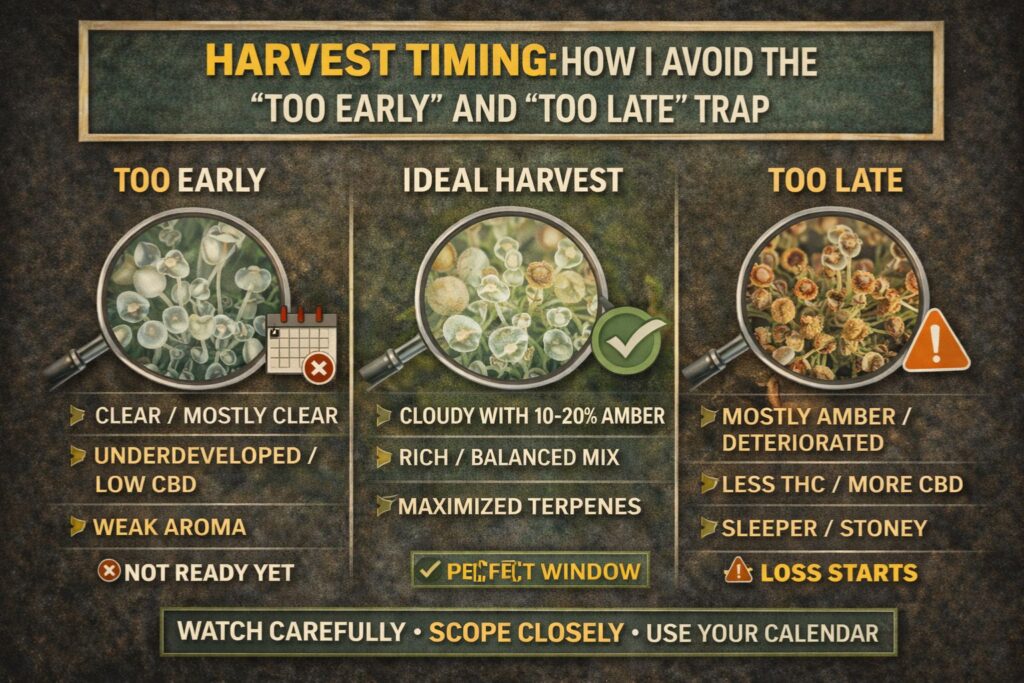
This is the part I had to learn by experience. I used to harvest based on the calendar alone. Now I use the calendar as a guide and confirm with plant signals.
What I look for:
- Trichome maturity: mostly cloudy with some amber, depending on the effect I’m aiming for
- Calyx swelling and pistil change: flowers should look finished, not still throwing fresh white hairs everywhere
- Leaf fade: not required, but a natural fade often shows the plant is nearing the end
- Aroma development: the nose test matters; a plant that still smells “green” often needs more time
The “too late” trap is real. I’ve let plants go long chasing a little extra weight, and I’ve ended up with sleepy, dull smoke and less vibrant aroma. If your goal is terpene retention in quick grows, harvest timing is crucial. Overripe plants often lose the brightest notes.
If you’re dedicated to fast flowering strains, the discipline is harvesting in the window that matches the cultivar’s best expression, not the latest possible date.
Drying and curing: speeding up safely without ruining the crop
I’m careful here because “fast drying” can destroy quality. Still, I’ve developed a controlled approach to accelerated drying and curing that shortens the timeline without turning buds into hay.
My drying targets:
- Temperature: about 18–21°C if possible
- Humidity: 55–60% RH, with gentle airflow
- Darkness: I keep the space dark to protect cannabinoids and terpenes
- Duration: usually 10–14 days depending on flower tightness
For accelerated drying and curing, the key is not blasting heat or airflow. The goal is steady moisture release. If buds dry too quickly, terpene retention in quick grows suffers, and the smoke can feel harsh.
My cure routine:
- Trim when stems snap rather than bend.
- Jar or bin cure at stable room temp.
- Burp frequently early, then less often as moisture stabilizes.
- Aim for a stable internal humidity range that keeps buds springy, not wet.
If you want accelerated drying and curing to actually work, invest in a reliable hygrometer and don’t rush the last 10%. That last part makes the difference.
Does faster finishing mean lower yield or lower potency?
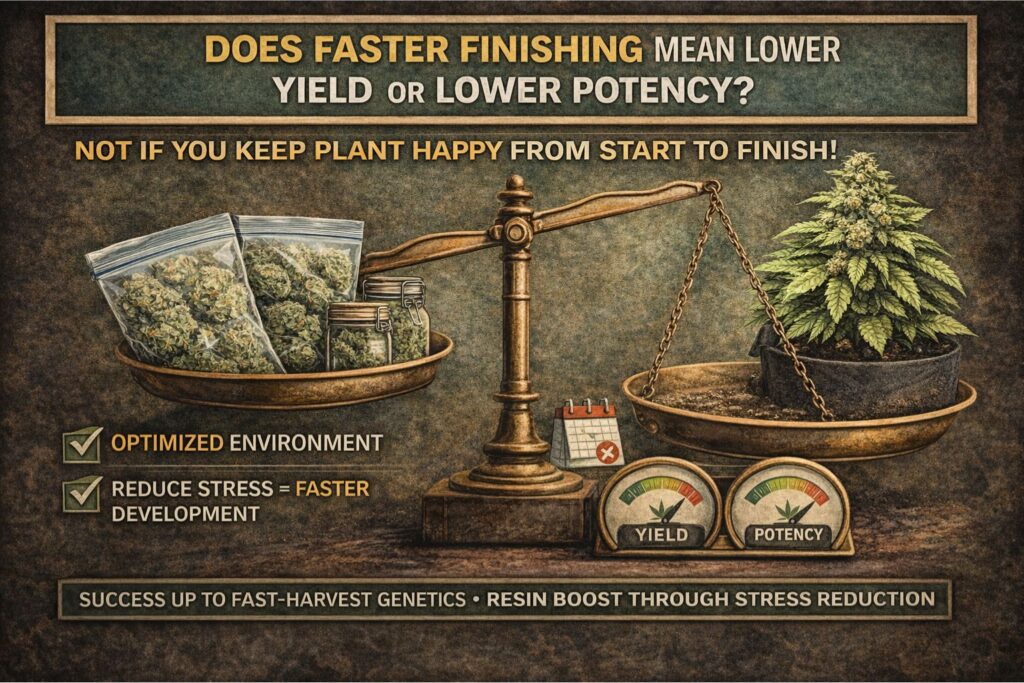
From my runs, the honest answer is: sometimes, but not automatically.
Yield is more connected to:
- Canopy size and light distribution
- Root health and container volume
- How early you flip and how much training you do
- Environmental stability
Potency is more connected to:
- Genetic potential
- Light intensity and spectrum
- Stress management
- Proper harvest and dry/cure
I’ve pulled very satisfying harvests from short flower photoperiod strains when the canopy is even and the environment is dialed. I’ve also had disappointing yields when I tried to push speed while cutting corners.
If you’re choosing quick harvest cannabis genetics, treat the “fast” trait as one piece of the puzzle.
Shopping and planning: choosing seeds for a faster schedule
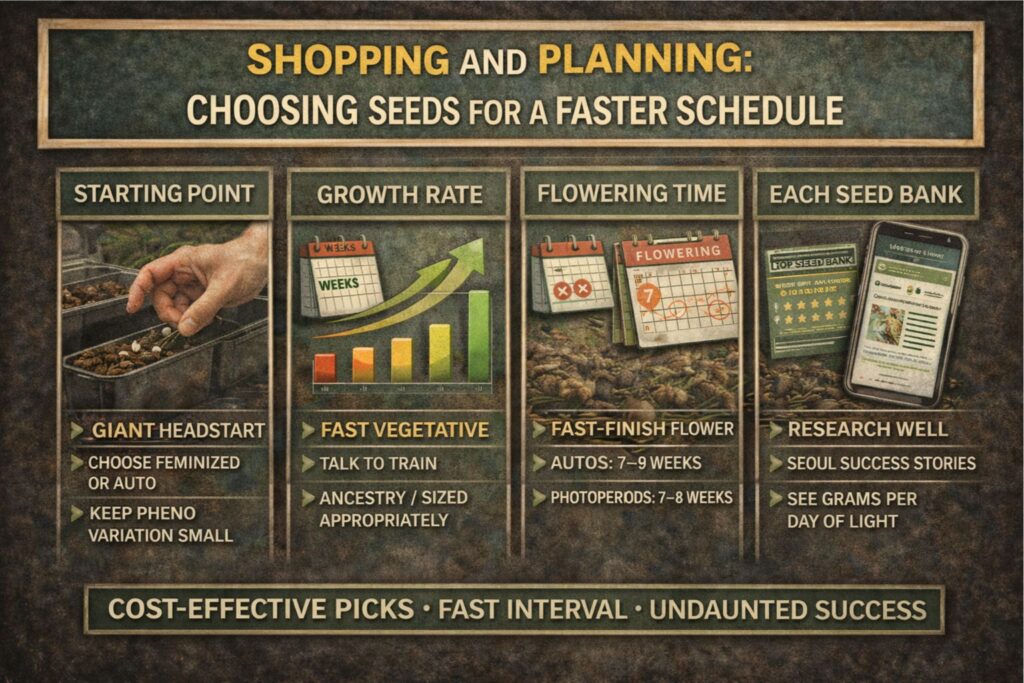
When people ask me how to buy cannabis seeds online for a faster run, I point them back to planning.
What I consider before ordering:
- Your grow environment. Tent, room, greenhouse, outdoor? Humidity control matters a lot for early finishes.
- Your goal. Do you want a compact plant quick finish or a larger plant with a slightly longer timeline?
- Your skill level. A fast cultivar can be less forgiving if you make mistakes in feed or irrigation.
- Seed type. Feminized seeds can simplify planning if you want all flowering plants, while regular seeds are useful if you plan to select males for breeding projects.
- Shipping and storage. Seeds should be stored cool and dry, and you should plan around delivery timelines.
I’m not giving legal advice, but I do encourage growers to understand local rules before they order. “Can you ship marijuana seeds to my region?” is a common search query, and the best answer is always: confirm your local situation and proceed responsibly.
If you’re comparing a seed bank to another, look for transparency: clear descriptions, germination guidance, and realistic flowering ranges.
Checklist: my quick-finish grow plan
When I plan a run focused on fast flowering strains, this is the checklist I keep on my wall:
- Choose cultivars with a realistic short flowering window
- Start with a stable seedling environment (warm and humid, gentle light)
- Build a healthy root zone before pushing intensity
- Use speed-focused canopy management early
- Maintain steady VPD through veg and flower
- Run enough PPFD in flower to avoid slow ripening
- Taper nitrogen late to encourage finishing
- Keep late-flower humidity under control
- Harvest by maturity, not by impatience
- Use accelerated drying and curing only with controlled temperature and humidity
This checklist has saved me from “almost finished” plants that drag for two extra weeks.
FAQ: long-tail questions I see all the time
How do I shorten total grow time without sacrificing quality?
Use fast flowering strains, keep veg purposeful, and run a stable environment. Don’t overtrain. A fast turnaround indoor grow comes from consistency and clean execution.
What’s the best light level for a quick finish?
I’ve had the best results finishing short flower photoperiod strains with roughly 700–900 PPFD at the canopy, assuming temperature and humidity are controlled and nutrition is appropriate.
Can I run a 7 week flowering schedule every time?
A 7 week flowering schedule is possible with the right cultivar and conditions, but it’s not guaranteed. If the plant is stressed, underlit, or overfed, it can take longer even if genetics are “fast.”
Do fast finishes mean weaker buds?
Not necessarily. Early finishing weed varieties can be very potent when the environment is dialed and harvest is timed correctly. Quality often depends more on drying and curing than on the calendar.
What training works best when time is limited?
I stick to speed-focused canopy management: gentle LST, minimal topping, and smart defoliation. The rapid bud stacking technique starts with an even canopy, not aggressive cutting.
How do I avoid harsh smoke when I want to finish quickly?
Don’t rush the post-harvest. Controlled accelerated drying and curing can shorten the timeline, but it still needs stable conditions. Terpene retention in quick grows is protected by slow, consistent drying.
Should I choose autos or photos for quick harvest cannabis genetics?
If you can avoid early stress, autos can be convenient. If you want control and you’re focused on short flower photoperiod strains, photoperiod plants often give you more flexibility.
What’s the biggest mistake growers make with compact plants?
Overwatering small containers and starving the roots of oxygen. For a compact plant quick finish, roots must stay healthy, and the canopy must stay evenly lit.
Final notes from my grow journal
I love the efficiency of fast flowering strains, but I only recommend them when the rest of the system supports them. Fast genetics can’t rescue a weak environment, and rushing harvest or drying will erase the time you saved.
If you’re optimizing your next run, start with quick harvest cannabis genetics, commit to speed-focused canopy management, and keep the room stable. When you do that, a fast turnaround indoor grow stops feeling like a gamble and starts feeling repeatable.
