I’ve grown plenty of plants in containers—tomatoes, basil, peppers—and I’ll be honest: cannabis in a pot is less forgiving than most kitchen-garden staples. The plant is vigorous, but the root zone is confined, and every decision you make shows up quickly in the leaves. After multiple seasons dialing it in indoors and on a sheltered balcony, I now reach for the same core approach every time: Easy Container Gardening that treats the container like a small, controllable ecosystem rather than “dirt in a bucket.”
This post is for readers of our website who want a practical, repeatable process for container growing. I’ll cover what I actually do, what I stopped doing because it caused problems, and the measurements I track (PPFD, EC, temperature, humidity, and VPD). I’ll also include seed-shopping considerations—feminized seeds, autoflowers, indica/sativa/hybrid traits, choosing seed banks, realistic shipping expectations, and the importance of understanding regional grow laws. Always follow local rules where you live.
Why I Choose Easy Container Gardening for Cannabis
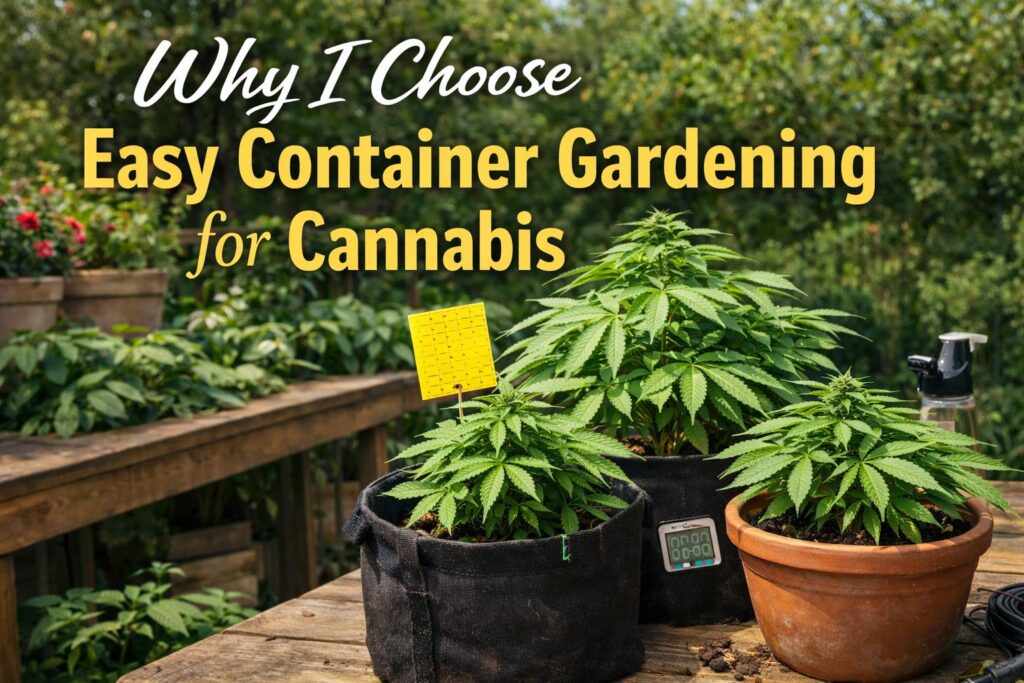
When I’m working with limited space, I rely on Easy Container Gardening because it gives me control. Containers let me manage root volume so plants stay the size my area can handle, refresh media quickly if something goes wrong, move plants to dodge heat or storms, and isolate problems like pests without risking an entire garden.
That’s the upside. The downside is that containers punish inconsistency. Miss one watering in peak flower, and the plant can stall or throw off nutrient uptake. Overwater early, and you create an oxygen-starved root zone that invites fungus gnats and slow growth. Easy Container Gardening works best when you build a simple routine and stick to it.
Container Choices That Changed My Results
Size and shape
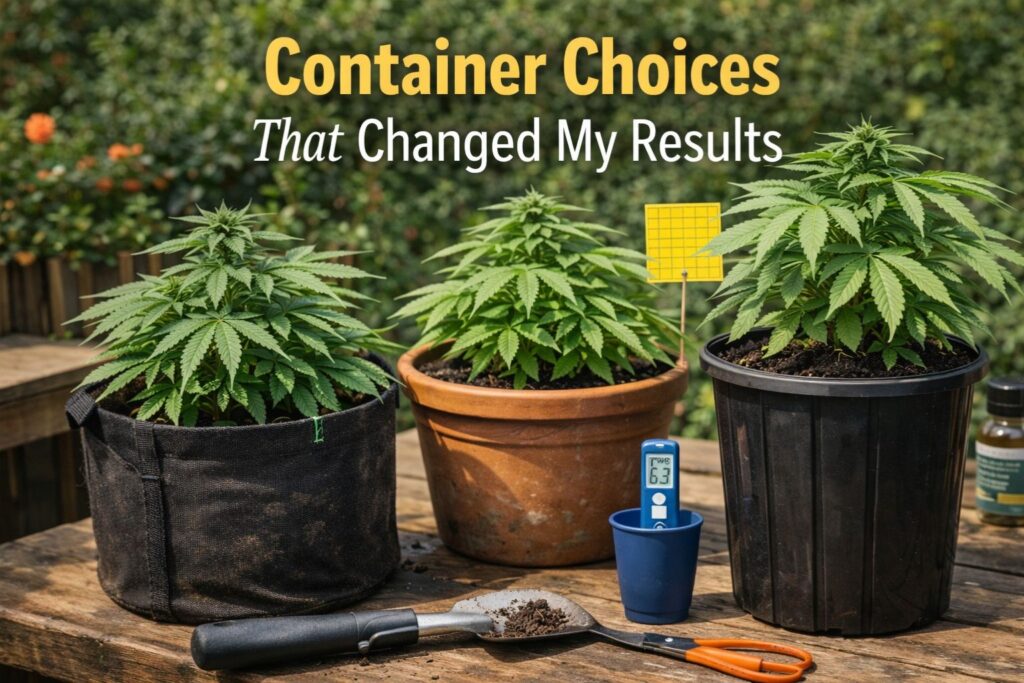
For photoperiod plants (the kind you flower by changing the light cycle), I get the best balance in 11–20 liter containers (roughly 3–5 gallons). For bigger plants, I’ll go larger, but only if I can water properly and maintain airflow. For autoflowers, 8–15 liters is usually enough because they finish fast and don’t always exploit extra root volume.
I also pay attention to shape. Tall, narrow pots can dry unevenly. Short, wide containers often provide more consistent moisture across the root zone. In Easy Container Gardening, consistency is everything.
Fabric vs plastic
I’m a fan of breathable containers, especially when I’m running a fabric pot soil mix. Fabric pots air-prune roots, reduce circling, and make it harder to overwater because evaporation and gas exchange are better. Plastic is fine, but it demands tighter control: careful watering, lots of drainage, and more attention to oxygen in the root zone.
I keep both around. For a discreet balcony run, rigid pots can look like normal houseplants. For performance in a tent or greenhouse corner, fabric wins—especially for a small-space cannabis container grow where root health is the main limiter.
My Media Recipes for Potted Cannabis
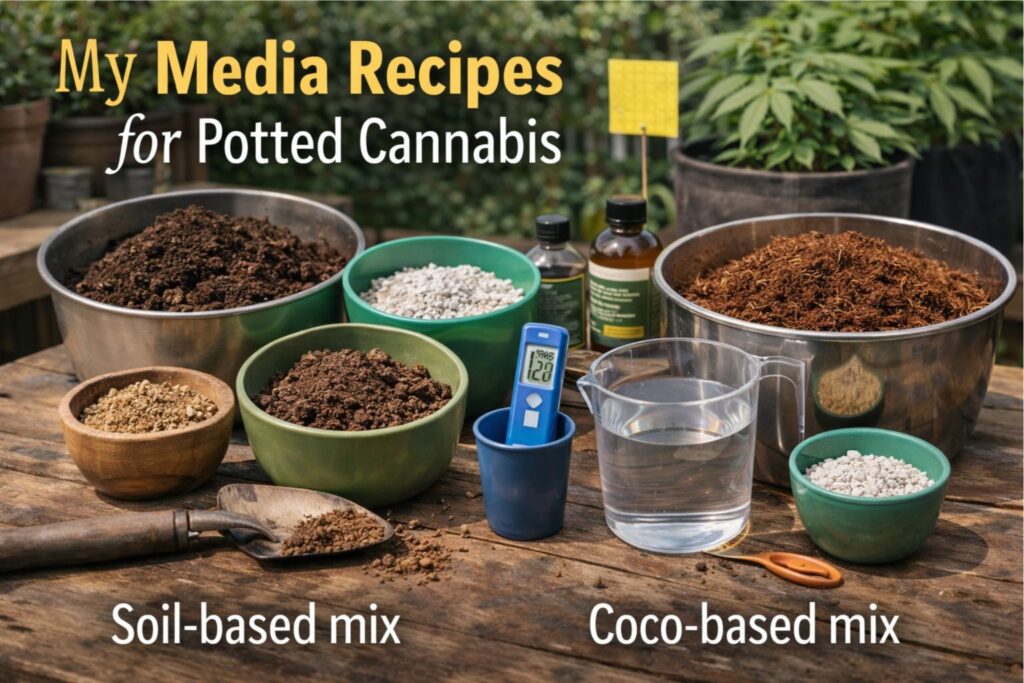
A container is only as good as what’s inside it. I rotate between two styles depending on my schedule and how much monitoring I can do. Both work for a small-space cannabis container grow, but they demand different habits.
Soil-forward, buffered and forgiving
For beginners and busy weeks, I build a fabric pot soil mix that holds moisture while still draining well:
- 40% high-quality potting base (peat or coco based)
- 30% aeration (perlite, pumice, or rice hulls)
- 20% compost or worm castings (not too hot)
- 10% extra coco coir for even wetting
I add a light mineral amendment if the base is plain, then I let the mix sit moist for about a week before transplanting. This blend supports Easy Container Gardening because it gives you a wider margin for error and smoother dry-down timing.
Coco-forward for tight control
When I want faster growth and predictable feeding, I run coco-heavy mixes with high aeration. This is where I rely heavily on runoff ec testing. Coco doesn’t provide nutrition by itself, so I feed consistently, track EC/PPM, and manage runoff.
If you’re deciding between soil and hydroponic-style management, think of coco as “hydroponic behavior in a pot.” It can perform incredibly well in a small-space cannabis container grow, but it asks you to be present and consistent.
Seed Buying Choices That Matter in Containers
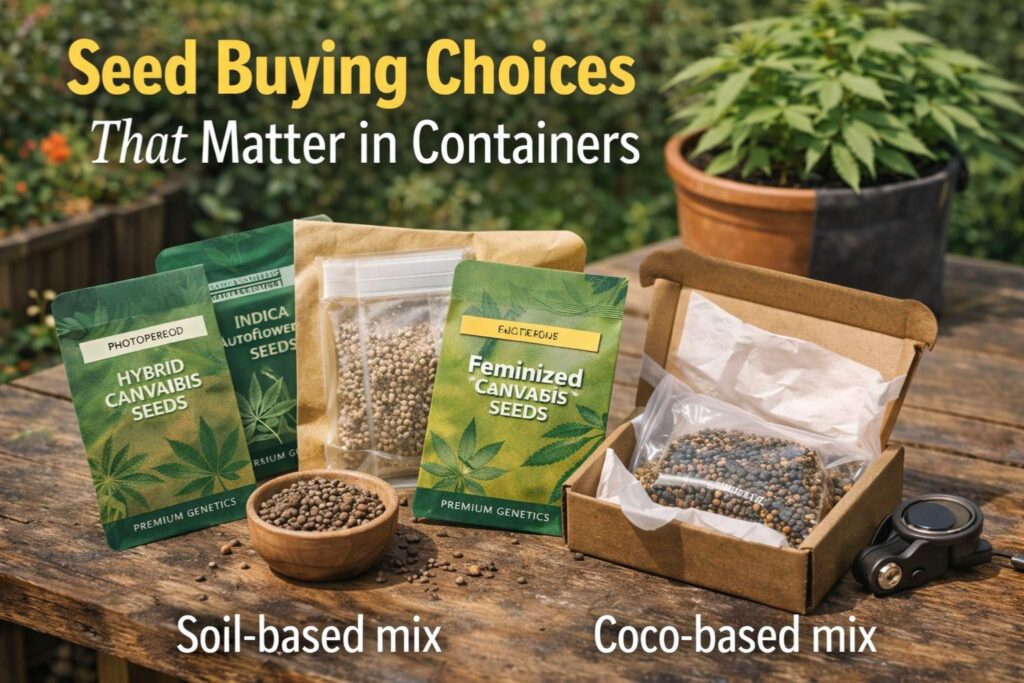
A container grow starts with the right genetics. I don’t chase hype; I chase traits that fit the space and match my routine.
Feminized seeds, autos, and plant structure
If you want predictable flower production and you’re not breeding, feminized seeds reduce the chance of ending up with males. Autoflowers can be excellent for balconies or quick indoor runs because they flower on their own schedule. Photoperiod plants give you more training time, which is helpful for low-stress training in containers.
For structure, I look for:
- Hybrid vigor with manageable node spacing
- Resistance to stress (heat swings, dry spells)
- A frame that responds well to topping and tie-downs
You’ll see seed banks describe varieties as indica, sativa, or hybrid. In practice, I use those labels as rough signals about growth pattern rather than strict categories.
Seed banks, shipping realities, and regional laws
When ordering online, I prioritize seed banks with clear policies and realistic timelines. If you live in a region with strict rules, think through what discreet seed shipping tips means for your comfort level. I treat discreet seed shipping tips as a research step, not an afterthought. Different countries and states treat seeds differently, and laws can change. Know your regional grow laws before you order, and don’t assume what’s true in one place is true everywhere.
Germination and Early Life in Pots
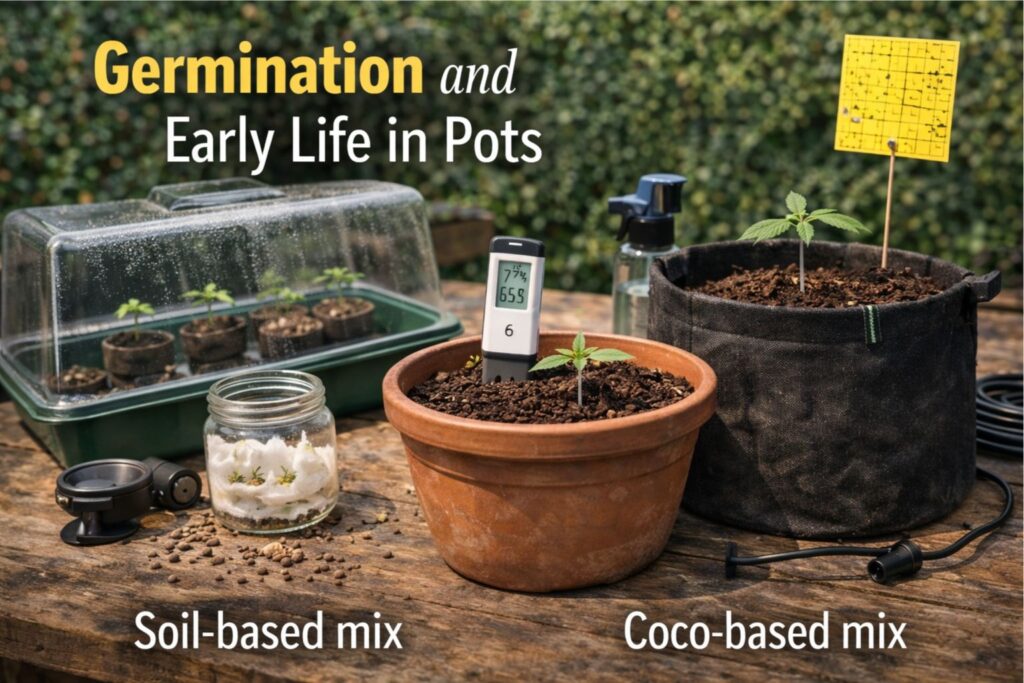
I used to overcomplicate germination. Now I keep it simple and gentle, because early mistakes are amplified in Easy Container Gardening.
My consistent germination routine
- Hydrate: I soak seeds in plain water for 12–18 hours, no longer.
- Sprout: I move them to a moist (not wet) paper towel in a warm spot.
- Plant: Once a taproot shows, I plant 1–2 cm deep in a pre-moistened starter mix.
- Light: I give seedlings a low but steady light level.
For early light, I target roughly 200–300 PPFD at the seedling canopy. Too much light early can dry the medium and stall growth.
Transplanting and seedling hardening off
If you’re moving plants from a starter cup into the final container, seedling hardening off is real. I harden them off to stronger light and airflow over a few days. The goal is to prevent shock: sudden intensity jumps can cause droop, clawing, or pale new growth.
In Easy Container Gardening, transplant timing matters. I transplant when roots have filled the starter but haven’t started circling aggressively. seedling hardening off is part of that timing, not an optional extra. That rhythm also keeps my small-space cannabis container grow on schedule.
Lighting and Environment Targets I Actually Use
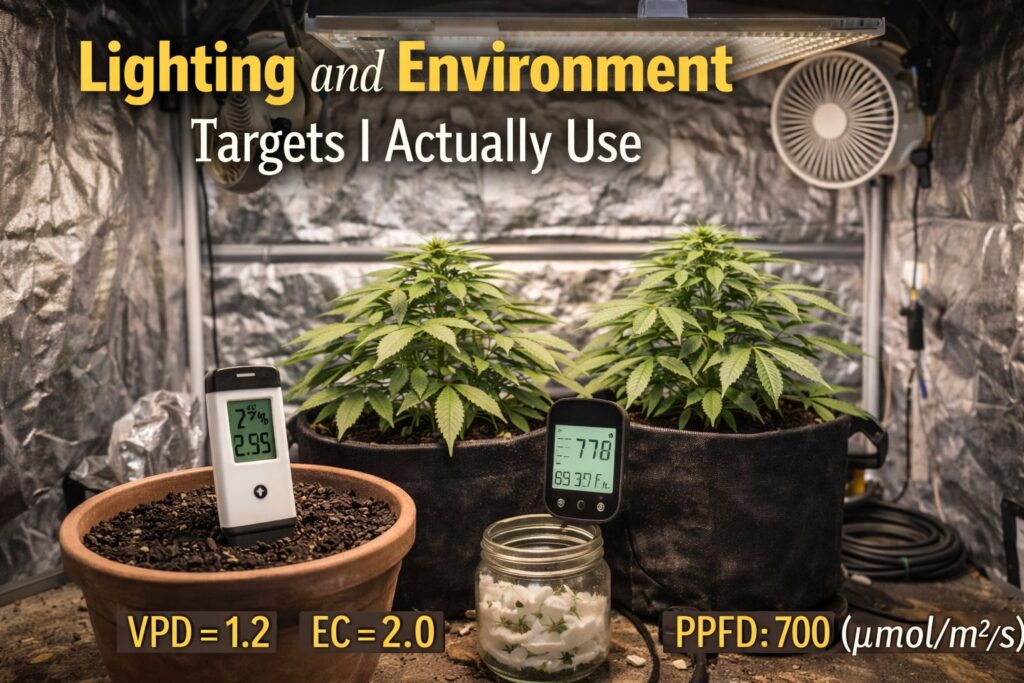
Indoor PPFD ranges
Here are my working targets for photoperiod plants:
- Vegetative stage: 400–600 PPFD
- Early flower: 600–800 PPFD
- Mid to late flower: 700–900 PPFD (only if the plant is healthy and CO2 is normal)
Autoflowers often do well at the lower end because they can be stress-sensitive, especially in a small-space cannabis container grow where airflow and heat can fluctuate.
Temperature, humidity, and vpd in a tent
Instead of obsessing over a single number, I watch VPD. For a typical indoor run:
- Veg: 24–27°C with 55–70% RH
- Flower: 22–26°C with 45–55% RH
That usually puts me in a workable vpd in a tent range for healthy transpiration. When vpd in a tent drifts too low, I see slower drinking; when vpd in a tent is too high, leaf edges can crisp. I also keep gentle airflow across the canopy and under it, which reduces mildew risk and keeps leaves dry after watering.
Watering: The Container Skill That Separates Good From Great
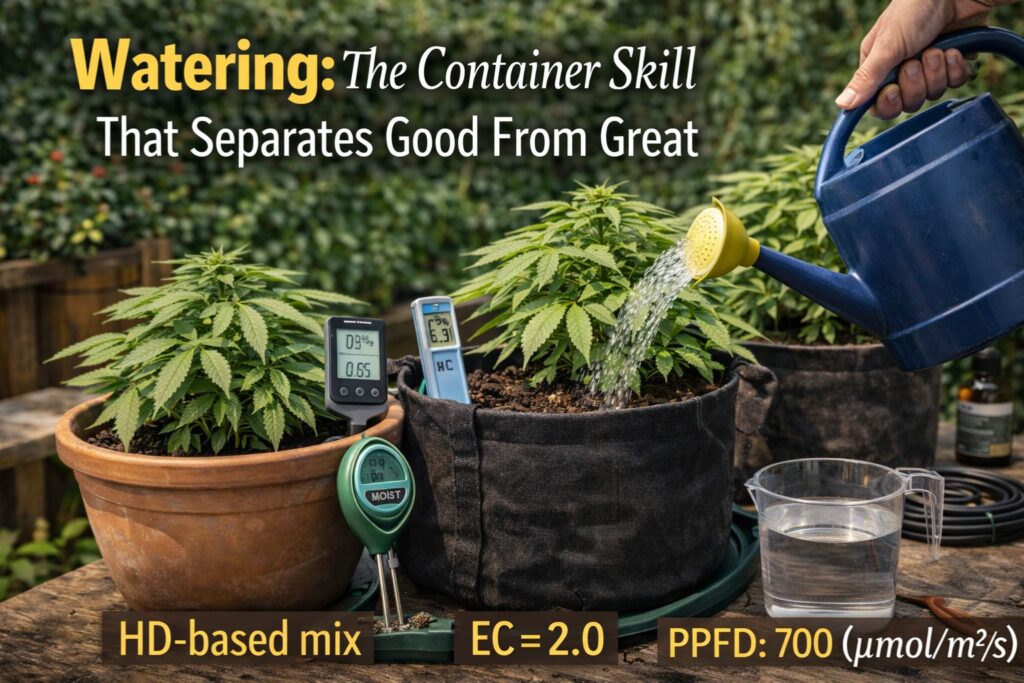
If you asked me what made my results jump, I’d point to watering discipline. Easy Container Gardening is basically a watering strategy with a plant on top.
How I water soil-forward mixes
I water until I see a modest amount of runoff, then I wait until the pot is clearly lighter before watering again. I use a lift test and a finger check near the pot edge, not just the surface. In a fabric pot soil mix, I watch for even dry-down; the edges can dry faster than the center.
How I water coco-forward mixes
In coco, I’m much more consistent. I aim for multiple smaller irrigations and I monitor runoff ec testing to avoid salt buildup. If EC in the runoff climbs too high, I correct gently with a lower-EC feed rather than dumping massive volumes through the pot.
Automating with drip irrigation for pots
For busy stretches, drip irrigation for pots saves the grow. A simple reservoir and drippers keep moisture steady, which is exactly what Easy Container Gardening needs. I still inspect daily, but automation removes the human error of “I’ll water later.” It’s also a reliable upgrade for a small-space cannabis container grow because you can keep plant size modest while maintaining consistent moisture.
Nutrition: A Practical Feeding Framework
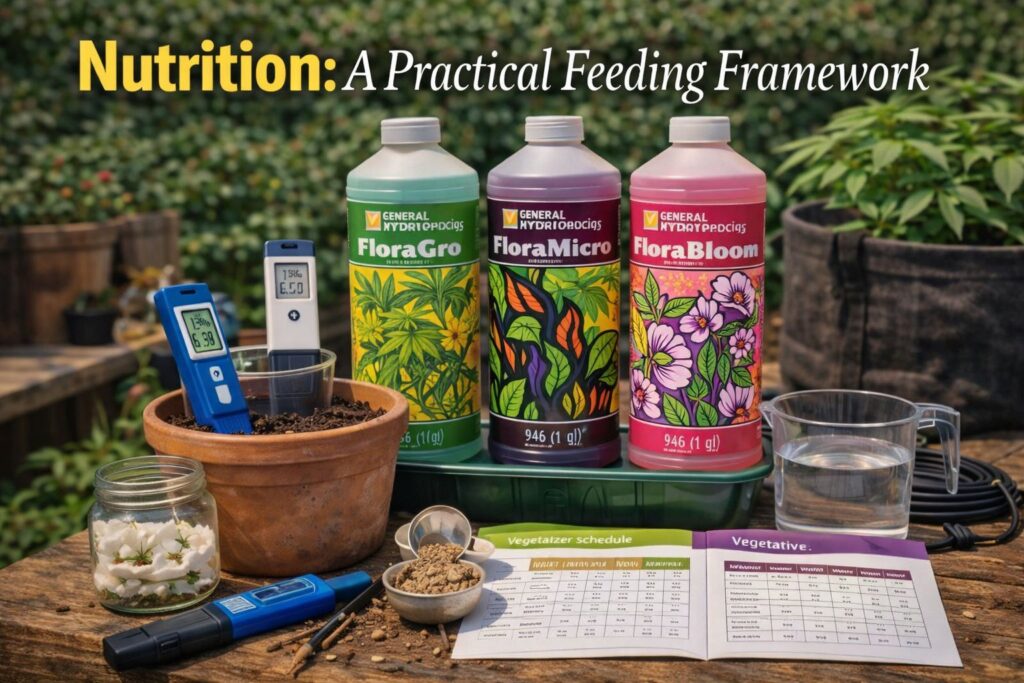
I prefer a straightforward nutrient program, whether organic-leaning or mineral-based. The key is consistency and measurement, especially when you’re doing runoff ec testing.
EC targets (starting points, not commandments)
These are general ranges I’ve used successfully:
- Early veg: 0.8–1.2 EC
- Late veg: 1.2–1.6 EC
- Early flower: 1.4–1.8 EC
- Mid flower: 1.6–2.0 EC
- Late flower: taper based on plant response
I adjust based on leaf color, tip burn, and growth rate. In containers, small changes show fast.
runoff ec testing as my reality check
runoff ec testing is not glamorous, but it keeps me honest. If input EC is moderate and runoff is high, salts are accumulating. If runoff is far lower than input, the plant may be underfed, or the media may be holding too much water.
I like to log three things: the EC I feed, the pH I feed, and the runoff ec testing result. If you only track one metric, make it runoff ec testing. That small habit is one of the biggest improvements I’ve made in my own Easy Container Gardening routine.
Training Methods That Work Well in Pots
Topping and canopy shaping
For photoperiod plants, I usually top once or twice early, then I spread branches outward. This is where low-stress training in containers shines. By keeping the canopy even, I get better light distribution and more consistent flower development.
The low-stress approach
I lean on low-stress training in containers instead of aggressive techniques that cause long recovery. In a container, recovery time is expensive because root volume is limited. Gentle, repeated adjustments work better than one big bend that cracks a stem.
When I’m short on time, I’ll simplify to three rules:
- Keep the top growth spread out
- Keep airflow through the center
- Don’t force the plant to recover from big injuries
That’s Easy Container Gardening in practice: fewer dramatic moves, more steady progress.
Pest and Disease: My Prevention-First Routine
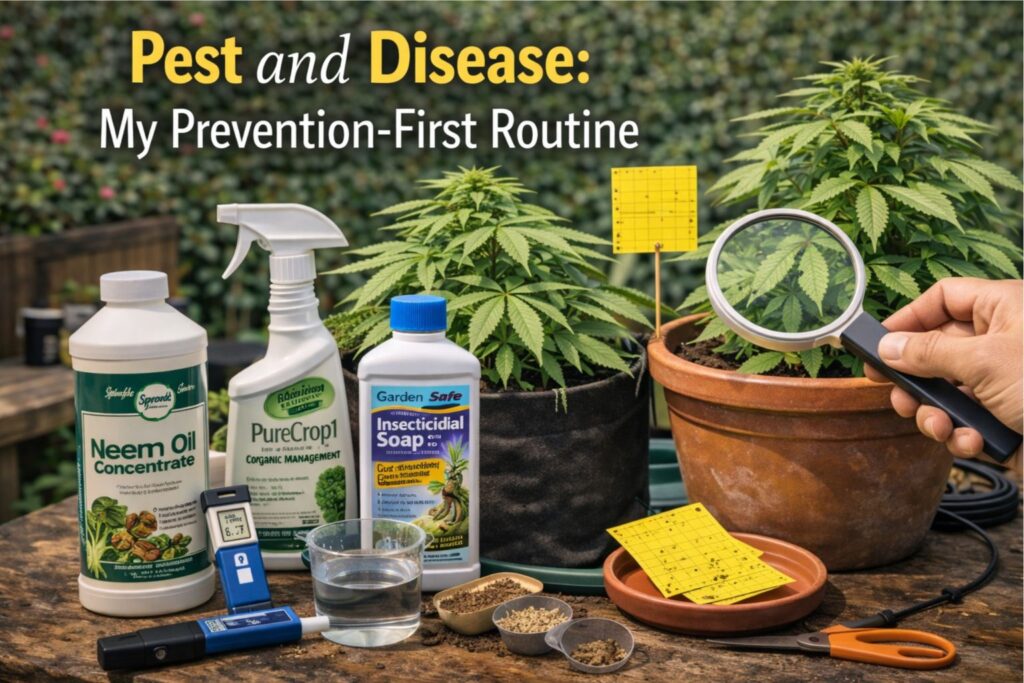
Pests arrive quietly. I don’t wait for damage.
sticky trap pest scouting
Every run, I hang yellow sticky cards and do sticky trap pest scouting twice a week. It sounds small, but it catches fungus gnats, thrips, and other flyers early. I also inspect the underside of leaves with a small flashlight.
sticky trap pest scouting is especially useful in a small-space cannabis container grow because a tiny problem can become a full-tent problem fast.
Clean inputs and airflow
Most issues start with dirty tools or overly wet media. I keep clean trays under pots, avoid standing water, and maintain airflow at soil level. In flower, I keep humidity moderate and I don’t spray anything that could contaminate buds. I avoid making health claims about pests or products; I focus on clean cultivation habits and early detection.
Harvest Timing and Post-Harvest in Small Spaces
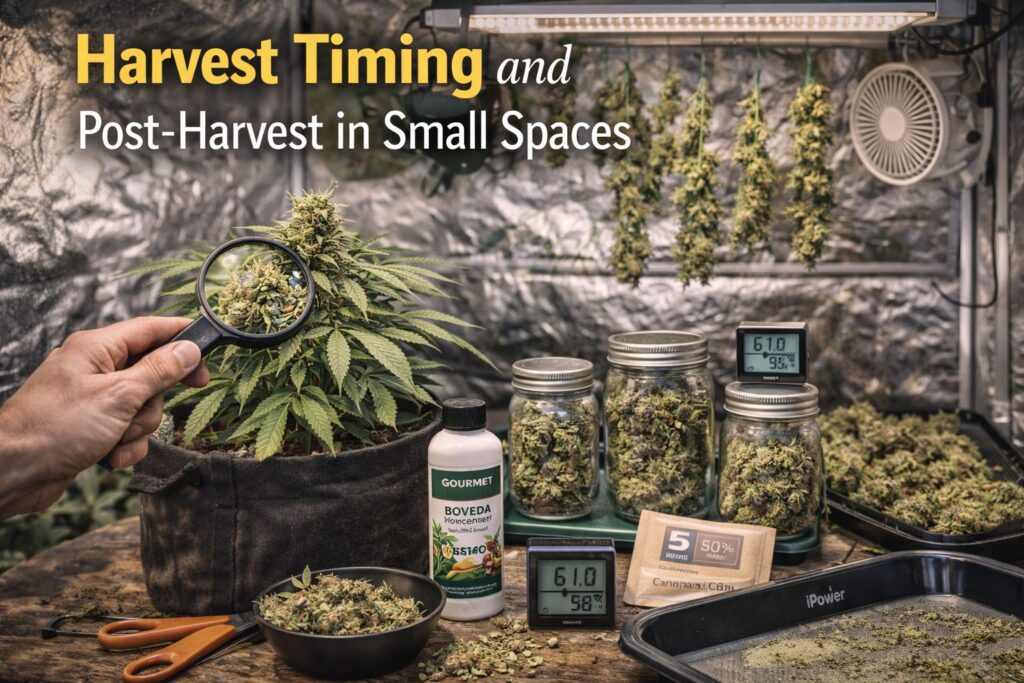
Harvest timing without guesswork
I harvest based on plant maturity cues, not the calendar alone. A loupe helps me see resin gland development, but I also watch overall plant fade and aroma. If the plant is still pushing fresh white pistils aggressively, I usually wait.
drying in cardboard wardrobe
Not everyone has a dedicated drying room. I’ve had surprisingly consistent results with drying in cardboard wardrobe when space is tight. Drying in cardboard wardrobe is not glamorous, but it can be very controllable if you monitor humidity. I control airflow gently, keep it dark, and aim for around 18–20°C with 50–60% RH if possible.
Drying in cardboard wardrobe buffers rapid humidity swings, but I still monitor closely to prevent mold. If drying in cardboard wardrobe feels risky in your climate, shorten branch size and increase gentle exhaust. If the cardboard smells musty, I change it out. If humidity spikes, I increase gentle exhaust rather than blasting a fan directly at flowers.
After drying, I cure in airtight containers, “burping” briefly in the first week, then less often as moisture stabilizes. If you’re drying in cardboard wardrobe, keep notes on temperature and RH so you can repeat the results.
A Hands-On Checklist for Easy Container Gardening With Cannabis
Setup
- Choose container size that matches your space and plant type
- Build a fabric pot soil mix with strong drainage and even wetting
- Plan airflow and lighting before you germinate
- Treat seedling hardening off as a scheduled step, not something you do only if the plant looks weak
- Decide whether your run is a small-space cannabis container grow indoors, on a balcony, or both
Environment
- Measure PPFD at canopy height
- Track temperature and humidity; keep vpd in a tent in a workable range
- Keep leaves gently moving, not flapping
Water and feed
- Lift pots to learn dry-down timing
- Use drip irrigation for pots if your schedule is inconsistent
- Log feed EC and do runoff ec testing weekly
Health
- Start sticky trap pest scouting from day one
- Keep the grow area clean and uncluttered
- Respond early, not late
FAQ: Common Google-Style Questions About Pots, Seeds, and Growing
Can I grow weed in a pot on a balcony?
Yes, if your local rules allow it and you can control light, airflow, and discretion. The core principles of Easy Container Gardening apply to balconies, but wind and heat swings require closer monitoring and consistent watering.
What pot size is best for marijuana in containers?
For many home growers, 11–20 liters works well for photoperiod plants, and 8–15 liters works well for autoflowers. Your watering habits matter as much as pot size, especially in Easy Container Gardening.
Is soil or coco better for a small-space cannabis container grow?
For a small-space cannabis container grow, soil-forward mixes are more forgiving. Coco can outperform, but it demands consistent feeding, stable moisture, and routine runoff ec testing.
How do I keep pests away from potted cannabis plants?
Start with cleanliness, airflow, and sticky trap pest scouting. Catching problems early is easier than trying to fix a heavy infestation later.
What does discreet seed shipping tips really mean?
It means understanding what a seed bank promises, what customs and regional rules can involve, and what level of privacy you personally need. Read policies carefully, keep expectations realistic, and stay within the law. Discreet seed shipping tips are about realistic expectations, not guarantees. If you are new, write down your own discreet seed shipping tips checklist before you place an order.
What’s the easiest training method for containers?
low-stress training in containers is the easiest to learn and the hardest to regret. It’s gentle, repeatable, and it fits Easy Container Gardening because it keeps the canopy even without stressing the plant.
Closing Thoughts
After years of trial and error, I’ve come to trust Easy Container Gardening as the most practical way to grow cannabis when space is limited or when I want control over the root zone. The container doesn’t have to be a weakness. When you build a stable medium, set measurable environment targets, and lean on repeatable routines like drip irrigation for pots, runoff ec testing, and sticky trap pest scouting, the plant rewards you with predictable performance.
If you take one lesson from my own runs, it’s this: the best container growers don’t chase perfection. They chase repeatability.
