Table of Contents
When I first started growing marijuana, I assumed the labels on seed packs told me everything I needed to know. Indica meant short and sleepy, sativa meant tall and energetic, and that was that. After years of running different genetics side by side indoors in tents, outdoors in raised beds, and in mixed hybrid gardens, I have learned that the real Differences Between Indica and Sativa Strains are more nuanced than the marketing suggests.
In this article, I walk through what those differences actually look like in a grow room: plant structure, flowering times, environmental needs, training techniques, and how ruderalis genetics changed autoflowering weed forever. I also cover how to identify indica vs sativa plants in real life, not just in theory, and how I adjust my cultivation style depending on what I am growing.
I am not offering medical or legal advice here. My goal is simple: to give you an honest, experience-driven indica sativa home grow guide you can use to plan your next cannabis run, whether you are growing in a closet, a tent, or a sunny backyard.
Where Indica, Sativa, and Ruderalis Come From
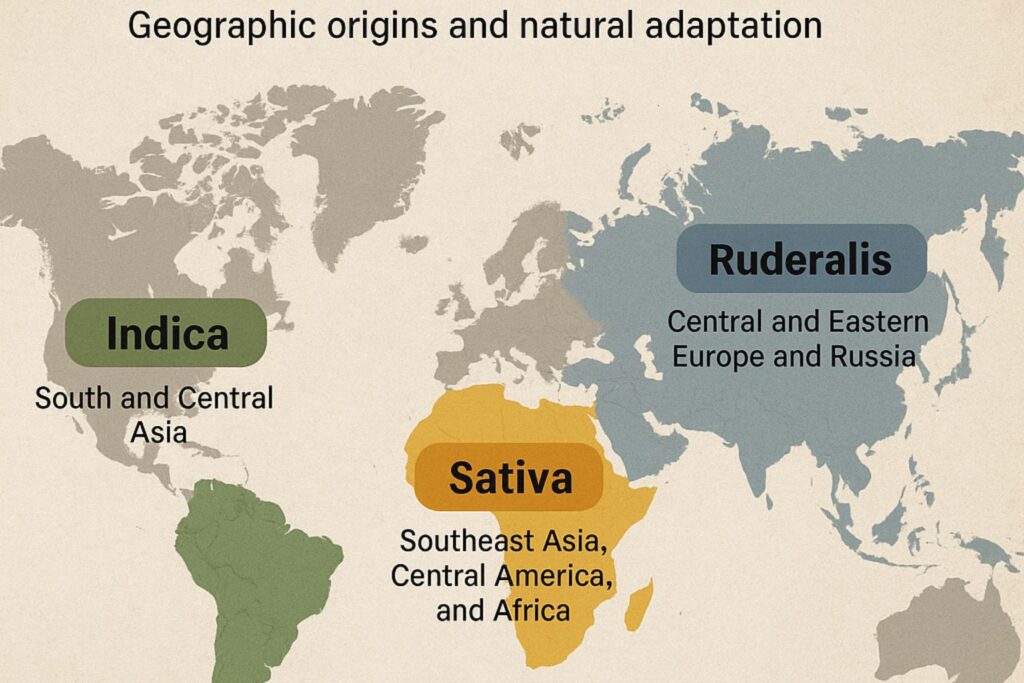
Geographic origins and natural adaptation
Indica and sativa cannabis originally adapted to very different environments. Sativa-type plants developed in equatorial and tropical regions, where seasons are long and light remains fairly consistent. Indica-type plants evolved in harsher, more mountainous regions with shorter seasons and cooler nights.
Cannabis ruderalis, the less famous third type, originates from colder parts of Central and Eastern Europe and Russia, where summers are short and conditions are rough. That tough environment is what led ruderalis to develop its famous autoflowering trait, switching to bloom based on age rather than day length.
When I look at the Differences Between Indica and Sativa Strains in my own garden, I always keep these origins in mind. They explain why some plants shrug off cool nights and why others keep stretching like they are still chasing tropical sun.
Indica and Sativa Plant Structure in Real Grows
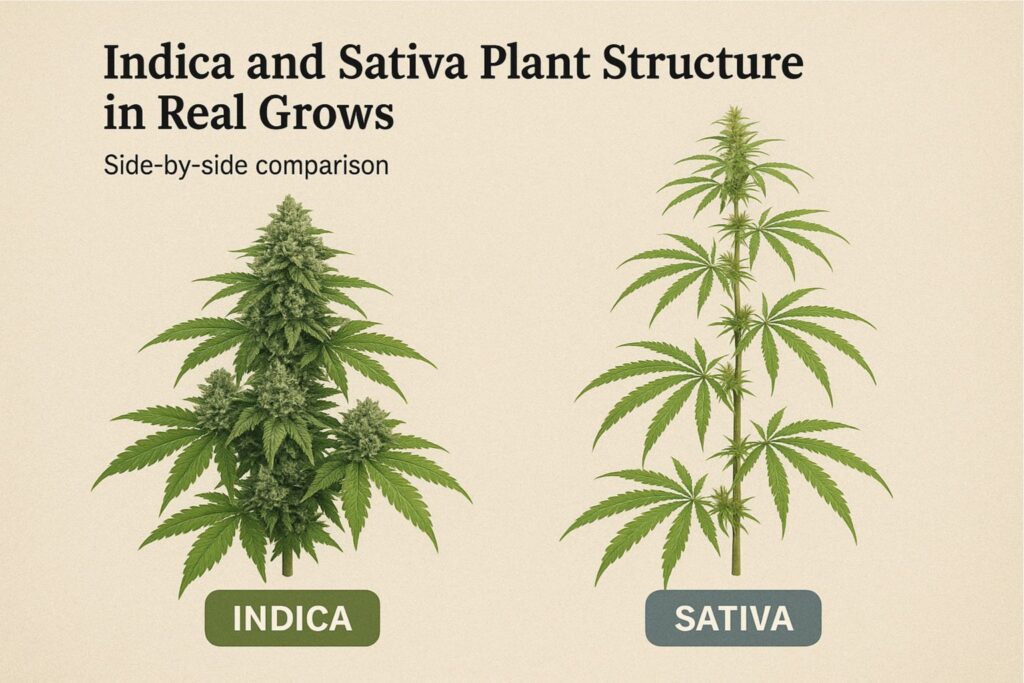
Indica and sativa plant structure
In my experience, indica and sativa plant structure is the first clear difference you see after a few weeks of vegetative growth.
Indica-type plants tend to show:
- Shorter and more compact frames
- Thick, sturdy stems
- Broad, dark green leaflets
- Tighter branch spacing and a denser profile
Sativa-type plants tend to show:
- Taller, more open frames
- Thinner stems that still become strong with good airflow
- Narrow, lighter green leaves
- Longer internodes with airier spacing between nodes
The most practical piece from an indica and sativa plant structure standpoint is canopy management. Indicas naturally fill space horizontally; they behave like compact bushes. Sativas behave more like young trees or vines, shooting upward and outward with less effort on your part.
Indica sativa height differences in the grow room
Indica sativa height differences really show up once you flip photoperiod plants to flower indoors. Indicas usually stretch a little, often ending up around 25 to 75 percent taller than they were at flip. Sativas, especially sativa-dominant hybrids, can easily double or even triple in height during the early weeks of bloom.
Because of these indica sativa height differences, I almost never flip all plants at the same size. I often:
- Flip sativas earlier, when they are shorter
- Let indicas veg a bit longer to fill out the space
- Elevate shorter pots on stands or blocks to even out the canopy
If you run mixed genetics in the same tent, treating all plants identically is one of the fastest ways to end up with light burn on some tops and underpowered lower branches on others.
Growing Conditions: Indica and Sativa Side by Side
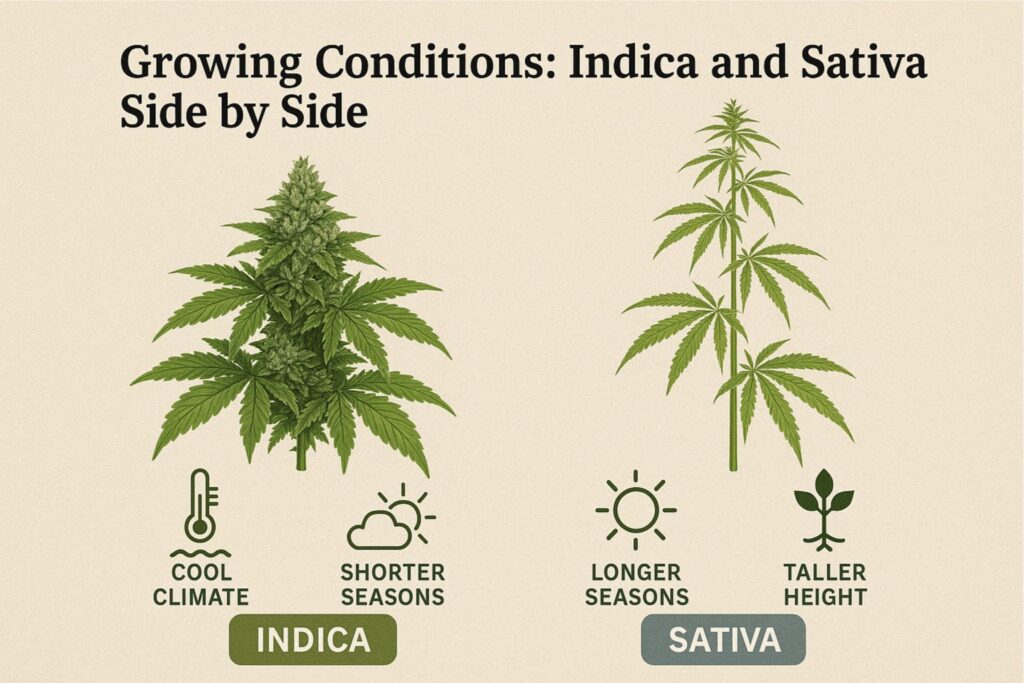
Core indica and sativa growing conditions
Most of my rooms share the same baseline environment for marijuana plants of any type. From there, I fine-tune the details to suit the Differences Between Indica and Sativa Strains.
Typical targets I use are:
- Temperature, lights on: 22–27°C (72–80°F)
- Temperature, lights off: 18–22°C (64–72°F)
- Relative humidity during veg: 55–65 percent
- Relative humidity late flower: 40–50 percent
- VPD: roughly 0.8–1.2 kPa in veg and 1.2–1.5 kPa in flower
Within that range, I tweak microclimates. Indicas tend to be a bit more tolerant of cooler nights and slightly higher nutrient levels in my experience. Sativas often appreciate a touch more airflow and a slightly lighter feed to avoid tip burn. Those subtle adjustments are at the heart of real-world indica and sativa growing conditions.
Light levels and PPFD
Under LED lighting, I usually aim for:
- Seedlings and young clones: 150–250 µmol/m²/s
- Vegetative growth for both types: 300–500 µmol/m²/s
- Flowering: 600–900 µmol/m²/s
Indicas often handle higher PPFD near the top of the canopy because they stay compact and are easier to keep at a fixed distance from the light. Tall sativas may need a bit more room between the fixture and the upper buds to avoid light stress, especially if the fixture has a strong hotspot.
In mixed gardens, I sometimes park taller sativa plants around the edges of the coverage area and shorter indicas directly under the most intense part of the fixture. That small adjustment can even out development without complex equipment. Managing light this way is one of those simple but effective indica sativa cultivation tips that improves overall results.
Indica Sativa Cultivation Tips by Growth Stage
Germination and early seedlings
Regardless of type, I start indica and sativa seeds in the same basic way:
- Pre-soak seeds for 12–24 hours in clean, room-temperature water
- Move them into a lightly moistened starter cube or small pot with airy media
- Keep temperatures around 24–26°C (75–79°F) and humidity around 70 percent
- Provide gentle LED light at 150–200 µmol/m²/s
At this stage, the Differences Between Indica and Sativa Strains do not show up much. Seedling leaf shapes may hint at future traits, but I treat them all equally until I see their growth rate and posture.
Vegetative growth: shaping the plants
This is where indica sativa cultivation tips start to diverge.
For most indica plants in veg, I prefer to:
- Top once or twice to create four to eight main branches
- Use early low-stress training to open up the center
- Practice selective defoliation of large, shade-casting fan leaves
- Provide moderate nitrogen-rich feeding with EC in the 1.3–1.8 range in coco or hydro
For sativas and sativa-leaning hybrids, my approach shifts:
- Flip earlier, sometimes after only one topping
- Use more bending and tying (low-stress training) instead of heavy topping
- Encourage a flat, even canopy rather than a single central cola
- Provide slightly lighter feeding early on to prevent nutrient burn
If you want a practical indica sativa home grow guide in one sentence for vegetative growth, it is this: push indicas a little harder to fill the space, and restrain sativas before they race away from you.
Understanding Indica Sativa Flowering Schedule
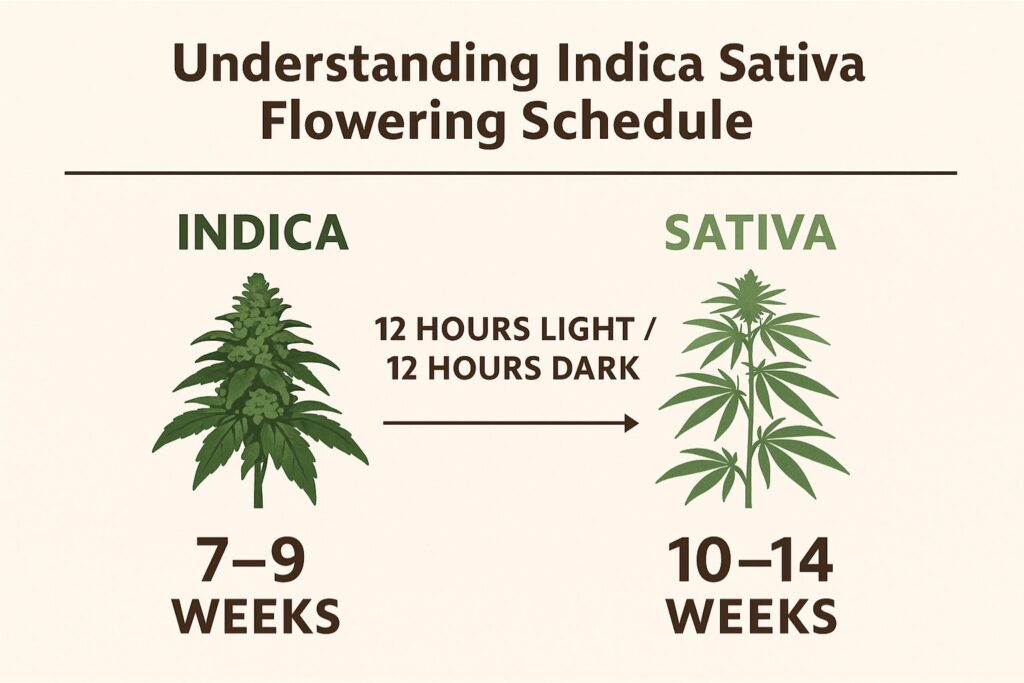
Photoperiod plants: flip to 12/12
For photoperiod plants, flowering starts when you reduce light to 12 hours on and 12 hours off. At that point, the indica sativa flowering schedule begins to look very different.
In my experience, indicas typically finish flowering in about seven to nine weeks after the flip, while many sativas and sativa-dominant hybrids may need ten to fourteen weeks. When I plan my indica sativa flowering schedule, I often stagger flip times:
- Sativas flipped first, knowing they will run longer
- Indicas flipped one to two weeks later, so they finish closer together
- Harvest windows organized so my dry space is not overloaded at once
Flowering stretch and canopy control
How to identify indica vs sativa plants during stretch is simple once you have seen it a few times:
- Indicas usually stretch modestly, thickening stems and stacking nodes close together.
- Sativas surge upward, sometimes doubling or tripling their height, with more distance between bud sites.
To handle this, I:
- Use trellis netting for both types but rely on it heavily for sativas
- Supercrop tall sativa tops by gently bending stems to keep them at the same level as indicas
- Adjust hanging heights so the whole canopy receives similar PPFD
Learning to read that early flowering stretch is one of the most important indica sativa cultivation tips you will ever pick up.
Indica Sativa Bud Structure Comparison and Aroma
Visual differences at harvest
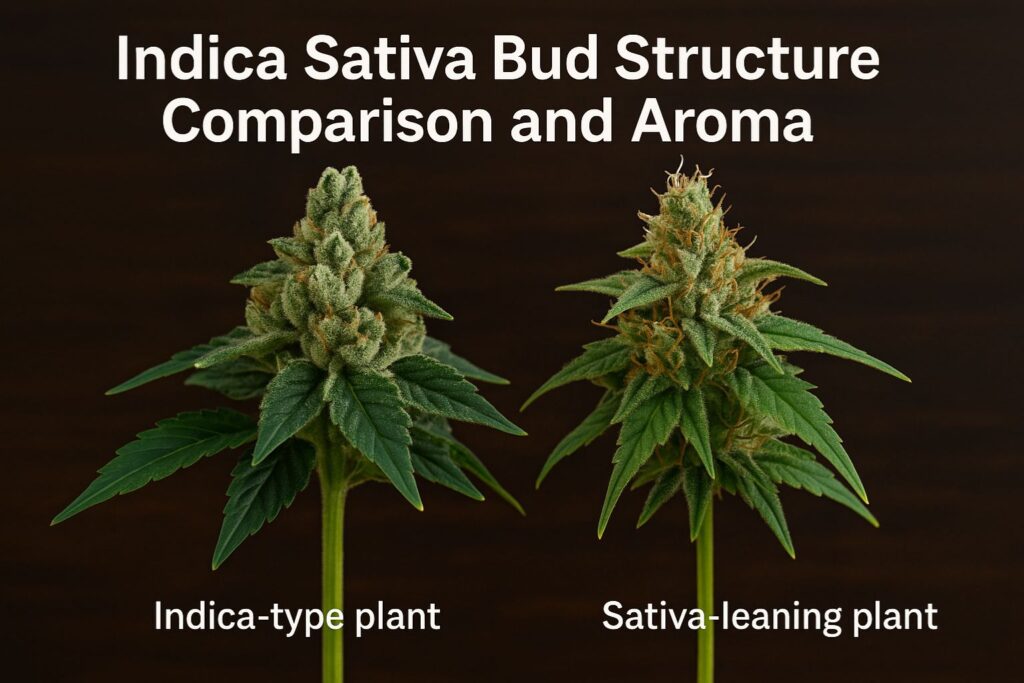
Indica sativa bud structure comparison is often what growers notice on trimming day. Indica-dominant plants frequently produce:
- Dense, chunky flowers
- Heavier buds per inch of branch
- Tighter calyx stacking and more compact colas
Sativa-leaning plants often show:
- Airier, fox-tailed or elongated flowers
- More open bud structures with visible gaps
- Larger overall plant mass but lighter dried yield per branch
It is easy to think you have grown more weed from a tall sativa when you see the plant hanging, but the scale often reveals that a shorter indica yielded just as much, or even more, dried cannabis because of sheer bud density.
Indica sativa terpene profile overview
While terpene profiles are highly strain dependent and modern breeding blurs lines, there are still broad patterns that show up in an indica sativa terpene profile overview:
- Indica-type aromas often lean toward earthy, musky, hashy, or gassy notes, sometimes with sweet berry or dessert-like undertones.
- Sativa-type aromas frequently include citrus, tropical fruit, floral, or spice notes.
In my own jars, I have had indica-dominant strains that smelled like dank soil and fuel, and sativa-leaning ones that smelled like a fruit stand. Modern hybrids can flip these expectations completely, so I never assume effects purely from scent or from a simple indica vs sativa label.
Where Ruderalis Fits: Ruderalis Autoflower Genetics Overview
Ruderalis is often ignored until you start working with autoflowering weed. A good ruderalis autoflower genetics overview helps explain why these plants behave so differently.
Cannabis ruderalis:
- Originated in colder regions like Russia and parts of Central and Eastern Europe
- Developed a survival strategy where flowering depends on plant age, not day length
- Tends to stay small and stocky in pure form
- Naturally has lower THC than typical indica or sativa plants
Breeders crossed ruderalis with indica and sativa strains to create autoflowering hybrids that keep the automatic flowering trait but gain more desirable bud structure and potency.
From a grower’s perspective, the biggest difference compared to photoperiod weed is timing:
- Autoflowers typically start flowering around three to four weeks from germination, regardless of light schedule.
- Many autoflowering strains finish in nine to twelve weeks from seed, making multiple outdoor harvests per season possible in some climates.
The main warning I give beginners is that autos do not forgive major early mistakes. There is no way to extend veg to recover from stunting. When working with autoflowers, I keep transplant stress minimal and avoid aggressive topping or heavy pruning during early growth.
Practical Seed-Selection Tips for Home Growers
Step 1: Decide on photoperiod vs autoflower
When you are deciding between indica, sativa, and autoflowering genetics, the marketing can be overwhelming. I simplify it for my own garden by choosing plant type based on control and timing.
Choose photoperiod indica or sativa if:
- You want full control over vegetative length and plant size
- You can keep your grow light schedule consistent
- You have a dedicated space where light leaks are under control
Choose autoflowering marijuana seeds if:
- You want a faster seed-to-harvest cycle
- You have limited control over light schedules, for example, on a balcony
- You want to avoid flipping to 12/12 entirely
Step 2: Match genetics to your environment
Ask yourself:
- Is my tent or room height limited?
- Lean toward indica or indica-leaning autoflower strains.
- Do I have a tall space or outdoor area with plenty of sun?
- Consider sativa-dominant or taller hybrids.
- Do I live in a cool region with short summers?
- Autoflowers with ruderalis lineage can be a good fit.
I also always check breeder notes for estimated flowering time and reported height. While those numbers are not perfect, they help me predict the Differences Between Indica and Sativa Strains in terms of workload and scheduling.
Feeding, Deficiencies, and IPM Across Indica and Sativa
Nutrient strength and EC or PPM
In coco and hydro setups, I usually keep electrical conductivity in these ranges:
- Early vegetative growth: 1.2–1.6
- Late vegetative growth: 1.6–1.8
- Early flower: 1.7–2.0
- Late flower: 1.5–1.8
Indicas often tolerate slightly higher nutrient strength. Their dense structure and strong stems seem to handle it. Sativas, with their faster, leggier growth, sometimes show nutrient burn on leaf tips sooner. When in doubt, I start feeds on the lower end and increase slowly based on plant response rather than chasing a rigid feeding chart.
Watching for nutrient issues
Common signs I see across both types include:
- Nitrogen deficiency: uniform yellowing starting with older leaves
- Nutrient burn: crisp, brown tips on newer leaves
- Calcium deficiency: rusty spots and edge damage on leaves
Because sativas stretch so aggressively, they can show calcium and magnesium deficiencies under strong LEDs earlier than indicas. I respond with a modest increase in calcium and magnesium supplements and a careful check of pH before making bigger changes.
Integrated pest management
My integrated pest management routine does not change dramatically between indica and sativa, but plant structure affects airflow and inspection. Dense indica canopies trap moisture and are more prone to mold if humidity is too high late in flower. Sativas, with airier branching, can be slightly more forgiving but still attract pests like spider mites and thrips if you slack on prevention.
My basic IPM habits include:
- Sticky traps to monitor flying pests
- Regular leaf inspections on tops and undersides
- Strong airflow in and above the canopy
- Prudent use of biological controls and pest-safe sprays during vegetative growth, not late flower
The Differences Between Indica and Sativa Strains matter here mainly for how easily you can see into the plant and how much defoliation you need to keep air moving.
Drying, Curing, and Post-Harvest Differences
Drying dense indicas vs airy sativas
Dense indica buds dry more slowly and are more susceptible to mold if they stay wet too long in a damp space. Airier sativa flowers can crisp up faster if humidity is too low. I try to dry all weed in similar conditions:
- Temperature around 18–21°C (64–70°F)
- Relative humidity around 55–60 percent
- Gentle air movement, but never blowing directly on the buds
For thick indica colas, I sometimes break them into slightly smaller sections before hanging to avoid a too-wet core. With sativa-type branches, I pay more attention to not overdrying the thinner flowers.
Curing and aroma development
Regardless of type, I cure in glass jars or similar airtight containers:
- Fill jars to about 70 percent capacity
- Burp once or twice a day for the first week with short openings
- Reduce burping to a few times per week afterward
Over several weeks, both indica and sativa flowers develop deeper, more nuanced terpene profiles. In my experience, indicas often mellow into rich, earthy, or fuel-forward aromas, while sativas hold on to brighter citrus and floral notes. Again, modern hybrids keep blurring these lines.
FAQ: Common Questions About Indica, Sativa, and Ruderalis
What are the main Differences Between Indica and Sativa Strains for growers?
From a grower’s point of view, the main Differences Between Indica and Sativa Strains are:
- Plant height and structure
- Flowering time, with indicas usually finishing faster
- Bud density and final weight
- Training and canopy management needs
Effects can vary widely within each group because of modern hybridization, so I focus first on how the plant will behave in my space rather than relying only on labels.
How to identify indica vs sativa plants in vegetative growth?
You can often tell by:
- Leaf shape: broader, darker leaves suggest indica influence, while narrow, lighter leaves suggest sativa.
- Growth pattern: compact bushes versus lanky, quickly stretching plants.
- Internode spacing: tighter spacing for indica, more space between nodes for sativa.
Hybrids may show a mix of traits, so I treat labels as clues, not absolute rules. Learning how to identify indica vs sativa plants by these signs is one of the most useful skills you can develop early on.
Are autoflowers indica or sativa?
Most autoflowering strains are hybrids that blend indica or sativa genetics with ruderalis. The ruderalis side contributes the autoflowering trait, which is flowering based on age rather than light schedule, while the indica or sativa parents influence size, aroma, bud structure, and general growth style.
Is one type easier for beginners?
Many new growers find indica-leaning plants easier indoors because:
- They stay shorter
- They finish flowering sooner
- They are simpler to manage in small tents
However, with proper planning, a beginner can manage sativa-leaning plants as well, especially by flipping earlier and using simple training like low-stress training and trellising.
Can I mix indica, sativa, and autoflowers in one grow?
Yes, but it takes planning. When I mix them, I:
- Keep autoflowers in their own containers and avoid topping them late
- Flip photoperiod plants to flower based on their type and expected stretch
- Raise or lower pots and lights to keep the canopy as even as possible
If you are just getting started, you may find it easier to focus a run on one plant type before adding more complexity.
Final Thoughts: Using Indica and Sativa Labels Wisely
Over the years, I have learned that the labels on a seed pack are a starting point, not a full description of what a plant will do. The Differences Between Indica and Sativa Strains are real in terms of plant structure, timing, and basic growth habits, but modern hybrids blur the edges more every season.
As a cultivator, my advice is to treat these categories like a toolbox:
- Use indica-type plants when you want compact, fast-finishing weed in tight spaces.
- Use sativa-type plants when you have height, time, and light to spare.
- Use autoflowering genetics with ruderalis heritage when you want quick cycles or multiple outdoor harvests.
Pay attention to how each plant responds in your own environment, including medium, nutrients, light intensity, and climate. Take notes. Over a few cycles, you will develop your own personalized indica and sativa growing conditions and your own practices that go far beyond any simple label on a pack of seeds.
