When I sealed my first grow room and pushed CO2 to 1,000 ppm, I expected magic overnight. What I actually saw was this: some plants exploded with growth and stacked dense, greasy colas… and a few just sat there, drinking more nutrients without giving much back.
That experience taught me an important lesson: not every cannabis plant is built to take advantage of cannabis CO2 supplementation. To really benefit from 800–1200 ppm, you need true CO2-responsive seeds, the right environment, and a grower willing to dial in details.
In this article, I’ll walk through how I choose CO2-responsive seeds, which types of cannabis strains for high CO2 have performed best in my indoor marijuana cultivation, and how I set up lighting, nutrients, and grow room environment control so those genetics can actually scale. I’ll also touch on practical buying tips for feminized cannabis seeds and autoflowering weed seeds from reputable banks, including what I look for beyond clever strain names and flashy photos.
This is not a promise of miracle yields. It’s a field report from years of experimenting with weed under enriched CO2, and a realistic look at both the upside and the trade-offs.
Why CO2 levels between 800 and 1200 ppm change the game
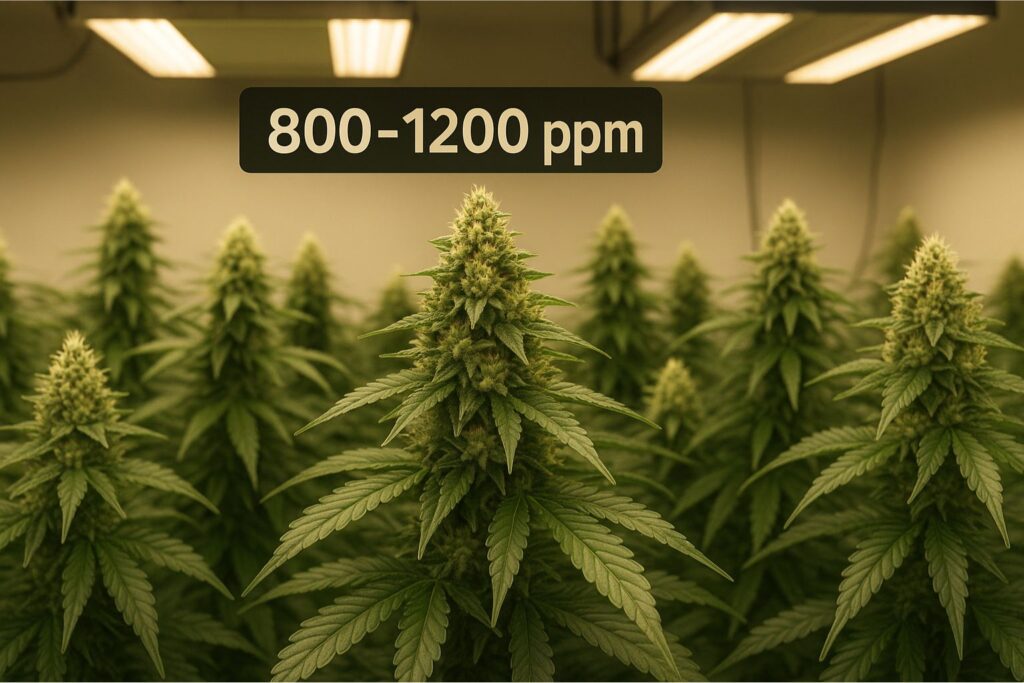
Under normal conditions, the air in your grow room hovers around 400–450 ppm CO2. Once you move into 800–1200 ppm and combine it with strong lighting, cannabis can photosynthesize faster, build more biomass, and generally tolerate a bit more heat.
From what I’ve seen, properly selected CO2-responsive seeds show three consistent benefits:
- Faster vegetative growth
- Thicker stems and stronger branching to hold weight
- Tighter internodes and improved bud density in flower
But here’s the catch: just cranking the tank and calling it “cannabis CO2 supplementation” is not enough.
CO2 only works if the rest of the system can keep up
The plants that loved CO2 in my rooms had three things going for them:
- Strong light intensity
- In my sealed rooms, I aim for 850–1,050 µmol/m²/s PPFD at canopy in mid flower. When I write about cannabis lighting and PPFD, this is the range where I consistently see CO2 usage make sense. Below that, the benefit of higher CO2 falls off.
- Stable climate
- With cannabis CO2 supplementation, plants tolerate slightly higher temps. I run 27–29 °C in lights-on flower with 55–60% RH. That keeps my VPD in a sweet spot for aggressive growth while still limiting mold risk.
- Adequate nutrition
- Plants under high light and high CO2 want more food. If I don’t adjust my feed, CO2-responsive seeds simply start showing hunger symptoms instead of stacking extra weight.
If the grow room environment control is weak, or lights are dim, boosting CO2 mostly wastes gas and money.
What makes a seed truly “CO2 responsive”?
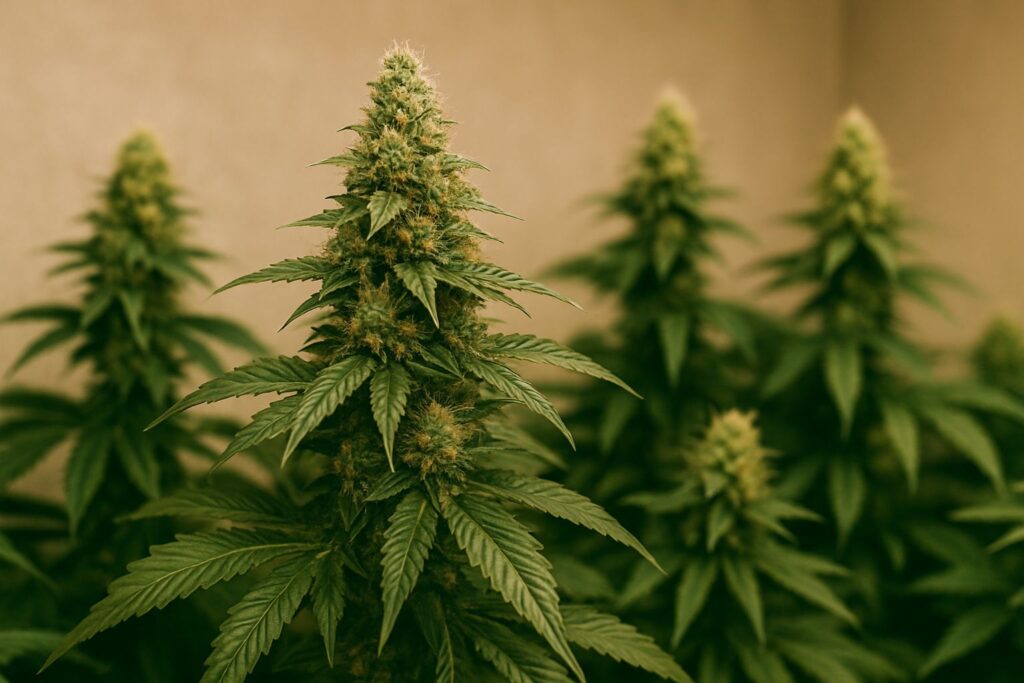
Over time, I’ve noticed patterns in which genetics are genuine CO2-responsive seeds and which are happier at lower-intensity setups. When I’m evaluating a pack—whether it’s feminized cannabis seeds or autoflowering weed seeds—I look at the following.
1. Structure and morphology
In my indoor marijuana cultivation rooms, I get the best results with medium-tall plants that:
- Show strong apical growth but still branch readily
- Hold up under high-intensity light without bleaching
- Have enough internodal spacing that buds don’t merge into one giant, mold-prone mass
Many indica sativa hybrid strains fit this profile. They carry the vigor and stretch from sativa lines but still build dense, chunky flowers from the indica side. Not every hybrid does this well under CO2, but indica sativa hybrid strains give me the highest odds.
2. Feeding response and root vigor
CO2-responsive seeds almost always show strong root systems. When I transplant them into final containers, they colonize the medium quickly and happily accept a slight bump in EC once they’ve settled.
In coco or hydro, my CO2-ready plants in veg typically sit at 1.5–1.8 EC, then rise to 2.0–2.2 EC in mid flower. When I run organic cannabis nutrients in soil mixes, I top-dress more frequently and use gentle liquid boosters as the canopy starts to explode.
If a cultivar is easily burned or hates medium-to-high EC, it rarely ranks among my favorite cannabis strains for high CO2.
3. Flowering time and finish
Varieties that finish too fast sometimes can’t fully capitalize on enriched CO2, because they simply don’t spend many weeks in heavy production. On the flip side, ultra-long sativas can drag the cycle out and complicate grow room environment control.
My sweet spot for CO2-responsive seeds is 8–10 weeks of flowering. Most of my standout indica sativa hybrid strains finish in that window, letting me keep a consistent schedule without sacrificing quality.
Seed types that have performed best for me under CO2
Every grower will develop their own short list, but here’s how I think about seed choice when cannabis CO2 supplementation is on the table.
Feminized cannabis seeds: Reliable workhorses for sealed rooms
The backbone of my CO2 rooms is high-quality feminized cannabis seeds. I like them because:
- I can fill a canopy quickly with known females
- Phenotype variation is manageable when the breeder is solid
- They respond predictably when I push light and CO2 together
When shopping for feminized cannabis seeds that might qualify as CO2-responsive seeds, I look for:
- Breeder notes about high-yield potential and strong branching
- Reports of good performance in indoor marijuana cultivation
- Photos showing robust bud structure rather than just exotic color
Over several cycles, certain lines have become my go-to cannabis strains for high CO2. Even when I test new releases, I’ll keep a few proven feminized cannabis seeds in the room as “anchors”—they help me gauge whether my environment and feeding are dialed in.
I also pay attention to practical details like cannabis seed bank shipping reliability. There is nothing more frustrating than planning a CO2-heavy run and waiting on delayed cannabis seed bank shipping. Consistent, discreet delivery matters when you’re running a tight schedule.
Autoflowering weed seeds: CO2 in smaller or staggered setups
For growers working in smaller tents or running continuous harvests, autoflowering weed seeds can also benefit from elevated CO2, especially in dense Sea of Green layouts.
I’ve had good results when I:
- Choose vigorous autoflowering weed seeds bred specifically for indoor marijuana cultivation
- Keep the light schedule at 18/6 or 20/4, ensuring plenty of photons for the CO2 to “push”
- Maintain 800–1,000 ppm rather than the very top of the range; autos can be sensitive to stress
The key is timing. With autos, you don’t control veg length, so there’s less room for recovery if something goes wrong with cannabis CO2 supplementation. That said, when the strain is stable and the environment is tight, autoflowering weed seeds can absolutely respond well to enriched CO2.
Again, reliable cannabis seed bank shipping becomes important. Autos are often run back-to-back, so I like to have the next batch ready on the shelf before I chop the current one.
Indica sativa hybrid strains: Balancing vigor and density
From my own experience, most of the top-performing CO2-responsive seeds fall under indica sativa hybrid strains rather than pure landrace types. These hybrids usually give me:
- Enough stretch to fill a trellis after flipping
- Thick enough buds to reward the extra inputs
- A balanced high that appeals to a broad range of consumers
When I scan breeder descriptions, I look for hints that a variety behaves well under high light and heat. Growers mentioning “perfect for indoor marijuana cultivation” or “handles strong LED lighting” often point me toward cannabis strains for high CO2.
Running diverse indica sativa hybrid strains in one room also helps me compare how different genetics handle the same environment. Over time, the winners become the basis of my personal CO2-responsive seeds lineup.
Dialing in your environment for CO2-responsive seeds
Even the best CO2-responsive seeds will disappoint if the room is unstable. Here is how I approach grow room environment control when running 800–1200 ppm.
Temperature, humidity, and VPD
In a sealed room with cannabis CO2 supplementation, I set my targets as:
- Veg: 26–28 °C with 60–70% RH
- Early flower: 26–28 °C with 60–65% RH
- Mid to late flower: 27–29 °C with 50–60% RH
These ranges keep my VPD in a comfortable zone where plants can transpire freely without excessive stress. It also keeps mold pressure manageable, which matters when buds from CO2-responsive seeds become especially chunky.
Good grow room environment control means using dehumidifiers sized properly for your space, along with mini-splits or other cooling that can hold setpoints even when all lights are blazing.
Cannabis lighting and PPFD
CO2 and light go hand in hand. Without sufficient intensity, cannabis CO2 supplementation doesn’t give much return. In my rooms, I treat cannabis lighting and PPFD as the steering wheel and CO2 as the turbocharger.
My general PPFD targets:
- Veg: 400–600 µmol/m²/s
- Early flower: 700–800 µmol/m²/s
- Peak flower with CO2: 850–1,050 µmol/m²/s
I use a handheld meter to map PPFD across the canopy instead of guessing. CO2-responsive seeds tend to show their potential when I combine those PPFD ranges with consistent 800–1200 ppm CO2 and tight environmental control.
Feeding CO2-responsive seeds: nutrients and irrigation
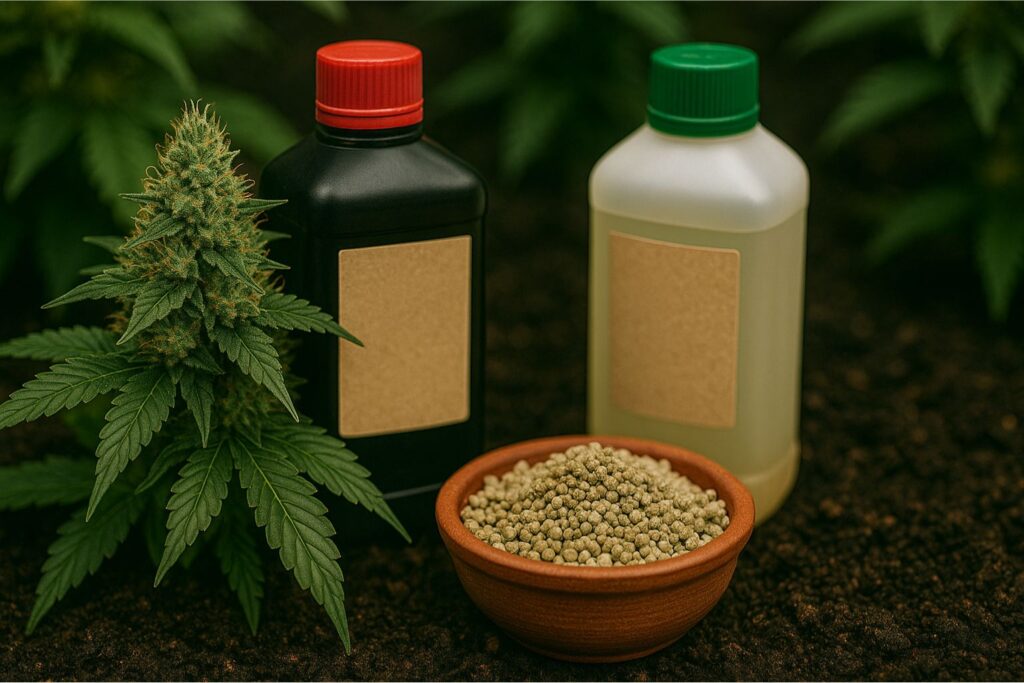
When plants grow faster, they need more inputs—but “more” should be precise, not reckless.
Organic cannabis nutrients vs. mineral feeds
I’ve run both mineral and organic cannabis nutrients under CO2. Each approach works, but they demand different strategies.
With mineral lines:
- I track EC and pH closely, checking runoff regularly
- I increase EC slightly (0.2–0.4) compared to non-CO2 runs once plants are clearly hungry
- I watch leaf color and tip health; CO2-responsive seeds can still burn if pushed too far
With organic cannabis nutrients:
- I rely heavily on a living soil base with compost and aeration
- I add top-dressings of dry amendments every 2–3 weeks
- I supplement with mild liquid feeds as the canopy fills out under strong light
Both systems can fuel cannabis strains for high CO2; the key is consistency. Plants under enriched CO2 don’t appreciate wild swings in moisture or nutrient availability.
Irrigation strategy
Because CO2-responsive seeds typically transpire more, I irrigate:
- More frequently in coco and hydro, with smaller volumes per event
- Deeply but less frequently in large organic soil containers
Automated drip systems make life easier when cannabis CO2 supplementation is in play. They help me avoid underwatering during hot, bright periods while still maintaining oxygen at the root zone.
Training, plant density, and pest management under CO2
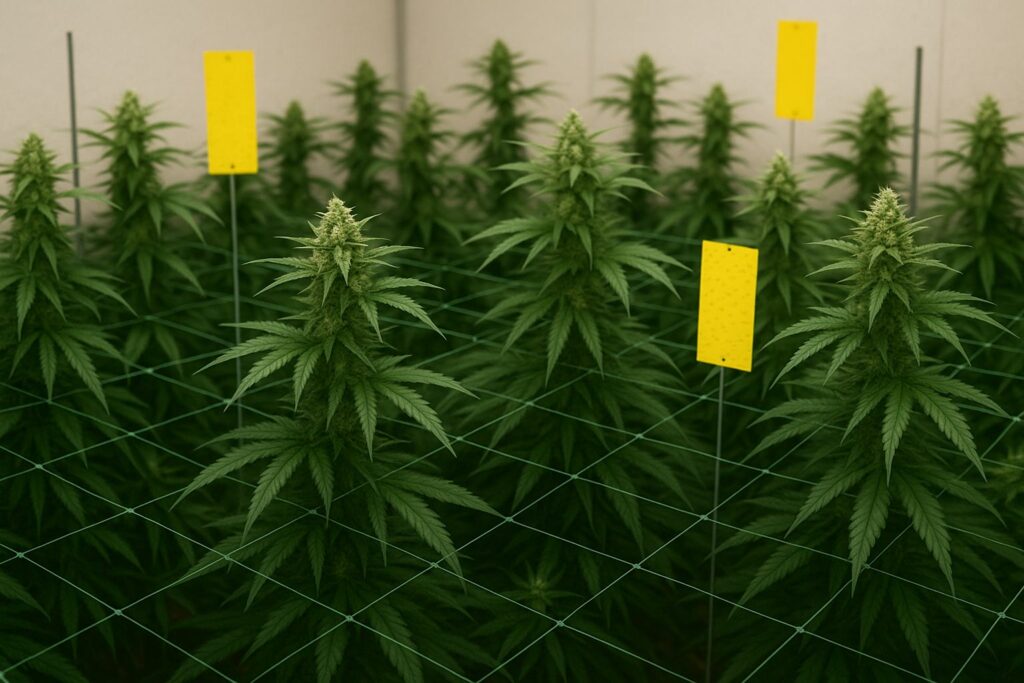
CO2 doesn’t replace basic good habits. In some ways, it makes them more important.
Training and spacing
In my indoor marijuana cultivation rooms with CO2, I usually:
- Top once or twice in veg
- Use trellis netting to spread the canopy
- Aim for 4–6 strong tops per plant in a moderate plant count, or single-cola style in high-density SOG
CO2-responsive seeds can easily overfill a space, so I’m careful not to pack too many plants under each light. Overcrowding defeats the purpose of carefully managed grow room environment control by limiting airflow.
Pest and disease management
Warm, humid, CO2-rich rooms are great for plants—but also attractive to pests and pathogens if you’re not vigilant.
My basic protocol:
- Start every run with clean clones or seeds from trusted sources
- Inspect young plants daily for mites, thrips, and PM
- Use biological controls and mild sprays in veg; avoid heavy interventions in late flower
Healthy indica sativa hybrid strains with strong vigor tend to resist issues better, but I never assume genetics alone will save a crop.
Buying CO2-responsive seeds: practical considerations
Shopping for CO2-responsive seeds is partly science, partly art. Beyond the genetic traits I look for, I also care about the buying experience.
Reliable cannabis seed bank shipping is a big deal. When I find a source that delivers seeds discreetly, within the promised timeframe, and with accurate labeling, I stick with them. It doesn’t matter how promising a strain description sounds if the package never arrives or lands weeks after I planned to start a cycle.
When exploring new feminized cannabis seeds or autoflowering weed seeds, I usually:
- Start with small packs across several cannabis strains for high CO2 potential.
- Run them side by side with my proven favorites in the same CO2-enriched room.
- Take notes on yield, quality, and how they respond to my cannabis lighting and PPFD targets.
Over a couple of runs, the truly exceptional CO2-responsive seeds rise to the top, and I’ll then buy larger amounts once I know they fit my style.
Always remember: follow your local laws on cannabis, marijuana, and weed cultivation, possession, and seed purchasing. Regulations vary widely, and it’s every grower’s responsibility to stay compliant.
FAQ: Common questions about CO2-responsive seeds
Do I need CO2-responsive seeds to run cannabis CO2 supplementation?
Technically, any plant will use extra CO2, but CO2-responsive seeds are those that show a noticeable jump in performance when you combine high light, strong nutrition, and tight grow room environment control. In my experience, generic genetics might give small gains, while carefully selected cannabis strains for high CO2 can deliver much more pronounced improvements.
Are feminized cannabis seeds or autoflowering weed seeds better for CO2?
Both can work. For most growers, feminized cannabis seeds are easier to manage in a sealed room because you can control veg time and canopy shape. Autoflowering weed seeds are great for smaller spaces or perpetual harvests but give you less flexibility. I’ve had success with both, as long as the genetics were stable and suited to indoor marijuana cultivation.
What lighting do I need for CO2-responsive seeds?
Think of cannabis lighting and PPFD as the engine that drives growth. I don’t run CO2 unless I can deliver at least 700–800 µmol/m²/s in peak flower, ideally pushing up to 1,000 µmol/m²/s across most of the canopy. Without that level of intensity, cannabis CO2 supplementation produces smaller gains that may not justify the complexity.
How high should I push CO2 levels?
For most sealed rooms, 800–1,000 ppm is a great starting range. As your system becomes more stable, you can experiment up to around 1,200 ppm. I’ve rarely seen significant benefits above that for typical indoor marijuana cultivation, and the risk of human exposure increases the higher you go. Always prioritize safety and proper monitoring.
Is CO2 worth it for small home grows?
CO2 can help even small home setups, but only if you’re already close to maxing out your environment, lighting, and genetics. If your budget is limited, I’d invest first in good lights, solid grow room environment control, and proven CO2-responsive seeds from a reputable source with reliable cannabis seed bank shipping. CO2 is a powerful upgrade, but it’s not the first one I recommend.
High-CO2 growing is not magic—it’s precision farming in a sealed box. When you match CO2-responsive seeds with strong cannabis lighting and PPFD, balanced organic cannabis nutrients or mineral feeds, and disciplined grow room environment control, you give your plants every reason to reward the extra effort.
Treat 800–1200 ppm as a tool, not a shortcut. Choose your cannabis strains for high CO2 carefully, learn how they behave in your unique space, and adjust slowly. Over time, you’ll build your own list of trusted feminized cannabis seeds and autoflowering weed seeds that truly deserve a place in your CO2-enriched garden.
