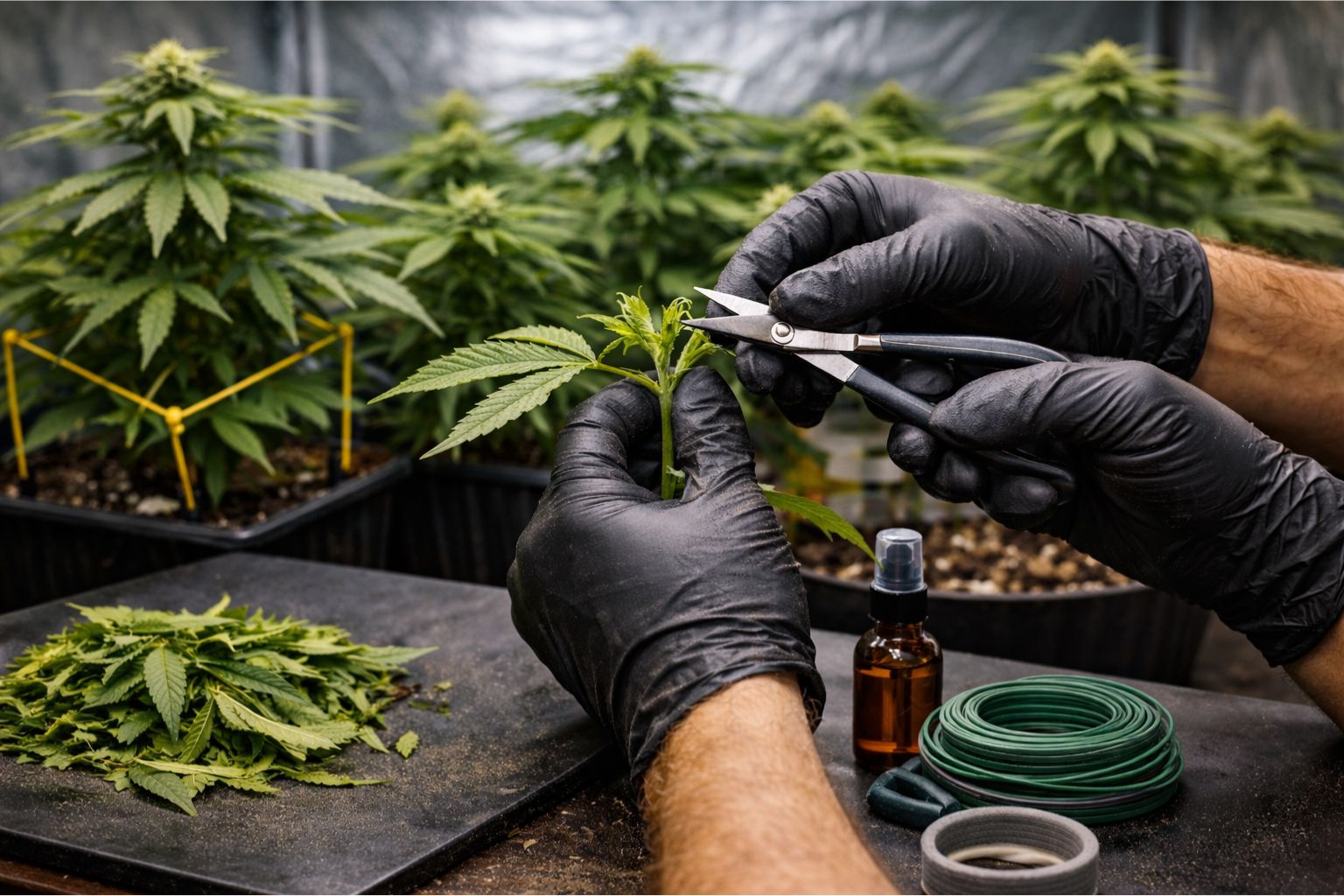
I used to treat pruning like a cosmetic choice: take a leaf here, snip a branch there, hope the plant figures it out. The first time I topped a plant the wrong way, it stalled hard, threw uneven side branches, and finished with a lopsided canopy that never really filled in. That run taught me something simple: cannabis plant pruning and topping works best when it is planned, measured, and supported by the environment, not when it is done impulsively.
In this post I’m writing from my own grow-room routine, the mistakes I made, and the system that now gives me predictable structure across different genetics. I’ll cover the cuts themselves, but also the things that matter just as much: light levels, temperature and humidity, nutrient strength, and how I decide whether a cultivar is worth topping at all. I grow both cannabis and marijuana cultivars (and yes, I still call it weed when I’m talking with friends), but the plant physiology is the same either way.
What pruning and topping are really doing
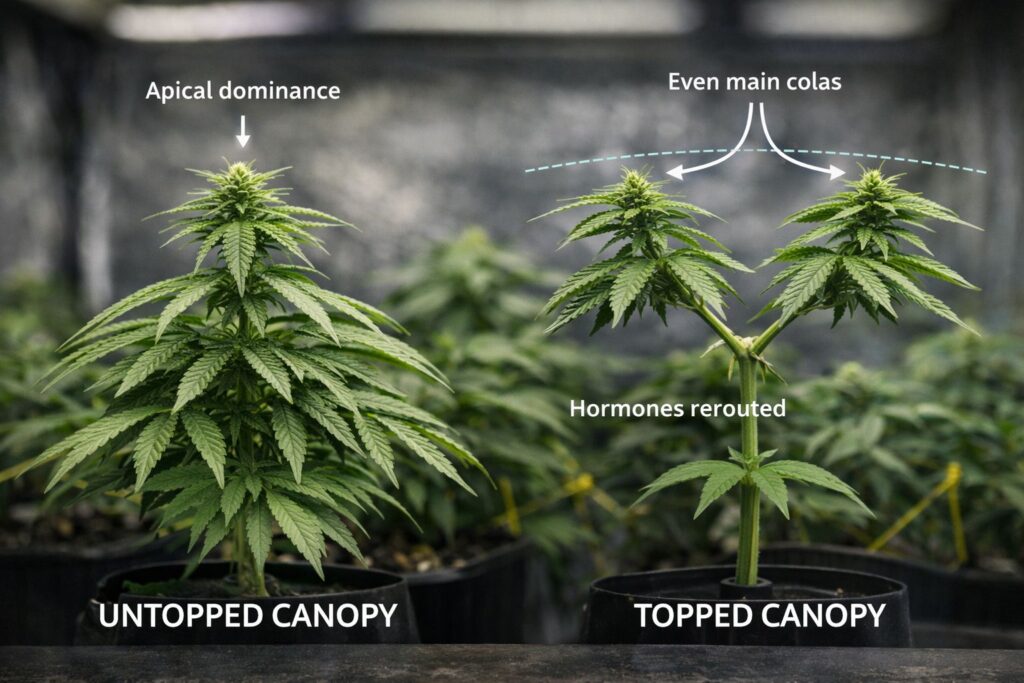
Cannabis wants to prioritize one main growing tip. That top tip produces hormones that suppress lower growth, a pattern called apical dominance. When you remove that tip, the plant redistributes growth signals and energy to side branches. That is why cannabis plant pruning and topping can turn one tall spear into multiple main colas with a flatter canopy.
Pruning is broader than topping. For me, pruning means removing growth that I don’t want to feed: weak lower branches, interior shoots that will never see light, and leaves that block airflow or create wet pockets. The goal is not defoliation for its own sake. The goal is to use plant resources efficiently while keeping the canopy healthy.
There are trade-offs. Every cut is a wound. If you cut too often, too late, or in the wrong conditions, you can slow growth and increase the risk of stress responses. The good news is that you can reduce that risk with a repeatable process: a structured topping schedule, a sterile pruning workflow, and recovery parameters you can actually measure.
Genetics and seed choices that respond well to training
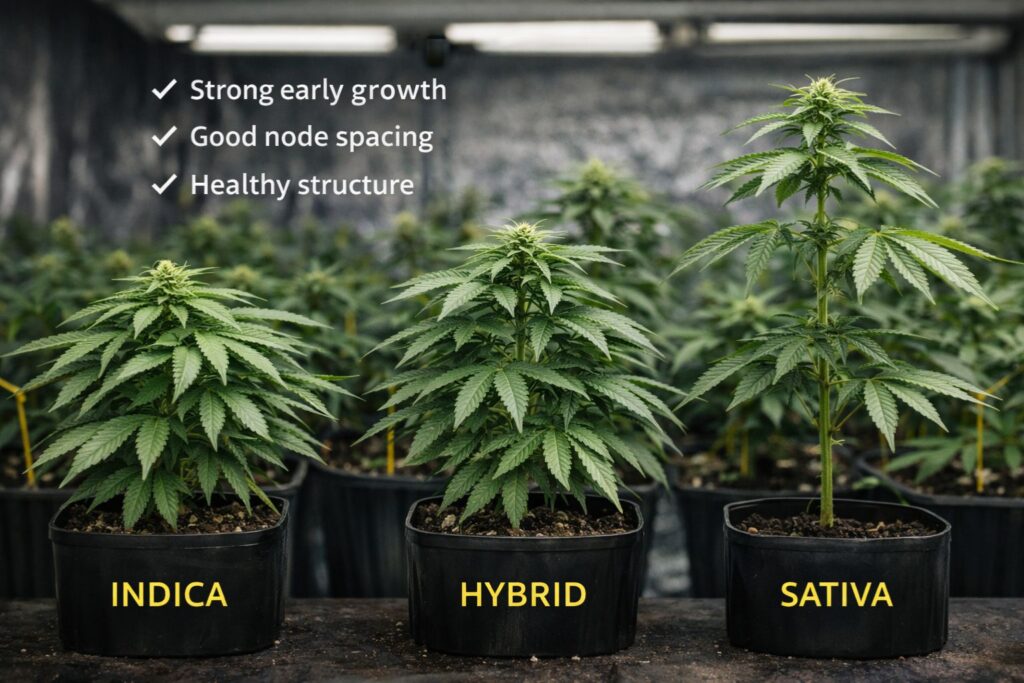
Before I ever reach for scissors, I decide whether the plant is a good candidate for topping. Some cultivars love it and branch evenly. Others sulk, stretch oddly, or form thin side branches that don’t support weight later.
Here is what I look for when I’m selecting vigorous seedlings:
- Fast early growth with thick stems by week 2–3 from sprout
- Even leaf spacing and clean node stacking
- No persistent twisting, clawing, or mottling that suggests early stress
- A pushy top that wants to dominate, because topping gives that energy somewhere useful to go
Seed format matters for planning. With feminized seeds, I expect each plant to be a producer, so I’m more willing to top early and shape the canopy for yield consistency. With regular seeds, I avoid heavy early training until I confirm sex, because I don’t want to invest time into a plant I might remove later.
Autoflowers are a separate decision. Some autos can be topped, but the window is short, and a missed timing can cost the whole run because the clock doesn’t pause. If I top an auto at all, I treat it like a single, carefully timed event and then I focus on gentle bending. For photoperiod plants, cannabis plant pruning and topping is much easier because I control the veg time and the flip.
I also pay attention to indica, sativa, and hybrid structure, but I treat those labels as a rough starting point, not a guarantee. What matters more in practice is internode spacing and branch strength. A lanky sativa-leaning plant might need topping plus aggressive support and tying, while a tight indica-leaning plant may need more selective pruning to prevent humidity pockets.
If you buy seeds online, store them correctly as soon as they arrive. I treat shipping-friendly seed storage as part of the growing process. From there, I store them dry, dark, and cool in a sealed container with a small desiccant pack, then I let them come to room temperature before opening the container to avoid condensation. Shipping-friendly seed storage also helps preserve germination rates if you aren’t planting immediately. Shipping-friendly seed storage is boring, but it prevents avoidable failures.
When I’m comparing seed banks, I look for three practical things: clear cultivar info (photoperiod vs. auto, expected stretch, and typical finish time), responsive support, and shipping options that match my region. Good shipping is not just speed; it is discreet packaging, tracking where available, and realistic delivery windows. If a seed bank can’t explain how they handle delays or replacements, I move on.
One important note: regional rules vary. I’m not offering legal advice. Before you germinate anything, confirm the rules where you live and what is permitted in your area.
My sterile pruning workflow and the tools I trust
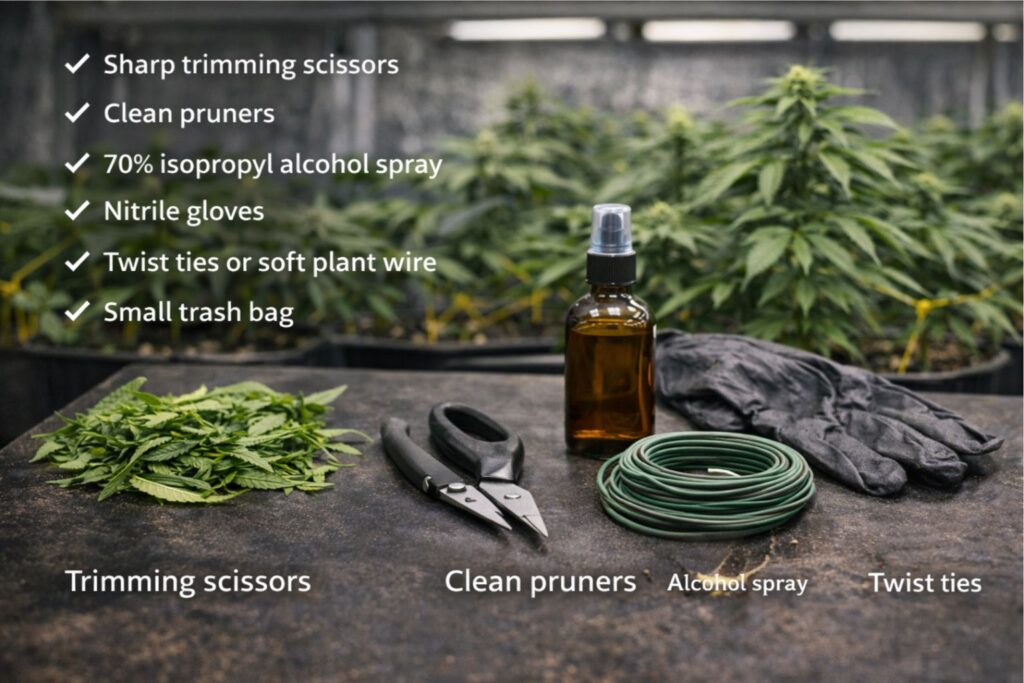
I don’t top with dirty scissors anymore. A sterile pruning workflow is the cheapest insurance you can buy. When I get lazy on sanitation, I notice slower healing and occasional stem discoloration. When I stay consistent, wounds close fast and the plant keeps pushing.
My sterile pruning workflow looks like this:
- Sharp trimming scissors for soft stems, plus clean pruners for thicker growth
- 70% isopropyl alcohol in a spray bottle
- Paper towels
- Nitrile gloves if I’m moving between plants
- Twist ties or soft plant wire for immediate support after topping
- A small trash bag so removed material never sits on the soil surface
I spray and wipe the blades before the first cut and between plants. If I’m doing multiple cuts on one plant, I still wipe the blades every few snips. A sterile pruning workflow is also about timing: I do cuts when the room is stable, not when I’m still dialing in temperature and humidity.
A structured topping schedule that doesn’t stall plants
A structured topping schedule is my biggest quality-of-life change. Instead of topping whenever a plant looks ready, I use a checklist and a target node count.
My baseline structured topping schedule for photoperiod plants:
- Wait until the plant has 5–6 true nodes and the stem is thick enough to resist bending.
- Top once above the 4th or 5th node, depending on internode spacing and pot size.
- Give the plant 5–10 days to recover and show strong, even side growth.
- If the cultivar responds well, consider a second topping on the new mains, but only if veg time allows.
This structured topping schedule keeps me from topping too early. Early topping can work, but in my room it increases the chance of uneven branching unless the environment is perfect.
Node selection for topping: where I cut and why
Node selection for topping is where most new growers get tripped up. If you cut too low, you can end up with crowded branching that’s hard to train. If you cut too high, you may leave a long, weak main stem that flops later.
My node selection for topping is based on three questions:
- Do I have enough vertical room for a short, bushy plant, or do I need to keep it taller?
- Are the lower branches thick enough to become mains after topping?
- Is the spacing tight enough that the plant won’t become an unmanageable tangle?
For most medium-vigor hybrids, I cut above the 4th node. For more vigorous plants in larger containers, I may cut above the 5th node to keep a little more height and spacing.
I repeat node selection for topping every run, because even the same cultivar can act differently depending on light intensity and feeding. Node selection for topping is not a one-size rule; it is a decision you make with the plant in front of you.
Healing time after topping: what I watch for
Healing time after topping is not just wait a week. I watch for specific signs that the plant is back in growth mode:
- The cut site dries and seals without staying wet
- Side branches point upward and begin to accelerate
- New leaves look normal in size and shape
- No sudden droop that lasts into the next light cycle
In my room, healing time after topping is usually 3–7 days for healthy photoperiod plants. If the plant was already stressed, healing time after topping can stretch to 10+ days, and that’s my sign that I should slow down and correct the basics before making more cuts.
I also pay attention to the cut itself. I make a clean, decisive snip. Crushing or tearing tissue extends healing time after topping and invites problems.
Pruning for airflow and yield without overdoing it
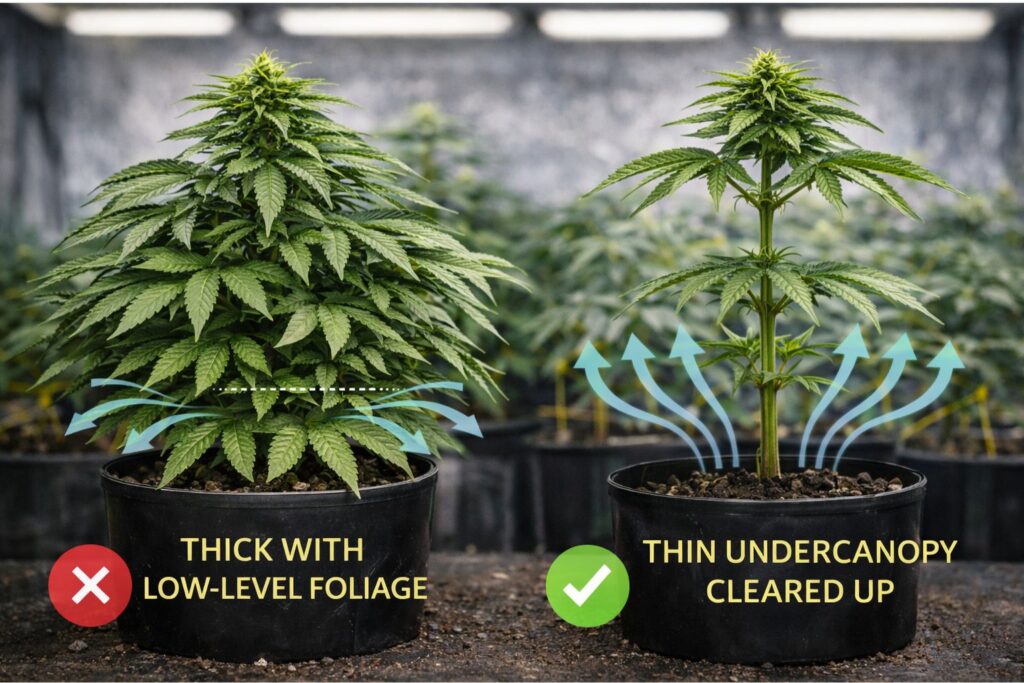
Once topping is done, pruning becomes about shaping and airflow. I prune in phases rather than stripping the plant all at once.
Pre-flower cleanup pruning: my before-the-flip routine
Pre-flower cleanup pruning is the session that makes flowering easier. I do it 5–10 days before I change the photoperiod to 12/12 on photoperiod plants. The goal is to remove growth that will never reach the canopy and to create a clean structure that won’t trap humidity.
My pre-flower cleanup pruning checklist:
- Remove thin lower branches that won’t reach the top third of the canopy
- Clear interior shoots that are shaded and growing inward
- Keep strong lateral branches that have a clear path to light
- Remove damaged leaves that are clearly dying, not just imperfect
- Avoid taking too much at once; I aim to remove less than a quarter of the total leaf mass in one session
Pre-flower cleanup pruning is also where I decide whether I want 6–8 main tops or more. If I’m running fewer plants, I may keep more tops per plant. If I’m running many plants, I keep fewer tops and focus on uniformity.
I do pre-flower cleanup pruning again around day 21 of flower if the canopy is too dense, but I keep that second session light. Late heavy pruning can slow flower development.
Environment targets that speed recovery
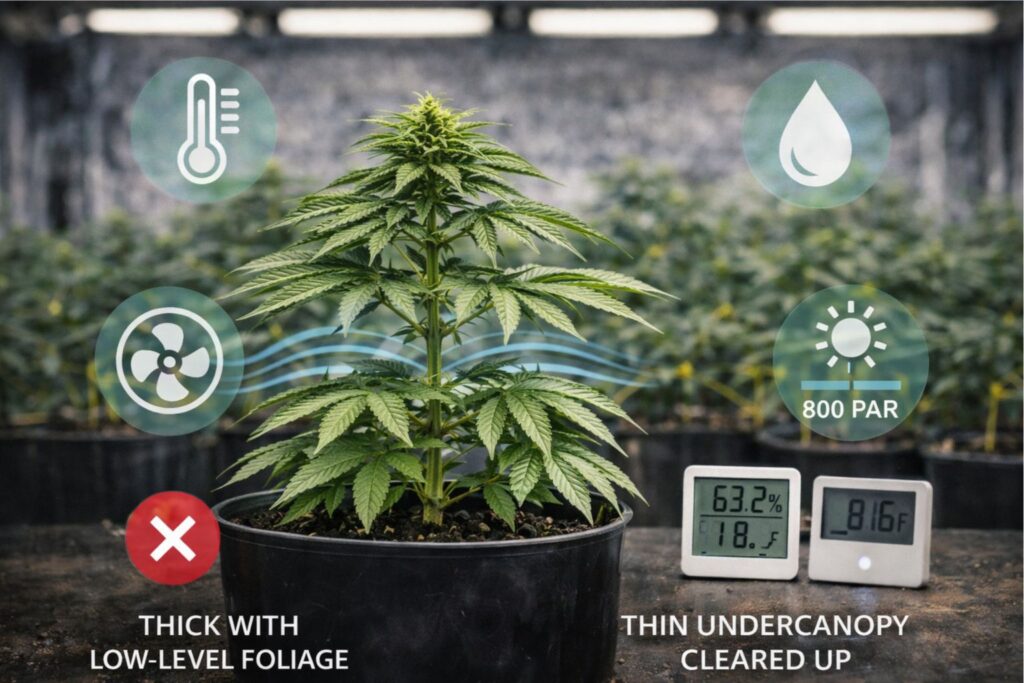
If you only take one thing from my experience, make it this: recovery is mostly environmental. Cannabis plant pruning and topping creates a wound and a redistribution of growth. Your job is to give the plant stable conditions so it can respond quickly.
Recovery lighting intensity: how I avoid stalling after cuts
Recovery lighting intensity is a balancing act. Too much light can increase stress and water demand right when the plant is healing. Too little light can slow growth and make side branches lazy.
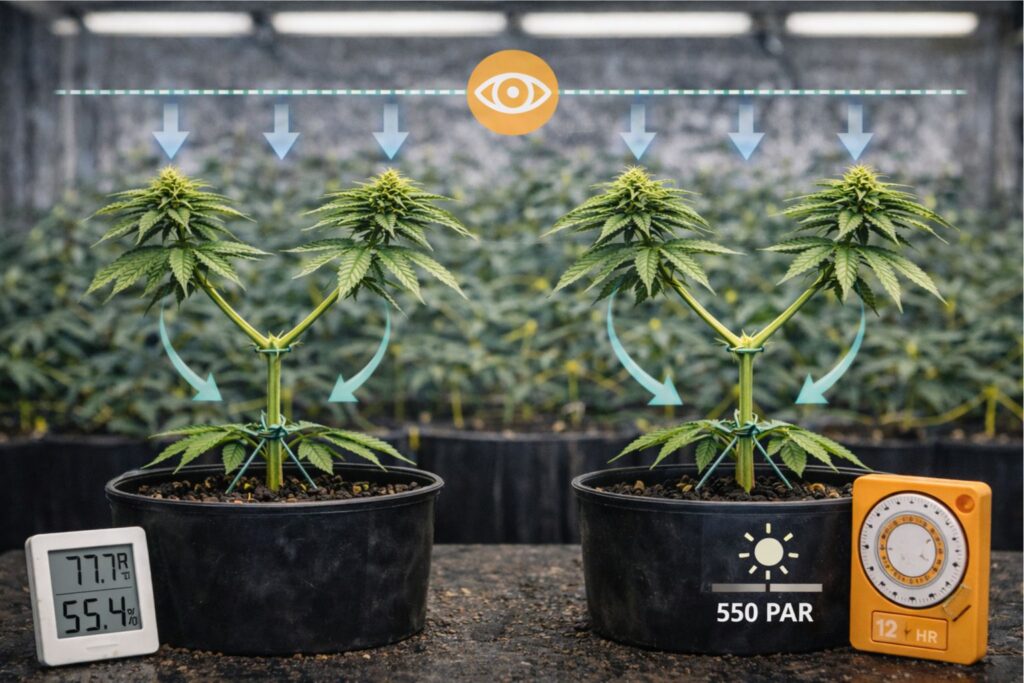
My recovery lighting intensity targets for veg, as a starting point:
- 300–500 PPFD for 24–48 hours after topping if the plant is sensitive
- 500–700 PPFD once the plant is clearly pushing new growth again
In a well-dialed room, I don’t always need to lower intensity, but I do watch leaf posture. If leaves are praying hard and the plant looks thirsty right after topping, I back off the dimmer slightly and raise it again after the plant rebounds. Recovery lighting intensity is also different for young seedlings versus big veg plants, so I adjust based on leaf size and root development.
I mention recovery lighting intensity several times because it is one of the most overlooked levers. Recovery lighting intensity, combined with stable humidity, often matters more than any additive.
Temperature, humidity, and VPD targets
My preferred ranges during veg recovery:
- Temperature: 24–27°C lights on, 20–23°C lights off
- Relative humidity: 55–70% depending on plant size
- VPD: roughly 0.8–1.2 kPa for most veg stages
If humidity is too low right after topping, the plant can drink too aggressively and droop. If humidity is too high, wounds can stay wet and airflow issues show up. I use a steady oscillating fan that moves air across the canopy without blasting the cut site directly.
My post-cut nutrient strategy for clean regrowth
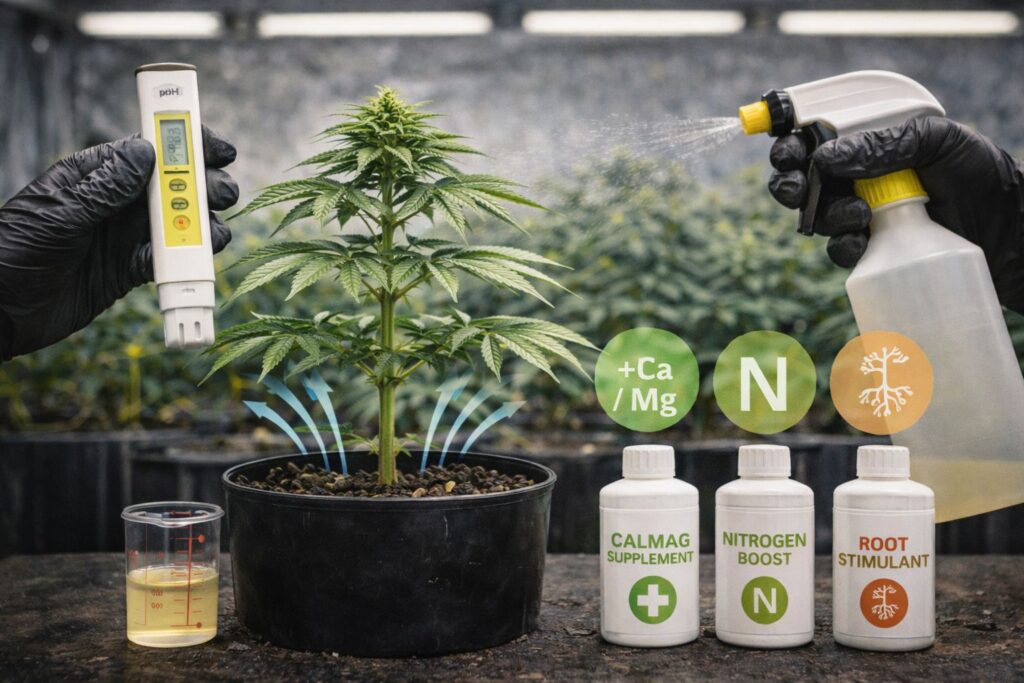
Post-cut feeding is where I made a lot of mistakes early on. My instinct was to help with stronger nutrients, but that often made things worse. A post-cut nutrient strategy should support roots and steady growth, not force new growth through a stressed system.
My post-cut nutrient strategy is simple:
- Keep the same base nutrient recipe, but avoid big increases for 5–7 days
- If I’m in hydro, I keep EC moderate and stable rather than chasing numbers
- If I’m in soil, I avoid heavy top-dressing right after a major pruning session
- I prioritize calcium and magnesium consistency because fluctuations show up fast in new growth
- I watch runoff or reservoir trends rather than feeding on a calendar
Typical ranges I see work well in veg (these are general and depend on cultivar and system):
- Hydro or coco: EC around 1.2–1.8 with steady pH control
- Soil: mild-to-moderate feeding with careful watering practices to keep oxygen in the root zone
A post-cut nutrient strategy also includes watering timing. I avoid saturating the medium right before I cut. If the medium is too wet, plants can be heavy and prone to droop. If it’s too dry, they can be thirsty and slow to respond. I aim for comfortably moist, then I cut, then I water lightly if needed.
I revisit my post-cut nutrient strategy every run because different genetics respond differently. A post-cut nutrient strategy that works for one vigorous hybrid may be too strong for a delicate phenotype.
Canopy shaping after topping: keeping it even
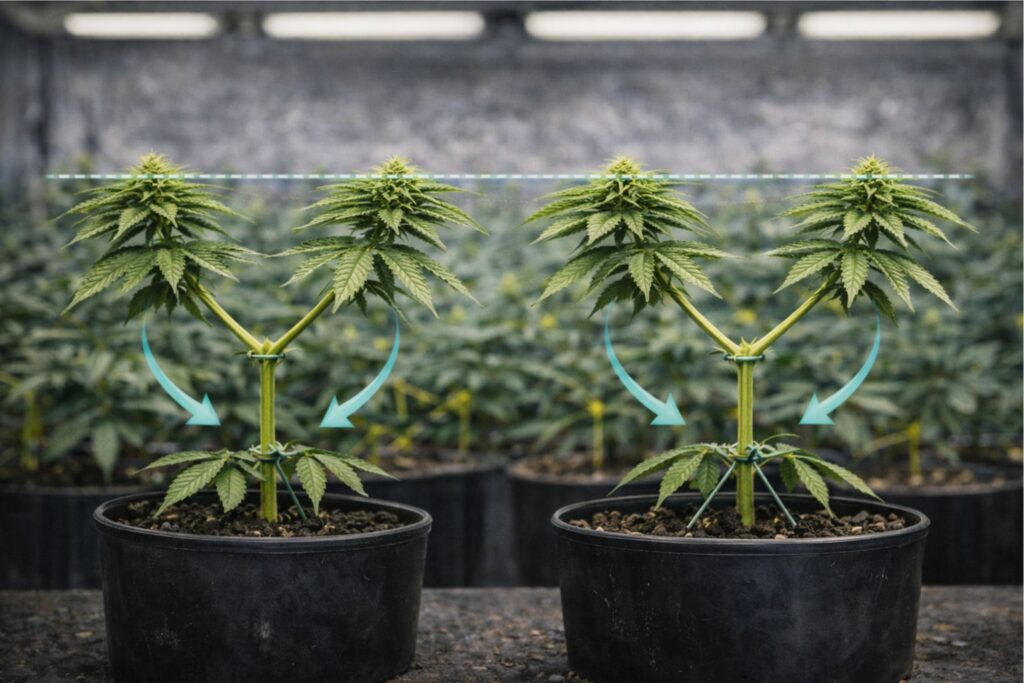
Topping is only step one. The canopy still needs guidance.
Canopy symmetry training: my tie-down method
Canopy symmetry training is how I keep multiple tops at the same height. After topping, I gently pull the new mains outward and down, so the center opens and light reaches the inner growth.
My canopy symmetry training routine:
- Wait until new mains are 10–15 cm long and flexible
- Tie each main to the pot edge or a stake, pulling outward, not straight down
- Adjust ties every 2–3 days as stems thicken
- Keep a small gap between branches so airflow stays consistent
Canopy symmetry training matters because it prevents the one-branch-wins-again problem. Canopy symmetry training also gives me predictable spacing for support stakes later in flower. If I skip canopy symmetry training, I usually end up doing more pruning to fix what training would have prevented.
I’ll say it plainly: canopy symmetry training is the reason my tops finish at similar heights. Canopy symmetry training saves me from chasing the canopy every day.
Managing stretch after topping during the transition to flower
The first 2–3 weeks after the flip are where structure can fall apart. Managing stretch after topping is about anticipating that the plant will try to regain dominance and grow upward fast.
My managing stretch after topping checklist:
- Flip only when the canopy is about half to two-thirds of the final height you can handle
- Keep training ties in place through early stretch
- Avoid heavy pruning in the first 10 days after the flip; let the plant set its direction
- Increase support as branches elongate so they don’t crease under their own weight
Managing stretch after topping also means watching the light. As plants stretch, the top gets closer to the fixture. I raise lights or dim slightly to keep tops healthy while still driving growth.
If stretch is extreme, I prefer bending and tying over cutting. Managing stretch after topping with gentle training is usually less disruptive than more topping in early flower.
In short: managing stretch after topping is not a single action. Managing stretch after topping is a period where you stay engaged and keep the canopy even.
Soil vs. hydro: how my approach changes
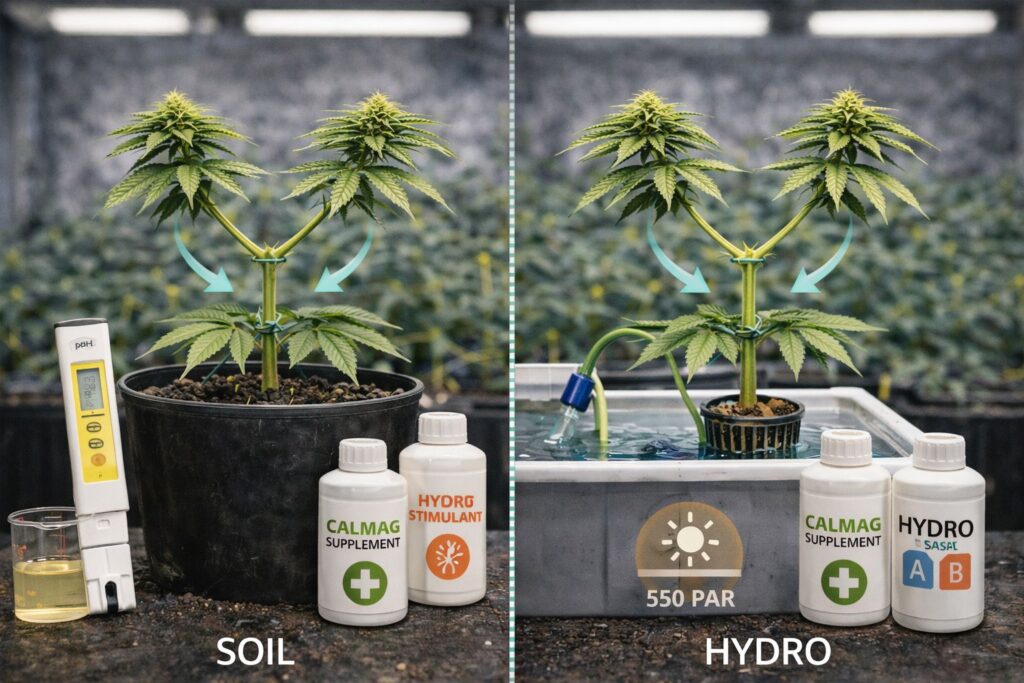
I’ve trained plants in soil, coco, and recirculating hydro. The cuts are the same, but recovery can differ.
In soil, recovery is often forgiving if the medium is well-aerated and watering is consistent. Overwatering is the big risk, especially after pruning when transpiration can change.
In hydro and coco, growth can rebound fast, but swings can punish you quickly. If the reservoir drifts or EC jumps, new growth shows it. That’s why I keep a steady post-cut nutrient strategy and I avoid changing multiple variables at once.
No matter the system, my sterile pruning workflow and structured topping schedule stay the same.
Pest and disease considerations around fresh cuts
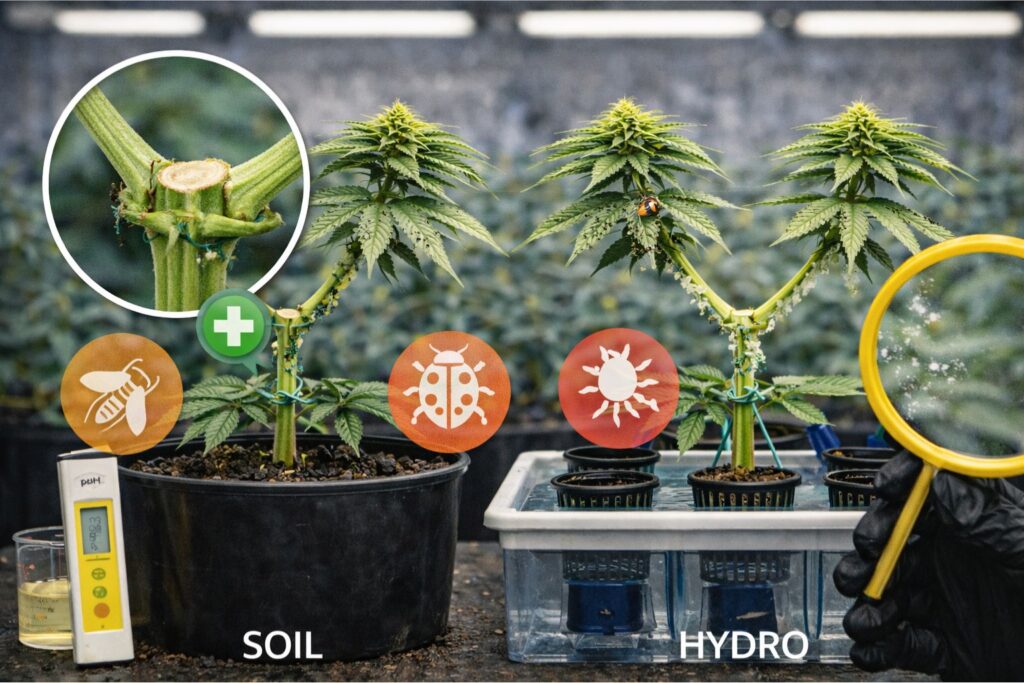
Fresh wounds and dense canopies can attract problems if you ignore airflow. I keep a routine of inspecting the underside of leaves and the branch junctions, especially after pre-flower cleanup pruning when the canopy changes.
A few practical habits that help:
- Don’t leave plant debris on the medium surface
- Keep humidity stable and avoid stagnant air
- Quarantine new plants and clones
- Inspect with a small flashlight; pests hide in shadows
If you’re dealing with ongoing pest pressure, I recommend keeping pruning minimal until the issue is controlled. Stress plus pests is a bad combination.
Post-harvest note: how structure affects trimming and drying
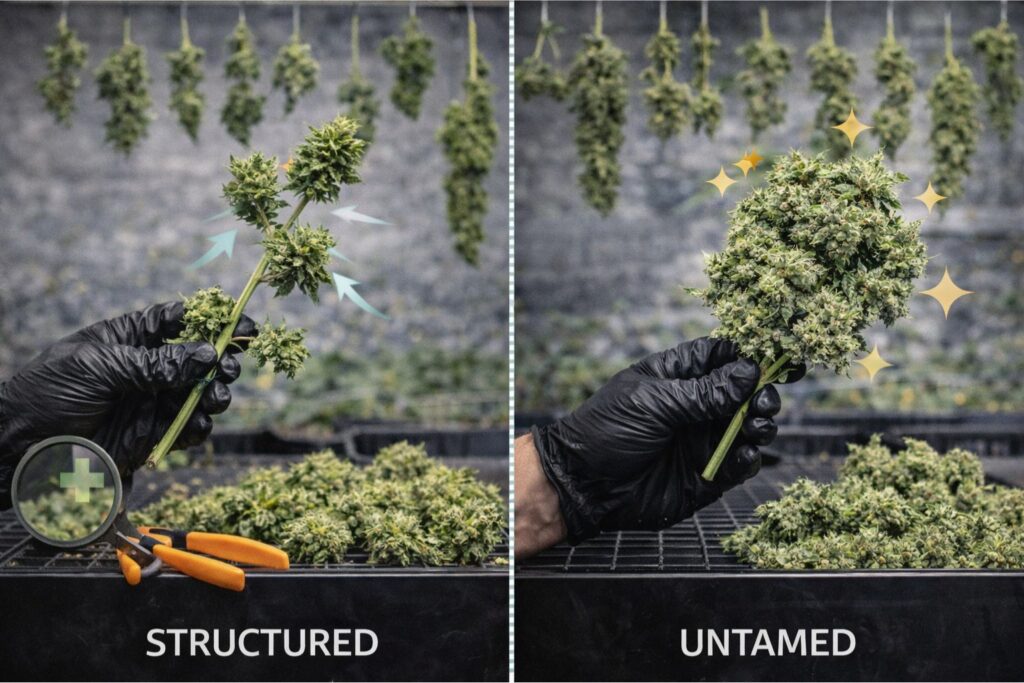
Pruning decisions show up at harvest. When I do cannabis plant pruning and topping well, the plant finishes with fewer popcorn sites and better airflow through flower. That usually means less larf to trim and a more predictable dry.
I dry slowly in a dark space with steady airflow and stable temperature and humidity. A clean structure makes it easier to hang branches without crowding. It also helps me avoid the wet interior problem where big, dense plants dry unevenly.
Common mistakes I see (and the fixes I use)
- Topping too early
Fix: follow a structured topping schedule and wait for real node development. - Cutting with dirty tools
Fix: commit to a sterile pruning workflow every session. - Too many cuts in one week
Fix: respect healing time after topping and do pruning in phases. - Ignoring the environment
Fix: dial recovery lighting intensity and keep VPD in a workable range. - Overfeeding after topping
Fix: use a steady post-cut nutrient strategy instead of sudden increases. - Letting one branch re-dominate
Fix: start canopy symmetry training as soon as the new mains are flexible. - Flipping too late
Fix: plan managing stretch after topping before you switch the photoperiod.
FAQ: real-world questions I hear all the time
When is the safest time to top weed plants indoors?
For photoperiod weed plants, I top when there are 5–6 true nodes and the plant is growing quickly. I follow my structured topping schedule so topping happens during strong veg growth, not during recovery from other stress.
Can I do cannabis plant pruning and topping on autoflowers?
Sometimes, but the timing is unforgiving. If you choose to do cannabis plant pruning and topping on an auto, it should be a single early event, followed by gentle bending. If the plant is slow or small, I skip topping and focus on training.
Does topping change potency or effects in marijuana flowers?
Topping changes structure more than chemistry. In my experience, topping can improve light distribution so more sites mature well, but genetics and overall growing conditions matter far more for flower quality than the cut itself.
How many times should I top a plant?
For most home grows, one topping is enough. If you have time and space, a second topping can work, but only if healing time after topping is quick and the plant is thriving. I keep node selection for topping consistent so structure stays manageable.
What should I do right after I top?
Right after topping, I check recovery lighting intensity, keep airflow gentle, and avoid major feeding changes. My post-cut nutrient strategy is about stability. I also start canopy symmetry training once new growth is long enough to tie.
Is pruning the same as defoliation?
Not exactly. Pruning is removing unwanted growth and shaping structure. Defoliation is removing leaves. I do pre-flower cleanup pruning to remove weak growth, then I remove only the leaves that are blocking airflow or light. I don’t chase a leafless look.
How do I choose seeds if I want to top and train?
I look for vigorous growth, good branching, and manageable internode spacing. Feminized seeds make planning easier because each plant is likely to flower, while some autos are less forgiving. After the package arrives, shipping-friendly seed storage keeps seeds viable until you’re ready to germinate.
