People message me every week asking which cannabis, marijuana, or weed “treats” a specific diagnosis. I understand why: when standard care feels limited, it’s natural to look for alternatives. But as a hands-on cultivator, I need to be careful with words. This is an evidence-based medical cannabis overview from the grow-room perspective, not medical advice. I’m not claiming that cannabis cures, prevents, or treats disease.
What I can do is share what I’ve learned about consistency, product selection, and safer decision-making. When you see the phrase Cannabis for Treating Medical Conditions, read it as “how people use cannabis products in the real world while trying to manage symptoms,” and always involve a licensed clinician for individualized guidance.
The most important baseline: what’s approved and what isn’t
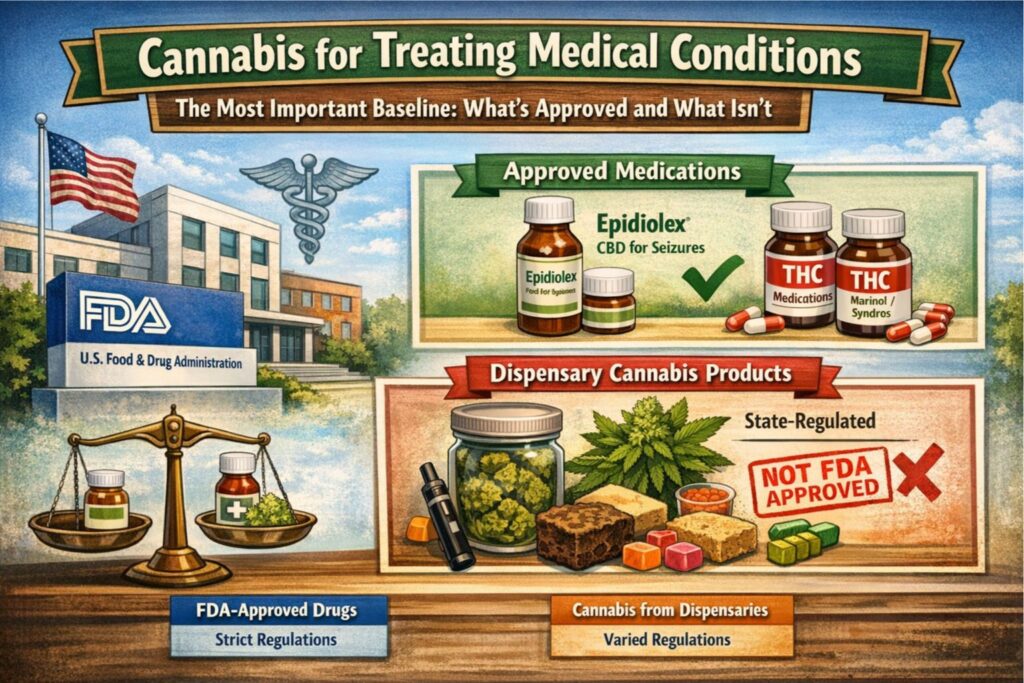
Here’s the reality check I start with in every patient-physician cannabis discussion:
- In the U.S., the FDA states it has not approved cannabis itself to treat any disease or condition, but it has approved specific cannabinoid drug products (one cannabis-derived and several synthetic).
- Epidiolex (a purified cannabidiol medicine) is approved for certain seizure disorders (Lennox-Gastaut syndrome, Dravet syndrome, and tuberous sclerosis complex).
- Synthetic THC medicines such as dronabinol (Marinol/Syndros) have approved uses for chemotherapy-related nausea/vomiting and appetite/weight loss in specific contexts, and their labels also list important adverse reactions and interaction cautions.
That doesn’t mean dispensary products never help people feel better; it means the evidence and regulation are different. If you want an evidence-based medical cannabis overview, it’s worth separating “regulated prescription drug” from “state-regulated cannabis product.”
Why I talk about consistency before I talk about conditions
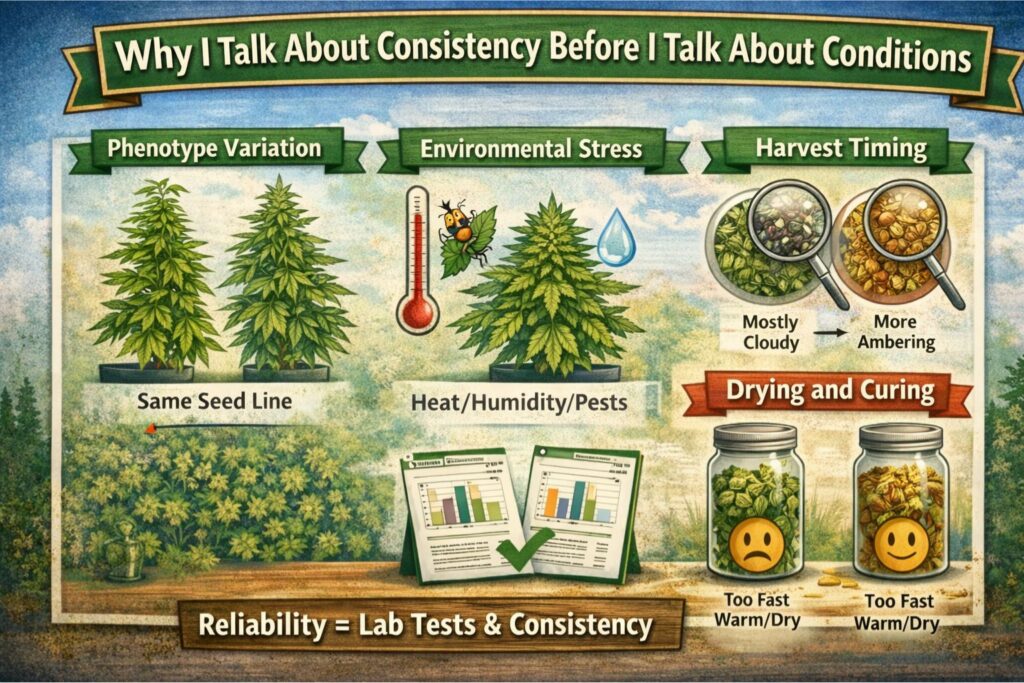
When someone asks me about Cannabis for Treating Medical Conditions, I talk about chemistry first. Two jars with the same strain name can be different. In my own runs, the same cultivar can shift aroma, potency, and harshness depending on:
- phenotype variation (same seed line, different expression)
- environmental stress (heat spikes, low humidity, pests)
- harvest timing (mostly cloudy resin glands vs. more ambering)
- drying and curing conditions (too fast, too warm, too dry)
This is where lab-tested cannabis products matter. Lab-tested cannabis products make it easier to compare batches. Lab-tested cannabis products also help a clinician or patient track what actually worked (or didn’t).
Cannabis dosing and titration basics (how people avoid the most common mistakes)
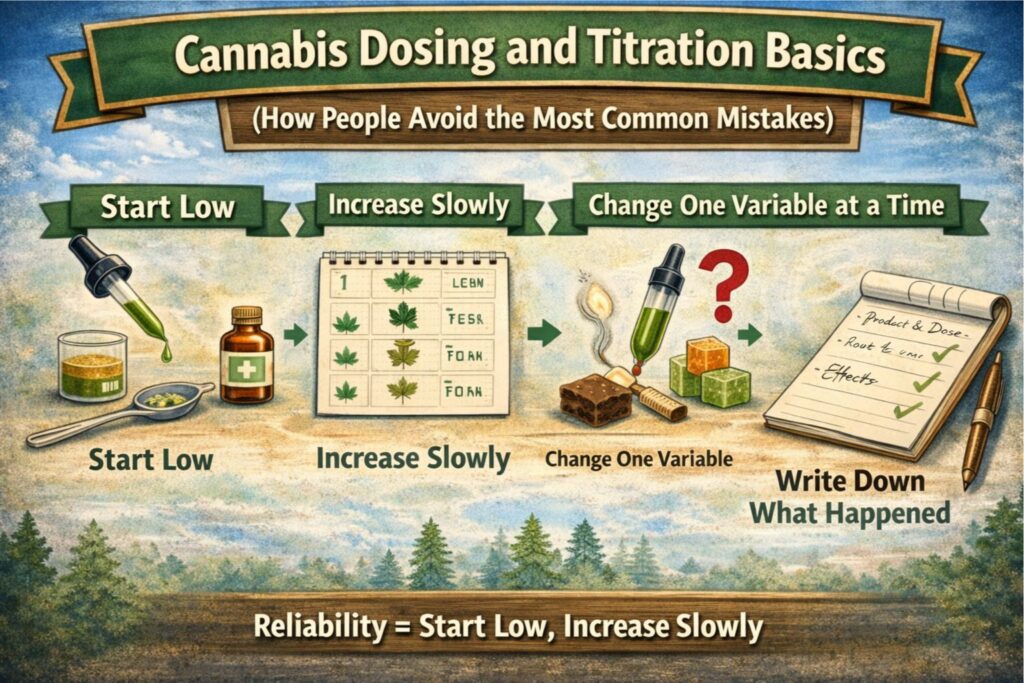
The most helpful advice I hear from clinicians and experienced patients is simple: start low and go slow. These cannabis dosing and titration basics aren’t glamorous, but they reduce bad experiences.
- Start with the lowest practical amount and wait long enough to assess effects.
- Increase in small steps on separate days, not hour-by-hour.
- Keep one variable at a time (same product, same route, same schedule) so you can learn.
I’m repeating it because it matters: cannabis dosing and titration basics are how people avoid “too much, too fast.” Cannabis dosing and titration basics also make your notes usable in a patient-physician cannabis discussion.
Routes of administration for cannabis: why onset and duration change everything
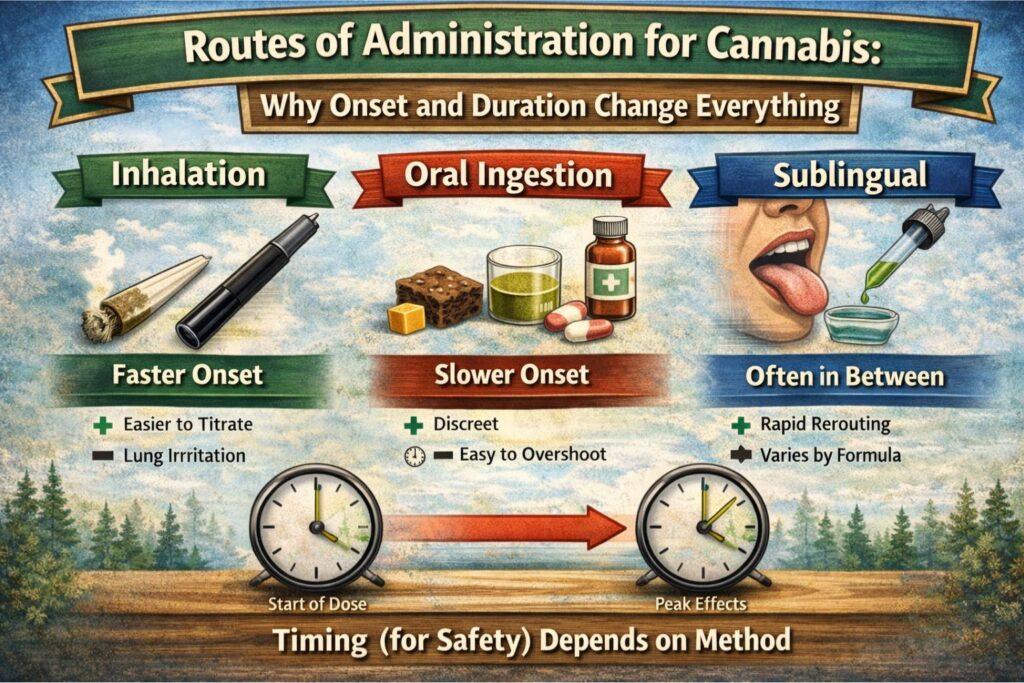
Routes of administration for cannabis are not interchangeable. The same dose can feel very different depending on the method.
- Inhalation: faster onset, shorter duration; easier to titrate, but higher technique and lung irritation considerations.
- Oral ingestion: slower onset, longer duration; easier to overshoot if you re-dose too soon.
- Sublingual: often somewhere in between, depending on formulation.
If you’re exploring Cannabis for Treating Medical Conditions, your first decision is often about routes of administration for cannabis. Routes of administration for cannabis also determine what “wait time” means for cannabis dosing and titration basics.
THC:CBD ratio for symptom management (what I’ve seen people track)
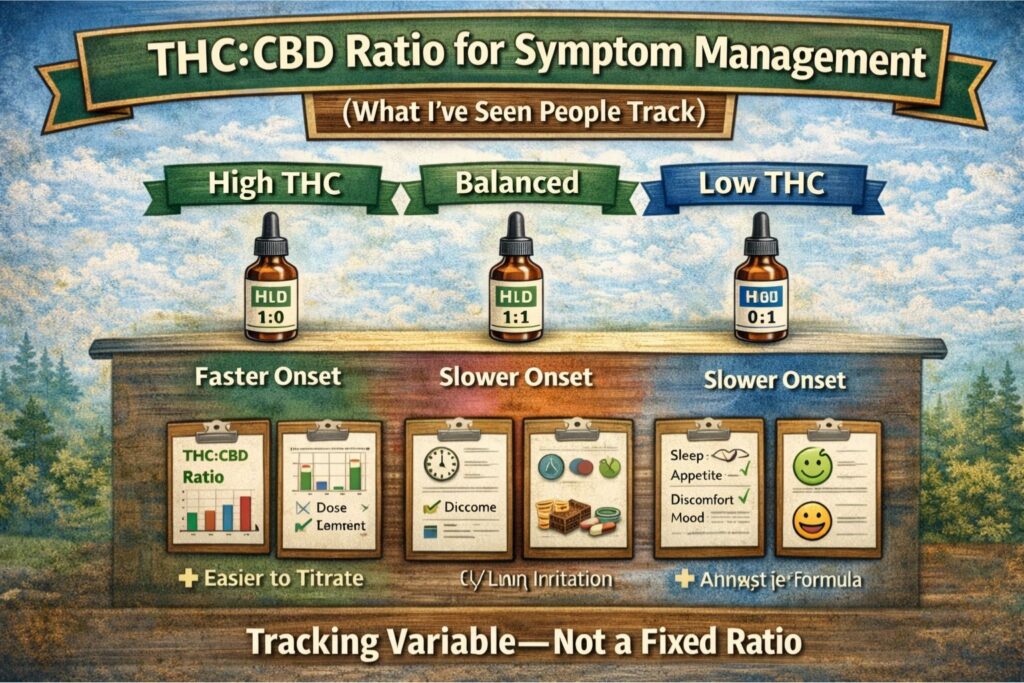
I can’t tell you which ratio treats a condition. What I can share is what people track when they’re trying to be systematic: a THC:CBD ratio for symptom management, the dose, and the outcome notes (sleep, appetite, discomfort, mood, etc.).
Some people prefer low-THC options; others tolerate THC well but only at night; some do better with balanced formulas. That’s why THC:CBD ratio for symptom management is a tracking concept, not a promise. THC:CBD ratio for symptom management should always be discussed in context of age, other meds, and risk factors.
Cannabis drug interaction considerations that don’t get enough attention
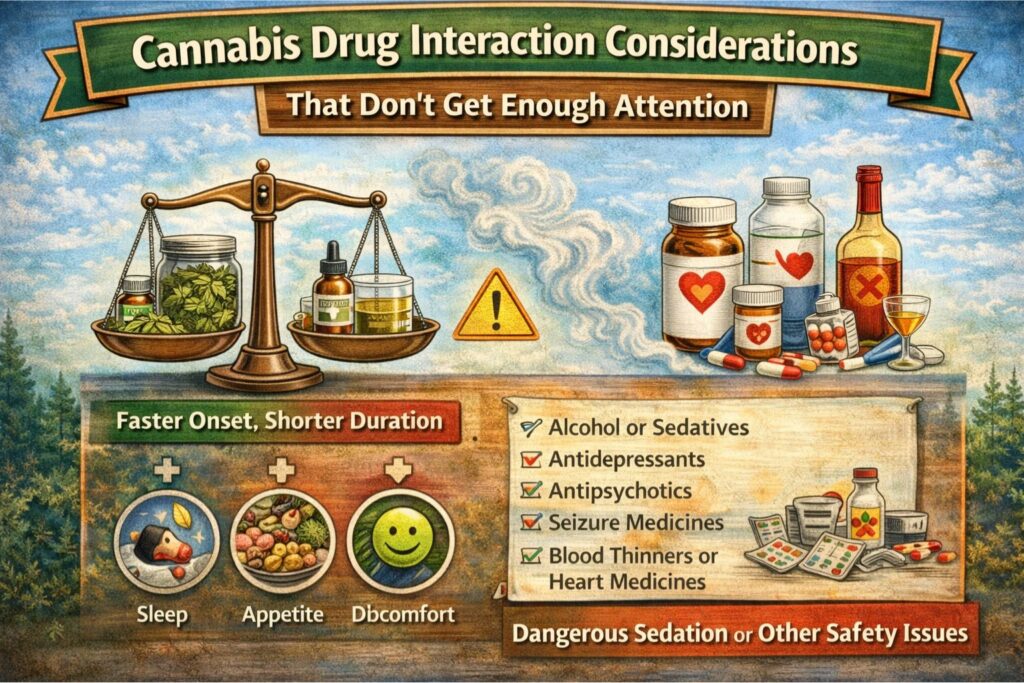
Cannabis drug interaction considerations are one reason I push people back toward clinicians. Cannabinoids can have additive sedation with other sedating meds, and prescription labels for cannabinoid drugs include interaction cautions.
Practical cannabis drug interaction considerations to bring up in a patient-physician cannabis discussion:
- alcohol or sedatives (sleep meds, benzodiazepines, some antihistamines)
- antidepressants or antipsychotics
- seizure medicines
- blood thinners and cardiac medicines
Cannabis drug interaction considerations also include practical safety: don’t drive or operate machinery when impaired.
A medical cannabis side effects checklist I share with friends
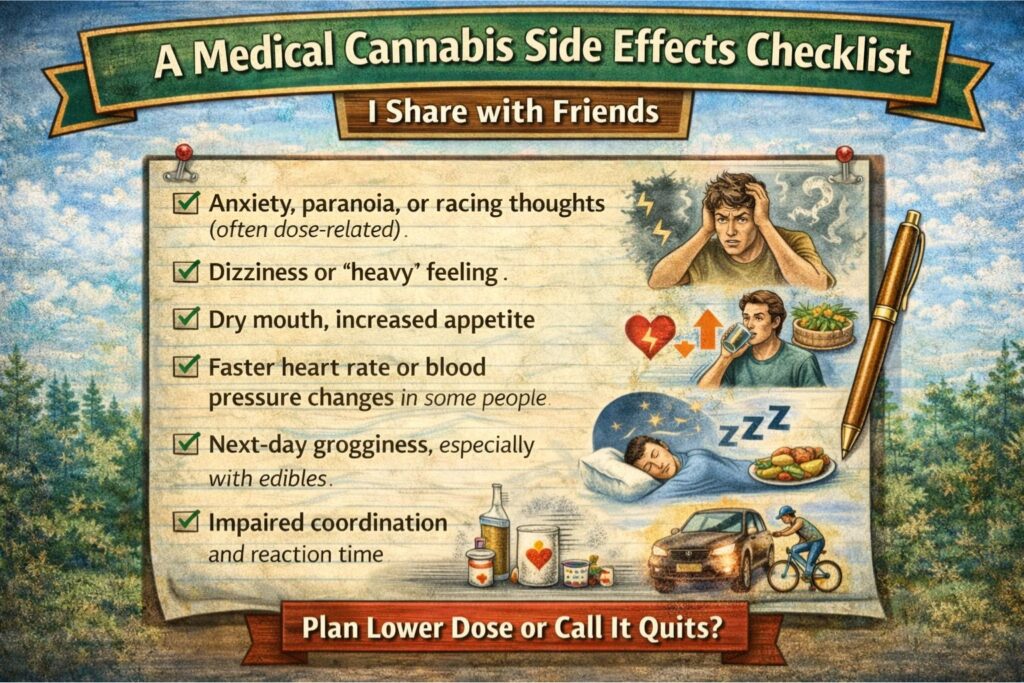
This medical cannabis side effects checklist is not exhaustive, but it’s a realistic starting point:
- dizziness or “heavy” feeling
- anxiety, paranoia, or racing thoughts (often dose-related)
- dry mouth, increased appetite
- fast heart rate or blood pressure changes in some people
- next-day grogginess, especially with edibles
- impaired coordination and reaction time
Use a medical cannabis side effects checklist to decide whether to reduce dose, change route, or stop. A medical cannabis side effects checklist also helps you write better notes for a clinician.
How cultivation influences cannabis cultivar chemistry control
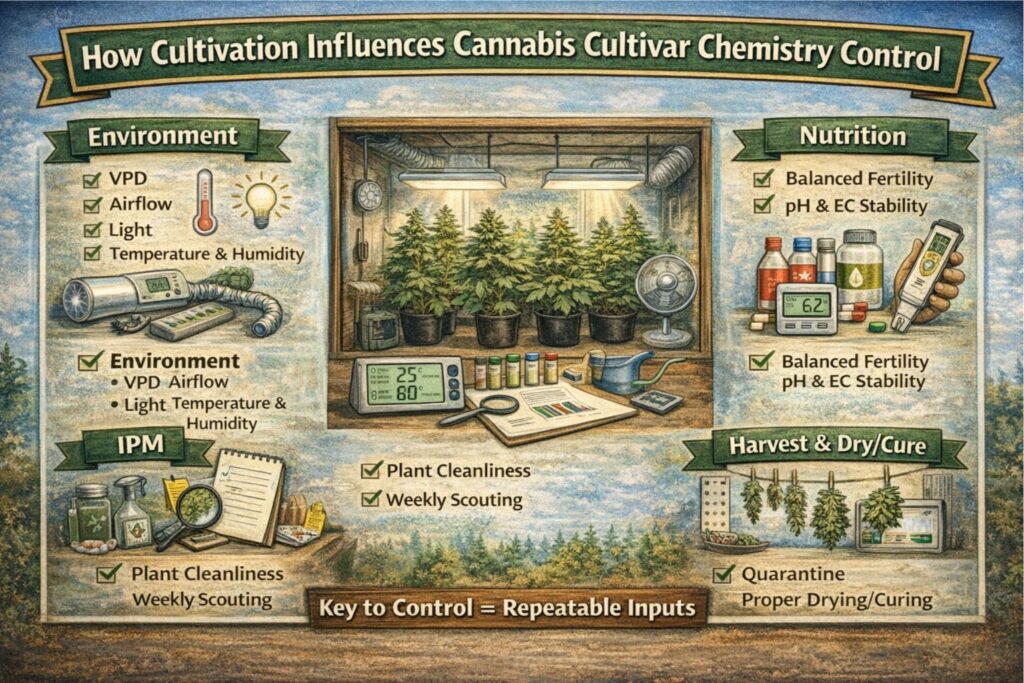
Here’s where the grower experience matters. When someone is relying on Cannabis for Treating Medical Conditions as part of their routine, cannabis cultivar chemistry control becomes the goal: repeatable cannabinoids and terpenes, low contamination risk, and clean post-harvest handling.
My indoor targets (ranges, not rigid rules)
These are the environmental bands that improved terpene profile consistency in my rooms:
- Veg: 24–28°C with 55–70% RH, steady airflow
- Flower: 22–26°C with 45–60% RH early, then 40–55% RH late
- PPFD: 300–600 in veg; 700–1,000 in flower (cultivar-dependent)
- VPD: roughly 1.0–1.3 kPa early flower; 1.2–1.5 kPa mid/late
When I hold those ranges, terpene profile consistency improves. When I chase extremes, terpene profile consistency usually suffers.
Nutrition and medium notes (soil vs hydro, briefly)
For cannabis cultivar chemistry control, stability beats aggression:
- Keep pH in the appropriate range for your medium.
- Make small EC/PPM changes and watch leaf tips for stress.
- Don’t let the root zone swing from bone-dry to flooded repeatedly.
Whether you’re in soil or hydro, cannabis cultivar chemistry control comes from repeatable inputs.
IPM and contamination risk
If you want lab-tested cannabis products to come back clean, you need prevention:
- quarantine new plants
- scout weekly (undersides of leaves, sticky traps)
- avoid late sprays in flower whenever possible
- clean the drying space like it’s part of the grow
This isn’t just “grower pride.” For people thinking about Cannabis for Treating Medical Conditions, contamination and harshness can be deal-breakers.
Drying and curing: the overlooked step for consistency
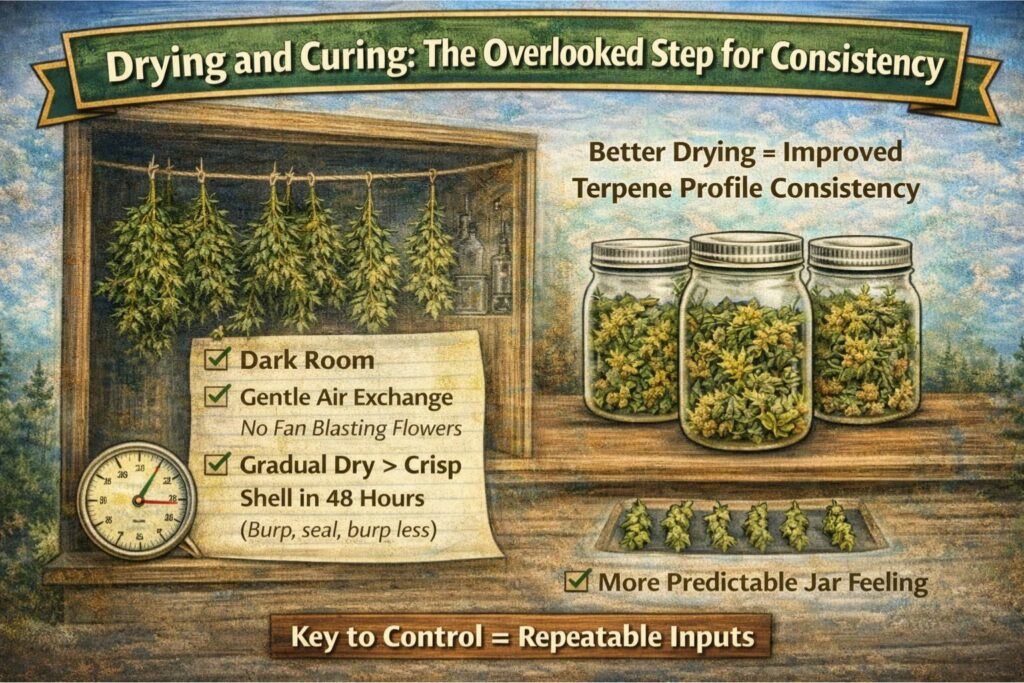
I’ve ruined more “good” weed in drying than anywhere else. If you want terpene profile consistency, slow drying matters.
My basics:
- dark room, gentle air exchange, no fan blasting flowers
- aim for a gradual dry rather than a crisp outer shell in 48 hours
- cure airtight, vent briefly early on, then reduce burping over time
Better drying improves terpene profile consistency, and it makes the jar feel more predictable.
Buying cannabis seeds online and choosing genetics responsibly
People also ask me seed questions tied to Cannabis for Treating Medical Conditions. I’m not giving legal advice, and grow laws by region vary widely. But from a cultivation standpoint, here’s what I recommend:
- Choose genetics for stability and repeatability, not only high potency.
- If you’re new, consider feminized seeds to reduce the chance of male plants.
- Autoflowering lines can be convenient, but they’re less forgiving of early stress.
- Expect phenotype variation unless you’re working from a proven mother.
If you’re trying to buy cannabis seeds online, ask the seed bank about testing, storage, and shipping methods. If you’re trying to buy cannabis seeds online, plan your environment first (tent size, heat, odor control). And if you’re trying to buy cannabis seeds online, remember that indica/sativa/hybrid is a rough shorthand; lab-tested cannabis products tell you more.
FAQ (long-tail questions I hear all the time)
Is Cannabis for Treating Medical Conditions backed by science?
Some uses have stronger evidence than others, and the strongest evidence is usually for specific, regulated cannabinoid medicines and indications.
For dispensary products, evidence varies by product type, dose, and study design. Treat this as an evidence-based medical cannabis overview, not a guarantee.
What’s the safest way to start with cannabis dosing and titration basics?
Start low, wait long enough, and change one variable at a time. Cannabis dosing and titration basics are about learning your response without stacking doses too quickly.
Which routes of administration for cannabis are easiest to control?
Many people find inhalation easier to titrate, while oral products are easier to overdo because onset is slower. Routes of administration for cannabis should match your risk tolerance and your setting.
How do I pick a THC:CBD ratio for symptom management?
Use your clinician, your product’s lab data, and your notes. THC:CBD ratio for symptom management is best treated as a tracking variable, not a fixed rule.
What should I bring up in a patient-physician cannabis discussion?
Your goals, current medications, prior experiences, and any cannabis drug interaction considerations. Also bring your medical cannabis side effects checklist notes so the conversation is concrete.
What should I look for when choosing lab-tested cannabis products?
A complete certificate of analysis (potency, terpene profile if available, and contamination screens). Lab-tested cannabis products make batch-to-batch comparison possible.
Can home growers improve cannabis cultivar chemistry control?
Yes, but it takes consistency: environment, nutrition, IPM, harvest timing, and careful drying. Cannabis cultivar chemistry control is a process, not a single trick.
Any final caution for Cannabis for Treating Medical Conditions?
Avoid mixing with alcohol, avoid driving when impaired, and treat cannabis drug interaction considerations seriously. If symptoms worsen or you feel unsafe, stop and get professional help.
