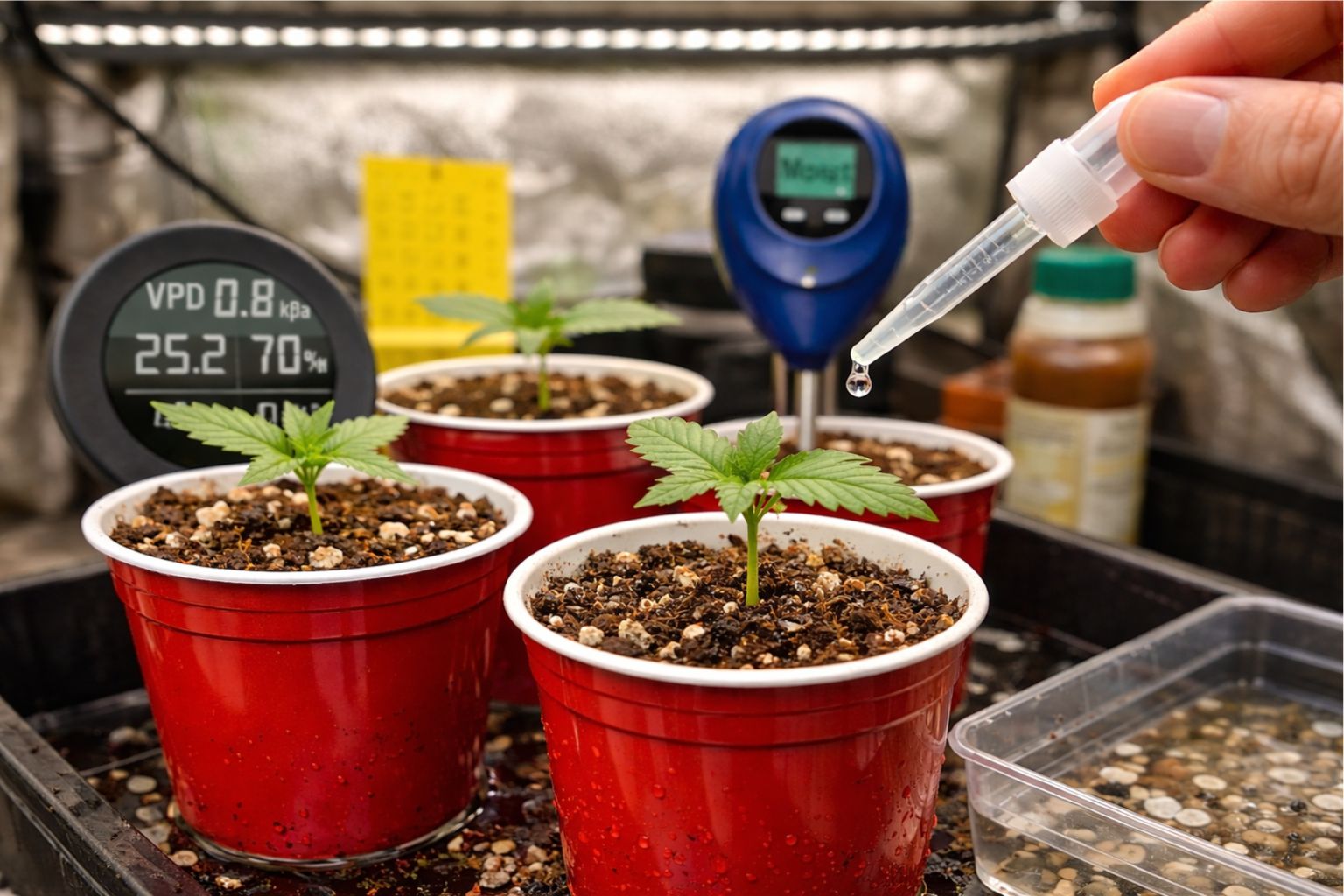
Introduction: why I changed my watering habits
I used to lose more cannabis seedlings to “kindness” than to neglect. The pattern was always the same: I’d see a dry-looking top layer, add more water, and a few days later the stem would thin out at the soil line or the leaves would stall. Over time I realized I wasn’t managing water; I was managing my anxiety.
This post is a practical walk-through of cannabis and seedling watering practices that have been repeatable in my propagation tent across both photoperiod plants and autoflowers. I’ll share exactly what I do, what I measure, and what I stopped doing. I’ll also cover how my watering choices connect to lighting, humidity, airflow, genetics, and even how I shop for seeds online without chasing hype.
If you grow marijuana or weed at home (where it’s legal), seedling watering is one of the earliest make-or-break skills. It’s also one of the easiest to overcomplicate. My goal here is to keep it simple, measurable, and forgiving.
My baseline environment: the part most people skip
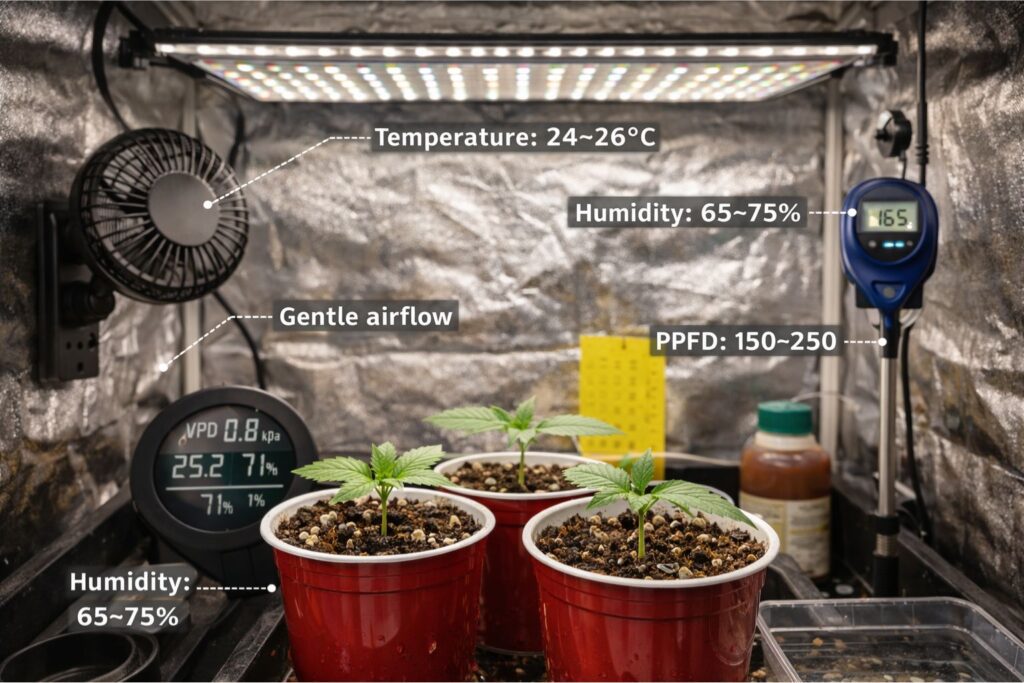
Watering decisions only make sense when the environment is stable. Before I tightened my climate, I was “watering to compensate” for swings in temperature and humidity. That approach never lasted.
Temperature, humidity, and the target VPD
For seedlings I aim for:
- Day temperature: 24–26°C
- Night temperature: 21–23°C
- Relative humidity: 65–75% for the first 10–14 days
- Gentle airflow that moves leaves slightly but never blasts stems
With those numbers, my VPD usually sits around 0.6–0.9 kPa. When I talk about VPD for cannabis seedlings, I’m really talking about how fast the medium dries and how hard the plant needs to transpire. A high VPD makes tiny plants drink faster than their small roots can support, and that pushes me into frequent watering that reduces oxygen in the medium. A low VPD can keep everything too wet for too long. I want the middle.
I check VPD for cannabis seedlings at least twice per day during the first week, because the tent changes after lights-on and right before lights-off. Once I learned to hold VPD for cannabis seedlings steady, the rest of my routine got easier.
Light intensity and photoperiod
Seedlings do not need aggressive intensity. In my tent:
- Photoperiod: 18/6 for most starts
- PPFD: 150–250 at canopy for the first 10 days
- Gradual increase to 250–350 once true leaves are expanding
Too much light increases transpiration and can make you think you have a watering problem. I used to respond by watering more, which made the roots lazier and the medium soggy. Now I adjust light first, then water.
The real goal: oxygen, not constant wetness
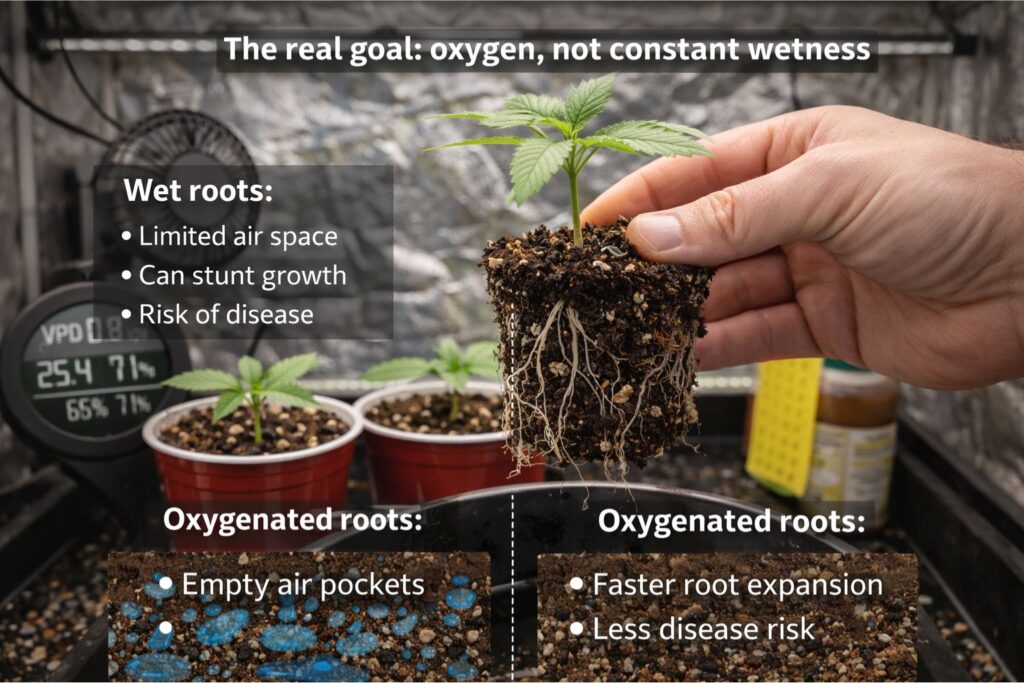
A seedling’s roots need moisture, but they also need air. Many “overwatering” issues are actually “under-oxygenation” issues. When the pore spaces in your medium fill with water for long periods, roots slow down. Slow roots mean less uptake, which leads to pale growth, droop, and sometimes disease.
This is where seedling root zone moisture becomes a more useful concept than “water every X days.” seedling root zone moisture is about how the entire container feels, not how the surface looks. I trained myself to judge seedling root zone moisture by lifting pots, not by staring at them.
I also learned that seedling root zone moisture is different depending on the container. A large pot holds more water than a seedling can use, and it stays wet longer. A small cup dries faster but is easier to manage. The same amount of water in different containers creates very different outcomes.
My germination-to-emergence watering routine
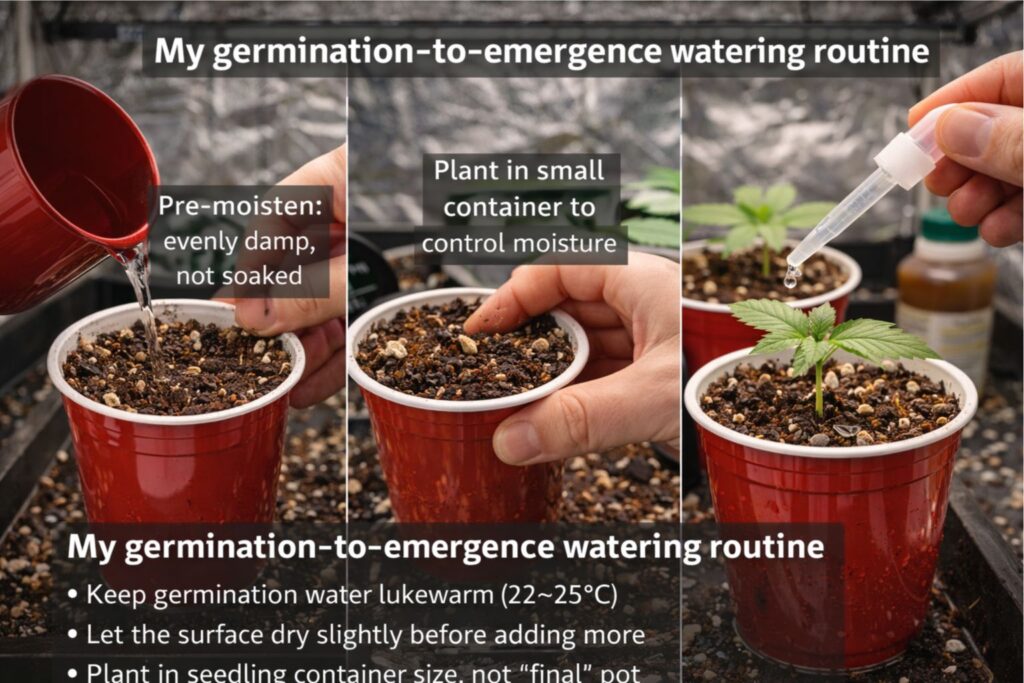
I start most seeds in small containers because it gives me better control of moisture and oxygen. I do not chase the fastest germination; I chase the most consistent emergence.
Water temperature, moisture level, and patience
If I’m using paper towel or direct sow, I pay attention to water temperature for germination. I’ve had the best results when water temperature for germination is lukewarm, roughly 22–25°C. Cold water slows enzyme activity and can drag out the process; very warm water can reduce oxygen in the soak.
My goal is evenly damp, not soaked. Whether in a starter plug or a light seedling mix, I want the medium to hold together if squeezed but not drip water. I learned to set that baseline once and then avoid “topping up” out of habit.
I keep water temperature for germination consistent by mixing room-temperature water and checking it with a cheap aquarium thermometer. It sounds fussy, but it prevented a lot of variability for me.
The cotyledon stage: my schedule and why it works
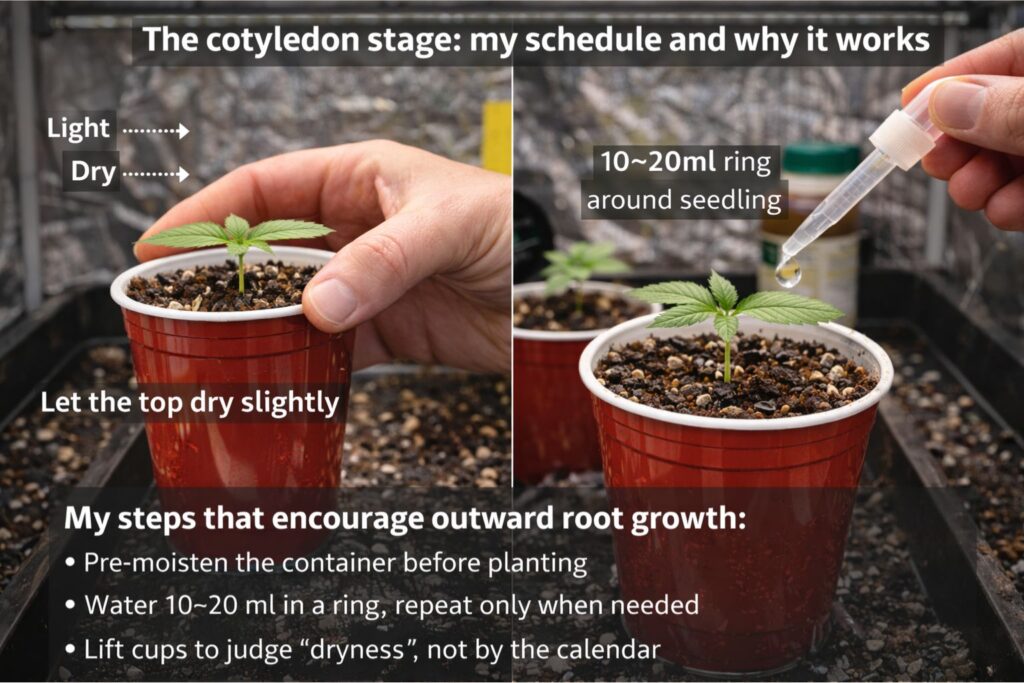
The cotyledon stage is when I see most growers drown seedlings. The plant has just enough leaf to transpire a little, but the roots are still minimal. If the medium stays saturated, you invite stem issues.
This is where my cotyledon stage watering schedule matters. My cotyledon stage watering schedule is not based on the calendar; it’s based on container weight and how quickly the top 1–2 cm dries under my current VPD.
Here’s what I do in a typical 16–20 oz cup of light soil mix:
- Pre-moisten the medium before planting.
- After the seed sprouts, I do not water the entire cup immediately.
- I add 10–20 ml in a small ring around the seedling, then wait.
- I repeat only when the cup feels noticeably lighter.
The cotyledon stage watering schedule teaches the roots to search outward. If I keep everything wet, roots don’t explore and the plant stays fragile. When I follow this cotyledon stage watering schedule, I get thicker stems and faster true-leaf growth.
Runoff and why I mostly avoid it early on
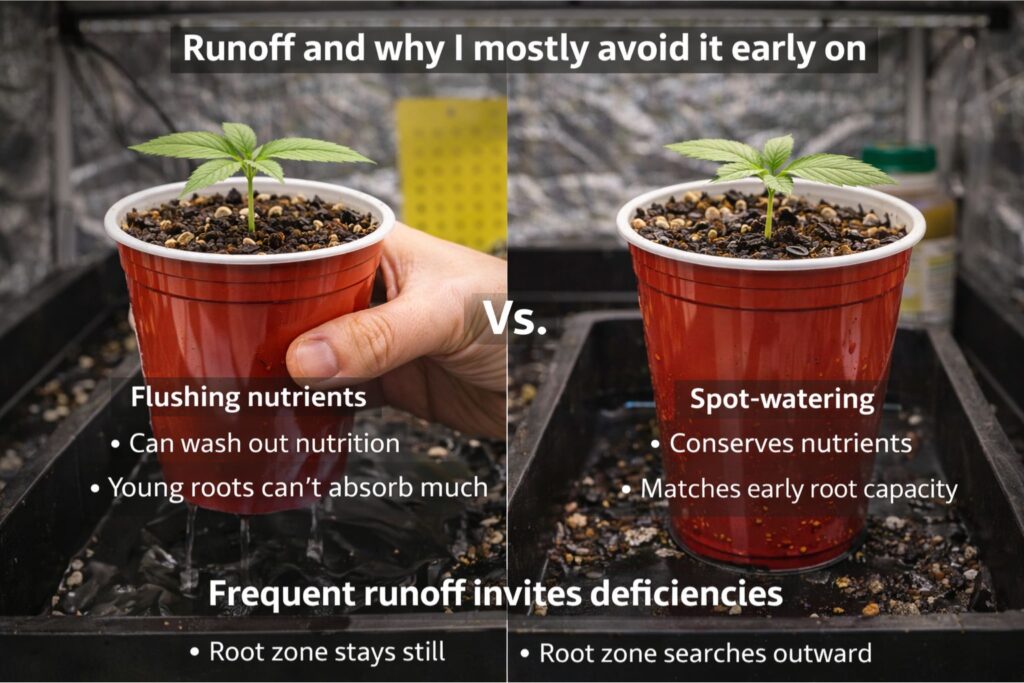
I’m a fan of runoff later in veg to manage salts in coco or to confirm even saturation. But early on, runoff can be a trap. Many beginners chase runoff and end up saturating small containers repeatedly.
Instead, I use a runoff-free irrigation technique during the seedling stage in soil mixes. A runoff-free irrigation technique simply means I water measured amounts that wet the target zone without pushing water out the bottom. This helps keep oxygen in the medium and prevents a sour, anaerobic smell.
When I do use a runoff-free irrigation technique, I also keep a log. I note the amount added and how long it takes the cup to feel lighter again. That log is what made my watering repeatable across different genetics.
Bottom-watering: when it helped and when it backfired
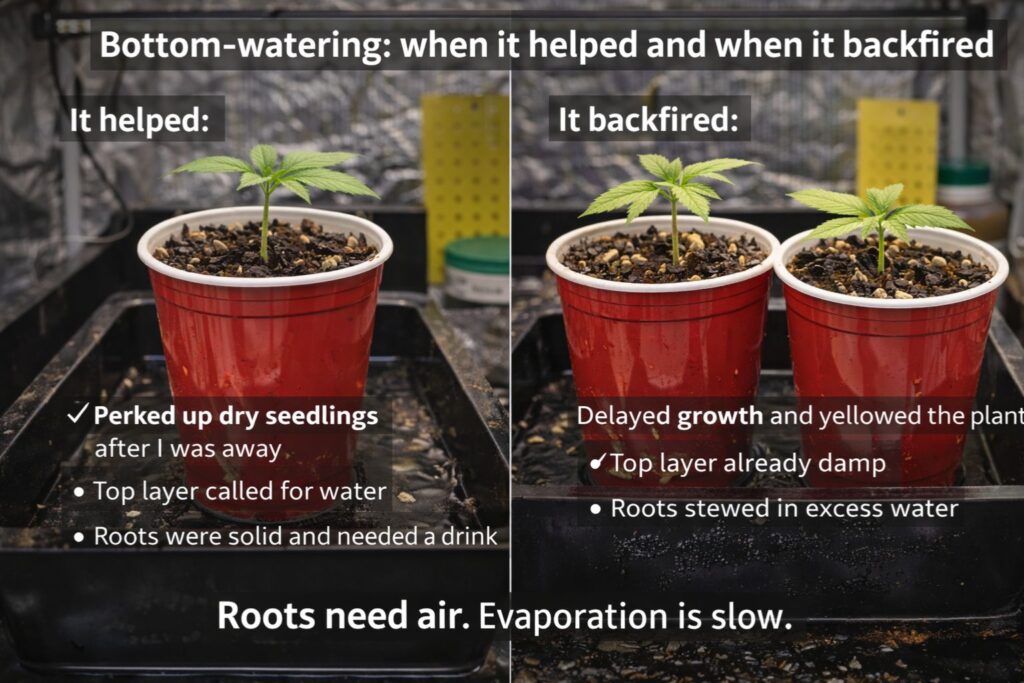
Bottom-watering can be useful, but only if you treat it as a tool, not a default. I use bottom-watering cannabis starts when the top layer dries too fast under higher airflow, or when I want to encourage deeper roots before transplant.
My method:
- I place cups in a shallow tray with 0.5–1 cm of water.
- I let them wick for 10–15 minutes.
- I remove the cups and let them drain fully.
bottom-watering cannabis starts can backfire if you leave cups sitting in water. That keeps the lower zone constantly wet and can invite gnats. bottom-watering cannabis starts works best for me as an occasional reset, not an everyday habit.
Nutrients: less is usually more in week one
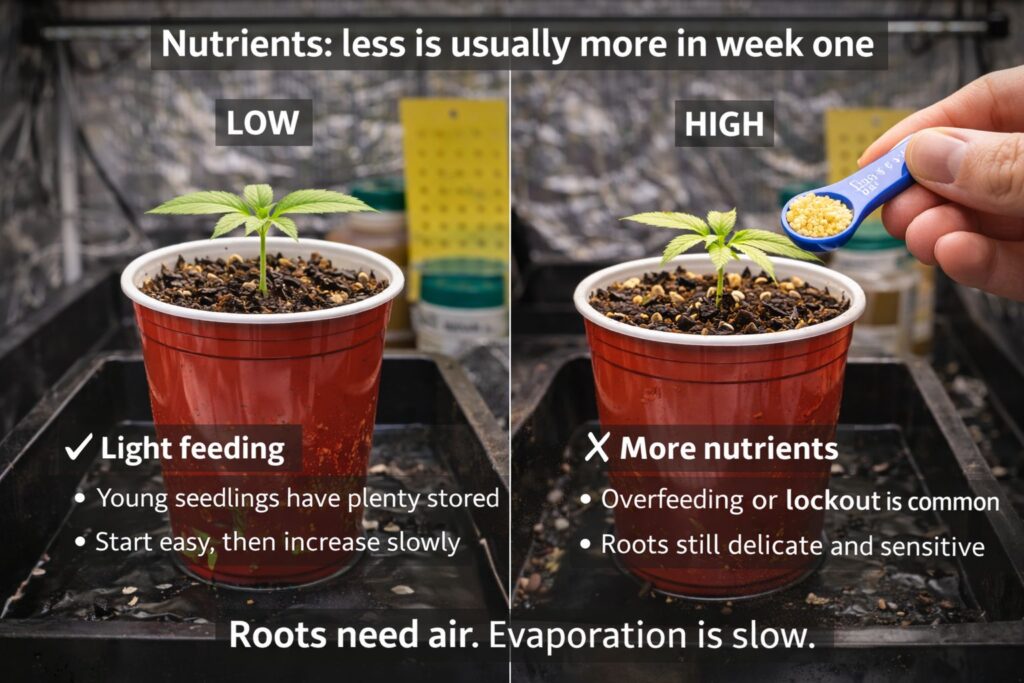
I’ve grown seedlings in plain water and in lightly amended mixes. The mistake I made early was feeding too soon because I wanted “vigorous” growth. That often created clawing or stalled leaves.
If I’m in an inert medium like coco, I introduce a very mild feed after the first true leaves appear. I call it gentle nutrient priming for seedlings. gentle nutrient priming for seedlings for me means:
- EC: 0.4–0.8 (200–400 ppm on a 500 scale)
- pH: 5.8–6.1 in coco; 6.2–6.6 in soil-based mixes
- Balanced base nutrient, not a heavy bloom product
gentle nutrient priming for seedlings is about avoiding deficiency without forcing growth. The plant should look healthy green, not dark and glossy. When I keep gentle nutrient priming for seedlings mild, I get better root development and fewer setbacks.
Damping-off: what I do to prevent it
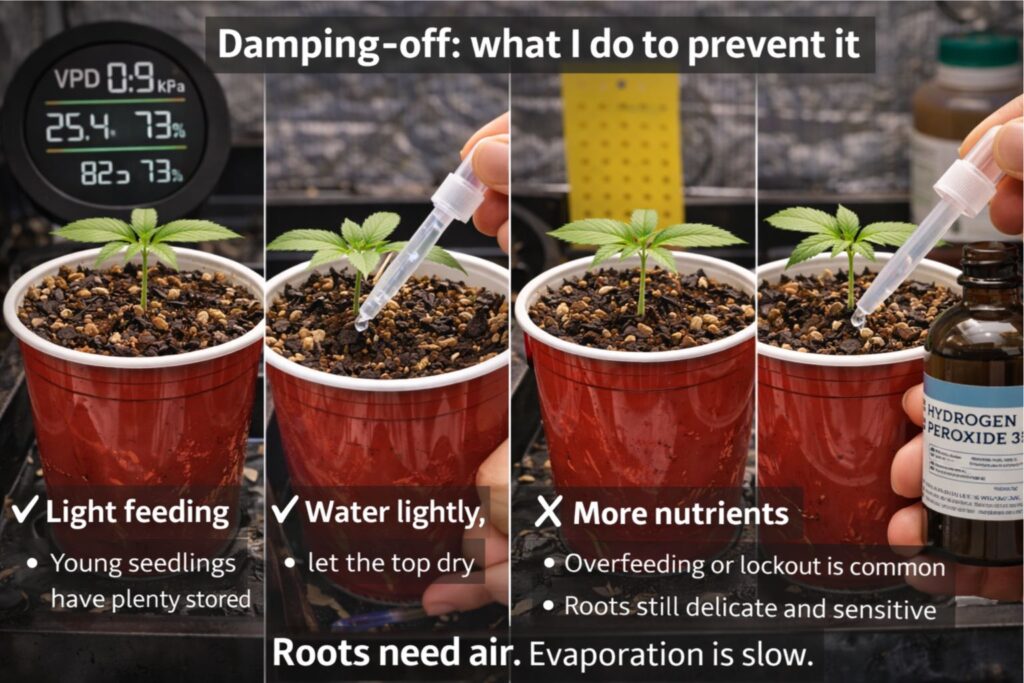
Damping-off is one of the quickest ways to lose seedlings, and it often looks like it “just happened overnight.” For me, it usually traced back to stale air and a constantly wet surface.
seedling damping-off prevention is mostly environmental:
- Keep airflow moving across the medium surface
- Avoid saturated cups for multiple days
- Do not bury stems too deep in wet mix
- Sanitize trays and tools between runs
I also dust the surface lightly with dry medium after watering if it looks glossy. That helps break the algae cycle. seedling damping-off prevention improves dramatically when the surface can dry a little between waterings.
The third thing I changed for seedling damping-off prevention was spacing. Crowded cups trap humidity and reduce airflow. I leave small gaps so air can circulate.
Medium choices: soil, coco, and “hydro starts”
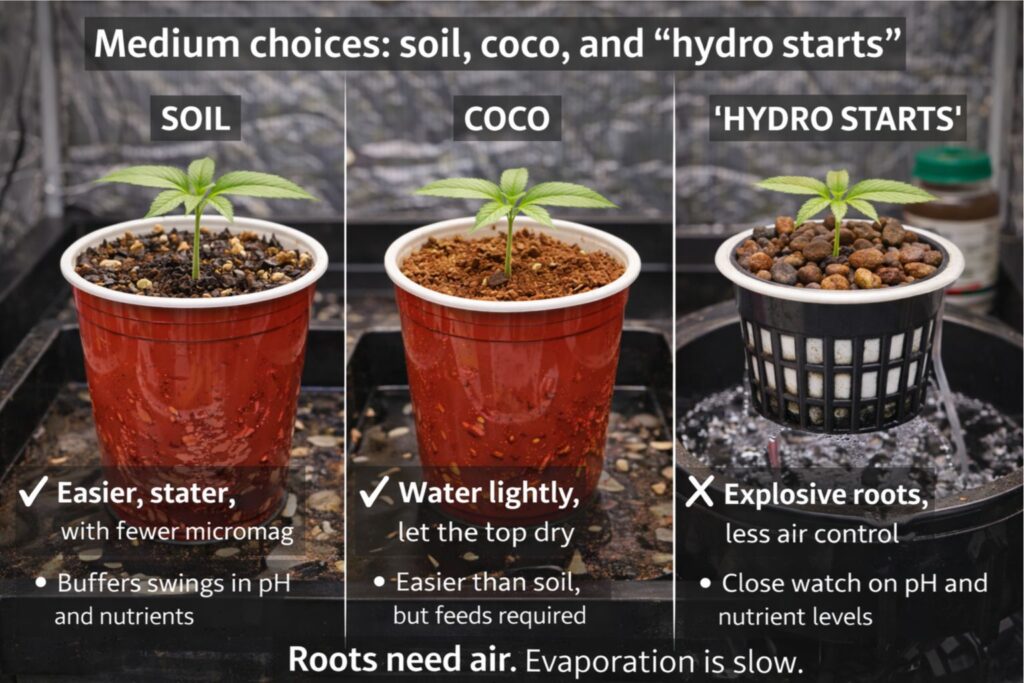
Watering changes depending on the medium. I’ve used light soil mixes, coco-perlite blends, and small hydro-style starter systems.
Soil-based mixes
Soil holds nutrients and buffers pH, which is forgiving. But soil can stay wet too long in large containers. In soil, I rely heavily on lifting cups and checking seedling root zone moisture.
Coco-perlite
Coco drains fast and holds air, but it needs consistent feeding. In coco, I still avoid constant saturation by measuring inputs, but I accept more frequent watering. A runoff-free irrigation technique can still work if your feed is consistent, but later in veg I prefer some runoff.
Small hydro starts
If you start in rockwool or another inert plug, consistency matters. The plug should be moist, not dripping, and the environment must be stable. Here, VPD for cannabis seedlings becomes even more important because the plug dries quickly under strong airflow.
Container size and the solo cup checkpoint
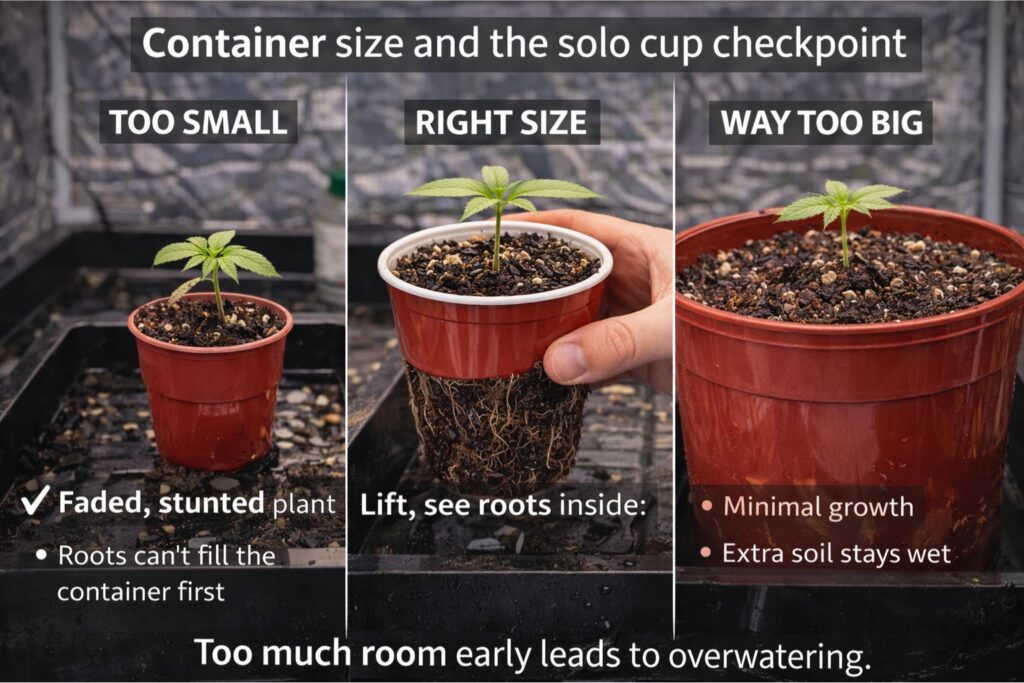
I like solo cups because they tell me the truth. When roots fill a cup, the plant starts drinking faster and the dry-back becomes predictable.
Reading the cup: the transplant trigger
I use transplant timing from solo cup as a simple rule: once the plant is drying the cup in 24–36 hours and you see roots at the drain holes, it’s time. transplant timing from solo cup also depends on genetics. Some vigorous hybrids fill faster; smaller indica-leaning plants may take longer.
I’ve delayed transplant timing from solo cup before and watched growth slow as roots circled. When I transplant on time, the plant takes off within a day or two.
Genetics and buying seeds: what watering taught me
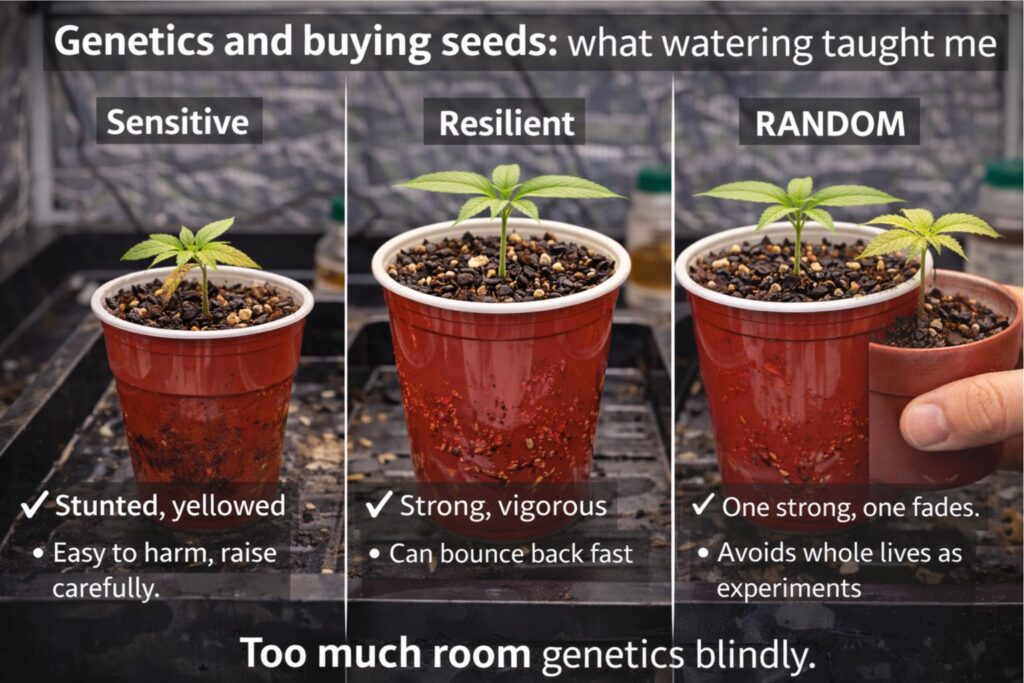
Different genetics respond differently to moisture. Some lines tolerate heavier watering; others sulk if the medium stays wet. That’s why I stopped chasing strain names and started looking at breeder reputation, stability, and realistic plant structure.
When I shop for seeds, I look for:
- Clear descriptions of growth traits and expected size
- Stable lines with documented phenotypes
- Feminized seeds when I want predictable canopy planning and fewer surprises
- Autoflowers when I need speed or have limited height
- Transparent seed banks and online seed shops with clear policies
If you’re choosing between indica, sativa, or a hybrid, remember those labels are only rough guides. I’ve seen “sativa” plants that drink slowly early on and “indica” plants that explode with growth. Your environment and medium matter as much as genetics.
On the shopping side, I prefer established seed banks with transparent shipping policies and discreet packaging. International shipping can add delays, so I time orders before I need them and store seeds cool and dry. Always check regional grow laws before ordering or cultivating; legality and plant counts vary widely.
Mycorrhizae and early root support
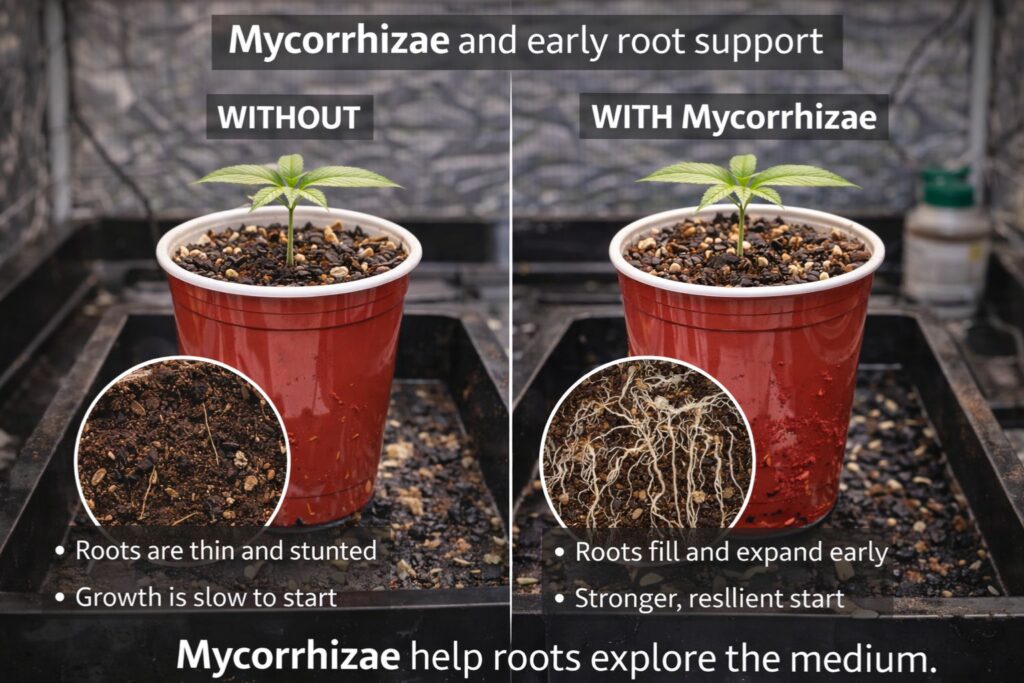
I’m not religious about additives, but mycorrhizae has been one of the few that consistently helped me when used correctly. mycorrhizae inoculation at seedling stage works best when it actually contacts the root zone.
I apply a small pinch in the planting hole or dust the transplant rootball. mycorrhizae inoculation at seedling stage is not a substitute for good watering, but it can improve resilience when you miss a watering window.
I avoid heavy sterilizing agents if I’m relying on microbes. mycorrhizae inoculation at seedling stage thrives in a moderately moist, oxygenated medium.
Pest control in the seedling area
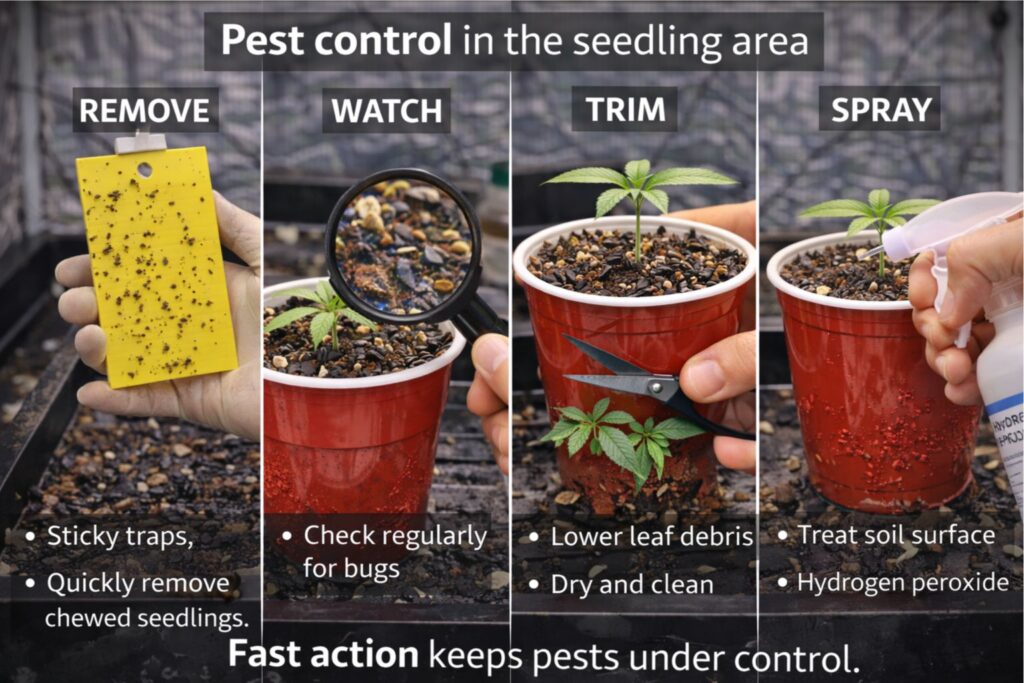
Overly wet media invites pests. Fungus gnats are the obvious one, but I also see issues with algae, which becomes a gnat nursery.
My seedling pest checklist:
- Let the surface dry slightly between waterings
- Use sticky traps to monitor adults
- Avoid standing water in trays after bottom-watering cannabis starts
- Maintain clean floors and remove spilled medium
If gnats appear, I reduce surface moisture and improve airflow first before reaching for stronger measures.
What I look for in a “good watering week”
When cannabis and seedling watering practices are dialed in, seedlings show a predictable rhythm:
- Leaves perk up after watering, then slowly relax as the medium dries
- New growth appears every day or two
- Stems thicken without stretching
- The medium smells earthy, not sour
If I see droop that doesn’t recover after lights-on, I suspect too much water. If leaves taco upward and the cup dries in hours, I suspect too much light or high VPD.
Practical checklists I actually use
Before I water
- Lift the container and compare weight to yesterday
- Look for slight drying at the surface, not crusty dryness
- Check temperature and humidity to confirm VPD range
- Confirm the seedling has enough light, not too much
While I water
- Add measured amounts in a ring, not directly at the stem
- Keep notes on ml added for each container
- Use water temperature for germination and keep early watering around 22–25°C
- Stick to the cotyledon stage watering schedule concept: weight first, calendar second
After I water
- Ensure airflow is moving across the surface
- Empty trays so there’s no standing water
- Watch for signs that seedling damping-off prevention is working: dry-ish surface, firm stems
- Re-check the cup weight later to learn the dry-back curve
FAQ: common Google-style questions I hear all the time
How often should I water weed seedlings in solo cups?
I don’t water on a fixed schedule. I lift the cup daily and water only when the container feels clearly lighter. That approach keeps seedling root zone moisture in the right range without saturating the whole cup.
What is the best VPD for small marijuana plants?
For my propagation tent, VPD for cannabis seedlings around 0.6–0.9 kPa has been a reliable target. If VPD is higher, seedlings dry too quickly and you’ll be tempted to water too often.
Should I feed seedlings right after they sprout?
Usually no. I wait until true leaves are developing, then start gentle nutrient priming for seedlings at low EC. In richer soil mixes, I often wait even longer.
Is bottom-watering safe for early seedlings?
bottom-watering cannabis starts can be safe if it’s brief and you let cups drain afterward. If cups sit in water, the lower zone stays too wet and pests can follow.
How do I prevent damping-off without chemicals?
seedling damping-off prevention is mostly airflow and moisture management. Keep the surface from staying glossy-wet for days, avoid crowded spacing, and clean trays between runs.
Do autoflowers need different seedling watering?
Autoflowers usually have a shorter timeline, so I’m careful not to stunt them with heavy watering or strong nutrients. I keep the same cannabis and seedling watering practices fundamentals, but I prioritize gentle dry-backs and avoid stressful swings.
Is it better to start in soil or hydro?
Soil is more forgiving for beginners because it buffers mistakes. Hydro-style plugs can work, but they demand stable climate and careful monitoring of VPD for cannabis seedlings. Either way, consistent seedling root zone moisture is the goal.
When do I transplant from a solo cup?
I use transplant timing from solo cup when the plant dries the container in 24–36 hours and roots show at drain holes. If you wait too long, growth slows as roots circle.
Closing: tying early watering to the full grow
I’ve noticed that cannabis and seedling watering practices influence the entire run. Seedlings that build strong roots early handle training, topping, and transplant stress better later. They also recover faster if you make a mistake in veg.
When the early stage is steady, I spend less time “fixing” plants and more time guiding them. That carries into flower and even post-harvest work: healthy plants tend to ripen more evenly, and the dry and cure are simpler because the canopy developed predictably.
If you take only one thing from my routine, make it this: manage seedling root zone moisture with container weight and environmental stability, and the rest of the decisions become obvious.
