
Why Growing Choices Matter To How Weed Feels
Genetics set the ceiling
Genotype determines potential. When I evaluate cannabis strains, I look at breeder data, lab-tested lineage, and reported chemotypes. The ratio of THC vs CBD and dominant terpenes and aroma usually predicts whether a cultivar might land as calm, clear, heavy, or bright. My notes show that three different cannabis strains grown side by side, under identical PPFD and VPD, can still deliver very different outcomes because their cannabinoid and terpene baselines differ.
Phenotype expression shapes the experience
Within one pack of feminized seeds, phenotype differences still appear. A lime-forward pheno may hit smoother than its gas-forward sister even with the same THC vs CBD numbers. The lesson: log phenotypes, keep cuts you enjoy, and be honest about what you actually feel. Over several cycles, I’ve found that keeping two phenotypes of the same cannabis strains gives me options across the indica vs sativa spectrum without changing my entire garden plan.
From seed bank to mailbox
Reputable seed banks matter for quality and predictability. I purchase feminized seeds and autoflower seeds from sources that publish clear information and ship discreetly. Shipping time, storage conditions, and regional grow laws can all affect when germination starts. None of this determines cannabis and its effects by itself, but a solid start lets the rest of the process do its work.
Environment: The Invisible Hand Behind Effects
Lighting targets for predictable potency
I run full-spectrum LEDs. In veg, I target 300–450 µmol/m²/s PPFD; in flower, 800–1,000 µmol/m²/s at the canopy. DLI lives around 18–22 mol/day in veg and 40–50 mol/day in bloom. Those numbers have consistently helped me capture the terpene clarity that shows up as smoothness and clean terpenes and aroma after cure. If PPFD creeps too high without enough CO₂ or airflow, I’ve seen harsher smoke and flatter flavor even when THC vs CBD tests look strong.
Temperature, humidity, and VPD bands I use
- Early flower: 24–26°C, 60–65% RH, VPD 1.0–1.2 kPa
- Mid-to-late flower: 24–25°C, 50–55% RH, VPD 1.2–1.4 kPa
- Drying room: 18–20°C, 55–60% RH, dark and clean
These ranges preserve terpenes and aroma and reduce the risk of botrytis and mildew. When I ignored VPD one summer, the same cannabis strains tasted muted and felt “muddy” compared to a winter run at proper VPD.
Nutrient management without the guesswork
In coco, I feed at 1.6–2.0 EC (800–1,000 PPM, 500 scale) with adequate calcium and magnesium. In living soil, I top-dress and brew microbe teas. Either way, my late-bloom nutrient management tapers nitrogen and supports potassium and sulfur for terpene synthesis. Overfeeding late has repeatedly dulled terpenes and aroma and made smoke harsher. Balanced nutrient management has done more for a pleasant, even experience than chasing an extra percent of THC.
Media, Photoperiods, and Plant Type: Choosing the Right Path
Feminized seeds for uniformity
For most of my production, feminized seeds save time and space. The uniformity makes it easier to compare cannabis and its effects across lighting tweaks, training methods, and dry/cure schedules. Over several cycles, feminized seeds have given me tighter ranges on THC vs CBD and more consistent terpenes and aroma. That consistency shows up in customer notes too.
Autoflower seeds for quick turnarounds
When I need material fast, I stagger autoflower seeds under 18–20 hours of light. Modern autos can be terp-heavy and potent. Three back-to-back runs showed me that autoflower seeds can match photoperiod quality when nutrient management and VPD are on point. They also let me sample more cannabis strains in a year, which clarifies how indica vs sativa lean contributes to feel.
Photoperiod control and training
For photoperiods, I top once at the fifth node, then low-stress train to keep PPFD even. I’ve used SCROG in small spaces; it boosts yield and homogenizes flower, which reduces batch-to-batch variation in cannabis and its effects. I flip to 12/12 when plants reach 70–80% of final height. If stretch surprises me, I lower dimmers slightly while keeping DLI steady so I don’t cook terpenes and aroma at the top colas.
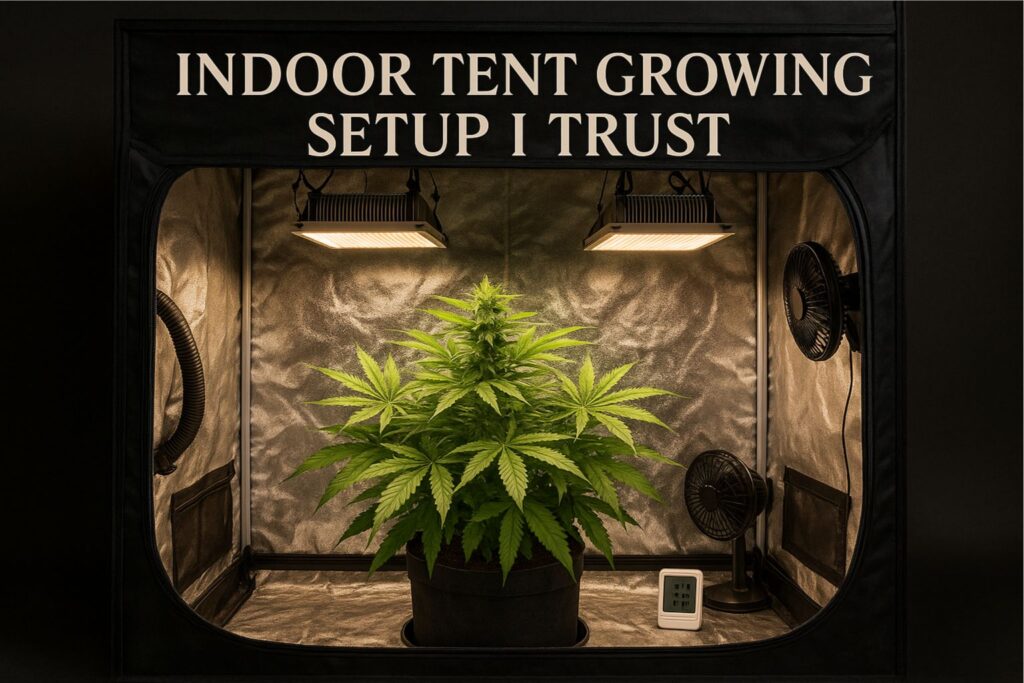
Indoor Tent Growing Setup I Trust
Tent, intake, and exhaust
My standard indoor tent growing footprint is 2×4 feet with a 6-inch exhaust, carbon filter, and oscillating fans. Passive intake plus pre-filters keeps dust down, which helps with pest and disease control later. This compact system has produced reliable marijuana with full flavors as long as I keep RH and VPD in check.
Sensors and sanity checks
I verify PPFD with a PAR meter and double-check temperatures with an independent probe. Cheap hygrometers can drift, so I calibrate with a salt test. When numbers are honest, adjustments to indoor tent growing are small and effective. The reward is clearer terpenes and aroma and steadier THC vs CBD across cycles.
Irrigation rhythm
In coco, I feed to 10–20% runoff daily in late veg and early flower, which stabilizes EC and PPM. In soil, I water by pot weight. Both approaches are nutrient management in practice, and both directly influence cannabis and its effects: stressed roots lead to sharp flavors and inconsistent outcomes.
Pest and Disease Control Without Nuking Your Terps
Prevent first
Sticky cards, weekly leaf inspections, and cleaning tools between tents are my baseline. I quarantine new clones. For pest and disease control that protects terpenes and aroma, I prefer biologicals in veg and avoid sprays in late flower. Airflow and leafing are simple but powerful.
When issues appear
If I spot mites early, I respond with targeted biologicals and physical removal. For powdery mildew, environment comes first: lower RH, increase airflow, and remove infected leaves. A clean harvest tastes better and feels smoother, which has taught me that pest and disease control is not just about yield—it’s about the experience later.
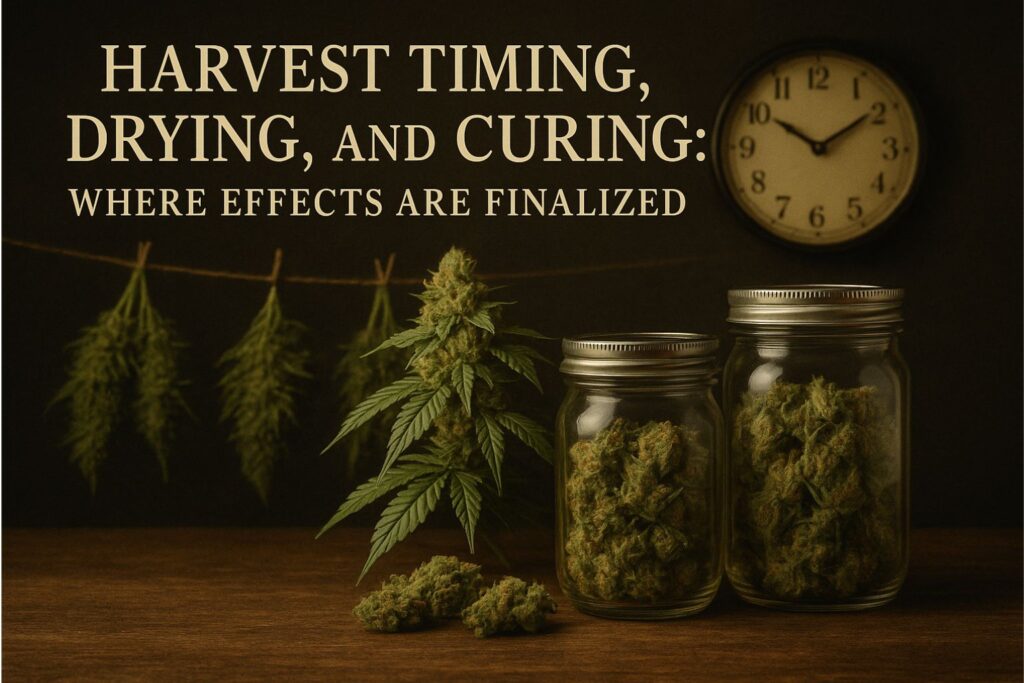
Harvest Timing, Drying, and Curing: Where Effects Are Finalized
Watching trichomes and pistils
I harvest most cannabis strains with mostly cloudy trichomes and 5–15% amber. Earlier pulls can feel racier; later pulls can feel heavier. That timing interacts with indica vs sativa leanings and with THC vs CBD balance. It’s one of the final, precise levers we have on cannabis and its effects.
Drying that protects the good stuff
I dry for 10–14 days at 18–20°C and 55–60% RH. Fast, hot dries collapse terpenes and aroma and create a rough finish. Slow, cool dries preserve what the plant worked to build. I use gentle air movement that doesn’t blow on buds. The difference is obvious in any method of consumption.
Curing for stability
I cure in glass at 58–62% RH with weekly burps for the first two weeks. After a month, the marijuana taste rounds out, and I notice smoother edges regardless of indica vs sativa leaning. If a jar smells of fresh grass, I revisit dry room RH rather than blaming the cultivar.
How Consumption Method Changes What You Feel
Combustion and vaporization
Combustion is familiar and immediate. Vaporization is cleaner and highlights terpenes and aroma. With the same cannabis strains, vapor at lower temps (170–190°C) feels lighter; higher temps (200–220°C) feel fuller. THC vs CBD ratios remain the anchor, but terpenes and aroma are more noticeable in a vape.
Edibles and tinctures
Decarboxylation and infusion technique decide potency and onset. My standard decarb is 115–120°C for 35–45 minutes, verified with a probe. For tincture, I make a quick, cold ethanol wash and reduce to strength. Edibles translate indoor tent growing quality into flavor: clean nutrient management and careful cure make a better gummy every time.
Indica vs Sativa, Or Something Deeper?
Chemotype over marketing
Indica vs sativa can hint at feel, but the most reliable predictor I have is a strain’s THC vs CBD ratio plus dominant terpenes and aroma. For example, two sativas with different terpene profiles can feel very different. My advice: track your own reactions and match them to the lab data where available.
Blending for balance
Sometimes I blend two cannabis strains to tune cannabis and its effects. A citrus-forward cultivar can brighten a heavy kush. If you enjoy edibles, blending tinctures is straightforward and repeatable.
Beginner’s Corner: Start Clean, Stay Curious

Germination that sets you up to win
I keep germination at 22–25°C with high humidity, either in paper towels or starter plugs. Germination logs include time to pop and vigor after transplant. Managing germination well means a stronger plant later, which influences yield, terpenes and aroma, and ultimately cannabis and its effects.
Simple first run in a tent
For indoor tent growing, run one light, one nutrient line, and one or two cannabis strains. Focus on PPFD, VPD, and nutrient management basics. Keep pest and disease control preventative and gentle. A straightforward first harvest is the fastest teacher.
Troubleshooting Effects: If Your Weed Feels Off
Harsh, quick fade
Possible causes: hot, rapid dry; too much nitrogen late; over-lighting at the canopy. Solutions: lower dry temp, taper feeds, map PPFD. Revisit nutrient management.
Flat, grassy flavor
Possible causes: early harvest; rushed dry; jars above 65% RH. Solutions: wait for cloudy trichomes, extend dry, stabilize cure. This is where terpenes and aroma are either saved or lost.
Inconsistent experiences between jars
Possible causes: uneven canopy light; mixed phenotypes; cure jars at different RH. Solutions: train evenly, label phenotypes of feminized seeds, use humidity packs. Keep indoor tent growing steady.
Seed Shopping, Shipping, and Regional Considerations

Choosing the right vendor
Reputable seed banks publish clear information and handle shipping discreetly. I look for clear lineage, realistic flowering times, and transparent storage methods. This is true whether I’m buying feminized seeds or autoflower seeds.
Matching seeds to your space
Small tent or balcony? Autoflower seeds shine. Bigger tent with training time? Feminized seeds and photoperiods let you shape the canopy. Either path can deliver satisfying cannabis and its effects when environment and nutrient management cooperate.
Know your local rules
Plant counts, visibility, and security requirements vary. Check regional grow laws before you start. Good choices here keep the focus on cultivation, not complications.
Checklists I Use Every Cycle
Environment checklist
- Calibrate meters; verify PPFD and DLI
- Set temp/RH targets for VPD phase by phase
- Confirm fans, filters, and intake are clean
Nutrient management checklist
- Mix fresh solution; log EC/PPM and pH
- Track runoff; adjust feed strength slowly
- Taper nitrogen in late bloom; monitor leaf color
Pest and disease control checklist
- Inspect undersides of leaves weekly
- Refresh sticky cards; clean scissors and stakes
- Avoid foliar sprays once pistils set
Post-harvest checklist
- Dark, cool, clean dry room at 55–60% RH
- Gentle trim; no heat during cure
- Label jars by cannabis strains and phenotype; record RH
FAQ: Natural-Language Questions I Hear Often
What affects cannabis and its effects more: strain or environment?
Both matter. Cannabis strains set the chemical potential. Environment, nutrient management, and drying decide how much of that potential survives. Track THC vs CBD data where possible and compare your logs.
Are feminized seeds better than regular for beginners?
Feminized seeds remove sexing and save space. For a first indoor tent growing run, they simplify planning. Regular seeds are great for breeding projects later.
Do autoflower seeds make weaker marijuana?
Not in my experience. With correct PPFD, VPD, and nutrient management, autoflower seeds can match photoperiod potency and deliver excellent terpenes and aroma.
What’s a good starting light intensity?
Aim for 300–450 µmol/m²/s PPFD in veg and 800–1,000 µmol/m²/s in flower. Measure at canopy height. Numbers bring indoor tent growing under control.
How do I keep pests away without ruining flavor?
Focus on prevention. Maintain airflow, cleanliness, and quarantines. Use biologicals in veg. Smart pest and disease control preserves terpenes and aroma and supports enjoyable outcomes.
Closing Thoughts: Cultivate the Experience You Want
Cannabis and its effects begin with the seed you choose and end with how you dry, cure, and consume. Across dozens of cycles, three themes keep showing up. First, choose cannabis strains intentionally and verify with your senses and notes. Second, let the environment work for you by measuring PPFD, EC/PPM, temperature, RH, and VPD. Third, stay consistent with nutrient management, gentle pest and disease control, and a patient dry and cure.
Whether you favor indica vs sativa leaners, prefer feminized seeds for uniformity, or rely on autoflower seeds for quick harvests, the path is the same: clear goals, honest logging, and small improvements every run. In my garden, that approach has turned unpredictable weed into predictable marijuana with flavors I can trace back to terpenes and aroma and a feel I can explain through THC vs CBD. That’s the craft, and it’s reachable for any careful home grower.
