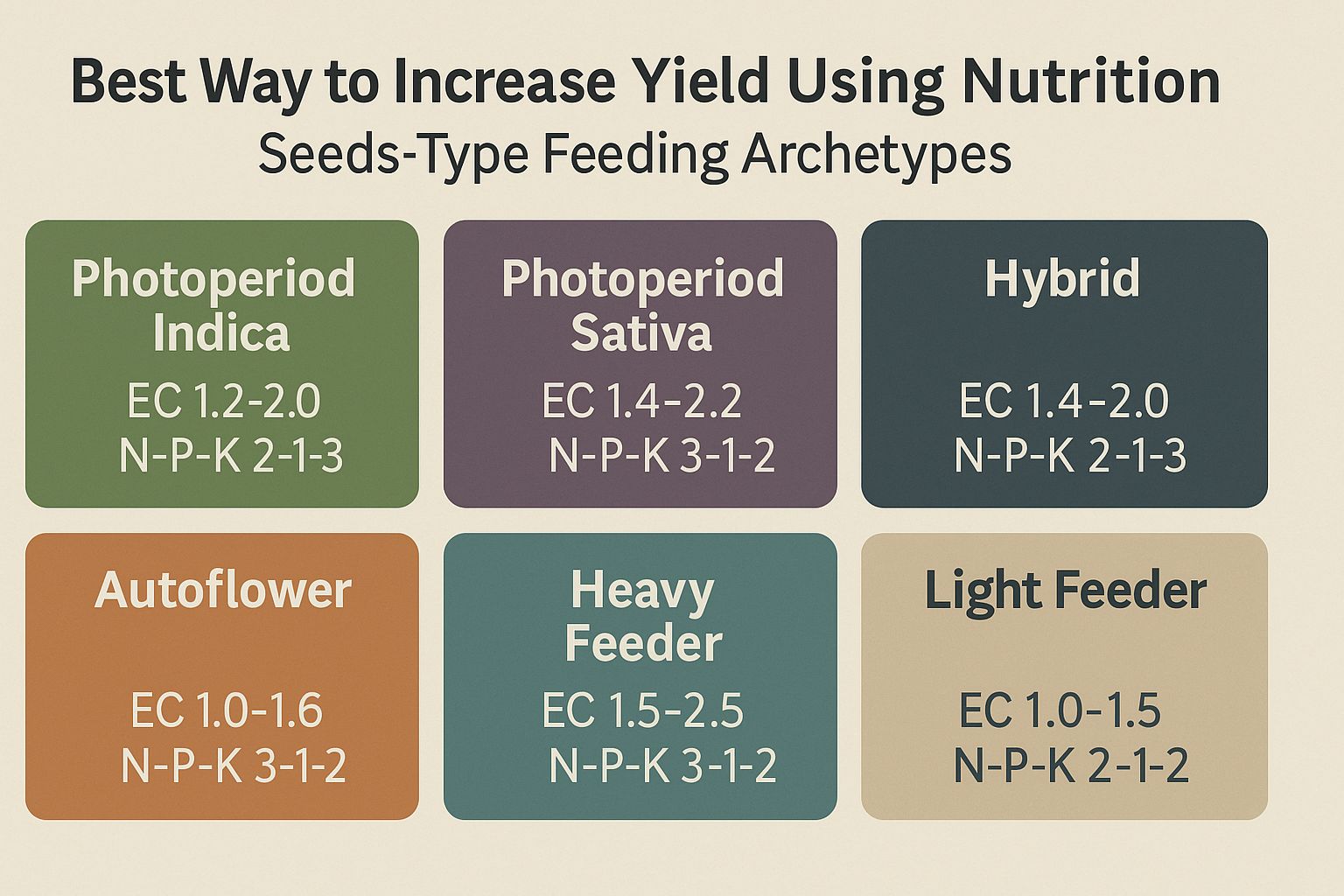
Increase Yield Using Nutrition: Why seed type changes how you should feed cannabis plants.
The phrase “seed type” usually makes people think of autoflower vs photoperiod, or feminized cannabis seeds vs regular. Those differences matter, but from a nutrition standpoint I care even more about how the genetics behave in the pot.
Over time I noticed patterns:
- Some indica-leaning lines stayed dark green on very low EC.
- Certain sativa hybrids clawed and burned on the same mix.
- Heavier, chunky hybrids kept asking for more food right into late flower.
When I started tracking this in my grow notes, I realized I was looking at distinct cannabis feeding archetypes. Today I treat a tray of beginner friendly weed seeds very differently depending on whether they fall into a light feeder cannabis strains group or a heavy feeder cannabis strains group.
Instead of pushing every plant on the same cannabis nutrient schedule from a feed chart, I now:
- Start them all on a conservative baseline.
- Watch how fast they drink and how their leaf color shifts.
- Move them up or down into different feeding groups by week three or four.
That simple habit alone is one of my biggest indoor cannabis yield tips.
The Four Cannabis Feeding Archetypes I Use

You can slice this many ways, but these four archetypes cover most of the marijuana plants I’ve grown.
1. Light Feeder Cannabis Strains
These are the plants that stay happy and productive on the low end of any cannabis nutrient schedule. They usually show:
- Long, narrow leaves.
- Faster vertical stretch.
- Quick reactions to overfeeding.
Classic haze-leaning hybrids and some landrace-influenced lines often fall here. In coco or hydro, I might only run 0.8–1.2 EC in mid veg and peak around 1.6 EC in flower, watching cannabis EC and PPM closely for any spike.
With these light feeder cannabis strains, my main rule is “never chase the bottle.” If leaf color is good and growth is steady, I resist the urge to add more nutrients just because a chart says so—Increase Yield Using Nutrition comes from consistency, not overfeeding. That restraint alone has saved many new growers from burning sensitive genetics when feeding marijuana plants.
2. Balanced Feeders
Balanced feeders are the easiest archetype for most growers and make excellent beginner friendly weed seeds. Their traits:
- Medium leaf size and internode spacing.
- Solid root development without explosive stretch.
- Happy in the middle of standard feeding ranges.
Most modern hybrids advertised as easy or versatile fall into this category. I follow a standard cannabis nutrient schedule from the manufacturer, then adjust cannabis EC and PPM slightly based on runoff and leaf color.
Balanced feeders also respond well to organic cannabis nutrients. If you like to top-dress dry amendments or run living soil indoors, I recommend picking strains that breeders describe as resilient or beginner friendly.
3. Heavy Feeder Cannabis Strains
Heavy feeder cannabis strains are the ones that really let you push yields when you get nutrition right. They often have:
- Thick, dark leaves.
- Stocky structure with dense branching.
- Appetite that increases sharply under strong light.
When I’m feeding marijuana plants from this archetype in coco, I might run 1.4–1.8 EC in veg and 1.8–2.2 EC in peak flower, always tracking cannabis EC and PPM at both input and runoff.
Heavier feeders particularly benefit from:
- Consistent irrigation rather than feast–famine cycles.
- Slightly higher levels of calcium and magnesium.
- Aggressive but controlled lighting, around 800–900 PPFD in bloom if VPD is dialed in.
If your goal is maximum production, stacking your tent with heavy feeder cannabis strains and running them on an advanced cannabis nutrient schedule can be one of the best indoor cannabis yield tips you’ll ever implement.
4. Sensitive Autos
Autoflower seeds complicate things because they are on their own timer. A mistake in week three can haunt the rest of the cycle.
From a nutrition standpoint I treat many autos like a cross between light feeder cannabis strains and balanced feeders. My typical autoflower nutrient schedule looks like this:
- Very mild feed (0.6–0.8 EC) once true leaves set.
- Gradual rise to 1.2–1.4 EC in mid-veg / early flower.
- Careful monitoring of cannabis EC and PPM in runoff, backing off quickly at the first sign of burn.
Because you cannot extend veg to recover, my autoflower nutrient schedule always favors “slightly under” over “slightly over.” This conservative approach is especially important when working with beginner friendly weed seeds that happen to be autos.
Building A Cannabis Nutrient Schedule Around Archetypes
Once you recognize cannabis feeding archetypes, you can design your cannabis nutrient schedule in layers instead of forcing every plant into one rigid plan.
Step 1: Start With A Baseline
For most indoor runs I start with:
- Coco or coco-heavy mix in fabric pots.
- pH between 5.7 and 6.1 in coco, or 6.2–6.8 in soil, to keep nutrient availability in the sweet spot.
- EC around 0.6–0.8 for rooted clones or seedlings.
At this stage I am mostly focused on root development, not yield. I keep organic cannabis nutrients light and avoid strong boosters until plants show they can handle it.
Step 2: Watch Runoff And Growth
By week three in veg I am checking:
- Runoff EC vs input EC.
- Leaf color, especially new growth.
- Overall vigor and internode spacing.
If runoff EC is rising and leaves are dark or clawed, I treat that plant as a light feeder. If EC is steady and the plant looks hungry, it may belong in the heavy feeder group. Increase Yield Using Nutrition by matching seeds to these cannabis feeding archetypes early, which helps prevent the nutrient issues that often derail a cannabis nutrient schedule.
Step 3: Split Your Feeding Marijuana Plants Into Groups
Practically, this means labeling pots and mixing two or three different strengths of nutrient solution:
- Light feeder mix
- Medium mix
- Heavy mix
For example, you might run 1.2 EC for light feeder cannabis strains, 1.6 EC for balanced feeders, and 1.9 EC for heavy feeder cannabis strains. Combined with correct pH and runoff practices, this simple grouping is one of the most reliable indoor cannabis yield tips I can offer.
How Seed Type And Genetics Influence Feeding
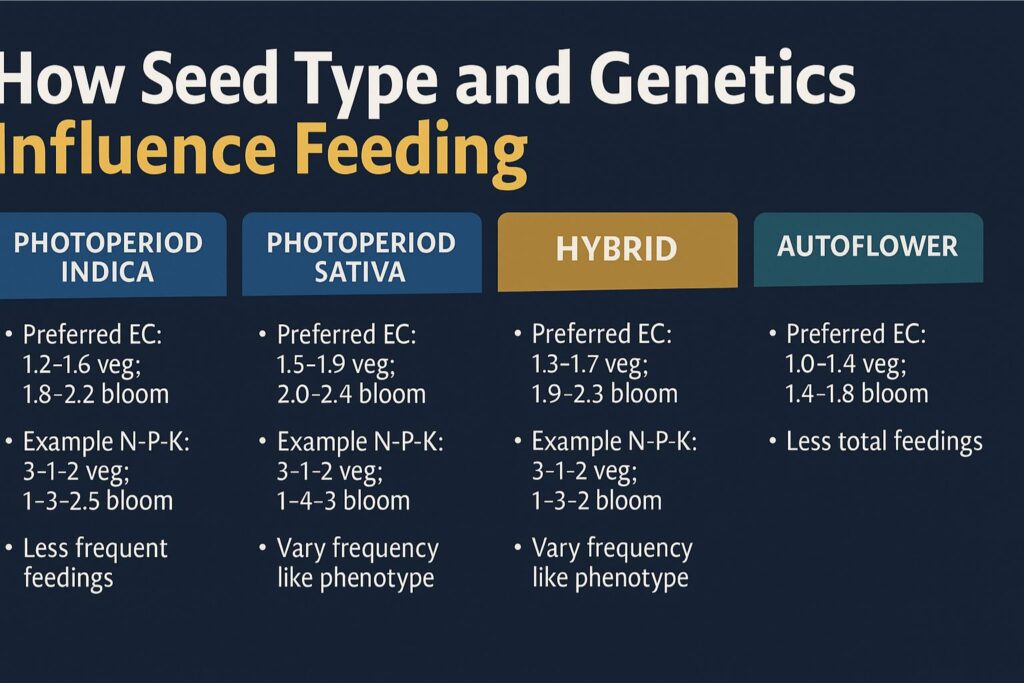
Beyond feeding archetypes, the actual seed type still matters. Here is how I factor that into my decisions.
Feminized Cannabis Seeds
Feminized cannabis seeds are my default for most indoor runs, and Increase Yield Using Nutrition is a big reason why. Because I don’t need to remove males, I can focus entirely on dialing in the cannabis nutrient schedule and training. For feminized lines I:
- Run slightly longer veg times to fill the canopy.
- Use topping and low-stress training without worrying about wasted males.
- Track which phenotype fits which cannabis feeding archetypes and clone keeper cuts.
Many breeders label which feminized cannabis seeds are easy, medium, or advanced. I cross-reference that with my experience and earmark the “easy” lines as beginner friendly weed seeds for newer growers.
Autoflowers And Their Nutritional Limits
Autoflower seeds demand a cautious autoflower nutrient schedule. I try to:
- Avoid heavy transplant shocks.
- Start in the final pot.
- Apply gentle, frequent feeds instead of big jumps.
Because many autos are marketed to new growers, understanding their place in cannabis feeding archetypes is vital. I consider them medium at best unless the breeder clearly notes they can handle strong feeding marijuana plants routines.
Indica, Sativa, And Hybrid Expectations
While not a hard rule, I often find:
- Many sativa-leaning lines behave closer to light feeder cannabis strains.
- Many compact, indica-leaning hybrids lean into heavy feeder cannabis strains.
- Balanced hybrids can fall anywhere, so I rely on observation and notes rather than assumptions.
Using Organic Cannabis Nutrients Inside Feeding Archetypes
When I switched part of my garden to organic cannabis nutrients, I worried I would lose the fine-tuned control of EC and PPM. What I found instead was a slightly slower, more buffered response that still fit within my cannabis feeding archetypes.
In practice:
- I still monitor cannabis EC and PPM in runoff, but I interpret the numbers as trends rather than strict limits.
- Light feeder cannabis strains get lighter top-dressings and more time between amendments.
- Heavy feeder cannabis strains handle bigger doses of dry amendments and teas.
Organic lines can still burn plants if you overdo it, but the damage often unfolds more slowly. That slower pace gives me a little more time to correct the cannabis nutrient schedule before yields suffer.
Real-World Examples From My Grow Room
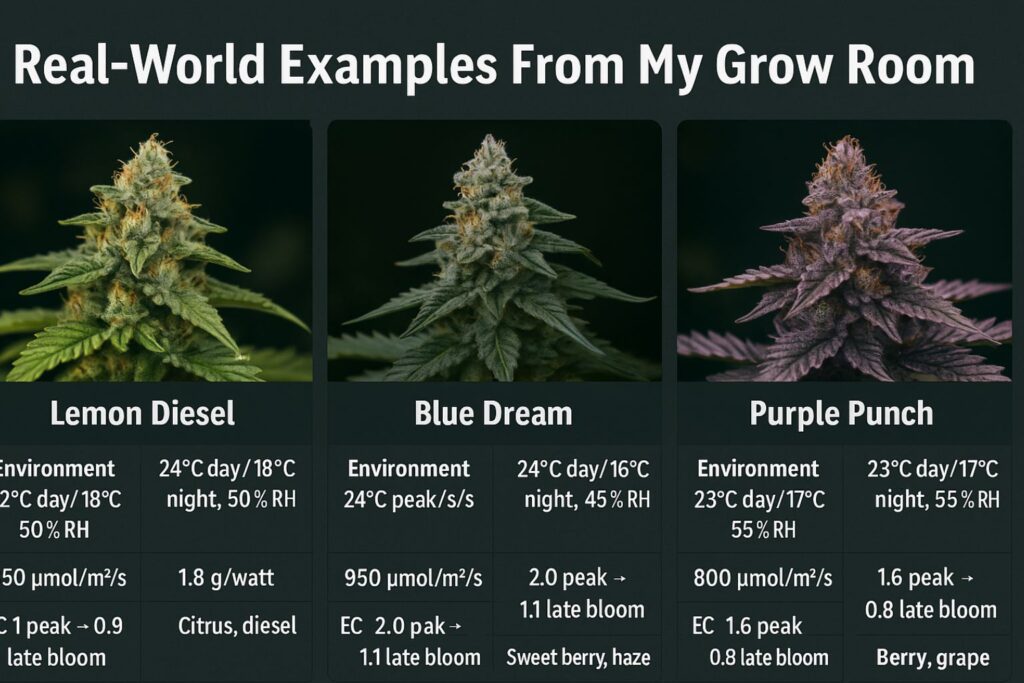
To make this less abstract, here is how I approached feeding marijuana plants from three different archetypes in the same tent.
Example 1: Balanced Hybrid In Coco
Seed type: feminized cannabis seeds, hybrid marketed as “easy.”
- Classified as a balanced feeder by week three.
- Veg EC 1.2–1.4, flower EC 1.6–1.8.
- Moderate defoliation and basic LST.
This plant finished with dense, golf-ball sized buds and zero nutrient burn. Matching it to the balanced cannabis feeding archetypes group allowed me to follow a standard cannabis nutrient schedule with only minor tweaks.
Example 2: Light Feeder Haze Hybrid In Soil
Seed type: regular, sativa-leaning.
- Pale new growth showed early sensitivity.
- Soil mix heavily amended with organic cannabis nutrients from the start.
- Very light liquid feeds, mostly microbe teas and calcium supplements.
Despite being fed less than most charts recommend, this plant yielded well and produced clean-burning, aromatic weed. Treating it as one of my light feeder cannabis strains saved it from chronic overfeeding.
Example 3: Heavy Feeder Indica Hybrid In Coco
Seed type: feminized cannabis seeds, indica-dominant.
- Dark foliage and thick stems even at low EC.
- Ramp-up to 2.0 EC in mid-flower under 850 PPFD.
- Careful monitoring of cannabis EC and PPM to avoid lockout.
This was one of my best indoor cannabis yield tips in action: recognizing a heavy feeder cannabis strain early and feeding it hard but clean. With regular runoff checks and a strong cannabis nutrient schedule, the plant finished with rock-hard colas and no deficiency.
Indoor Cannabis Yield Tips That Work With Any Archetype
Regardless of which cannabis feeding archetypes you are running, a few universal practices always improve yield:
- Keep temperatures in the 72–80°F (22–27°C) range with appropriate humidity and VPD.
- Make sure your lighting matches your feeding; underfed plants cannot fully use strong LEDs.
- Use oscillating fans and regular pruning to prevent microclimates and mold.
- Track every change in your grow log, including EC, PPM, pH, and visual notes.
When you combine these indoor cannabis yield tips with the right cannabis nutrient schedule for each archetype, yield increases become predictable instead of lucky.
FAQ: Seed-Type Feeding Archetypes And Nutrition
How do I know which cannabis feeding archetypes my new seeds belong to?
Start with conservative feeding marijuana plants, then watch how quickly they drink and how their leaves respond in the first three weeks. Dark green leaves and strong growth at low EC often signal light feeder cannabis strains, while pale or hungry-looking plants at moderate EC may be heavy feeder cannabis strains.
Can I run one cannabis nutrient schedule if I have mixed seed types?
You can, but you will likely be compromising. I recommend at least two mixes: one for light feeder cannabis strains and one for heavy or balanced feeders. Even that small change can greatly improve yields for mixed trays of beginner friendly weed seeds.
How should I adjust my autoflower nutrient schedule compared to photos?
For autos, keep your autoflower nutrient schedule milder overall, especially in early life. Avoid big jumps in EC, and monitor cannabis EC and PPM in runoff closely. Because autos have fixed life cycles, any major stress early on will cap your final yield.
Do feminized cannabis seeds need different nutrients from regular seeds?
Not inherently. Feminized cannabis seeds follow the same cannabis feeding archetypes as regular seeds. The advantage is logistical: since you are not discarding males, you can dedicate more space and attention to refining your cannabis nutrient schedule and training.
Are organic cannabis nutrients better for yield?
They are not automatically better or worse. Organic cannabis nutrients can produce excellent quality and competitive yields, especially when combined with good environment and the right cannabis feeding archetypes. The key is consistency and understanding how slowly or quickly your organic amendments release nutrients.
Final Thoughts
The best way to increase yield using nutrition is not chasing a universal “perfect” feed chart. It is learning to read your plants, grouping them into practical cannabis feeding archetypes, and then tailoring your cannabis nutrient schedule to those groups.
Whether you run autoflower nutrient schedule experiments, push heavy feeder cannabis strains in coco, or keep things simple with organic cannabis nutrients in soil, the same principle applies: let the seed type and plant behavior tell you how to feed.
Once you do, you will stop fighting your genetics and start working with them. Your jars, your trim tray, and your future grows will all show the difference.
