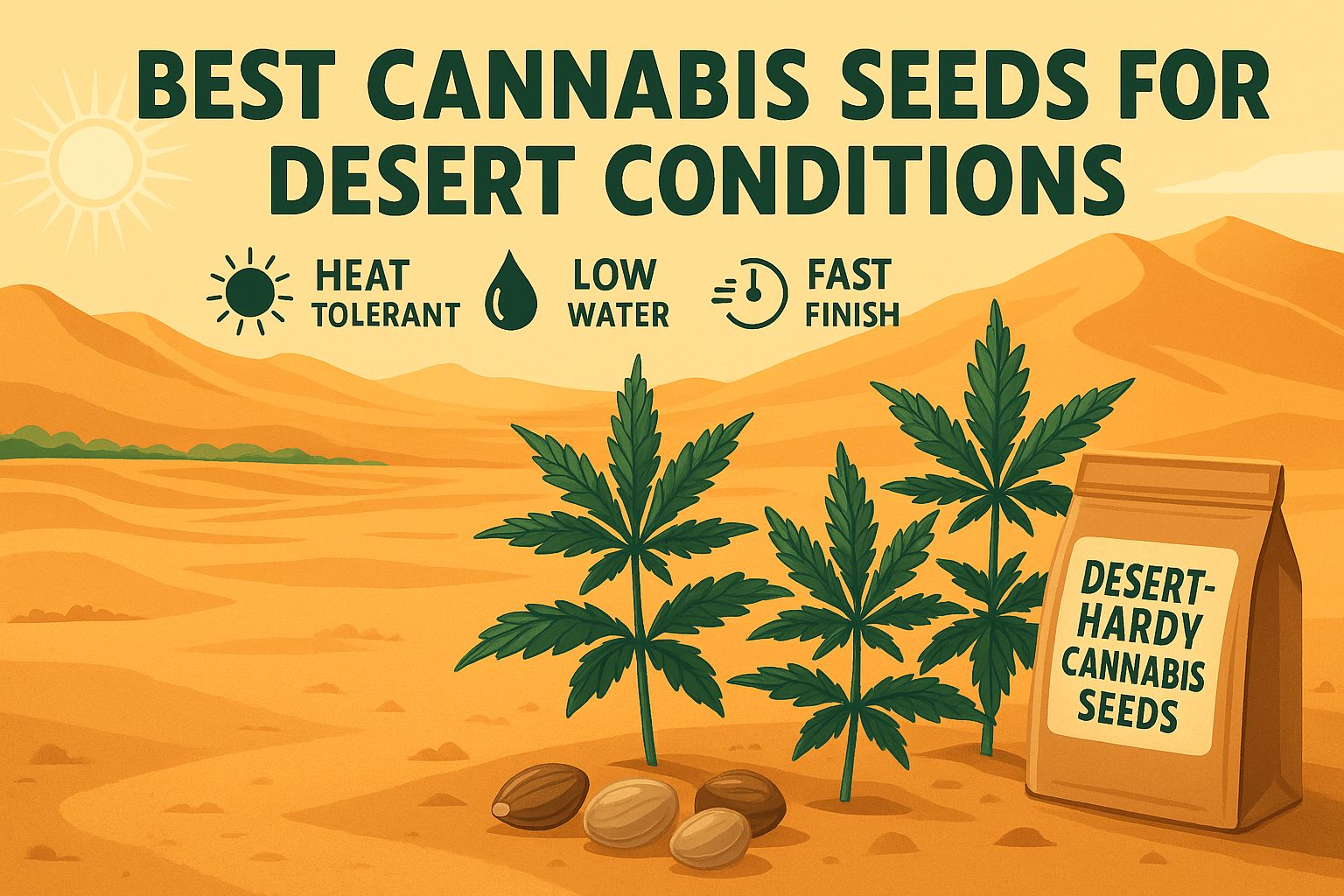
Why the Desert Demands a Different Playbook
I grow in a place where summer pavement shimmers at noon and humidity readings often sit in the single digits. When you cultivate cannabis in these conditions, you quickly learn that the best seeds for desert conditions aren’t just a marketing line; they’re the difference between a thriving canopy and a stressed patchwork of survivors. Over the past few years I’ve run side-by-side trials in tents and small greenhouse bays, cycling through multiple phenotypes, mediums, and irrigation strategies to identify desert cannabis strains that consistently finish well. This article captures those hard-earned insights, focusing on drought-resistant cannabis selections, heat-tolerant genetics, and day-to-day practices that keep plants happy when the sun is relentless.
I’ll cover how I evaluate seed stock, what I’ve learned about VPD management at 40°C outdoor ambient, the role of drip irrigation for cannabis in sandy soils, and why coco coir growing has become my default approach for fast recovery after heat spikes. You’ll find practical notes for germination in arid climates, and a candid comparison of soil vs hydro for desert growing based on crop steering data, not speculation. Throughout, I’ll point to which traits I prioritize when choosing the best seeds for desert conditions so you can replicate the process in your own environment.
What Makes a Seed “Desert-Ready” in Practice
Genetic traits I look for
From trialing dozens of lines, the desert keepers have a few things in common:
- Shorter internodes and sturdy leaf petioles that resist wind desiccation
- Thick leaf cuticles and slightly smaller leaflets that transpire less under high VPD
- Early to mid-flowering timing to beat the hottest late-summer weeks
- Roots that rapidly colonize media for better water uptake under heat
In other words, desert cannabis strains that excel here are often hybrids with rugged, landrace-influenced vigor. I specifically hunt for heat-tolerant genetics that don’t fold when midday temps push past 35°C inside a vented greenhouse despite active cooling.
Seed form factor and reliability
For production predictability, I mostly run feminized seeds. In the desert, wasted space from males is a bigger penalty because every square foot needs tight irrigation coverage. Feminized seeds simplify planning, reduce transplant shocks by eliminating culls, and allow me to optimize drip irrigation for cannabis with precise emitter placement from day one. Autos have their place (I’ll detail those), but for large cycles my winners are still regular photoperiods made predictable with feminized seeds.
My Environment and Targets
Ambient, canopy, and VPD management
Daytime ambient 33–42°C is common. Indoors, I aim for canopy temps of 27–30°C in veg and 24–28°C in flower with night drops of 3–5°C. Relative humidity is the limiter; outside it can be 10–25%. To keep stomata open without runaway stress, VPD management is essential. I target:
- Veg VPD: 0.9–1.1 kPa
- Early flower VPD: 1.1–1.3 kPa
- Late flower VPD: 1.3–1.5 kPa
These targets are achievable with fogging or ultrasonic humidification in sealed rooms, but in vented greenhouses I rely on staged evaporative cooling and careful irrigation timing. Repeating this: VPD management is the number-one driver of success in my desert runs.
Lighting and PPFD under heat
Even tough, heat-tolerant genetics will underperform if PPFD is mismatched to heat load. In veg I run 300–450 µmol/m²/s and ramp to 700–900 µmol/m²/s in mid flower, topping out at 1000–1100 µmol/m²/s only if leaf temps are stable and CO₂ is above 900 ppm. Under desert conditions, chasing 1200+ PPFD without airtight control usually backfires. When I back PPFD off slightly during heat waves, resin quality and color hold better, especially with desert cannabis strains that prefer moderate intensity while keeping VPD in range.
Mediums and Water: What Actually Holds Up
Why coco coir growing is my default
I’ve run soil, rockwool, and coco. Coco coir growing consistently gives me the fastest bounce-back after heat stress. It drains quickly, oxygenates roots in hot spells, and pairs beautifully with drip irrigation for cannabis. With coco I run 20–30% perlite or pumice, 2–6 small irrigations per light cycle in veg, and 4–10 pulses in flower depending on EC and dryback targets. This is particularly valuable for drought-resistant cannabis lines because they thrive when roots never see long periods of saturation.
Soil vs hydro for desert growing
I’ve done multiple A/B runs with living soil beds and high-frequency fertigation. Soil wins for microbial buffer and flavor complexity, but it struggles when greenhouse temps go volatile—root zones can stay warm longer and recovery from midday wilt is slower. On the hydro end, rockwool performs but punishes any irrigation mistake under desert heat. For most growers, the middle path is best: coco offers hydro responsiveness with soil forgiveness. If you’re choosing soil vs hydro for desert growing, my data suggests coco-based fertigation is the most resilient choice three cycles out of four.
Irrigation hardware that survives
For drip irrigation for cannabis, I use pressure-compensating 2 L/hr emitters with anti-siphon features to prevent backflow in elevated beds. I place two emitters per 3–5 gallon container and three per 7–10 gallon. I run inline filters at 120 mesh and flush weekly. In sand-blown areas, I’ve learned to shield lines with inexpensive landscape fabric to limit UV and grit abrasion. Simple changes like these keep drip irrigation for cannabis systems from clogging right when your plants need them most.
Nutrients, EC, and Foliar Strategy
Baselines that survived the summer
In coco, my safe summer baseline:
- Veg: 1.3–1.6 EC, pH 5.8–6.0
- Early flower: 1.7–1.9 EC
- Peak bulking: 2.0–2.2 EC if runoff stays below 2.5–2.8 and tips aren’t burning
- Flush/taper: 0.8–1.0 EC final 7–10 days
Heat-tolerant genetics can handle slightly higher EC, but only if irrigation frequency is dialed and VPD management is stable. With drought-resistant cannabis lines, I keep calcium and magnesium consistent and avoid large swings to prevent mid-flower interveinal chlorosis.
Foliar in low humidity
Low humidity can tempt overuse of foliar sprays. I keep foliar to early veg and pre-flower only, lights dimmed, and water treated to avoid spotting. For germination in arid climates and early seedling stages, I’ll use humidity domes rather than foliar crutches; domes make a bigger difference when air sits at 20% RH.
Germination and Early Growth in the Desert
My process for germination in arid climates
Germination in arid climates is less about gimmicks and more about moisture retention:
- Soak seeds 12–18 hours at 20–22°C
- Paper towel method inside a vented, lightly sealed container at 24–26°C
- Transplant taproot-down into pre-wet coco plugs after 24–48 hours
- Use a dome at 70–80% RH for days 1–5, then step down to 60–65%
Staying disciplined with germination in arid climates avoids early drought stress that can stunt forever. Even the best seeds for desert conditions won’t save a seedling that desiccates on day two.
Autos vs photos from a desert perspective
Autoflower seeds shine in shoulder seasons when heat is lower and daylight is abundant. I’ve had great quick turns with autoflower seeds from April–May and September–October cycles. During peak summer, photoperiods give me more control; I can veg under cooler conditions and flip when the forecast softens. If you’re using autoflower seeds in peak heat, keep containers smaller, pulse irrigations more often, and shelter mid-afternoon. I mention this because many growers expect autos to be set-and-forget; in the desert, autoflower seeds still need attentive VPD management and irrigation nuance.
Cultivar Examples That Have Worked For Me
Traits over names
Seed names change, but traits hold. When I evaluate desert cannabis strains now, I look for:
- Narrow-to-medium leaves and upright branching
- Mid-length flowering (56–63 days)
- Bud structure that’s not too dense, reducing late-flower foxtail risk
- Proven performance from breeders who test in heat
Pair those markers with heat-tolerant genetics from reputable seed banks, and your odds go up. I maintain a small mother library from feminized seeds that meet these criteria so I can re-run keepers across seasons.
Training, Canopy, and Air Movement
Low-stress training beats hard topping in heat
In hot weeks, hard topping has cost me a week of recovery. I now lean on LST, trellis guidance, and selective supercropping only when plants are robust. This lets heat-tolerant genetics keep metabolism humming without stress spikes. Indoors, I keep oscillating fans crossing below the canopy and a dedicated upper-canopy fan bank to disrupt boundary layers—small moves that make VPD management easier.
Pests and IPM When Humidity is Ultra-Low
Dry air doesn’t mean pest-free
Spider mites thrive in my climate. My desert IPM revolves around:
- Weekly leaf inspections with a 60x lens
- Predatory mites introduced in veg
- Clean intakes with MERV 13 prefilters
- Sanitation between cycles
Light, targeted sprays early in veg are fine, but I avoid heavy late-flower inputs. Healthy, drought-resistant cannabis lines seem less attractive to pests, but I never rely on that alone.
Harvest, Dry, and Cure in a Dry Place
Slow the dry deliberately
If the room sits at 25% RH, hang-drying will be too fast. I use sealed dry tents with dedicated humidification, aiming for 17–19°C and 58–62% RH, air gently exchanged. Dense colas from feminized seeds can case-harden in a day if you let desert air rush over them. Controlled dry preserves terpenes and keeps color. I cure in food-grade bins with Boveda packs only as a backup, burping as needed to hit target water activity.
Buying Strategy and Logistics for Hot Regions
Seed selection and shipping
I buy from trusted seed banks that provide germ rate transparency and ship discretely with heat considerations. If packages sit in a mailbox at 40°C, viability drops. I ask for faster shipping or pickup when possible. Seeking the best seeds for desert conditions, I confirm breeder notes on field testing in hot climates and look for volunteer reports from growers in Arizona, Nevada, or North Africa—regions that mirror my heat. Reviews mentioning desert cannabis strains, drought-resistant cannabis, or heat-tolerant genetics carry more weight for my environment.
Photoperiods, feminized seeds, and autos—how I mix them
For my main runs I lead with feminized seeds to simplify canopy planning and reduce culls. I fill gaps with autoflower seeds to keep grams-per-square-foot consistent. This blend has become the backbone of my desert playbook and has repeatedly produced reliable outcomes with the best seeds for desert conditions.
Soil vs Hydro for Desert Growing: The Decision Tree
Quick decision framework
- If you struggle to manage runoff EC in heat, choose coco coir growing.
- If you have dialed HVAC and stable humidity, rockwool can be efficient but unforgiving.
- If you value flavor and microbe-driven resilience, large living soil beds can work—but watch root temps and irrigate earlier in the day.
This is exactly why soil vs hydro for desert growing isn’t a moral debate—it’s a logistics one. I’ve run wins with each, but coco gives me the best margin for error when the thermometer soars.
Checklist: Running a Desert-Tolerant Crop
Environment and equipment
- Calibrated sensors for leaf temp, room temp, RH, and CO₂
- Humidification or evaporative cooling to support VPD management
- Drip irrigation for cannabis with pressure-compensating emitters
- Shade cloth options for greenhouse peaks
- Backup power for pumps and fans
Mediums and nutrients
- Coco coir growing mix with added perlite or pumice
- Baseline EC targets scaled to growth stage
- Weekly line flushes and runoff checks
- Calcium and magnesium steady through mid-flower
Genetics and scheduling
- Heat-tolerant genetics with proven mid-flower finish
- Feminized seeds for predictable canopy planning
- Autoflower seeds for shoulder-season quick runs
- Staggered start dates to avoid peak heat finishes
FAQ: Straight Answers for Hot-Region Growers
What are the best seeds for desert conditions if I’m brand new?
Look for feminized seeds labeled for heat-tolerant genetics and moderate flowering time. Choose compact hybrids with resilient structure. Ask seed banks about trials in hot regions and prioritize desert cannabis strains with real-world grower reports.
Do autoflower seeds handle heat better than photos?
Not automatically. Autoflower seeds can finish before the worst heat and avoid long veg stress, but during peak summer they still need careful VPD management and frequent irrigation pulses. Photoperiod plants give you more timing control.
How do I handle germination in arid climates without fancy gear?
Use a humidity dome for the first week, keep temps 24–26°C, and pre-wet plugs thoroughly. Avoid over-misting; steady moisture beats saturation. Germination in arid climates is mostly about stable temperature and protected humidity.
Is coco coir growing really better than soil in the desert?
Often. Coco dries faster, oxygenates better, and pairs with drip irrigation for cannabis to keep roots happy. Soil can still work, but recovery from heat stress is slower. When deciding soil vs hydro for desert growing, coco is a practical middle ground for most operators.
How do I size lighting in hot rooms?
Stay under 1000–1100 µmol/m²/s PPFD unless you have strong cooling and CO₂. During heat spikes, back off intensity slightly to maintain leaf temps and keep VPD management on target.
Putting It All Together
The growers who succeed in the desert don’t rely on a single silver bullet. They stack advantages: selecting the best seeds for desert conditions, dialing VPD management day by day, feeding at sane ECs, and running drip irrigation for cannabis that responds quickly to weather. They pick coco coir growing for resilience, anchor crop plans to feminized seeds, and sprinkle in autoflower seeds to capture cooler windows. They test, collect runoff data, and adapt. That’s been my path to consistent harvests under brutal skies.
If you take one idea from my experience, make it this: choose traits over hype. Ask whether a cultivar has heat-tolerant genetics, whether it’s shown to be drought-resistant cannabis, and whether other growers report success with desert cannabis strains. With those foundations—and a thoughtful plan for soil vs hydro for desert growing—you’ll give yourself the best chance to cultivate excellent marijuana despite the heat.
Keyword Usage Note
This article intentionally uses the focus phrase best seeds for desert conditions multiple times and reinforces related concepts with the secondary terms desert cannabis strains, drought-resistant cannabis, heat-tolerant genetics, autoflower seeds, feminized seeds, germination in arid climates, soil vs hydro for desert growing, VPD management, drip irrigation for cannabis, and coco coir growing throughout to aid discoverability while maintaining a natural, helpful tone.
