Why Basements Make Sense For Year-Round Growing
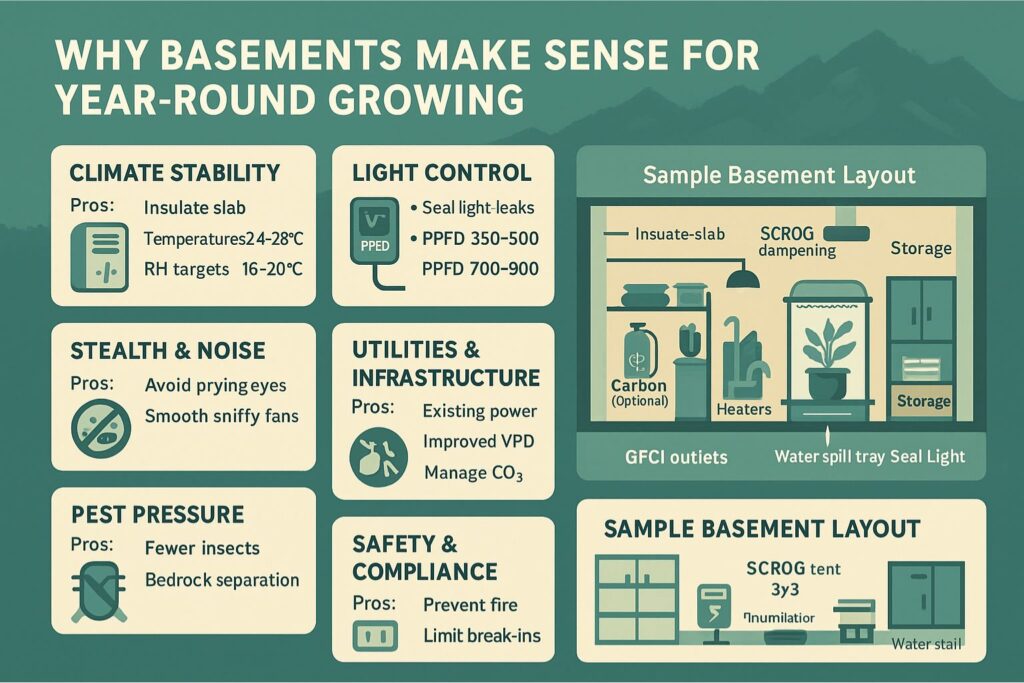
I’ve run tents in spare bedrooms, sheds, and garages, but the steadiest results have come from my basement. The slab keeps temperatures cool, the walls buffer swings, and noise from fans disappears into the house’s hum. The caveat is simple: not every cultivar loves 18–22°C air and moderate light intensity. That’s where basement cannabis seeds earn their name—genetics and phenotypes that finish beautifully with moderate PPFD for cannabis and a slightly cooler root zone.
Over several seasons I tested dozens of lines under these conditions. I learned that the right basement cannabis seeds paired with a tight VPD cannabis range and balanced EC and PPM for nutrients can outshine hotter setups with bigger fixtures. This guide distills what actually worked in my cool, concrete-walled room.
The Basement Profile: Conditions To Design Around
Basements trend toward cooler air, stable temps, and slightly higher relative humidity. Mine sits at 19–21°C most of the year. With lights on, canopy temp climbs to 23–25°C; lights off, it glides back to 18–19°C. If you try to force tropical vigor with high-intensity lighting and heavy feeding, plants stall. The better path is matching genetics, lighting, and nutrition to the environment so your basement cannabis seeds can express fully.
Target climate and VPD
I dial conditions to a VPD cannabis range that supports steady transpiration without overdrying the room.
- Seedling and early veg: 0.9–1.1 kPa
- Late veg: 1.0–1.2 kPa
- Flower weeks 1–4: 1.1–1.3 kPa
- Flower weeks 5–8+: 1.3–1.5 kPa
Basements can drift humid at lights off, so I let the dehumidifier run an hour into the dark cycle. That small habit keeps me in range and prevents the “morning dew” that cool climate marijuana strains dislike indoors.
Light levels that fit a cellar
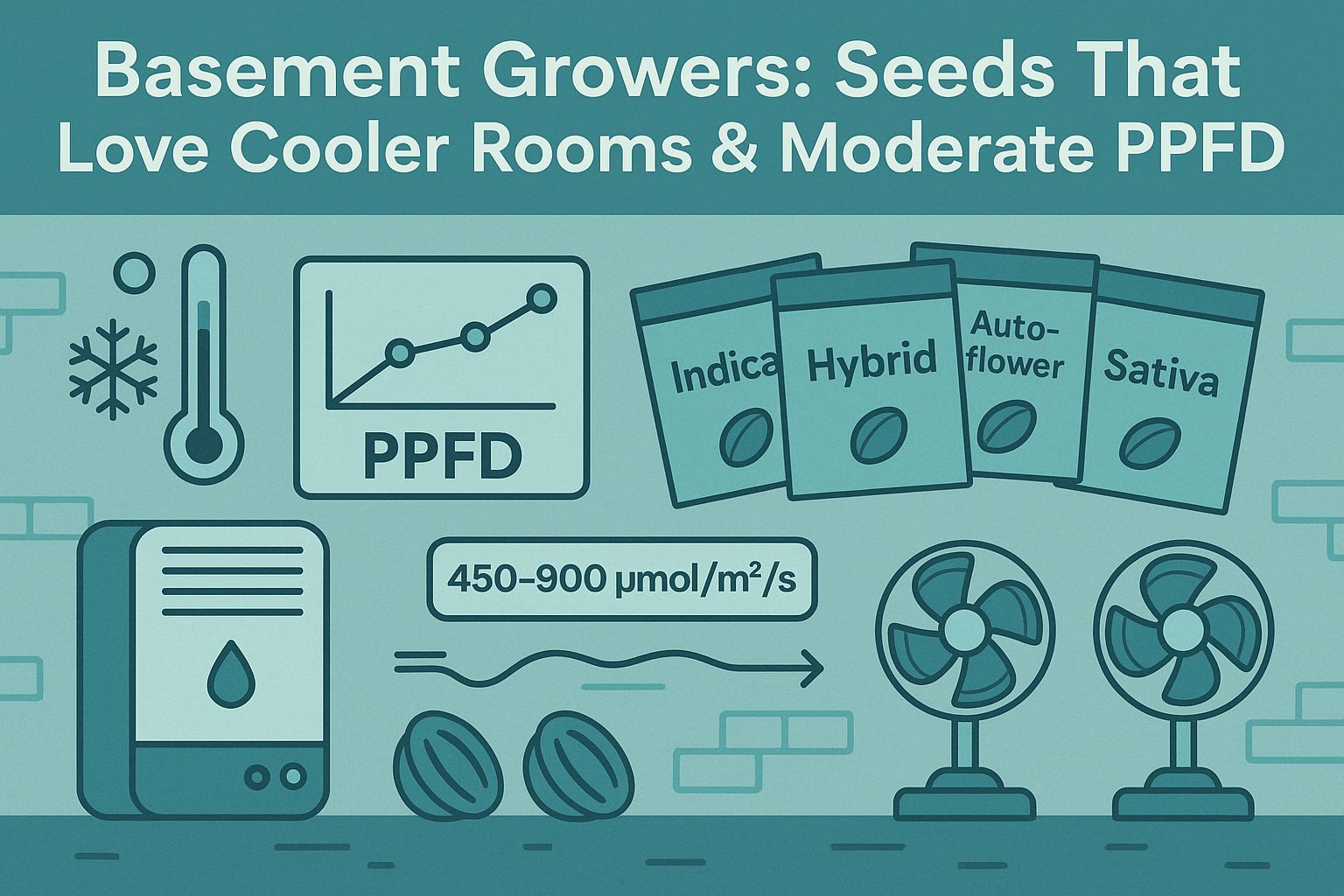
I run moderate PPFD for cannabis rather than blasting 1,300 µmol/m²/s and fighting heat.
- Seedlings: 200–300 µmol/m²/s
- Veg: 450–650 µmol/m²/s
- Flower: 700–900 µmol/m²/s, peaking near 950 only if CO₂ and airflow are perfect
With basement cannabis seeds that prefer cooler rooms, this moderate PPFD for cannabis produces tight node spacing and resinous flowers without edge burn or stalled uptake.
Feeding for cool-room metabolism
In cooler air, roots pull slower. My baseline EC and PPM for nutrients reflect that:
- Seedlings: 0.6–0.8 EC (300–400 PPM 500-scale)
- Veg: 1.2–1.5 EC (600–750 PPM)
- Early flower: 1.5–1.7 EC (750–850 PPM)
- Mid/late flower: 1.7–1.9 EC (850–950 PPM) if leaves are praying and tips remain clean
I lean toward calcium and magnesium support, and I avoid pushing nitrogen late. Balanced EC and PPM for nutrients matter more in basements because recovery from overfeeding takes longer at cool root temps.
Choosing Genetics: What Makes A Seed “Basement Friendly”
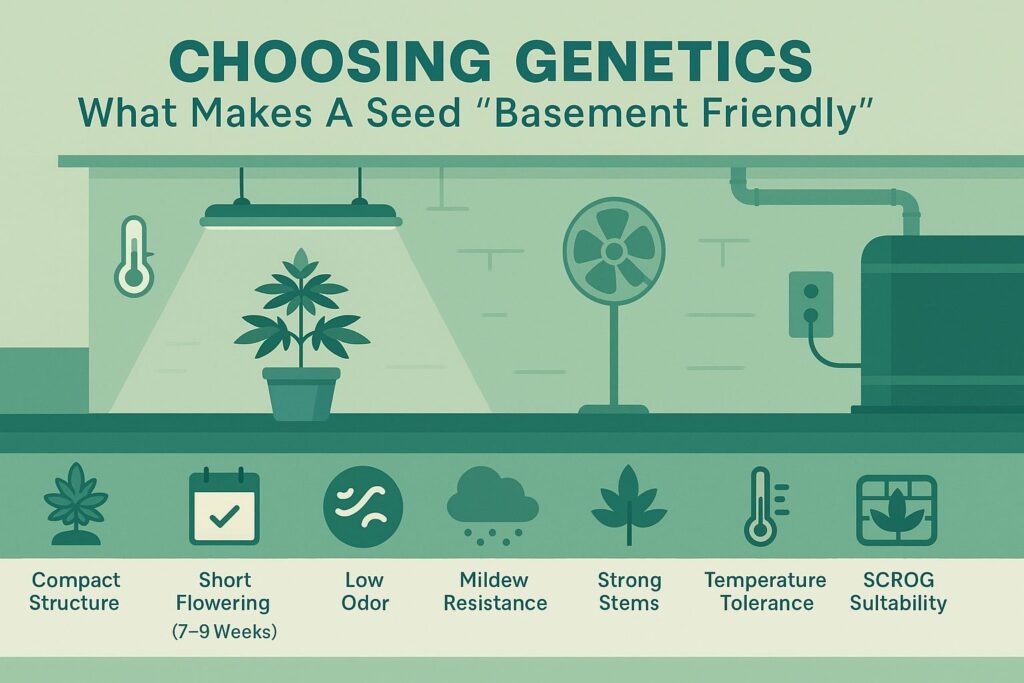
After many runs, I’ve noticed consistent markers among basement cannabis seeds that thrive at moderate PPFD for cannabis.
- 1) Cool-night tolerance. Plants maintain turgor and color after lights-off dips to 18°C.
- 2) Medium vigor. Hyper-stretchy types often demand warmer rooms; compact or moderate stretch is easier to manage.
- 3) Looser floral structure. Not airy, but not rock-hard baseballs—ideal for a basement where RH can creep.
- 4) Honest timelines. Eight-week finishers that really finish in eight when you stay in range.
Lines to look for at home grow seed banks
When I search home grow seed banks, I short-list cool climate marijuana strains and balanced indica sativa hybrid lines that advertise resilience over raw speed.
I prioritize:
- Northern-influenced hybrids with Afghan or Skunk heritage
- Old-school broad-leaf dominant selections that stack without demanding desert heat
- Modern indica sativa hybrid crosses known to frost at 800–900 PPFD
The variety category matters less than the phenotype details. At home grow seed banks, I read grower reviews and flag reports where people mention “performed in a cool basement” or “did great under 600–800 PPFD.” Those are code phrases for basement cannabis seeds that match our environment.
Feminized and auto options
I run feminized seeds for predictable canopies and keep a tray of autoflower cannabis seeds for rapid turns. In a basement, autos are fantastic under moderate PPFD for cannabis because the lifecycle is short and heat never becomes a battle. Feminized seeds dominate my photos because they remove sexing stress and let me train evenly. Between feminized seeds and autos, most of my year is covered with steady, low-risk harvests.
Medium, Pots, And Irrigation In A Basement
Soil vs hydro for weed when the floor is cold
I’ve run both, but I keep coming back to hybrid soil blends in fabric pots. Pure hydro is fast but unforgiving when the basement dips at night. The soil vs hydro for weed choice in a cool room is really about buffer.
My mix:
This mix solves the soil vs hydro for weed tug-of-war: organic buffer with enough air to avoid soggy roots on a cold slab.
Pot size and irrigation rhythm
I favor 15–20 L fabric pots for photos and 11–15 L for autos. I water early in the light cycle, track pot weight, and aim for a clear dry-back. In basements, overwatering is the quiet killer. With basement cannabis seeds and cool air, I’d rather underwater a day than bounce between wet feet and dehumidifier panic.
Lighting Layouts That Work In Tight Rooms
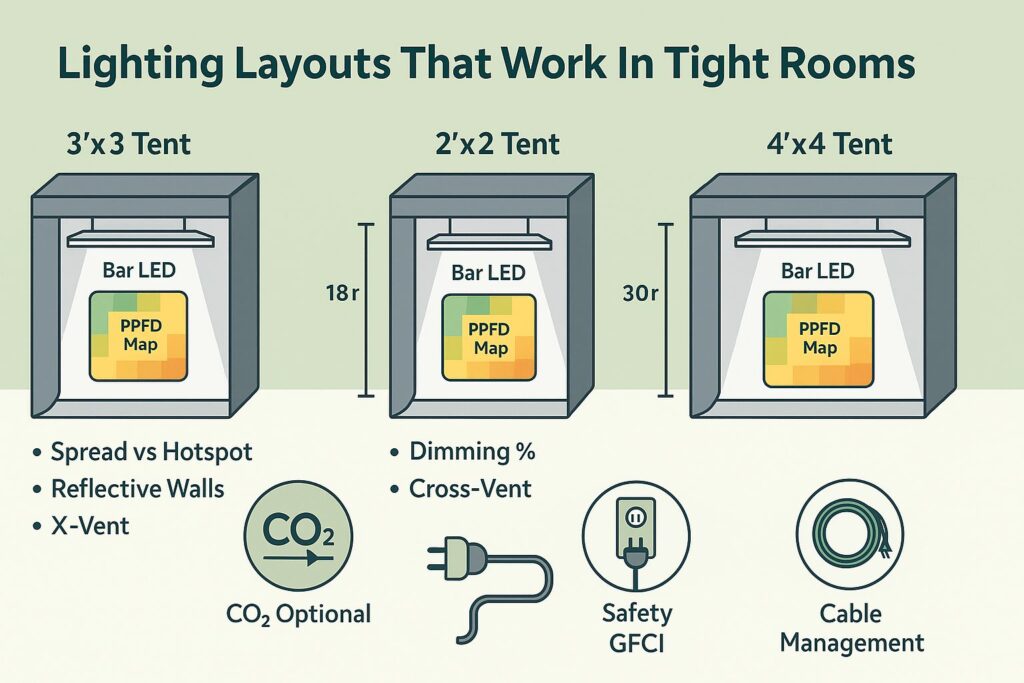
Basements often have low ceilings. I choose fixtures that spread well at 30–40 cm above the canopy so I can deliver moderate PPFD for cannabis without hotspots. A cross of bar-style LEDs with dimmable drivers lets me shape maps around 725–875 PPFD in flower. I verify with a PAR meter and move plants rather than cranking power.
Photoperiod scheduling
For photoperiods I veg at 18/6 and flower at 12/12. To keep nights from getting too cold, I schedule lights-on from late afternoon to morning; the house is quiet and the warmest part of the photoperiod spans the chilliest outdoor hours. This small scheduling trick keeps the VPD cannabis range stable and helps cool climate marijuana strains stay happy.
Training And Canopy Management
Low stress in cool rooms wins. I top photos once, then guide arms outward with soft ties. Autos get only early LST and leaf tucking. The goal is to build a flat, breathable canopy that matches moderate PPFD for cannabis. I defoliate selectively: remove leaves plastered against buds, keep lower third tidy, and avoid shock events that stall metabolism in the cool air.
Basement IPM: Clean, Simple, Predictable
Prevention over reaction
Basements can harbor spores and dust. I start clean, keep a HEPA filter running, and wipe walls between cycles. Sticky cards on each pot and yellow cards on tent poles catch early signals. A weekly scouting session under a headlamp is non-negotiable. The best integrated pest management in a basement is really good housekeeping and airflow.
Dehumidification and airflow
One midsize dehumidifier on a condensation pump drains to a floor sink. Two clip fans per square meter push air across the canopy, never directly at tops. I vent exhaust at floor level, pull intake at ceiling height inside the room, and run the grow tent as a gentle negative pressure system. These choices maintain a VPD cannabis range without turning the room into a wind tunnel.
From Seed To Sprout: What Works On A Concrete Slab
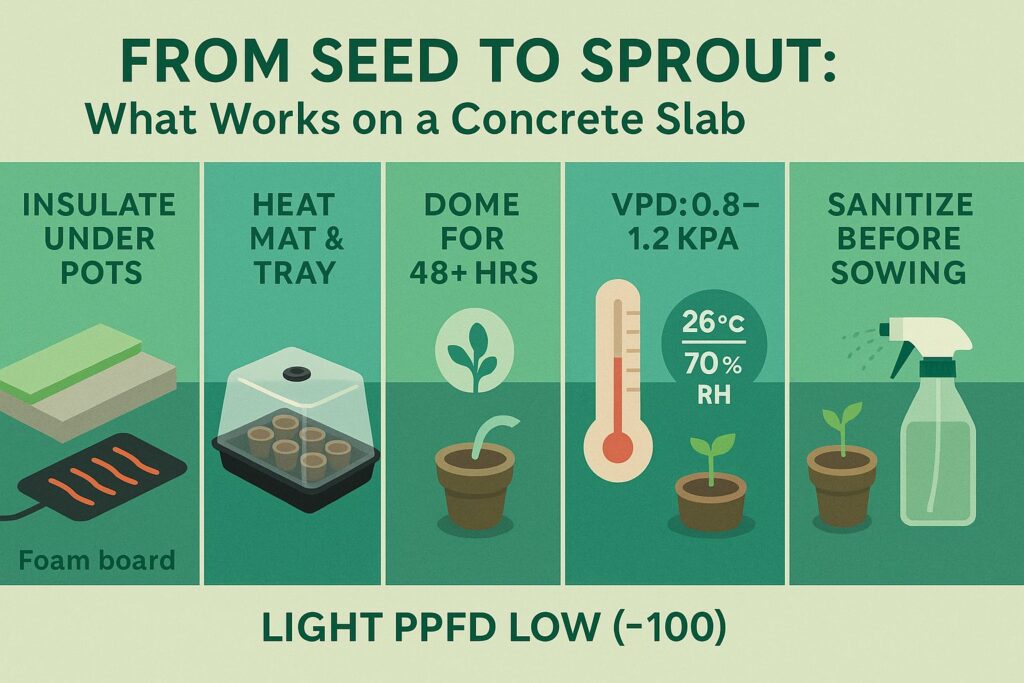
Strong starts are the easiest way to ensure basement cannabis seeds hit stride quickly.
My step-by-step germination techniques
- Pre-soak for 12–18 hours in room-temp water with a few drops of 3% H₂O₂.
- Transfer to a breathable bag with damp paper towel at 25°C for 12–36 hours.
- Plant as soon as the radicle reaches 5–8 mm, 0.5–1 cm deep in a light starter mix.
- Maintain 200–250 PPFD, 24°C air, and 70–75% RH the first week.
- Transplant when roots circle the plug, then introduce cooler room temps gradually.
These germination techniques deliver sturdy seedlings that handle the basement’s 19–21°C nights without sulking.
Feeding Plans That Respect Cool Metabolism
What I watch in leaf language
At moderate PPFD for cannabis, leaves should lift softly toward the light, with cool leaf edges and minimal tacoing. If tips burn or margins curl, I lower EC and PPM for nutrients and confirm runoff pH. If leaves droop at lights on, I check VPD first; cool rooms punish low VPD more than hot rooms.
Additives with a purpose
I keep it simple—silica in veg for stem strength, a micro package for trace balance, and beneficial microbes for root health. Too many additives complicate EC and PPM for nutrients and hide the signal. In basements, simplicity keeps troubleshooting clean.
Strain Selection Examples And How They Behaved
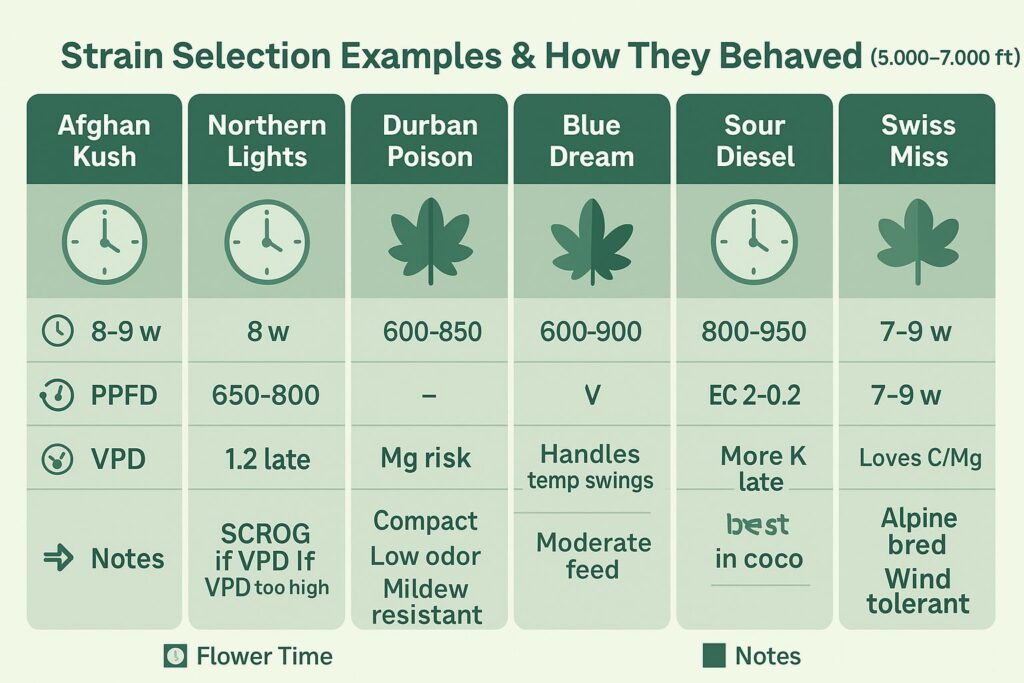
I won’t name proprietary lines here, but I can describe profiles that performed consistently as basement cannabis seeds.
- Broad-leaf dominant indica sativa hybrid with Afghani heritage: medium stretch, finished in 56–60 days, responded best to 800–850 PPFD and 1.6–1.8 EC.
- Skunk-leaning indica sativa hybrid: slightly looser buds, great terp retention at 19°C nights, ran 60–63 days. Loved 750–800 PPFD and moderate feeds.
- Compact autoflower cannabis seeds with cookie influence: 80–88 days from sprout, dense but not stone-hard flowers, ideal in 11 L pots with 650–750 PPFD.
- Narrow-leaf leaning indica sativa hybrid: needed more light and warmer nights; still succeeded at 875–900 PPFD but demanded the driest VPD cannabis range to avoid mildew. I only run this in summer cycles.
Across these, the repeatable pattern was simple: keep PPFD moderate, maintain VPD, aim for steady—not aggressive—feeding, and pick phenotypes that don’t demand tropical nights.
Drying And Curing In A Basement
Drying in the same cool space is a gift if you control humidity. I hang branches in a dark tent at 16–18°C and 55–60% RH with fans aimed at walls. The dry takes 10–14 days. I trim over a clean table with fresh filters and cure in glass at 58–62% RH. The aromas from cool-room flower are usually brighter and less bready, provided I didn’t over-dry to chase a number.
Buying Smart And Storing Smart
I purchase from home grow seed banks that publish real flower times and show canopy shots at moderate PPFD for cannabis. Shipping is planned a month ahead so I can stage germination techniques without rushing. Seeds are stored in the original packs inside an airtight tin with desiccant in the refrigerator. Good storage keeps the viability high, which matters when your entire schedule is organized around basement cannabis seeds performing on time.
Troubleshooting Matrix For Cool Rooms
- Pale new growth, slow uptake: Check root temp; raise pots off the slab and verify EC and PPM for nutrients aren’t too low.
- Edge curl or clawing at modest EC: Confirm PPFD map; hotspots in low ceilings sneak up quickly. Back the fixture off or dim.
- Overnight moisture on leaves: Increase dehumidifier run into the first hour of dark; nudge the VPD cannabis range higher with a small exhaust boost.
- Slow autos: Verify moderate PPFD for cannabis is at least 600–700 by day 25; autos never make up for a dim first third.
FAQ: Common Basement Grower Questions
What PPFD should I run in a low-ceiling tent?
Aim for moderate PPFD for cannabis: 450–650 in veg and 700–900 in flower. Spread the light with bar fixtures and measure with a PAR meter to avoid hotspots.
Which seeds are best for cool rooms?
Look for basement cannabis seeds described as tolerant of cool nights and stable humidity. At home grow seed banks, filter for cool climate marijuana strains and indica sativa hybrid lines with medium stretch. Favor feminized seeds for predictable canopies and autoflower cannabis seeds for quick, low-heat cycles.
Is soil or hydro better on a concrete slab?
For most hobbyists, a soil vs hydro for weed hybrid wins: living soil plus coco and perlite for drainage. Pure hydro can succeed, but cool nights slow roots and require tighter control.
What VPD targets should I hold?
Keep within a VPD cannabis range of 0.9–1.1 kPa in early growth, 1.1–1.3 kPa at flower start, and 1.3–1.5 kPa late flower. In basements, watch lights-off humidity carefully.
How should I feed in cool rooms?
Use moderate EC and PPM for nutrients and let the plant and runoff guide adjustments. Overfeeding in cool air causes tip burn that sticks around for weeks.
Do autos work in basements?
Yes. Autoflower cannabis seeds thrive with moderate PPFD for cannabis and minimal heat. Just ensure the first 25 days are bright enough and the pot dries between waterings.
Which germination method is most reliable?
Simple, clean germination techniques: short pre-soak, warm paper towel, early planting in a light mix, and steady 200–250 PPFD. Transition seedlings to the cool room gradually.
Checklist: One-Page Plan For Basement Success
- Choose basement cannabis seeds from trusted home grow seed banks with cool-room proof.
- Run feminized seeds for even training and autoflower cannabis seeds for quick cycles.
- Map lights to moderate PPFD for cannabis and verify with a meter.
- Hold a stable VPD cannabis range day and night; dehumidify into the first dark hour.
- Use a hybrid medium to balance soil vs hydro for weed trade-offs.
- Feed moderately and track EC and PPM for nutrients with each irrigation.
- Practice clean germination techniques and keep the room tidy.
- Dry at 16–18°C and 55–60% RH in darkness, cure at 58–62% RH.
Closing Thoughts From The Basement
Basements reward restraint and consistency. When I started picking genetics that like cooler air and tuning light to moderate PPFD for cannabis, yields climbed and headaches dropped. The pattern repeated across feminized seeds and autoflower cannabis seeds, across indica sativa hybrid mixes and classic cool climate marijuana strains: match the plant to the room, not the other way around. If you embrace that approach, basement cannabis seeds will pay you back in dense, aromatic jars without a roaring HVAC or sauna-level lighting.
Whether you’re building your first tent beside the water heater or upgrading a seasoned cellar, use the principles here—measured light, disciplined VPD cannabis range, honest EC and PPM for nutrients, practical media choices, and careful selection from home grow seed banks—to make the most of your square meters under the stairs. Cool rooms can grow warm, exceptional cannabis when the plan honors what the space naturally does best.
