Table of Contents
I’m writing this Alpine Blue Strain Review after running Alpine Blue through two indoor cycles. One round was in living soil and the next was in coco/perlite under LED. That matters because cannabis, marijuana, and weed can behave differently depending on medium, light intensity, and how steady your temperature and humidity are.
I’m not going to oversell it. I’ll share what I saw, the trade-offs, and the numbers that helped me get a clean finish: indoor LED grow targets, VPD for cannabis flowering, and a coco EC feeding range that kept the leaves healthy.
Genetics and phenotype variation
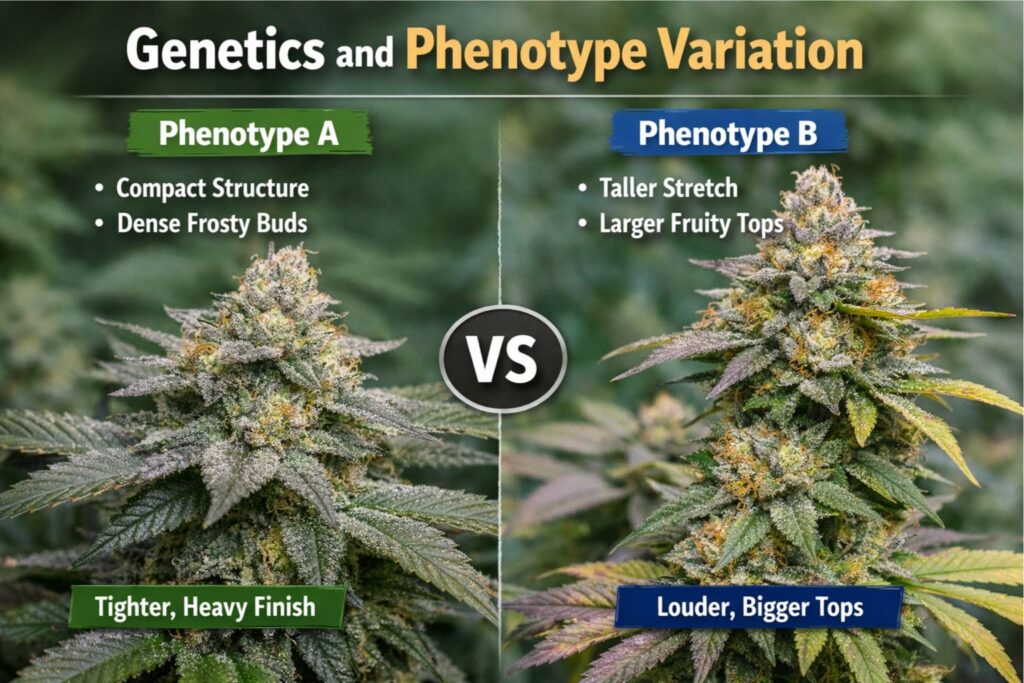
I don’t have lab-confirmed lineage for Alpine Blue, so I focus on repeatable observations instead of a perfect family tree. In my room it grew like a true middle hybrid: branching well, stretching moderately after flip, and responding well to training.
Across the two runs, I saw two clear phenotypes:
- Phenotype A: tighter spacing, slightly earlier resin, heavier finish.
- Phenotype B: longer spacing, louder fruit late flower, bigger tops with support.
If you can, run more than one seed and keep simple notes. That’s how you pick a keeper for your own environment.
Aroma and flavor notes I actually got
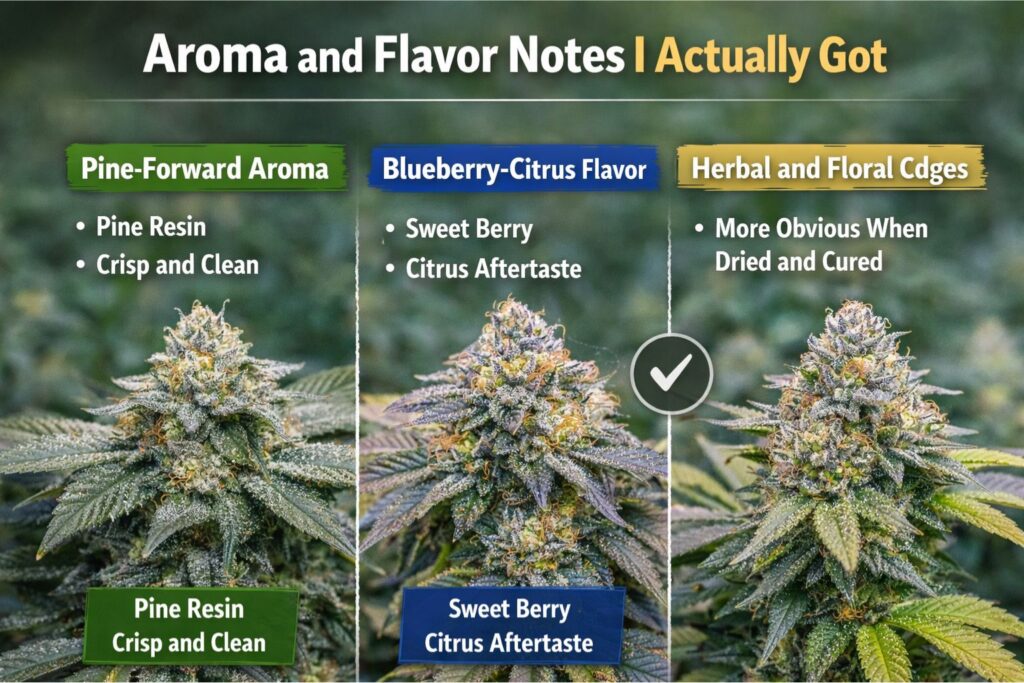
When people ask “what does it smell like,” I always separate living-plant smell from jar smell. The jar is where the Alpine Blue terpene profile becomes real.
In veg and early flower, I got a crisp pine-forward aroma that reminded me of pine resin and clean forest air. Later in flower, the sharp edge softened and the fruit became clearer. After cure, the dominant taste for me was blueberry-citrus flavor: sweet berry on the inhale with a bright, clean finish.
A quick honesty check: if the dry is rushed, the blueberry-citrus flavor turns dull and the smoke feels sharper. When I used a patient dry and cure routine, the Alpine Blue terpene profile stayed defined and the pine-forward aroma didn’t disappear.
Effects: what I felt and how harvest timing changed it
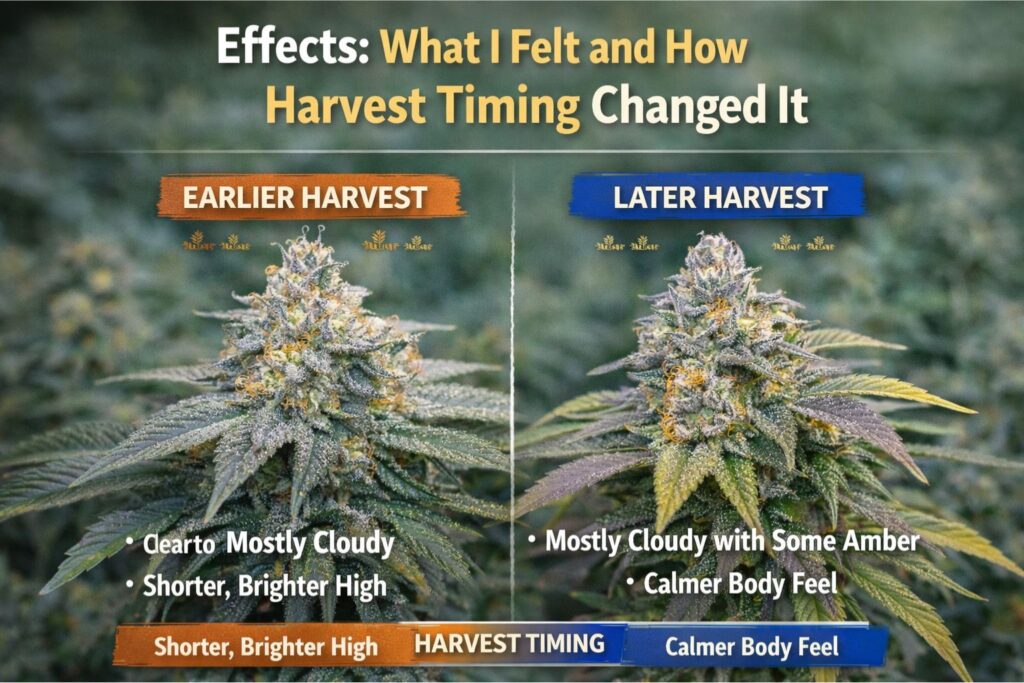
This part varies by person, tolerance, and harvest timing. I’m not making medical claims. This is simply what I experienced from my own jars.
At lighter doses, it felt upbeat and clear. At heavier doses, it became more body-forward and slow. That dose-dependent shift is what I mean by balanced hybrid effects. It can be a social, daytime smoke in small amounts, but it can also become an evening weed if you push it.
Harvest timing mattered:
- Earlier harvest: shorter, brighter head feel.
- Later harvest: calmer body feel and a heavier finish.
Even within this Alpine Blue Strain Review, I’ll say it again: phenotype matters. My Phenotype A leaned heavier, and Phenotype B leaned a bit brighter at the same dose.
Grow difficulty and the main things I would dial first
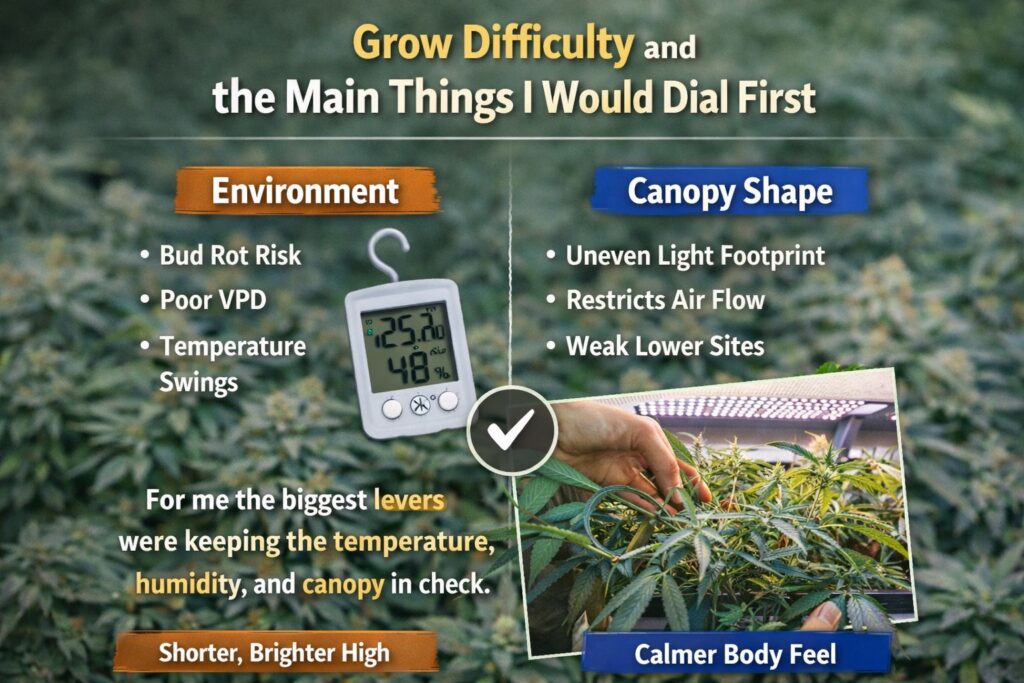
I’d rate it intermediate. It didn’t feel fragile, but it clearly preferred consistency. The two biggest levers were the environment (temp/RH) and the canopy shape.
Veg: my low-stress training plan
I use an 18/6 photoperiod in veg and focus on building roots before chasing size. My low-stress training plan looked like this:
- Top once around node 5–6.
- Tie branches outward early to widen the plant.
- Keep the canopy level with small adjustments every few days.
- Light defoliation for airflow and light penetration.
That low-stress training plan kept lower sites productive and helped me avoid shaded, weak growth.
Indoor LED grow targets (PPFD ranges)
I ramp LED intensity slowly and watch leaf posture. Here are the indoor LED grow targets I used as ranges, not rules:
- Early veg: 250–350 PPFD
- Established veg: 400–600 PPFD
- Early flower: 650–800 PPFD
- Mid flower: 800–950 PPFD
- Late flower: up to ~1,000 PPFD only if the plant stayed happy
If you don’t measure PPFD, the same principle still applies: increase light in small steps and back off if you see bleaching, tacoing, or stalled growth. Indoor LED grow targets are helpful, but the plant’s response is the final call.
Soil vs coco comparison from my notes
Here’s my direct soil vs coco comparison after doing both.
In living soil:
- Slower start, steadier mid-veg.
- Less daily mixing once the soil was active.
- Overwatering was the main risk.
In coco/perlite:
- Faster growth and faster correction when something was off.
- More daily work (regular irrigation and runoff checks).
- Easier to overfeed if you chase numbers.
That soil vs coco comparison comes down to your style. Soil is forgiving if you water well; coco is fast if you stay consistent.
Coco EC feeding range and avoiding nutrient burn
In coco, my coco EC feeding range ended up roughly here:
- Early veg: EC 1.0–1.4
- Late veg: EC 1.3–1.7
- Early flower: EC 1.6–2.0
- Mid flower: EC 1.8–2.3
- Late flower: EC 1.6–2.0
If you use PPM, be careful because meters use different scales. I prefer EC plus runoff trends. When I pushed past my coco EC feeding range, I saw leaf-tip burn and slower progress. When I stayed inside it and irrigated consistently, the canopy stayed healthier.
VPD for cannabis flowering and humidity control
If you want a clean finish, get serious about VPD. My VPD for cannabis flowering targets were:
- Veg: roughly 0.8–1.1 kPa
- Flower: roughly 1.2–1.5 kPa once buds are forming
Flower room bands that helped me:
- Temperature: 24–26°C lights on, 19–21°C lights off
- RH: 45–55% mid flower, 40–50% late flower
Keeping VPD for cannabis flowering steady reduced stress and lowered the risk of mold in dense tops.
Watering, root zone, and week-by-week flower notes
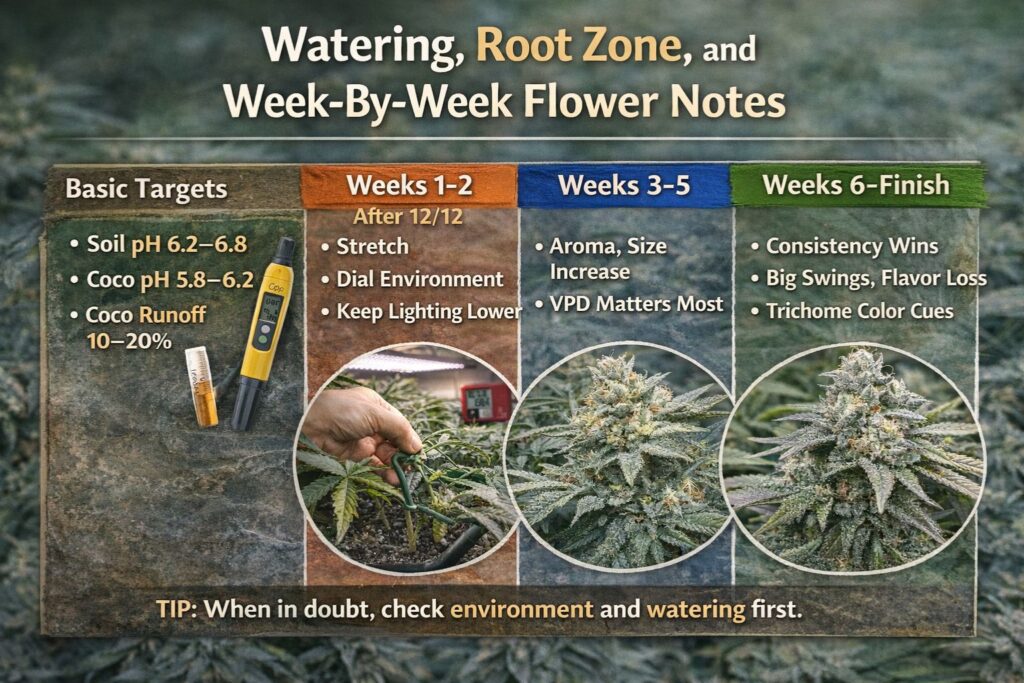
The fastest way I’ve ruined a good run is by letting the root zone swing between too dry and too wet. In soil, I wait until pots feel noticeably lighter, then water thoroughly and let it dry back again. In coco, I water more often with smaller shots and aim for consistent runoff.
My basic targets:
- Soil pH (if you measure): about 6.2–6.8
- Coco pH: about 5.8–6.2
- Coco runoff: roughly 10–20% to reduce salt build-up, especially when running the coco EC feeding range on the higher side
A simple flower timeline from my notes:
- Week 1–2 (after 12/12): stretch, set your low-stress training plan, keep indoor LED grow targets conservative
- Week 3–5: bud sites stack, aroma increases, and VPD for cannabis flowering matters more than “more food”
- Week 6–finish: consistency wins; big swings can mute the pine-forward aroma and flatten the blueberry-citrus flavor
If you’re seeing issues, I troubleshoot in this order: environment, watering pattern, then nutrition. Most “mystery problems” disappear when temperature, humidity, and irrigation stop bouncing around.
Quick troubleshooting I’ve actually used
Leaf tips burning:
- Reduce feed strength a step and keep irrigation consistent for a week
- Don’t raise light at the same time you raise EC; pick one change
Pale new growth in coco:
- Confirm pH is stable, then keep calcium and magnesium consistent
- Keep the low-stress training plan gentle until color improves
Musty smell risk late flower:
- Tighten humidity, improve airflow, and keep VPD for cannabis flowering steady
These fixes are boring, but they work. They also protect the dry and cure routine because healthier plants finish cleaner.
IPM basics I use every run
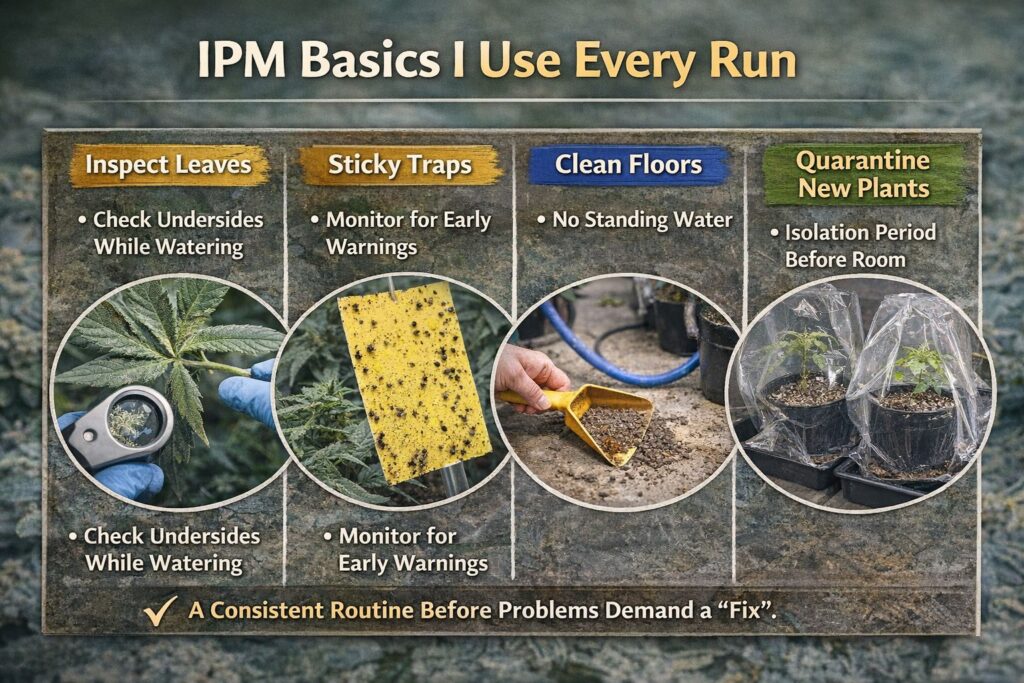
I keep pest management boring and consistent:
- Inspect leaf undersides while watering.
- Sticky traps for early warning.
- Clean floors and no standing water.
- Quarantine any new plants.
Prevention is easier than trying to “fix” bugs once buds are stacked.
Harvest cues and what I’d improve next time
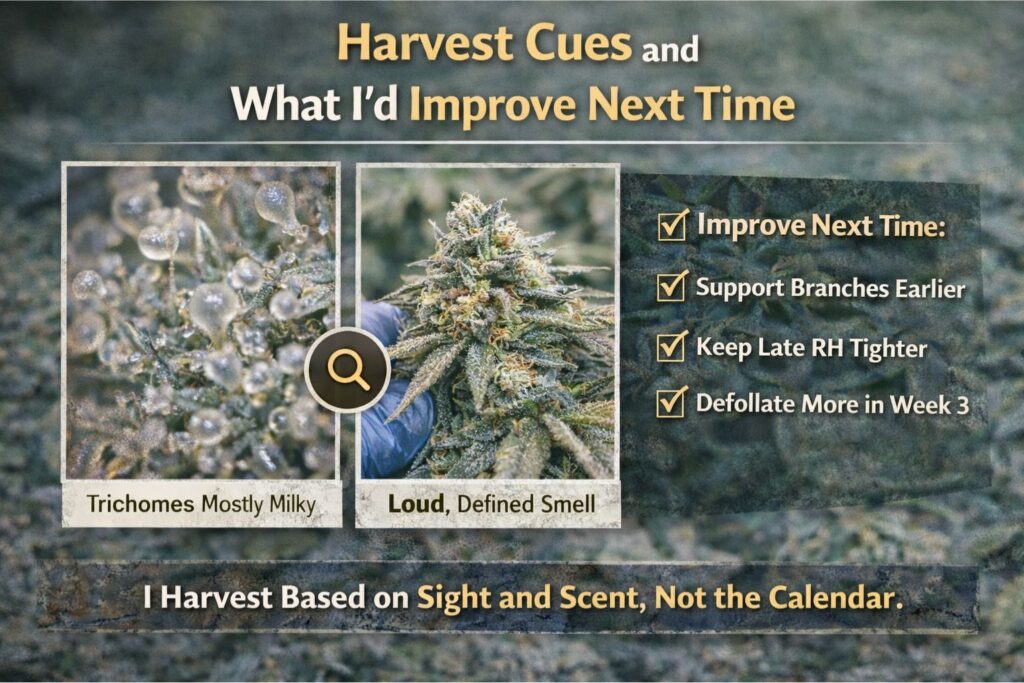
I don’t harvest by calendar alone. I look for mostly milky trichomes and the overall fade and smell. If the aroma is still sharp but “green,” I usually wait. If the smell is loud and defined, I start preparing.
Next time, I’d likely:
- Support branches earlier (Phenotype B got top-heavy).
- Keep late-flower humidity tighter to protect the Alpine Blue terpene profile.
- Maintain the same low-stress training plan but defoliate a touch more around week 3 of flower for airflow.
Dry and cure routine that kept flavor intact
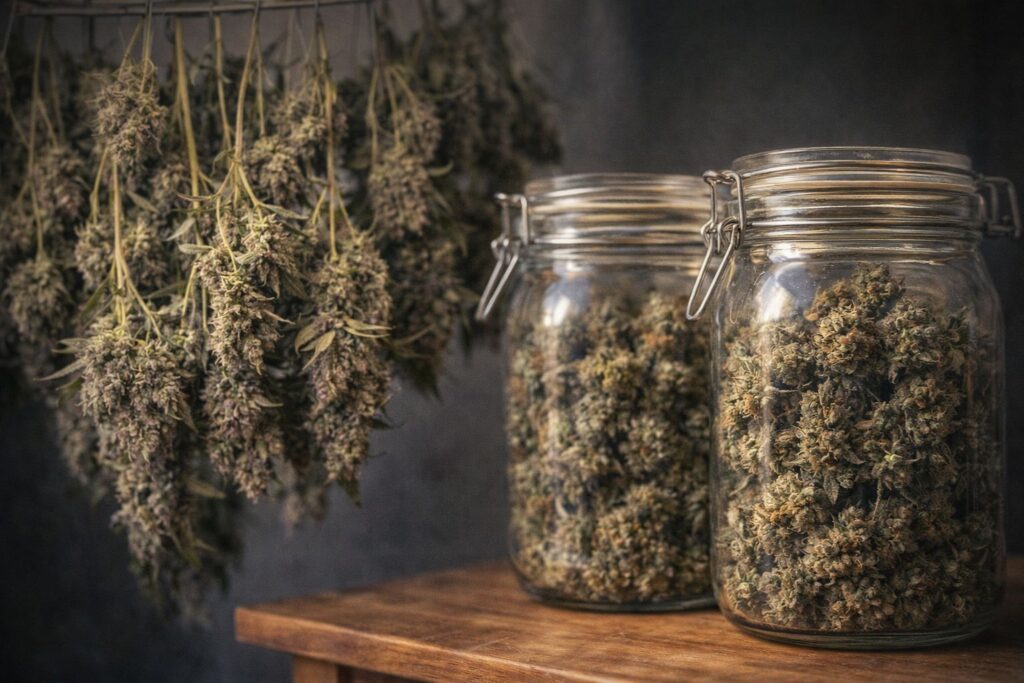
This is the part that decides whether the jar smells like hay or like cannabis. My dry and cure routine is simple:
Drying:
- 18–20°C
- 55–60% RH
- Gentle airflow (no fan blasting buds)
- 10–14 days depending on how tight the flowers are
Curing:
- Jar when small stems snap instead of bend.
- Burp daily for 5–7 days.
- Then burp every few days for another 2–3 weeks.
- Store cool, dark, and stable.
When I followed this dry and cure routine, the pine-forward aroma stayed crisp and the blueberry-citrus flavor became clearer over time.
Seed buying and planning questions I see most
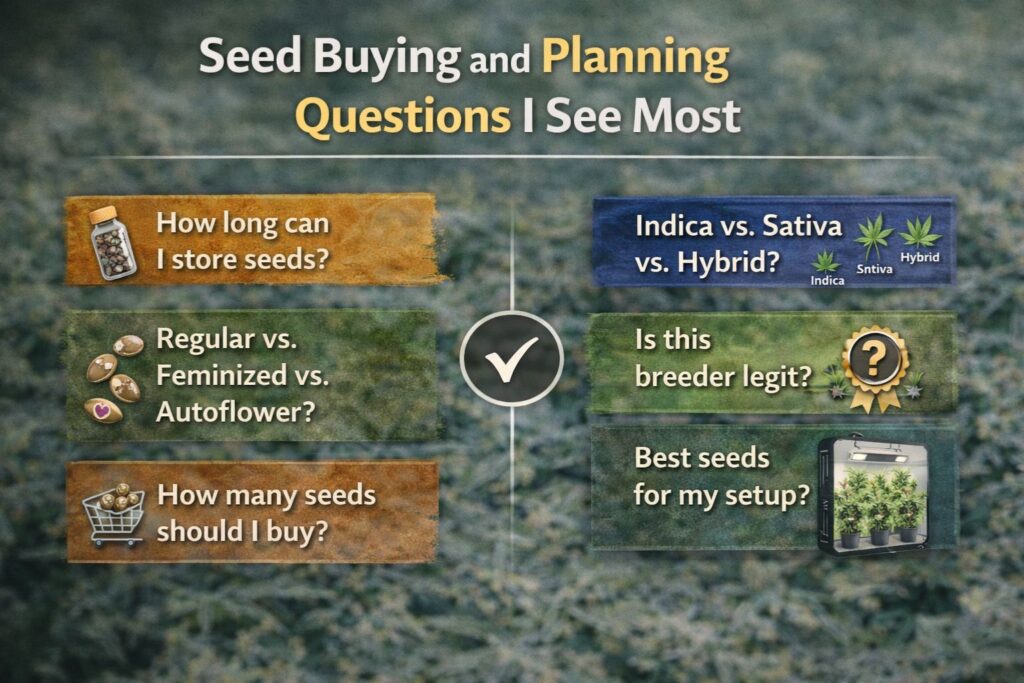
People searching Google often ask things like:
- “where can I buy feminized cannabis seeds online with reliable shipping”
- “should I choose soil or coco for my first grow”
- “what light schedule do I use for photoperiod plants”
I can’t give legal advice. Grow rules and shipping rules vary by region, so check your local regulations before ordering or planting. From a grower perspective, here’s what I look for when ordering seeds:
- Clear labeling (feminized vs regular, photoperiod vs autoflowering).
- Transparent shipping and customer support policies.
- Realistic descriptions and consistent stock.
If you’re new, feminized photoperiod seeds can simplify the run because you’re not sexing plants. If you want speed and smaller plants, autoflowering can work, but the feeding window is tighter.
FAQ
What’s the dominant taste after cure?
For me it’s blueberry-citrus flavor with a clean finish. The Alpine Blue terpene profile gets clearer after a few weeks of cure.
Is it more daytime or nighttime?
At small doses it felt daytime-friendly; at bigger doses it leaned into balanced hybrid effects and slowed me down.
What’s the biggest grow mistake to avoid?
Big swings in humidity late flower. Keep VPD for cannabis flowering stable and don’t overcrowd the canopy.
Should I run soil or coco?
My soil vs coco comparison: soil was easier day to day if I watered correctly; coco grew faster but demanded consistency and attention to the coco EC feeding range.
Final word on this Alpine Blue Strain Review
If you like a pine-forward aroma with a berry finish and you’re willing to run a steady environment, Alpine Blue can be rewarding. The keys in my room were simple: indoor LED grow targets that ramp slowly, a consistent low-stress training plan, and a patient dry and cure routine that protected the Alpine Blue terpene profile. That’s what made the jars smell like real weed instead of “generic” flower.
For a complete directory of cultivars, visit our Cannabis Strain Reviews.
