Table of Contents
I’m writing this 303 OG Strain Review the same way I build out my own grow notebook after a run: what I actually saw in the room from seedling to finish, what changed as the buds dried and cured, and how the effects felt at normal, repeatable doses. I’m not pulling these notes from strain hype or a single quick sample. I’m basing them on two complete indoor cycles I took to harvest myself (one in a living soil mix, one in coco under LEDs), plus an outdoor harvest from a close grower friend who ran the same line in large containers.
Across those three gardens, the core traits stayed familiar enough that I’m comfortable calling the profile consistent: OG-leaning structure, resin that comes in early, and a finished jar that lives in that pine-and-earth lane with a brighter citrus edge when the dry is done right. That said, this is still cannabis, and cannabis is never one-size-fits-all. Even within the same pack, I noticed differences in stretch, leaf shape, and how quickly the flowers stacked.
One plant stayed squat and bushed hard in veg, while another stretched more after the flip and needed support earlier in flower. The outdoor sample also leaned a touch louder on the earthy side compared to my indoor jars, which I’d expect from sun-grown flower and a different dry environment.
So consider this review a real-world field report, not a promise. Your results can swing based on phenotype, environment, and how you run your inputs. Medium choice (soil vs coco), lighting intensity, VPD stability, feeding strength, and even how slowly you dry and cure will change what you smell and taste in the end. If you’re growing from seed, plan for a little variation, take notes, and be ready to keep a standout pheno if you find one that checks all your boxes.
Genetics and phenotype behavior
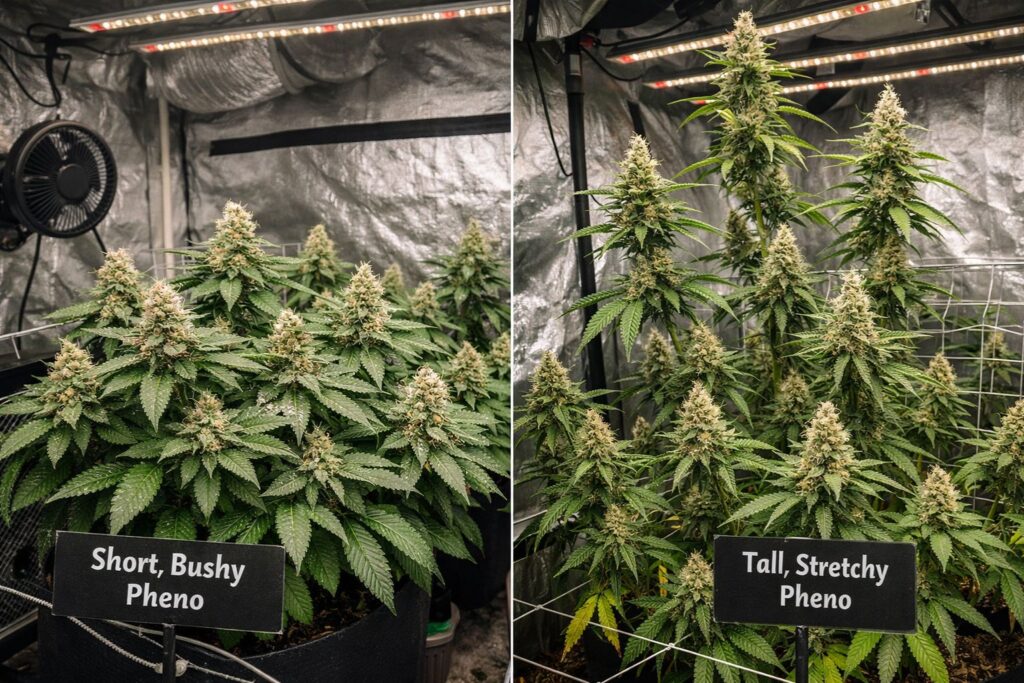
Most growers place this one in the OG family, and in my experience that’s a fair label. In my tents, it expressed a set of traits I associate with OG-leaning plants: dense, firm flower formation, a noticeable jump in trichome coverage early in bloom, and a stretch pattern that can surprise you if you flip too late in a short space. The bud structure especially felt “OG”—tight clusters that want to stack into chunky colas, which is great for bag appeal and resin output, but it also means you have to stay on top of airflow and humidity as flowers pack on weight.
What stood out to me across runs was the phenotype range. One plant stayed squat and bushy through veg with tighter internodes and broader leaves. It was easy to shape into a flat canopy, and it felt like it wanted to be topped and spread wide. The other plant was taller, with a bit more spacing between nodes, and it stretched more noticeably after the flip. That taller pheno stacked faster in weeks 4–6, but it also asked for support sooner because the tops got heavy before the branches fully lignified. I ended up using a net and a few stakes earlier than planned just to keep the canopy from leaning.
Those differences are exactly why I treat every 303 OG Strain Review as a real-world report, not a guarantee. Seed-grown cannabis can vary even when the label stays the same, and your environment will push traits in different directions. A warmer, drier room made the stretch a little more pronounced for me, while a cooler night drop tightened up the structure and seemed to help the flowers finish with a sharper, cleaner aroma. If you’re popping multiple seeds, it’s worth taking notes on stretch, stacking speed, and how each plant handles feeding so you can identify the keeper pheno that matches your space and goals.
Aroma and a 303 OG terpene breakdown
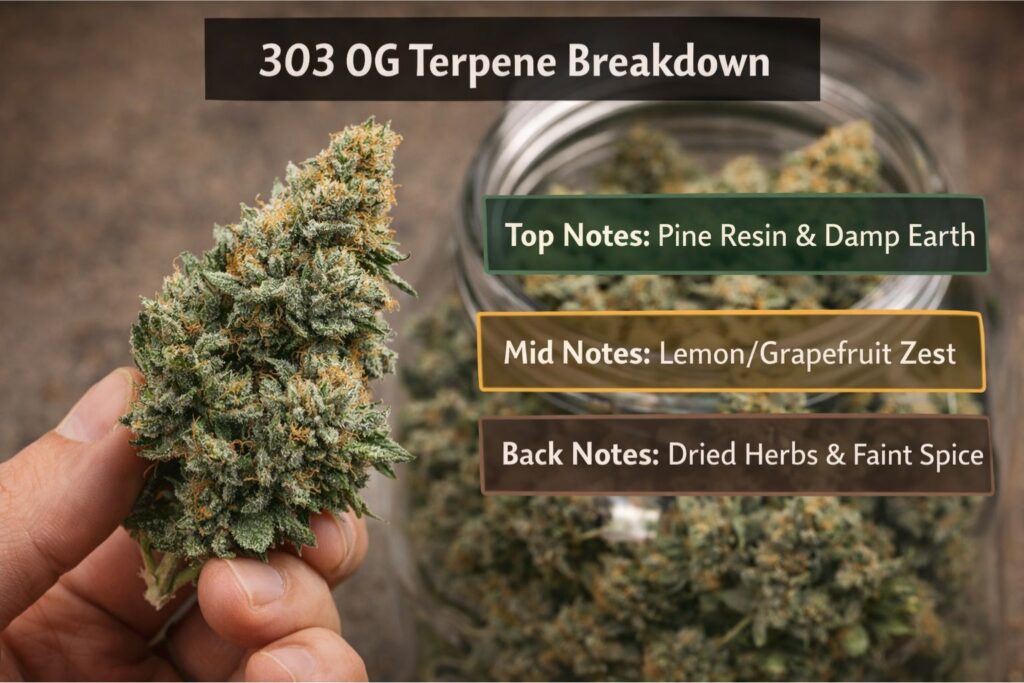
I judge scent on cured flower at 58–62% jar humidity. My best jars were pine-forward with citrus peel and a light pepper edge.
Here’s my practical 303 OG terpene breakdown:
- Top notes: pine resin and damp earth
- Mid notes: lemon or grapefruit zest
- Back notes: dried herbs, faint spice
The same 303 OG terpene breakdown was clearer when I dried slowly and cured steadily. Cooler nights kept the citrus brighter; hot, dry rooms pushed the 303 OG terpene breakdown more woody.
Flavor: my 303 OG smoke report and 303 OG flavor notes
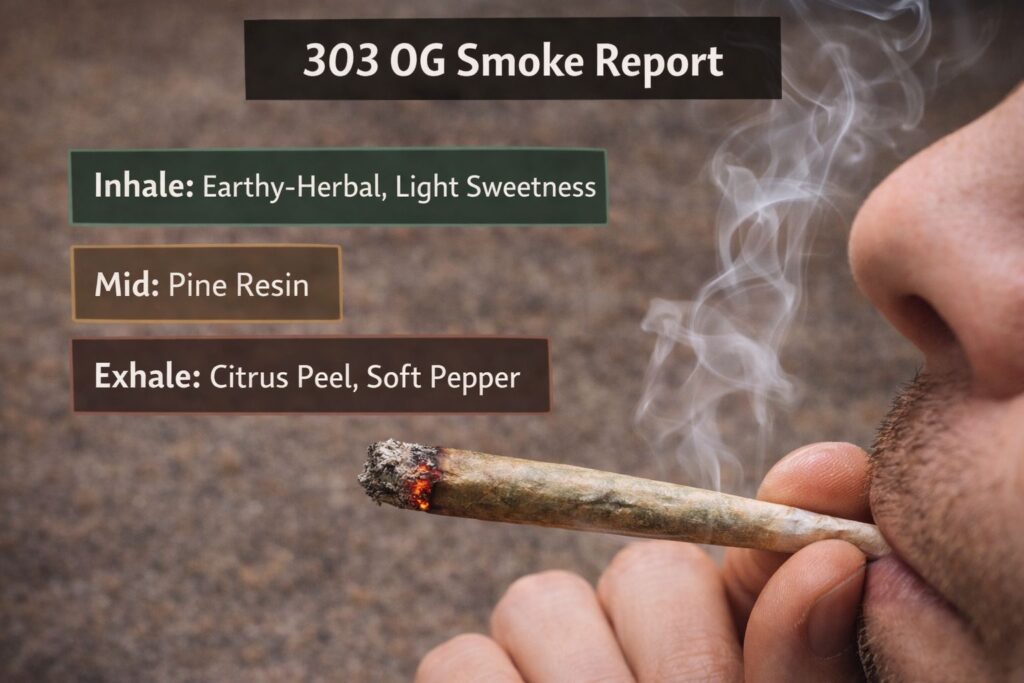
I don’t call it finished until two weeks of cure, and I prefer three to four. With a clean cure, the inhale is earthy-herbal, then pine, then citrus rind on the exhale.
My repeatable 303 OG smoke report:
- Inhale: earthy-herbal, light sweetness
- Mid: pine resin
- Exhale: citrus peel, soft pepper
If I dried too fast, the 303 OG smoke report got harsh and the citrus faded. When I took my time, the 303 OG smoke report stayed smooth and the 303 OG flavor notes stayed consistent: earth, pine, citrus peel. I’ll reference those 303 OG flavor notes again in the curing section, because curing decides whether those 303 OG flavor notes show up at all.
Effects: my 303 OG effects timeline (no medical claims)

This is subjective and dose-dependent. Start low, wait, and remember that marijuana effects vary by tolerance and method.
My typical 303 OG effects timeline from a moderate session:
- 0–15 minutes: mood lift, clearer focus
- 15–45 minutes: body tension eases, calmer pace
- 45–120 minutes: steady calm, slightly dreamy headspace
At higher intake, the same 303 OG effects timeline leaned heavier and more sedating. For me, it’s a better evening weed unless I keep it light.
Indoor grow targets: 303 OG grow tips indoors
Stability mattered more than fancy inputs. These are the 303 OG grow tips indoors that gave me the cleanest finish under LEDs:
- Veg photoperiod: 18/6; flower: 12/12
- PPFD: 300–500 in veg; 700–900 mid flower (ramp, don’t spike)
- Temp: 24–27°C lights on; 20–23°C lights off
- RH: 60–70% early veg; 50–60% late veg; 45–55% flower
- VPD: about 0.8–1.2 kPa veg; 1.2–1.5 kPa flower
I repeat these 303 OG grow tips indoors because they fix most “why does my plant look stressed?” issues before they start.
Stretch control and 303 OG stretch after flip
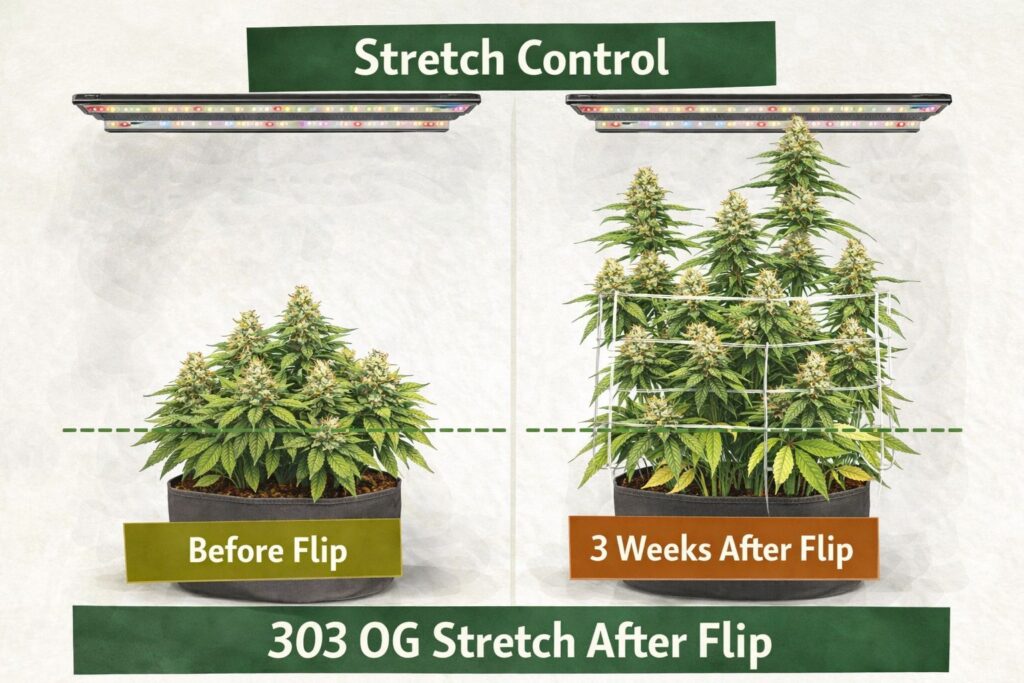
In my room, 303 OG stretch after flip was most noticeable from days 7–21 after switching to 12/12.
How I managed 303 OG stretch after flip:
- Flip a little earlier than you think in small tents
- Keep a flat canopy with early training
- Increase light intensity gradually
If you’re asking whether it stretches, yes, and 303 OG stretch after flip is easiest when the canopy is already even at flip.
Feeding: 303 OG soil feeding guide and 303 OG coco EC targets
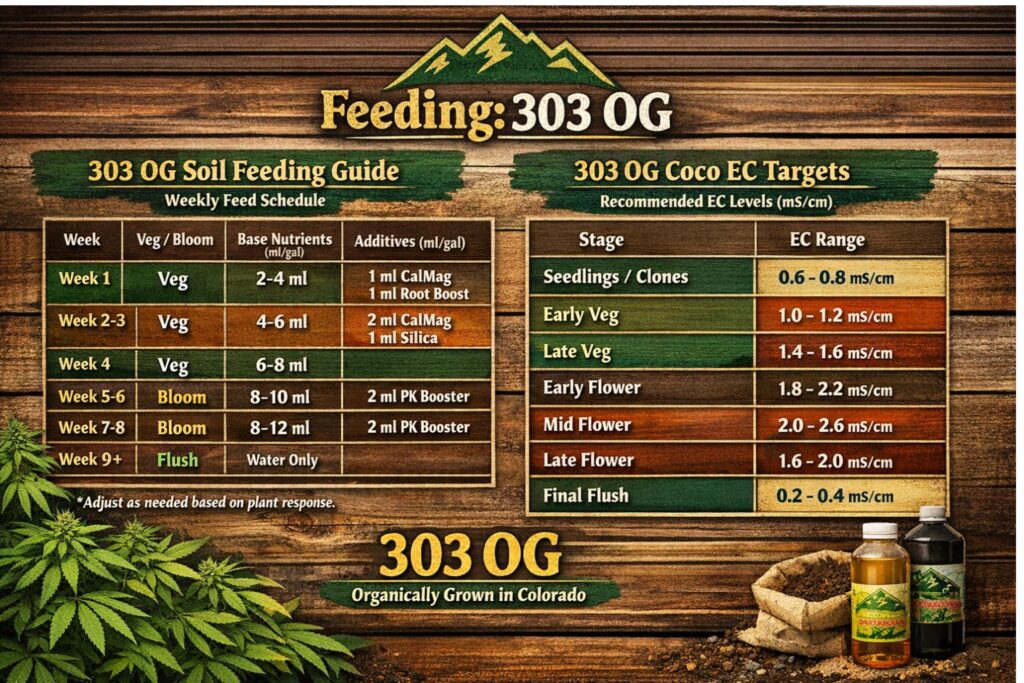
This cultivar didn’t reward heavy feeding for me. I got cleaner burn and sharper aroma by staying conservative.
My 303 OG soil feeding guide:
- Use an airy mix and avoid long, soggy wet periods
- Feed lightly and steadily instead of swinging strengths
- Watch leaf color; overly dark leaves usually mean back off
In coco, measurement helps. These 303 OG coco EC targets worked as a starting point under LEDs:
- Early veg: EC 0.8–1.2
- Late veg: EC 1.2–1.6
- Early flower: EC 1.6–1.8
- Mid flower: EC 1.8–2.2 if the plant is asking for it
- Late flower: taper down for a cleaner finish
I’m repeating the 303 OG coco EC targets here and in the FAQ because “what EC should I run?” is one of the most common new-grower questions.
Training approach (what I actually do)
Compact flowers need airflow. My baseline routine:
- Top once above the 4th–5th node
- Low-stress training to spread branches wide
- Light defoliation around day 21 and day 42 of flower (only what blocks bud sites)
- Add support as flowers swell
Timing and 303 OG flowering time indoors
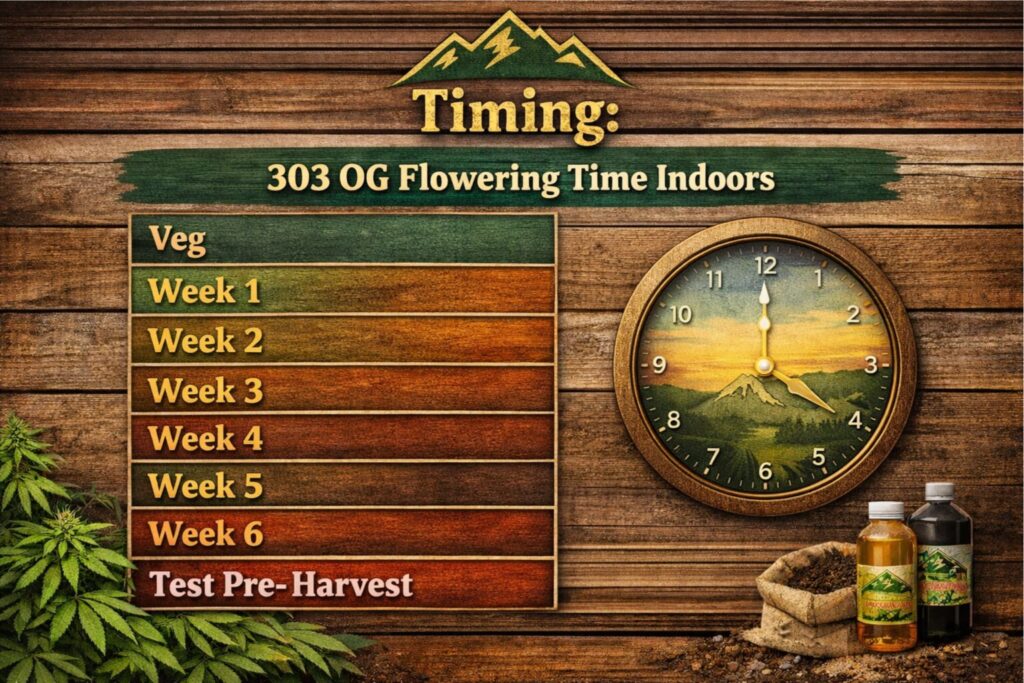
My 303 OG flowering time indoors landed in the 8–10 week range depending on phenotype and intensity. I plan for nine weeks, then watch the plant.
How I track 303 OG flowering time indoors:
- Weeks 1–3: stretch and site building
- Weeks 4–6: bulk and resin ramp
- Weeks 7–9+: finish and ripening
Harvest choices and 303 OG harvest window

Harvest timing changes the experience. Earlier felt brighter; later felt heavier for me.
My preferred 303 OG harvest window:
- Trichomes mostly milky with a small amount of amber
- Strong, “finished” aroma (not green)
- Calyxes swollen and bud structure firm
If you want a more functional vibe, don’t push the 303 OG harvest window too late. If you want heavier relaxation, extending the 303 OG harvest window slightly can do that, but you may dull the brighter parts of the 303 OG terpene breakdown.
Output and 303 OG yield per square meter
Real yield depends on canopy, light, and environment. In a stable room, my 303 OG yield per square meter was solid thanks to tight flower structure.
What improved 303 OG yield per square meter most:
- An even canopy
- Stable PPFD
- Avoiding mid-flower nutrient burn
I’ll call it dependable rather than extreme. The 303 OG yield per square meter improved more from training than from feeding harder.
Drying and curing: 303 OG cure for best flavor

Drying and curing decide everything. My best 303 OG cure for best flavor came from slowing down:
- Dry at 18–20°C and 55–60% RH if possible
- Gentle airflow in the room, not blasting buds
- Jar only when small stems snap
- Hold jars around 58–62% humidity; burp daily for the first week
This 303 OG cure for best flavor preserved the bright edge in the 303 OG terpene breakdown and kept my 303 OG smoke report smooth. If you want the 303 OG flavor notes to stay vivid, the 303 OG cure for best flavor matters as much as the grow.
Seed shopping and planning (non-legal-advice tone)
If you’re comparing feminized seeds to regular seeds for a small tent, I prefer feminized for predictability. If you’re considering autoflowering genetics for speed, remember you have less time to correct mistakes. Labels like indica/sativa/hybrid are helpful shorthand, but structure, finish time, and feeding sensitivity matter more.
Rules vary by region. If you’re unsure, check local regulations before you grow or order seeds. That’s not legal advice, just practical planning.
FAQ
How to germinate 303 OG seeds reliably?
For “how to germinate 303 OG seeds,” I use lightly moist paper towel at 24–26°C, then into the medium as soon as the taproot shows. The most common failure is keeping it too wet. If you keep searching “how to germinate 303 OG seeds,” check temperature stability and avoid drowning the sprout.
What’s the best approach in soil?
Stick to the 303 OG soil feeding guide: airy soil, steady watering rhythm, and gentle nutrition. Consistency beats chasing deficiencies.
What EC should I run in coco?
Start with the 303 OG coco EC targets above, then adjust based on leaf color and runoff. The 303 OG coco EC targets work best when you irrigate often enough to prevent salt buildup.
How do I manage stretch in a short tent?
Flip earlier and train in veg. 303 OG stretch after flip is manageable when the canopy is even and light intensity increases are gradual.
When should I harvest?
Use the 303 OG harvest window approach: mostly milky trichomes and a finished smell. If you’re torn, harvest a small test branch and see how it dries.
Final note
If you want an OG-leaning hybrid that can be relaxing without instantly shutting you down, this 303 OG Strain Review should give you a realistic baseline: stable environment, conservative feed, smart training, and the 303 OG cure for best flavor.
For a complete directory of cultivars, visit our Cannabis Strain Reviews.
